To save content items to your account,
please confirm that you agree to abide by our usage policies.
If this is the first time you use this feature, you will be asked to authorise Cambridge Core to connect with your account.
Find out more about saving content to .
To save content items to your Kindle, first ensure no-reply@cambridge.org
is added to your Approved Personal Document E-mail List under your Personal Document Settings
on the Manage Your Content and Devices page of your Amazon account. Then enter the ‘name’ part
of your Kindle email address below.
Find out more about saving to your Kindle.
Note you can select to save to either the @free.kindle.com or @kindle.com variations.
‘@free.kindle.com’ emails are free but can only be saved to your device when it is connected to wi-fi.
‘@kindle.com’ emails can be delivered even when you are not connected to wi-fi, but note that service fees apply.
Shark vertebrae and their centra (vertebral bodies) are high-performance structures able to survive millions of cycles of high amplitude strain despite lacking a repair mechanism for accumulating damage. Shark centra consist of mineralized cartilage, a biocomposite of bioapatite (bAp), and collagen, and the nanocrystalline bAp's contribution to functionality remains largely uninvestigated. Using the multiple detector energy-dispersive diffraction (EDD) system at 6-BM-B, the Advanced Photon Source, and 3D tomographic sampling, the 3D functionality of entire centra were probed. Immersion in ethanol vs phosphate-buffered saline produces only small changes in bAp d-spacing within a great hammerhead centrum. EDD mapping under in situ loading was performed an entire blue shark centrum, and 3D maps of bAp strain showed the two structural zones of the centrum, the corpus calcareum and intermedialia, contained opposite-signed strains approaching 0.5%, and application of ~8% nominal strain did not alter these strain magnitudes and their spatial distribution.
The fluvial capture of endorheic basins represents a milestone in basin chronology, implying a profound disequilibrium that triggers critical geomorphological, sedimentological, paleogeographic, and even paleoecological transformations. The primary goal of many geomorphological studies is to determine the timing of endorheic-to-exorheic transitions with the objective of unveiling the dynamics that follow the capture event. The age of the Guadix-Baza Basin capture in the Central Betic Cordillera (S Spain) remains a subject of controversy, with proposed estimates ranging from 17 to 600 ka. In this study, we present new 234U/230Th and optically stimulated luminescence ages from exorheic deposits exposed within the basin's main fluvial valley, the Guadiana Menor River. We acquired the oldest numerical age recorded to date for a postcapture deposit within the basin. This age corresponds to a travertine platform formed 240.8 ± 25 ka on a surface level that was already incised into the glacis surface at approximately 250 m. Using these data, we estimate that basin capture took place earlier than ca. 240 ka, plus the time required for the river to incise 250 m to the position of the travertine. Furthermore, the proximity of the Matuyama-Brunhes reversal (781 ka) to the top of the endorheic succession and the ages of the paleontological sites (> ca. 750 ka) throughout the basin suggest that the capture could have occurred earlier than the oldest previously proposed age of 600 ka.
Scientists have the epistemic responsibility of producing knowledge. They also have the social responsibility of aligning their research with the needs and values of various societal stakeholders. Individual scientists may be left with no guidance on how to prioritize and carry these different responsibilities. As I will argue, however, the responsibilities of science can be harmonized at the collective level. Drawing from debates in moral philosophy, I will propose a theory of the collective responsibilities of science that accounts for the internal diversity of research groups and for their different responsibilities.
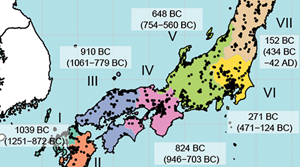
Rice agriculture was brought to Japan during the first millennium BC by migrant communities of farmers from the Korean peninsula. Substantial geographic variation is observed in the uptake of this new subsistence economy, reflecting different forms of interaction between farmers and foragers. Here, the authors analyse a combination of settlement and radiocarbon data to determine the extent to which these different forms of interaction led to regional variations in population growth rate. Their results confirm the presence of different trajectories of growth, providing new insights into the diversity of demographic processes during the earliest stages of farming in Japan.
The minimum diameter of the patent ductus arteriosus measured in the lateral angiographic view is usually used to determine the device size. Sometimes the device can be easily removed from the patent ductus arteriosus, even if it appears to be the optimum size.
Methods:
From 2016 to 2021, 29 patients who underwent contrast-enhanced CT prior to patent ductus arteriosus closure included. Morphological evaluation of the narrowest part of the patent ductus arteriosus was performed on contrast-enhanced CT. We also examined whether there were differences in morphology depended on Krichenko classification, age, and the diameter of the narrowest portion of the patent ductus arteriosus.
Results:
At the time of treatment, the median age was 4.8 (range, 1–52) months, and the median weight was 5.0 (2.5–12.7) kg. The median minimum vertical diameter of patent ductus arteriosus was 2.9 (1.6–6.6) mm. The narrowest patent ductus arteriosus part in the contrast CT imaging showed horizontal-to-vertical diameter ratios in the range of 1.0–1.7, with no case where the vertical diameter was larger than the horizontal diameter. The median horizontal-to-vertical diameter ratio by Krichenko type was: A, 1.22; C, 1.29; E, 1.62(p = 0.017). When classifying the patients into a group aged under six months (n = 21) and a group aged six months or older (n = 8), the respective median horizontal-to-vertical diameter ratio was 1.34 and 1.15 (p = 0.027). The vertical patent ductus arteriosus diameter was not correlated with the elliptical shape.
Conclusions:
Most patent ductus arteriosus cases have a horizontally oriented elliptical shape in this study. This characteristic showed high reproducibility and is important information that angiography cannot evaluate.
The aim of this study is to track the evolution in the use of the markers nenny, non + verb (non fait ‘no, it doesn’t’) and non in its absolute use between the middle of the 15th century and the end of the 18th. In Middle French, non already covers all the uses of the old markers nenny and non fait, but it remains in the minority. In Pre-Classical French (1550–1650), the frequency of nenny and non fait decreases considerably and, in Classical French (1650–1789), they become archaic. In the mid-17th century, non definitively assumes the functions of the medieval markers, which disappeared. The analysis of the temporal distribution of these markers helps to date the transition from ancient to modern uses. Several studies of phonetic, morphological and syntactic phenomena have also aimed to date the turning point between the medieval and the “classical” language, which occurs during the so-called “pre-classical” period. This research also seeks to contribute to the debate on the position of the boundary between Pre-Classical and Classical French on the basis of pragmatic criteria. The results support placing this boundary within the decade 1620–1630, as other studies did for morphosyntactic phenomena.
An association between antibiotic prescribing in upper respiratory infection and improved patient satisfaction has been documented, though data are mixed. Following implementation of a multifaceted antimicrobial stewardship bundle, no difference in patient satisfaction was observed between groups, despite a reduction in antibiotic prescribing from 28.3% to 14.1%.
A fixed-time control strategy based on adaptive event-triggered communication and force estimators is proposed for a class of teleoperation systems with time-varying delays and limited bandwidth. Two force estimators are designed to estimate the operator force and environment force instead of force sensors. With the position, velocity, force estimate signals, and triggering error, an adaptive event-triggered scheme is designed, which automatically adjusts the triggering thresholds to reduce the access frequency of the communication network. With the state information transmitted at the moment of event triggering while considering the time-varying delays, a fixed-time sliding mode controller is designed to achieve the position and force tracking. The stability of the system and the convergence of tracking error within a fixed time are mathematically proved. Experimental results indicate that the control strategy can significantly reduce the information transmission, enhance the bandwidth utilization, and ensure the convergence of tracking error within a fixed time for teleoperation systems.
This paper presents a decentralized, cooperative, real-time avoidance control strategy for robotic manipulators. The proposed avoidance control law builds on the concepts of artificial potential field functions and provides tighter bounds on the minimum safe distance when compared to traditional potential-based controllers. Moreover, the proposed avoidance control law is given in analytical, continuous closed form, avoiding the use of optimization techniques and discrete algorithms, and is rigorously proven to guarantee collision avoidance at all times. Examples of planar and 3D manipulators with cylindrical links under the proposed avoidance control are given and compared with the traditional approach of modeling links and obstacles with multiple spheres. The results show that the proposed avoidance control law can achieve, in general, faster convergence, smaller tracking errors, and lower control torques than the traditional approach. Furthermore, we provide extensions of the avoidance control to robotic manipulators with bounded control torques.
Reconstruction of a nineteenth-century cobbled pathway in the village of Aristi provides valuable insights into the material culture and settlement archaeology of Ottoman-era Greece. The authors argue that such small-scale pairing of restoration and archaeological practices in ‘traditional’ settlements could enhance our understanding of Ottoman archaeology without undermining the lived experience of such places.
In confined multi-obstacle environments, generating feasible paths for continuum robots is challenging due to the need to avoid obstacles while considering the kinematic limitations of the robot. This paper deals with the path-planning algorithm for continuum robots in confined multi-obstacle environments to prevent their over-deformation. By modifying the tree expansion process of the Rapidly-exploring Random Tree Star (RRT*) algorithm, a path-planning algorithm called the continuum-RRT* algorithm herein is proposed to achieve fewer iterations and faster convergence as well as generating desired paths that adhere to the kinematic limitations of the continuum robots. Then path planning and path tracking are implemented on a tendon-driven four-section continuum robot to validate the effectiveness of the path-planning algorithm. The path-planning results show that the path generated by the algorithm indeed has fewer transitions, and the path generated by the algorithm is closer to the optimal path that satisfies the kinematic limitations of the continuum robot. Furthermore, path-tracking experiments validate the successful navigation of the continuum robot along the algorithm-generated path, exhibiting an error range of 2.51%–3.91%. This attests to the effectiveness of the proposed algorithm in meeting the navigation requirements of continuum robots.
Previous research has indicated that explicit information (EI) about either the first language (L1) or second language (L2) along with task-essential practice can facilitate L2 learning (e.g., Fernández, 2008; McManus, 2022). However, little research has examined L1–L2 contrastive EI with L1/L2 practice. Targeting plural-marking accuracy, the present study sought to fill this gap by exposing 127 Japanese intermediate learners of English to six online treatment sessions across four conditions: (1) non-contrastive EI (pluralization rule explanation) + L2 practice, (2) contrastive EI + L2 practice, (3) as per Condition 2 + additional L1 practice (application of L2 pluralization to L1 through the Japanese suffix –tachi), and (4) using prepositions as a control, non-contrastive EI (prepositional rule explanation) + L2 practice. Accuracy was tested at pre/post/delayed intervals using an acceptability judgement task (reading) and a picture description task (writing). Statistical analyses demonstrated greater gains from the contrastive variables in the immediate post-test, with L1 practice appearing especially beneficial, despite improvements diminishing in the delayed post-test. Supplementary data from retroactive interviews and questionnaire responses indicated favourable orientations towards the intervention. The study advances understanding of how EI and practice type can be used to maximize L2 learning through web-based practices tailored to the nature of the learning problem.
In order to improve the positioning accuracy of industrial robots, this paper proposes a global calibration method for planar parallel robot considering joint errors, which solves the problem that the existing calibration methods only consider part of the error sources and the calibration accuracy is poor, and improves the calibration efficiency and robot positioning accuracy. Consequently, it improves calibration efficiency and the overall precision of robot positioning. Firstly, the error model of overdetermined equations combined with structural parameters is established, and the global sensitivity of each error source is analyzed. Based on the measurement data of laser tracker, the local error source is identified by the least square method, which improves the local error accuracy by 88.6%. Then, a global error spatial interpolation method based on inverse distance weighting method is proposed, and the global accuracy is improved by 59.16%. Finally, the radial basis function neural network error prediction model with strong nonlinear approximation function is designed for global calibration, and the accuracy is improved by 63.05%. Experimental results verify the effectiveness of the proposed method. This study not only provides technical support for the engineering application of this experimental platform but also provides theoretical guidance for the improvement of the accuracy of related robot platforms.
With the rapid expansion of the aviation industry, an increasing number of Close Spaced Parallel Runway (CSPR) airports are either planning or constructing End Around Taxiways (EAT) to alleviate field operation pressures and enhance safety. Taking Shanghai Hongqiao Airport’s typical CSPR EAT configuration as a case study, this research integrates the airport’s current operational status with the anticipated requirements for future structural renovations and increased flight volumes. Various operational scenarios are established, and simulation research on optimising EAT operations is conducted in advance. The simulation study proceeds as follows: first, an AirTOP simulation model is constructed based on Hongqiao Airport’s actual operational construction. Subsequently, leveraging existing operational scenarios, five simulation scenarios are devised by activating EATs at the departure and approach ends of the eastern zone. The merits and drawbacks of these scenarios are thoroughly analysed. The findings indicate that, with escalating flight volumes, the utilisation of EAT for larger aircraft can curtail their holding duration by nearly 8 min, consequently reducing overall arrival holding duration by 6 min. Departures from gates proximate to T1 experience a 3-min reduction in holding duration through the adoption of EAT at the approach end. Despite an increase in taxi distance due to a higher proportion of aircraft taxiing around, the overall taxi time is diminished. Activating EATs at the departure and approach ends of the eastern zone effectively mitigates the adverse effects of heightened flight volumes on field operational efficiency.
The overall efficiency of a turbofan engine may be expressed as a function of the Mach number, flight level and one other parameter. This may be either the net thrust, the turbine entry temperature or the fuel flow rate. Using basic aero-thermodynamic principles, dimensional analysis, normalisation and curve fitting, five approximate and “near universal” relations have been identified for engines having bypass ratios between 1 and 13. These relations contain five independent characteristic engine parameters. When these parameters are known, the relations form the basis of an estimation method for engine overall efficiency that is simple, fast, open source, completely transparent and, as new information appears, capable of further refinement. Since the empirical relations presented in this analysis are valid for Mach numbers greater than 0.2, the method is applicable to all airborne phases of flight. For a given aircraft, if the flight trajectory is specified in sufficient detail for the variation of net thrust with Mach number and flight level to be determined, only three of the five relations, together with the value of engine overall efficiency at a single reference condition, are needed to estimate the overall efficiency at every point on the trajectory. Comparisons with the data used in this analysis suggest that the accuracy is better than ±5% in most cases. In the completely general case, two additional engine characteristic parameters, one a total temperature ratio and the other a Mach number, are introduced. If these are known, both engine overall efficiency and net thrust can be expressed as functions of Mach number, flight level and turbine entry temperature. This allows the method to be used for the estimation of operating limits in the various phases of flight and in simplified optimisation studies, e.g. finding the environmentally optimum flight trajectory.
In previous work, estimates of engine overall efficiency at the “design optimum” condition have been estimated for 53 aircraft and engine combinations. It is shown that the ‘design optimum’ condition is an appropriate choice for the engine reference condition. Updated and revised values for the relevant parameters for these 53 examples, together with estimates for the two additional engine characteristic parameters, are given in tabular form.