To save content items to your account,
please confirm that you agree to abide by our usage policies.
If this is the first time you use this feature, you will be asked to authorise Cambridge Core to connect with your account.
Find out more about saving content to .
To save content items to your Kindle, first ensure no-reply@cambridge.org
is added to your Approved Personal Document E-mail List under your Personal Document Settings
on the Manage Your Content and Devices page of your Amazon account. Then enter the ‘name’ part
of your Kindle email address below.
Find out more about saving to your Kindle.
Note you can select to save to either the @free.kindle.com or @kindle.com variations.
‘@free.kindle.com’ emails are free but can only be saved to your device when it is connected to wi-fi.
‘@kindle.com’ emails can be delivered even when you are not connected to wi-fi, but note that service fees apply.
Amicarbazone, atrazine, and metribuzin behavior was examined in a field setting in Tennessee and in a laboratory setting using soils collected from Illinois and Tennessee. Fields planted to corn were sampled from 0 to 8 cm depth, and the samples were analyzed using methanolic extraction followed by tandem mass spectrometry analysis to determine residual herbicide concentrations. Conditions were favorable for herbicide degradation, including warm temperatures and adequate rainfall. All herbicide half-lives were <10 d. Laboratory research using soils with known atrazine-use histories showed that amicarbazone did not exhibit enhanced microbial degradation due to previous atrazine use. Apparent amicarbazone and metribuzin persistence levels implied that early-season weed control would be expected, but carryover to injure sensitive rotational crops would not be anticipated under these environmental conditions. Dissipation under field conditions of amicarbazone and metribuzin was not affected by being applied to separate plots or by coapplication to the same plots.
The concept of lifestyle-based risk scores is known but not evaluated in most rural communities of low- to mid-income countries. This study investigated the correlation of lifestyle scores with health indices.
Methods:
This was a descriptive cross-sectional investigation. A total of 203 participants (141 females and 62 males), 18–90 years, had anthropometric assessments and lifestyle scores determined from a 12-item framework. Data analysis included average age in different health conditions, lifestyle scores in age groups, and correlations with age.
Results:
Average age of healthy subpopulation was 39 years while diabetes, hypertension, and obesity subpopulations were 58, 64, and 56 years, respectively. The percentage of participants whose activities of daily living (ADL) were unaffected by ill-health decreased with age (P < 0.0001), and lifestyle scores also decreased with age (P < 0.01) and negatively correlated with physical activities.
Conclusion:
This report contributes to diabetes cardiovascular complications management. Sedentary ADL factors need integration in healthy lifestyle education especially among the elderly.
This article is about the seminar held at Luiss University in Rome on 17 June 2024. The seminar focused on ‘The End of Christian Democracy: A New Direction for Research’ and was the first milestone and official launch of the PRIN research project ‘The End of Christian Democracy: The Collapse of a Political Dream – Voices from the Margins’, led by a consortium of four universities: Luiss, Roma Tre, Bologna and Suor Orsola Benincasa, Naples.
This paper empirically examines the dynamic relationship between stock market volatility and commodity prices through the time-varying risk aversion channel using daily data between December 31 in 1999 and June 14 in 2021. We employ a time-varying structural-form vector autoregressive model (VAR) model with (aggregate, sectoral and sixteen individual) commodity prices. The results suggest that the transmission mechanism of stock market volatility shocks on the commodity prices change over time. The negative effect of stock market volatility on commodity prices is more statistically significant in the 2008–09 Global Financial Crisis than that during the COVID-19 pandemic in 2020. Further, the effect is greater in energy commodities compared to the agricultural and metals markets. The long-lasting negative effect of risk aversion is stronger compared to that of the expected stock market volatility on the commodity price. The change in the stock-commodity transmission mechanism is likely due to changes in underlying sources of risk aversion and expected uncertainty over time.
This short contribution presents an enigmatic clay mould recovered from a tile kiln in Vindolanda's North Field. This complete mould contains an impression of Apollo in bust form, but its exact use is unclear. This paper presents the mould and discusses its potential use for the manufacture of ceramic figurines. Found in an industrial area of the site, its discovery also provides valuable evidence for craft production along this frontier and hints at a largely unknown provincial industry.
During 2016–2022, Medicare part D beneficiaries filled 8,674,460 clotrimazole-betamethasone dipropionate prescriptions. Annual rates were stable (30.9 prescriptions/1,000 beneficiary-years in 2022, enough for one in every 33 beneficiaries). Diagnostic testing was infrequent, particularly among internal medicine, family medicine, and general practitioners, suggesting potential opportunities to improve diagnostic and prescribing practices.
Good Governing: The Police Power in the American States is a deep historical and legal analysis of state police power, examining its origins in the founding period of the American republic through the twentieth century. The book reveals how American police power was intended to be a broad, but not unlimited, charter of regulatory governance, designed to implement key constitutional objectives and advance the general welfare. It explores police power’s promise as a mechanism for implementing successful regulatory governance and tackling societal ills, while considering key structural issues like separation of powers and individual rights. This insightful book will shape understanding of the neglected state police power, a key part of constitutional governance in the United States. This title is also available as Open Access on Cambridge Core.
To assess the correlation between the dose distribution provided by the delivery analysis (DA) software and the measured dose distribution using an ArcCHECK (AC) phantom in the presence of thickness variation.
Materials and Methods:
Two sets of targets were established within the phantom. Target A was placed on the detector areas, whereas Target B was positioned at the centre of the phantom. Bolus was applied to the surface of the phantom at different thicknesses ranging from 0 to 2 cm to verify the dose distribution in both TomoHelical (HT) and TomoDirect (TD) techniques. The gamma passing rate (GPRs) were evaluated against predefined thresholds of 3%/3 mm and 3%/2 mm. Correlation study evaluated the level of agreement between DA and AC values.
Results:
Both AC and DA exhibited a decline in GPRs as the bolus thickness decreased. Significant correlations were observed between AC and DA for both HT and TD techniques, with a p value of less than 0.001.
Conclusion:
The results indicate that DA software has the capability to detect anatomical changes during tomotherapy treatments. This is substantiated by the statistical association found between DA and the standard AC phantom system for dose distributions in both HT and TD methods.
There is a populist narrative that authoritarian regimes were better able to respond to the challenges of the COVID-19 pandemic because of their strict enforcement powers, compliance of citizens, and speed of autocratic decision-making in a crisis. Research evidence to date on this assertion is however inconclusive or inconsistent. This paper analyses data from democratic and authoritarian countries with the aim of finding out whether autocratic regimes, using greater stringency measures (policy interventions to tackle COVID-19), had better public health outcomes than their counterparts. The results show that authoritarian regimes performed better in tackling the pandemic in terms of infection and death rates than their counterparts. However, we did not find any empirical evidence on the moderation effect of trust in government on the relationship between stringency measures against COVID-19 and policy outcomes. This result might be due to the lack of data transparency in authoritarian countries.
Community-acquired pneumonia (CAP) is a leading cause of hospitalizations and mortality in the US. Overuse of extended spectrum antibiotics (ESA) for CAP contributes to antimicrobial resistance. The 2019 Infectious Diseases Society of America/American Thoracic Society CAP guidelines emphasize de-escalation of ESA following negative cultures, early switch to oral (PO) antibiotics, and limited duration of therapy (DOT). This study describes clinicians’ acceptance of an infectious diseases-trained (ID) pharmacist-led stewardship recommendations in hospitalized patients with CAP.
Methods:
This prospective, single-arm, cohort study included adults admitted with a diagnosis of pneumonia to six Cleveland Clinic hospitals receiving ID pharmacist-led stewardship recommendations. The ID pharmacist provided recommendations for ESA de-escalation, DOT, intravenous (IV) to PO transition, and antimicrobial discontinuation. Descriptive statistics were used to describe clinician acceptance rates.
Results:
From November 1, 2022, to January 31, 2024, the ID pharmacist made recommendations for 685 patient encounters to 327 clinicians. Of these patients, 52% received an ESA and 15% had severe CAP. There were 959 recommendations: ESA de-escalation (19%), DOT (46%), IV to PO transition (19%), antimicrobial discontinuation (13%), and other (3%). Clinicians accepted 693 recommendations (72%): IV to PO transition (148/184, 80%), ESA de-escalation (141/181 78%), antimicrobial discontinuation (94/128, 73%), DOT (286/437, 65%), and other (24/29, 83%).
Conclusion:
Clinicians were generally receptive to ID pharmacist-led CAP recommendations with an overall acceptance rate of 72%. Prescribers were most receptive to recommendations for IV to PO conversion and least receptive to limiting DOT.
This chapter touches upon the very large topic of how individual rights interact with the police power. In what sense and to what degree do rights contravene state and local exercises of the police power? It is a shibboleth that regulatory power is constrained by rights. But this chapter interrogates these issues in more depth and detail, by discussing how rights claims are framed in connection with the police power and how the government’s assertions of power are circumscribed by particular doctrines and arguments in courts. Further, the chapter considers how the debate over the nature and content of so-called positive rights implicates the police power questions, questions concerning authority and content.
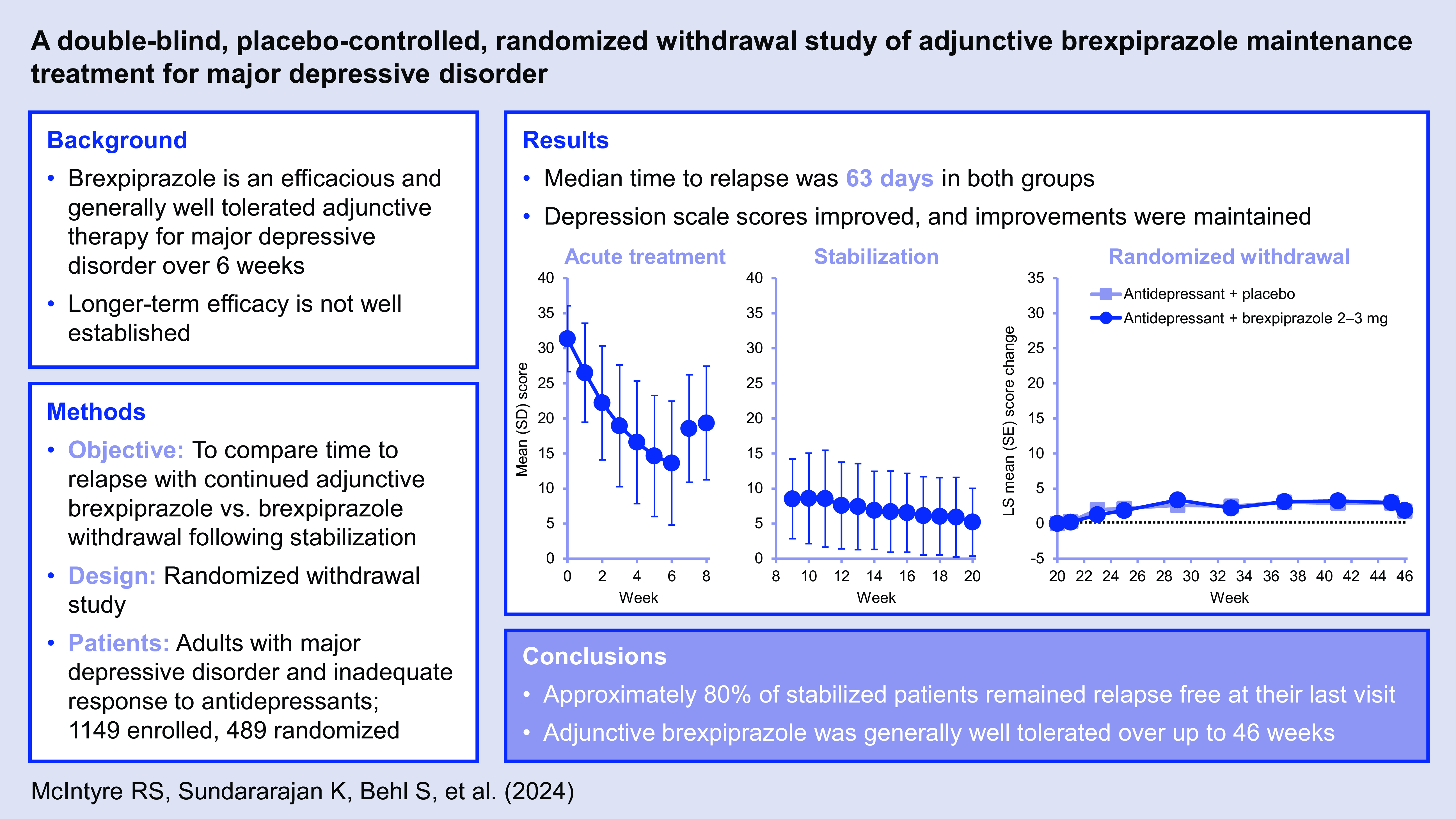
To compare time to relapse in patients with major depressive disorder (MDD) stabilised on antidepressant treatment (ADT) + brexpiprazole who were randomised to continued adjunctive brexpiprazole or brexpiprazole withdrawal (switch to placebo).
Methods:
This Phase 3, multicentre, double-blind, placebo-controlled, parallel-arm, randomised withdrawal study enrolled adults with MDD and inadequate response to 2–3 ADTs. All patients started on adjunctive brexpiprazole 2–3 mg/day (Phase A, 6–8 weeks). Patients whose symptoms stabilised (Phase B, 12 weeks) were randomised 1:1 to adjunctive brexpiprazole or adjunctive placebo (Phase C, 26 weeks). The primary endpoint was time to relapse in Phase C. Depression rating scale score changes were secondary endpoints.
Results:
1149 patients were enrolled and 489 patients were randomised (ADT + brexpiprazole n = 240; ADT + placebo n = 249). Median time to relapse was 63 days from randomisation in both treatment groups for patients who received ≥1 dose. Relapse criteria were met by 22.5% of patients (54/240) on ADT + brexpiprazole and 20.6% (51/248) on ADT + placebo (hazard ratio, 1.14; 95% confidence interval, 0.78–1.67; p = 0.51, log-rank test). Depression scale scores improved during Phases A–B and were maintained in Phase C. Mean weight increased by 2.2 kg in Phases A–B and stabilised in Phase C.
Conclusion:
Time to relapse was similar between continued adjunctive brexpiprazole and brexpiprazole withdrawal; in both groups, ∼80% of stabilised patients remained relapse free at their last visit. Adjunctive brexpiprazole therapy was generally well tolerated over up to 46 weeks, with minimal adverse effects following brexpiprazole withdrawal.
The stirring and mixing of heat and momentum in the ocean surface boundary layer (OSBL) are dominated by 1 to 10 km fluid flows – too small to be resolved in global and regional ocean models. Instead, these processes are parametrized. Two main parametrizations include vertical mixing by surface-forced metre-scale turbulence and overturning by kilometre-scale submesoscale frontal flows and instabilities. In present models, these distinct parametrizations are implemented in tandem, yet ignore meaningful interactions between these two scales that may influence net turbulent fluxes. Using a large-eddy simulation of frontal spin down resolving processes at both scales, this work diagnoses submesoscale and surface-forced turbulence impacts that are the foundation of OSBL parametrizations, following a traditional understanding of these flows. It is shown that frontal circulations act to suppress the vertical buoyancy flux by surface forced turbulence, and that this suppression is not represented by traditional boundary layer turbulence theory. A main result of this work is that current OSBL parametrizations excessively mix buoyancy and overestimate turbulence dissipation rates in the presence of lateral flows. These interactions have a direct influence on the upper ocean potential vorticity and energy budgets with implications for global upper ocean budgets and circulation.
Even as emperor, Napoleon was concerned with the émigrés. Although his general amnesty for the émigrés, which was promulgated on 26 April 1802, permitted most of the émigrés still inscribed on the ‘general list’ to return to France, it also excluded those belonging to six compromised categories. The number of these exceptions was not to exceed 1,000, the decree stipulating that the first 500 should be named within four months. As it turns out, it actually took the Ministry of Police more than two years to prepare a draft list of exceptions, which ran to more than 800 names. But it was not until 1807 that the first official list of émigrés (la première liste de maintenue) was finally decreed. Surprisingly, that list contained only 171 names. A second list released in 1810 added only 29 more. Examining these much-reduced lists, which have been almost entirely ignored, throws useful light on Napoleon’s continuing worries about the émigrés after 1804. For even then, he saw the Bourbons and the last émigrés as his personal enemies, threats to the security of the Empire, and possibly even reminders of what he saw as his fragile political legitimacy.
We extend the growth-at-risk (GaR) literature by examining US growth risks over 130 years using a time-varying parameter stochastic volatility regression model. This model effectively captures the distribution of GDP growth over long samples, accommodating changing relationships across variables and structural breaks. Our analysis offers several key insights for policymakers. We identify significant temporal variation in both the level and determinants of GaR. The stability of upside risks to GDP growth, as seen in previous research, is largely confined to the Great Moderation period, with a more balanced risk distribution prior to the 1970s. Additionally, the distribution of GDP growth has narrowed significantly since the end of the Bretton Woods system. Financial stress is consistently associated with higher downside risks, without affecting upside risks. Moreover, indicators such as credit growth and house prices influence both downside and upside risks during economic booms. Our findings also contribute to the financial cycle literature by providing a comprehensive view of the drivers and risks associated with economic booms and recessions over time.
Cementitious materials and their alkaline pore fluids can change the structure of bentonite used as a raw material for road embankments or concrete storage of garbage cans. This study investigated the alteration of montmorillonite-rich bentonite from northeast Morocco (Trebia deposit, Nador) in alkaline media rich in Ca2+, Mg2+, Na+, or K+. Specimens based on raw bentonite mixed with variable proportions of oxides (CaO, MgO) or hydroxides (NaOH, KOH) and water were prepared and aged for 28 days. Mineralogical composition by X-ray diffraction (XRD) was determined on raw bentonite and specimens to follow phase changes. Chemical composition and thermal characteristics were determined for raw bentonite and specimens by Fourier-transform infrared spectroscopy (FT-IR) and thermogravimetric/differential thermal analysis (TGA/DTA). Microstructural evolution and alteration of the external surface of bentonite were evaluated using scanning electron microscopy coupled with energy dispersive X-ray (SEM/EDX) analysis. XRD results of bentonite-CaO mixture demonstrated the formation of gels (e.g. C-S-H) and calcite. When the amount of CaO added increased, excess portlandite and the precipitation of calcite in the outer surface of bentonite occurred, stopping pozzolanic reaction and consequently decreasing the compressive strength of specimens. On the other hand, the addition of MgO allowed the formation of brucite. Sodalite and cancrinite were neoformed with the addition of 32 wt.% NaOH after 28 days of hydration. The addition of hydroxides (NaOH or KOH) to bentonite did not reveal any setting due to the absence of the formation of cementitious phases.
This article highlights the cross-disciplinary methodological potential of Third World approaches to international law (TWAIL) and microhistory by studying the active and complex exercise of agency by victims in an understudied historical instance of post-war justice, namely, the Singapore ‘Sook Ching’ trial or Nishimura trial. This trial dealt with the arbitrary massacre of Chinese residents by the Japanese military during the Second World War. Using TWAIL and microhistory methods, this article analyses trial transcripts and archival material on the Nishimura trial, with a focus on the trial experiences of witnesses, survivors, and community representatives. By studying the Nishimura trial as mobilization and meaning-making opportunity, this microhistory draws attention to the exercise of social and political agency by the Chinese community under difficult post-war conditions and British colonial rule. Chinese community leaders represented the community as collectively victimized and united in the pursuit of post-war justice. However, a close analysis of trial transcripts reveals tensions within the community and the need for a more complex understanding of victimhood.
Polyaenus (Strat. 8.23.5) includes an armoured elephant in his description of Julius Caesar crossing a defended ford in Britain (54 b.c.) – something found nowhere in Caesar's own Bellum Gallicum. From looking at a range of loci in the Strategica dealing with Caesar's military exploits in Celtic lands, it becomes clear that, instead of being the remnant of a now-lost source tradition, Polyaenus either based the elephant vignette on an underlying narrative structure provided by the Bellum Gallicum, or a source using this work very closely. Given the overall unlikelihood of Caesar taking an elephant to Britain, Polyaenus probably inserted an elephant for rhetorical and/or didactic purposes and was perhaps influenced by Caesar's own non-literary propaganda involving elephants.