To save content items to your account,
please confirm that you agree to abide by our usage policies.
If this is the first time you use this feature, you will be asked to authorise Cambridge Core to connect with your account.
Find out more about saving content to .
To save content items to your Kindle, first ensure no-reply@cambridge.org
is added to your Approved Personal Document E-mail List under your Personal Document Settings
on the Manage Your Content and Devices page of your Amazon account. Then enter the ‘name’ part
of your Kindle email address below.
Find out more about saving to your Kindle.
Note you can select to save to either the @free.kindle.com or @kindle.com variations.
‘@free.kindle.com’ emails are free but can only be saved to your device when it is connected to wi-fi.
‘@kindle.com’ emails can be delivered even when you are not connected to wi-fi, but note that service fees apply.
There is a populist narrative that authoritarian regimes were better able to respond to the challenges of the COVID-19 pandemic because of their strict enforcement powers, compliance of citizens, and speed of autocratic decision-making in a crisis. Research evidence to date on this assertion is however inconclusive or inconsistent. This paper analyses data from democratic and authoritarian countries with the aim of finding out whether autocratic regimes, using greater stringency measures (policy interventions to tackle COVID-19), had better public health outcomes than their counterparts. The results show that authoritarian regimes performed better in tackling the pandemic in terms of infection and death rates than their counterparts. However, we did not find any empirical evidence on the moderation effect of trust in government on the relationship between stringency measures against COVID-19 and policy outcomes. This result might be due to the lack of data transparency in authoritarian countries.
Community-acquired pneumonia (CAP) is a leading cause of hospitalizations and mortality in the US. Overuse of extended spectrum antibiotics (ESA) for CAP contributes to antimicrobial resistance. The 2019 Infectious Diseases Society of America/American Thoracic Society CAP guidelines emphasize de-escalation of ESA following negative cultures, early switch to oral (PO) antibiotics, and limited duration of therapy (DOT). This study describes clinicians’ acceptance of an infectious diseases-trained (ID) pharmacist-led stewardship recommendations in hospitalized patients with CAP.
Methods:
This prospective, single-arm, cohort study included adults admitted with a diagnosis of pneumonia to six Cleveland Clinic hospitals receiving ID pharmacist-led stewardship recommendations. The ID pharmacist provided recommendations for ESA de-escalation, DOT, intravenous (IV) to PO transition, and antimicrobial discontinuation. Descriptive statistics were used to describe clinician acceptance rates.
Results:
From November 1, 2022, to January 31, 2024, the ID pharmacist made recommendations for 685 patient encounters to 327 clinicians. Of these patients, 52% received an ESA and 15% had severe CAP. There were 959 recommendations: ESA de-escalation (19%), DOT (46%), IV to PO transition (19%), antimicrobial discontinuation (13%), and other (3%). Clinicians accepted 693 recommendations (72%): IV to PO transition (148/184, 80%), ESA de-escalation (141/181 78%), antimicrobial discontinuation (94/128, 73%), DOT (286/437, 65%), and other (24/29, 83%).
Conclusion:
Clinicians were generally receptive to ID pharmacist-led CAP recommendations with an overall acceptance rate of 72%. Prescribers were most receptive to recommendations for IV to PO conversion and least receptive to limiting DOT.
This chapter touches upon the very large topic of how individual rights interact with the police power. In what sense and to what degree do rights contravene state and local exercises of the police power? It is a shibboleth that regulatory power is constrained by rights. But this chapter interrogates these issues in more depth and detail, by discussing how rights claims are framed in connection with the police power and how the government’s assertions of power are circumscribed by particular doctrines and arguments in courts. Further, the chapter considers how the debate over the nature and content of so-called positive rights implicates the police power questions, questions concerning authority and content.
To compare time to relapse in patients with major depressive disorder (MDD) stabilised on antidepressant treatment (ADT) + brexpiprazole who were randomised to continued adjunctive brexpiprazole or brexpiprazole withdrawal (switch to placebo).
Methods:
This Phase 3, multicentre, double-blind, placebo-controlled, parallel-arm, randomised withdrawal study enrolled adults with MDD and inadequate response to 2–3 ADTs. All patients started on adjunctive brexpiprazole 2–3 mg/day (Phase A, 6–8 weeks). Patients whose symptoms stabilised (Phase B, 12 weeks) were randomised 1:1 to adjunctive brexpiprazole or adjunctive placebo (Phase C, 26 weeks). The primary endpoint was time to relapse in Phase C. Depression rating scale score changes were secondary endpoints.
Results:
1149 patients were enrolled and 489 patients were randomised (ADT + brexpiprazole n = 240; ADT + placebo n = 249). Median time to relapse was 63 days from randomisation in both treatment groups for patients who received ≥1 dose. Relapse criteria were met by 22.5% of patients (54/240) on ADT + brexpiprazole and 20.6% (51/248) on ADT + placebo (hazard ratio, 1.14; 95% confidence interval, 0.78–1.67; p = 0.51, log-rank test). Depression scale scores improved during Phases A–B and were maintained in Phase C. Mean weight increased by 2.2 kg in Phases A–B and stabilised in Phase C.
Conclusion:
Time to relapse was similar between continued adjunctive brexpiprazole and brexpiprazole withdrawal; in both groups, ∼80% of stabilised patients remained relapse free at their last visit. Adjunctive brexpiprazole therapy was generally well tolerated over up to 46 weeks, with minimal adverse effects following brexpiprazole withdrawal.
The stirring and mixing of heat and momentum in the ocean surface boundary layer (OSBL) are dominated by 1 to 10 km fluid flows – too small to be resolved in global and regional ocean models. Instead, these processes are parametrized. Two main parametrizations include vertical mixing by surface-forced metre-scale turbulence and overturning by kilometre-scale submesoscale frontal flows and instabilities. In present models, these distinct parametrizations are implemented in tandem, yet ignore meaningful interactions between these two scales that may influence net turbulent fluxes. Using a large-eddy simulation of frontal spin down resolving processes at both scales, this work diagnoses submesoscale and surface-forced turbulence impacts that are the foundation of OSBL parametrizations, following a traditional understanding of these flows. It is shown that frontal circulations act to suppress the vertical buoyancy flux by surface forced turbulence, and that this suppression is not represented by traditional boundary layer turbulence theory. A main result of this work is that current OSBL parametrizations excessively mix buoyancy and overestimate turbulence dissipation rates in the presence of lateral flows. These interactions have a direct influence on the upper ocean potential vorticity and energy budgets with implications for global upper ocean budgets and circulation.
Even as emperor, Napoleon was concerned with the émigrés. Although his general amnesty for the émigrés, which was promulgated on 26 April 1802, permitted most of the émigrés still inscribed on the ‘general list’ to return to France, it also excluded those belonging to six compromised categories. The number of these exceptions was not to exceed 1,000, the decree stipulating that the first 500 should be named within four months. As it turns out, it actually took the Ministry of Police more than two years to prepare a draft list of exceptions, which ran to more than 800 names. But it was not until 1807 that the first official list of émigrés (la première liste de maintenue) was finally decreed. Surprisingly, that list contained only 171 names. A second list released in 1810 added only 29 more. Examining these much-reduced lists, which have been almost entirely ignored, throws useful light on Napoleon’s continuing worries about the émigrés after 1804. For even then, he saw the Bourbons and the last émigrés as his personal enemies, threats to the security of the Empire, and possibly even reminders of what he saw as his fragile political legitimacy.
We extend the growth-at-risk (GaR) literature by examining US growth risks over 130 years using a time-varying parameter stochastic volatility regression model. This model effectively captures the distribution of GDP growth over long samples, accommodating changing relationships across variables and structural breaks. Our analysis offers several key insights for policymakers. We identify significant temporal variation in both the level and determinants of GaR. The stability of upside risks to GDP growth, as seen in previous research, is largely confined to the Great Moderation period, with a more balanced risk distribution prior to the 1970s. Additionally, the distribution of GDP growth has narrowed significantly since the end of the Bretton Woods system. Financial stress is consistently associated with higher downside risks, without affecting upside risks. Moreover, indicators such as credit growth and house prices influence both downside and upside risks during economic booms. Our findings also contribute to the financial cycle literature by providing a comprehensive view of the drivers and risks associated with economic booms and recessions over time.
Cementitious materials and their alkaline pore fluids can change the structure of bentonite used as a raw material for road embankments or concrete storage of garbage cans. This study investigated the alteration of montmorillonite-rich bentonite from northeast Morocco (Trebia deposit, Nador) in alkaline media rich in Ca2+, Mg2+, Na+, or K+. Specimens based on raw bentonite mixed with variable proportions of oxides (CaO, MgO) or hydroxides (NaOH, KOH) and water were prepared and aged for 28 days. Mineralogical composition by X-ray diffraction (XRD) was determined on raw bentonite and specimens to follow phase changes. Chemical composition and thermal characteristics were determined for raw bentonite and specimens by Fourier-transform infrared spectroscopy (FT-IR) and thermogravimetric/differential thermal analysis (TGA/DTA). Microstructural evolution and alteration of the external surface of bentonite were evaluated using scanning electron microscopy coupled with energy dispersive X-ray (SEM/EDX) analysis. XRD results of bentonite-CaO mixture demonstrated the formation of gels (e.g. C-S-H) and calcite. When the amount of CaO added increased, excess portlandite and the precipitation of calcite in the outer surface of bentonite occurred, stopping pozzolanic reaction and consequently decreasing the compressive strength of specimens. On the other hand, the addition of MgO allowed the formation of brucite. Sodalite and cancrinite were neoformed with the addition of 32 wt.% NaOH after 28 days of hydration. The addition of hydroxides (NaOH or KOH) to bentonite did not reveal any setting due to the absence of the formation of cementitious phases.
This article highlights the cross-disciplinary methodological potential of Third World approaches to international law (TWAIL) and microhistory by studying the active and complex exercise of agency by victims in an understudied historical instance of post-war justice, namely, the Singapore ‘Sook Ching’ trial or Nishimura trial. This trial dealt with the arbitrary massacre of Chinese residents by the Japanese military during the Second World War. Using TWAIL and microhistory methods, this article analyses trial transcripts and archival material on the Nishimura trial, with a focus on the trial experiences of witnesses, survivors, and community representatives. By studying the Nishimura trial as mobilization and meaning-making opportunity, this microhistory draws attention to the exercise of social and political agency by the Chinese community under difficult post-war conditions and British colonial rule. Chinese community leaders represented the community as collectively victimized and united in the pursuit of post-war justice. However, a close analysis of trial transcripts reveals tensions within the community and the need for a more complex understanding of victimhood.
Polyaenus (Strat. 8.23.5) includes an armoured elephant in his description of Julius Caesar crossing a defended ford in Britain (54 b.c.) – something found nowhere in Caesar's own Bellum Gallicum. From looking at a range of loci in the Strategica dealing with Caesar's military exploits in Celtic lands, it becomes clear that, instead of being the remnant of a now-lost source tradition, Polyaenus either based the elephant vignette on an underlying narrative structure provided by the Bellum Gallicum, or a source using this work very closely. Given the overall unlikelihood of Caesar taking an elephant to Britain, Polyaenus probably inserted an elephant for rhetorical and/or didactic purposes and was perhaps influenced by Caesar's own non-literary propaganda involving elephants.
To evaluate the variations in COVID-19 case fatality rates (CFRs) across different regions and waves, and the impact of public health interventions, social and economic characteristics, and demographic factors on COVID-19 CFRs, we collected data from 30 countries with the highest incidence rate in three waves. We summarized the CFRs of different countries and continents in each wave through meta-analysis. Spearman’s correlation and multiple linear regression were employed to estimate the correlation between influencing factors and reduction rates of CFRs. Significant differences in CFRs were observed among different regions during the three waves (P < 0.001). An association was found between the changes in fully vaccinated rates (rs = 0.41), population density (rs = 0.43), the proportion of individuals over 65 years old (rs = 0.43), and the reduction rates of case fatality rate. Compared to Wave 1, the reduction rates in Wave 2 were associated with population density (β = 0.19, 95%CI: 0.05–0.33) and smoking rates (β = −4.66, 95%CI: −8.98 – −0.33), while in Wave 3 it was associated with booster vaccine rates (β = 0.60, 95%CI: 0.11–1.09) and hospital beds per thousand people (β = 4.15, 95%CI: 1.41–6.89). These findings suggest that the COVID-19 CFRs varied across different countries and waves, and promoting booster vaccinations, increasing hospital bed capacity, and implementing tobacco control measures can help reduce CFRs.
We propose a novel time-asymptotically stable, implicit–explicit, adaptive, time integration method (denoted by the $\theta $-method) for the solution of the fractional advection–diffusion-reaction (FADR) equations. The spectral analysis of the method (involving the group velocity and the phase speed) indicates a region of favourable dispersion for a limited range of Péclet number. The numerical inversion of the coefficient matrix is avoided by exploiting the sparse structure of the matrix in the iterative solver for the Poisson equation. The accuracy and the efficacy of the method is benchmarked using (a) the two-dimensional fractional diffusion equation, originally proposed by researchers earlier, and (b) the incompressible, subdiffusive dynamics of a planar viscoelastic channel flow of the Rouse chain melts (FADR equation with fractional time-derivative of order ) and the Zimm chain solution (). Numerical simulations of the viscoelastic channel flow effectively capture the nonhomogeneous regions of high viscosity at low fluid inertia (or the so-called “spatiotemporal macrostructures”), experimentally observed in the flow-instability transition of subdiffusive flows.
Networks among legislators shape politics and policymaking within legislative institutions. In past work on legislative networks, the ties between legislators have been defined on those who serve in the same legislature or chamber. Online information networks, which have been found to play important roles in legislative communication at the national level, are not bounded by individual legislative bodies. We collect original data for over four thousand US state legislators and study patterns of connection among them on Twitter. We look at three types of Twitter networks—follower, retweets, and mentions. We describe these networks and estimate the relationships between ties and salient attributes of legislators. We find that networks are organized largely along geographic and partisan lines and that identity attributes—namely gender and race—exhibit strong associations with the formation of ties.
Thin-film beam combining technology is an effective approach to improve output power while maintaining beam quality. However, the lack of comprehensive research into the key factors affecting the beam quality in systems makes it challenging to achieve a practical combined beam source with high brightness. This paper clearly established that the temperature rise of dichroic mirrors (DMs) and sub-beam overlapping precision are the main factors affecting the beam quality of the system, with quantified effects. Based on this understanding, a combined light source of four channels of 3 kW fiber lasers was achieved, and an output power of 11.4 kW with a beam quality of M2x = 1.601 and M2y = 1.558, using three high-steepness low-absorption DMs and the active control technique. To the best of our knowledge, this is the best beam quality for a 10 kW light source. This study offers a solution for practical high-power laser sources in the tens of kilowatts range.
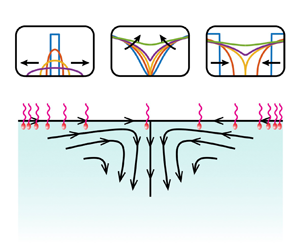
The Marangoni flow induced by an insoluble surfactant on a fluid–fluid interface is a fundamental problem investigated extensively due to its implications in colloid science, biology, the environment and industrial applications. Here, we study the limit of a deep liquid subphase with negligible inertia (low Reynolds number, $Re\ll {1}$), where the two-dimensional problem has been shown to be described by the complex Burgers equation. We analyse the problem through a self-similar formulation, providing further insights into its structure and revealing its universal features. Six different similarity solutions are found. One of the solutions includes surfactant diffusion, whereas the other five, which are identified through a phase-plane formalism, hold only in the limit of negligible diffusion (high surface Péclet number $Pe_s\gg {1}$). Surfactant ‘pulses’, with a locally higher concentration that spreads outward, lead to two similarity solutions of the first kind with a similarity exponent $\beta =1/2$. On the other hand, distributions that are locally depleted and flow inwards lead to similarity of the second kind, with two different exponents that we obtain exactly using stability arguments. We distinguish between ‘dimple’ solutions, where the surfactant has a quadratic minimum and $\beta =2$, from ‘hole’ solutions, where the concentration profile is flatter than quadratic and $\beta =3/2$. Each of these two cases exhibits two similarity solutions, one valid prior to a critical time $t_*$ when the derivative of the concentration is singular, and another one valid after $t_*$. We obtain all six solutions in closed form, and discuss predictions that can be extracted from these results.
Legal scholars continue to revisit historical treaties between Western and non-Western nations to challenge long-standing accounts of non-Western peoples’ engagement with international law. Following this trend, new scholarship has stressed African agency in Euro-African treaty-making. However, legal scholars have generally overlooked African perspectives, pointing to a lack of sources. Focusing on nineteenth-century treaty-making between France and the polities of the Western Sudan in West Africa, this article excavates African perspectives through a novel reading of Euro-African treaties in an African context. This reading analyses treaties within the Western Sudan’s broader diplomatic corpus in both French and Arabic. By focusing on markers of translation, transcription, and negotiation left on different copies of treaties, this method brings to light arguments and practices that have been obscured in published European-language versions. Reading Franco-Sudanian treaties in a Sudanian context reveals that different norms governed the ratification of treaties in the Western Sudan and Europe. Treaties that scholars have long considered unratified were in fact ratified according to Western Sudanian norms, which designated the governor of French Senegal rather than the French president as the official competent to ratify treaties for France. However, when French officials sought to use treaties to claim sovereign rights in West Africa against Great Britain, they pressed the president to ratify them again. Presidential ratification thus served to transpose Franco-Sudanian treaties from an African to a Western normative order. Uncovering the African origins of Euro-African treaties thus reveals their differential operation across autonomous inter-polity orders.
Scholars have called for additional research into the antecedents to corporate political activity (CPA), including why firms may engage in specific kinds of CPA. In response, in what we believe to be a first-of-its-kind study, we rely on upper echelons theory to explore the relationship between CEO personality and the kind of CPA in which a firm engages. In particular, we argue that certain traits will be related to ideological CPA (iCPA) that is less beneficial to the firm but which will appeal to CEOs with those traits. We also propose that managerial discretion will moderate the relationship between CEO personality and this form of opportunistic CPA. We test our hypotheses using a unique database combined with a variety of archival sources, resulting in a sample of 329 publicly traded firms from the S&P 500 for which we had complete records that engaged in CPA 63,142 times over a ten-year period (2011–2020). We find that CEO agreeableness, conscientiousness, and neuroticism will be negatively related to iCPA, while CEO openness will be positively associated with it. We further find that managerial discretion moderates the relationship of CEO extraversion and openness with iCPA, however in opposite directions. Finally, we discuss theoretical and managerial implications and propose directions for future research.
On 5 March 2024 the European Court of Justice (CJEU) issued a landmark decision on access to harmonised standards that grant presumption of conformity with legal requirements. The CJEU ruled that such standards should be made available free of charge because, once incorporated in EU legislation, they form part of EU law. While the decision was positively received in the scholarly community, it is expected to carry profound consequences for European standards organisations, who hold copyrights over harmonised standards and rely on their sales to finance their standardisation activities. The judgment may also affect the European Commission, whom the Advocate General and the CJEU placed at the centre of European standardisation due to its role in transforming harmonised standards into EU law. This case note engages with the ruling and aims to shed light onto its possible implications for the European standardisation system.
This article analyses how Labour women MPs championed the needs of ‘the housewife’ in parliament in order to improve the lives of women, especially working-class women, during the Attlee administration. Relying on personal experience to make their case, these women spoke as housewives, not just for housewives, using gendered experiences for political ends. This article examines how they applied the politics of housewifery to two specific contemporary economic challenges: the cost of living and the impact of taxation. In doing so, and in contrast to the established literature, it shows how far Labour women were prepared to challenge party and government policy on behalf of women. It thus contributes to historiographical debates about the Labour party’s relationship to consumerism and affluence as well as gender and austerity. Building on Brian Harrison’s influential study of interwar women MPs, it also responds to a recent call made by Miles Taylor in this journal for more attention to women as legislators in the post-war period. Methodologically, it emphasizes the benefits of qualitative analysis of ‘big data’ sources.
Community-Engaged Research (CEnR) and Community-Based Participatory Research (CBPR) require validated measures and metrics for evaluating research partnerships and outcomes. There is a need to adapt and translate existing measures for practical use with diverse and non-English-speaking communities. This paper describes the Spanish translation and adaptation of Engage for Equity’s Community Engagement Survey (E2 CES), a nationally validated and empirically-supported CEnR evaluation tool, into the full-length “Encuesta Comunitaria,” and a pragmatic shorter version “Fortaleciendo y Uniendo EsfueRzos Transdisciplinarios para Equidad de Salud” (FUERTES).
Methods:
Community and academic partners from the mainland US, Puerto Rico, and Nicaragua participated in translating and adapting E2 CES, preserving content validity, psychometric properties, and importance to stakeholders of items, scales, and CBPR constructs (contexts, partnership processes, intervention and research actions, and outcomes). Internal consistency was assessed using Cronbach’s alpha and convergent validity was assessed via a correlation matrix among scales.
Results:
Encuesta Comunitaria respondents (N = 57) self-identified as primarily Latinos/as/x (97%), female (74%), and academics (61%). Cronbach’s alpha values ranged from 0.72 to 0.88 for items in the context domain to 0.90–0.92 for items in the intervention/research domain. Correlations were found as expected among subscales, with the strongest relationships found for subscales within the same CBPR domain. Results informed the creation of FUERTES.
Conclusions:
Encuenta Comunitaria and FUERTES offer CEnR/CBPR practitioners two validated instruments for assessing their research partnering practices, and outcomes. Moreover, FUERTES meets the need for shorter pragmatic tools. These measures can further strengthen CEnR/CBPR involving Latino/a/x communities within the US, Latin America, and globally.