Refine search
Actions for selected content:
29 results
The boundary value problem for triholomorphic maps
- Part of
-
- Journal:
- Proceedings of the Royal Society of Edinburgh. Section A: Mathematics , First View
- Published online by Cambridge University Press:
- 20 November 2025, pp. 1-29
-
- Article
- Export citation
-
We introduce a natural boundary value problem for a triholomorphic map $u$ from a compact almost hyper-Hermitian manifold $M$ with smooth boundary $\partial M$ into a closed hyperKähler manifold $N$ with free boundary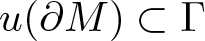 $u(\partial M)\subset \Gamma$ lying on some geometrically natural closed supporting submanifold $\Gamma\subset N$, called tri-isotropic submanifold. We establish partial regularity theory and energy quantization result in this boundary setting under some additional assumption on the $W^{2,1}$ norm of the weakly converging sequences.


Perturbed cone theorems for proper harmonic maps
- Part of
-
- Journal:
- Canadian Mathematical Bulletin , First View
- Published online by Cambridge University Press:
- 22 October 2025, pp. 1-18
-
- Article
-
- You have access
- Open access
- HTML
- Export citation
-
Inspired by the halfspace theorem for minimal surfaces in $\mathbb {R}^3$ of Hoffman–Meeks, the halfspace theorem of Rodriguez–Rosenberg, and the classical cone theorem of Omori in $\mathbb {R}^n$, we derive new non-existence results for proper harmonic maps into perturbed cones in $\mathbb {R}^n$, horospheres in $\mathbb {H}^n$, culminating in a generalization of Omori’s theorem in arbitrary Riemannian manifolds. The technical tool proved here extends the foliated Sampson’s maximum principle, initially developed in the first author’s Ph.D. thesis, to a non-compact setting.


Optimal boundary regularity of proper harmonic maps between asymptotically hyperbolic spaces
- Part of
-
- Journal:
- Canadian Journal of Mathematics , First View
- Published online by Cambridge University Press:
- 11 September 2025, pp. 1-38
-
- Article
- Export citation
-
This article studies the optimal boundary regularity of harmonic maps between a class of asymptotically hyperbolic spaces. To be precise, given any smooth boundary map with nowhere vanishing energy density, this article provides an asymptotic expansion formula for harmonic maps under the assumption of $C^1$ up to the boundary.

A RIGIDITY PROPERTY OF PLURIHARMONIC MAPS FROM PROJECTIVE MANIFOLDS
- Part of
-
- Journal:
- Bulletin of the Australian Mathematical Society / Volume 108 / Issue 1 / August 2023
- Published online by Cambridge University Press:
- 13 October 2022, pp. 166-168
- Print publication:
- August 2023
-
- Article
- Export citation
-
Suppose M is a complex projective manifold of dimension $\geq 2$, V is the support of an ample divisor in M and U is an open set in M that intersects each irreducible component of V. We show that a pluriharmonic map $f:M\to N$ into a Kähler manifold N is holomorphic whenever $f\vert _{V\,\cap \, U}$ is holomorphic.


Computing harmonic maps between Riemannian manifolds
- Part of
-
- Journal:
- Canadian Journal of Mathematics / Volume 75 / Issue 2 / April 2023
- Published online by Cambridge University Press:
- 18 February 2022, pp. 531-580
- Print publication:
- April 2023
-
- Article
- Export citation
ENERGY CONCENTRATION PROPERTIES OF A p-GINZBURG–LANDAU MODEL
- Part of
-
- Journal:
- Nagoya Mathematical Journal / Volume 247 / September 2022
- Published online by Cambridge University Press:
- 25 August 2021, pp. 494-515
-
- Article
- Export citation
-
This paper is concerned with the p-Ginzburg–Landau (p-GL) type model with $p\neq 2$. First, we obtain global energy estimates and energy concentration properties by the singularity analysis. Next, we give a decay rate of $1-|u_\varepsilon |$ in the domain away from the singularities when $\varepsilon \to 0$, where $u_\varepsilon $ is a minimizer of p-GL functional with $p \in (1,2)$. Finally, we obtain a Liouville theorem for the finite energy solutions of the p-GL equation on $\mathbb {R}^2$.


Unique continuation properties for polyharmonic maps between Riemannian manifolds
- Part of
-
- Journal:
- Canadian Journal of Mathematics / Volume 75 / Issue 1 / February 2023
- Published online by Cambridge University Press:
- 25 August 2021, pp. 1-28
- Print publication:
- February 2023
-
- Article
- Export citation
ELASTIC GRAPHS
- Part of
-
- Journal:
- Forum of Mathematics, Sigma / Volume 7 / 2019
- Published online by Cambridge University Press:
- 13 August 2019, e24
-
- Article
-
- You have access
- Open access
- Export citation
Vanishing theorems on complete manifolds with weighted Poincaré inequality and applications
-
- Journal:
- Nagoya Mathematical Journal / Volume 206 / June 2012
- Published online by Cambridge University Press:
- 11 January 2016, pp. 25-37
-
- Article
-
- You have access
- Export citation
BIHARMONIC CURVES INTO QUADRICS
-
- Journal:
- Glasgow Mathematical Journal / Volume 57 / Issue 1 / January 2015
- Published online by Cambridge University Press:
- 26 August 2014, pp. 131-141
-
- Article
-
- You have access
- Export citation
Multiscale Finite Element Methods for Flows on Rough Surfaces
-
- Journal:
- Communications in Computational Physics / Volume 14 / Issue 4 / October 2013
- Published online by Cambridge University Press:
- 03 June 2015, pp. 979-1000
- Print publication:
- October 2013
-
- Article
- Export citation
A Space of Harmonic Maps from a Sphere into the Complex Projective Space
-
- Journal:
- Canadian Journal of Mathematics / Volume 65 / Issue 4 / 01 August 2013
- Published online by Cambridge University Press:
- 20 November 2018, pp. 879-904
- Print publication:
- 01 August 2013
-
- Article
-
- You have access
- Export citation
-
Guest–Ohnita and Crawford have shown the path-connectedness of the space of harmonic maps from ${{S}^{2}}$ to $\text{C}{{P}^{n}}$ of a fixed degree and energy. It is well known that the $\partial$ transform is defined on this space. In this paper, we will show that the space is decomposed into mutually disjoint connected subspaces on which $\partial$ is homeomorphic.


A NEW QUANTITY IN RIEMANN-FINSLER GEOMETRY*
-
- Journal:
- Glasgow Mathematical Journal / Volume 54 / Issue 3 / September 2012
- Published online by Cambridge University Press:
- 30 March 2012, pp. 637-645
-
- Article
-
- You have access
- Export citation
Parabolic Geodesics in Sasakian 3-Manifolds
-
- Journal:
- Canadian Mathematical Bulletin / Volume 54 / Issue 3 / 01 September 2011
- Published online by Cambridge University Press:
- 20 November 2018, pp. 396-410
- Print publication:
- 01 September 2011
-
- Article
-
- You have access
- Export citation
On Some Explicit Constructions of Finsler Metrics with Scalar Flag Curvature
-
- Journal:
- Canadian Journal of Mathematics / Volume 62 / Issue 6 / 14 December 2010
- Published online by Cambridge University Press:
- 20 November 2018, pp. 1325-1339
- Print publication:
- 14 December 2010
-
- Article
-
- You have access
- Export citation
-
We give an explicit construction of polynomial (of arbitrary degree) $(\alpha ,\,\beta )$ -metrics with scalar flag curvature and determine their scalar flag curvature. These Finsler metrics contain all nontrivial projectively flat $(\alpha ,\,\beta )$ -metrics of constant flag curvature.

A Class of Finsler Metrics with Bounded Cartan Torsion
-
- Journal:
- Canadian Mathematical Bulletin / Volume 53 / Issue 1 / 01 March 2010
- Published online by Cambridge University Press:
- 20 November 2018, pp. 122-132
- Print publication:
- 01 March 2010
-
- Article
-
- You have access
- Export citation
-
In this paper, we find a class of $\left( \alpha ,\,\beta\right)$ metrics which have a bounded Cartan torsion. This class contains all Randers metrics. Furthermore, we give some applications and obtain two corollaries about curvature of this metrics.

Harmonic maps and cosymplectic manifolds
- Part of
-
- Journal:
- Journal of the Australian Mathematical Society / Volume 76 / Issue 1 / February 2004
- Published online by Cambridge University Press:
- 09 April 2009, pp. 75-92
-
- Article
-
- You have access
- Export citation
Harmonicity of Holomorphic Maps Between Almost Hermitian Manifolds
-
- Journal:
- Canadian Mathematical Bulletin / Volume 52 / Issue 1 / 01 March 2009
- Published online by Cambridge University Press:
- 20 November 2018, pp. 18-27
- Print publication:
- 01 March 2009
-
- Article
-
- You have access
- Export citation
SOME REMARKS ON TRANSVERSALLY HARMONIC MAPS
-
- Journal:
- Glasgow Mathematical Journal / Volume 50 / Issue 1 / January 2008
- Published online by Cambridge University Press:
- 01 January 2008, pp. 1-16
-
- Article
-
- You have access
- Export citation
Holomorphic Frames for Weakly Converging Holomorphic Vector Bundles
-
- Journal:
- Canadian Mathematical Bulletin / Volume 49 / Issue 1 / 01 March 2006
- Published online by Cambridge University Press:
- 20 November 2018, pp. 36-40
- Print publication:
- 01 March 2006
-
- Article
-
- You have access
- Export citation
