To save content items to your account,
please confirm that you agree to abide by our usage policies.
If this is the first time you use this feature, you will be asked to authorise Cambridge Core to connect with your account.
Find out more about saving content to .
To save content items to your Kindle, first ensure no-reply@cambridge.org
is added to your Approved Personal Document E-mail List under your Personal Document Settings
on the Manage Your Content and Devices page of your Amazon account. Then enter the ‘name’ part
of your Kindle email address below.
Find out more about saving to your Kindle.
Note you can select to save to either the @free.kindle.com or @kindle.com variations.
‘@free.kindle.com’ emails are free but can only be saved to your device when it is connected to wi-fi.
‘@kindle.com’ emails can be delivered even when you are not connected to wi-fi, but note that service fees apply.
Diabetes distress, whereby people with diabetes experience distressing psychological symptoms associated with living with their condition, is an emerging problem in India. Diabetes distress leads to self-care deficits, suboptimal glycaemic control (which can lead to increasing risks of complications) and impaired quality of life.
Aims
To determine the burden of diabetes distress and its associated factors in an Indian tertiary care centre in Trichy, Tamil Nadu, India, covering a population of 1.25 million.
Method
This prospective observational study involved a structured questionnaire covering demographic and clinical details, which was given to patients. The Diabetes Distress Scale 17 (DDS-17) was used to assess diabetes distress levels. The DDS-17 also measures four subdomains: emotional burden, physician-related distress, regimen-related distress and diabetes-related interpersonal distress. Patients were divided into two groups based on their DDS-17 score: no diabetes distress (DDS-17 score <2) versus diabetes distress (DDS-17 score ≥2) and compared. Correlation analysis, chi-squared tests and t-tests were used, with P < 0.05 considered statistically significant.
Results
Of 1019 respondents (mean age 56 years; 59.6% male, 40.4% female), diabetes distress was reported in 24.4% (n = 249). Factors significantly associated with higher DDS-17 scores were younger age (<45 years) (P < 0.0001), long-standing diabetes (>10 years) (P < 0.0001), and smoking and alcohol (P < 0.05). Significant protective factors for diabetes distress included working, daily exercise, no comorbidities and medical insurance cover (P < 0.05). Significant positive correlation between DDS-17 score and all four subdomains was observed (P < 0.0001).
Conclusions
Our findings highlight the need for routine psychological screening and holistic management strategies in diabetes care, to improve patient outcomes and quality of life.
The relation between perception and production in social meaning is often taken to be transparent, with social meaning associations learned from observations of language use. However, recent work has suggested that this relation is often more complex than previously thought. Here, we present new data comparing the social meaning of realized variable liaison in spoken French, couched within the framework of the pragmatic sociology of critique. We recall data from a recent matched guise experiment showing that listeners associate the realization of liaison with meanings like “professionalism”, specifically in social situations where efficacy and expertise are at issue. Basing ourselves on this finding, we use a production task, presenting these same social situations to amateur and professional actors. We find that our participants do not exploit the social meaning potential of variable liaison, producing liaison at lexically-determined rates on a par with previous corpus studies. We discuss this discrepancy between perception and production, which suggests that the link between the two is dependent on the linguistic variable under investigation.
The freedman Gregorio Cosme Osorio’s extant letters from Madrid in 1795 are the focus of Chapter 6. They provide a direct perspective of a cobrero leader’s legal culture, his views on the case, and his activities as liaison between Madrid and El Cobre (including an alleged meeting with the king). Cosme’s missives from the royal court, which high colonial officials considered subversive, critiqued politics of the law in the colony and kept the cobreros abreast of the imperial edicts issued in Madrid in their favor which colonial authorities ignored. His liaison role during fifteen years was crucial to keep the case alive in the royal court.
Dementia is a syndrome associated with an ongoing decline of brain function. It is common among older in-patients. Hospital admissions tend to be due to comorbid conditions rather than the dementia itself. Falls, infections, poor nutrition, dehydration, and delirium affect the length of stay and the functioning of patients with dementia. Without a timely diagnosis of the dementia and its associated clinical features, patients can experience adverse outcomes, which cause care home admissions instead of a discharge home. This chapter discusses the epidemiology, risk factors, assessment, and treatment of dementia in a general hospital setting.
Edited by
Masum Khwaja, Imperial College of Science, Technology and Medicine, London,Peter Tyrer, Imperial College of Science, Technology and Medicine, London
It has been long recognised that there is an over-representation of those with severe mental illness (SMI) interacting with the Criminal Justice System (CJS). Consequently, those who work with people with SMI are likely at some stage to find themselves interacting with and receiving requests to share information by different authorities to inform the justice process (before, during and after) as well as to facilitate multi-agency risk management structures in the community. In this chapter we briefly review the policy context and development of Liaison and Diversion systems within England and Wales for both adults and young people. Following the pathway of a mentally disordered offender being arrested by the police, we describe the medico-legal frameworks whereby mentally disordered and increased-risk offenders can be dealt with by the courts and managed in the community. We also consider the particular differences that pertain when the individual is a child or young person (CYP), and broader fora wherein information sharing occurs for the purpose of public protection in the community context, especially within MAPPA and PREVENT panels. We also note the use of the National Referral Mechanism.
Edited by
Masum Khwaja, Imperial College of Science, Technology and Medicine, London,Peter Tyrer, Imperial College of Science, Technology and Medicine, London
This chapter discusses information-sharing, including with victims of crime committed by persons with mental disorders. In general, a patient’s treatment is confidential and, unless the patient consents to information being shared, this limits the information that can be disclosed. However, information about a patient can be disclosed to a third party such as a victim if other statutes, such as the Domestic Violence and Mental Health Acts, permit this. Information can also be disclosed if another person is at risk of harm if the information is not disclosed. Furthermore, the victims of specific violent and sexual offences have certain rights to information about the offender. This includes offenders subject to the MHA and detained in hospital or subject to compulsion in the community. Patients can be victims as well as perpetrators of crime, and professionals working in health, social care and the justice system require a robust understanding of when to share confidential information. The first half of the chapter provides information on relevant legislation and guidance to be considered when sharing information about patients in general. The second half is focused on legislation and guidance on information sharing by organisations supporting victims of crimes committed by mentally disordered offenders.
As liaison psychiatrists, it is very important to mantein a good relationship with other medical specialties in order to obtain the best result for our patients. Most of the times, the somatic process affects direct or indirectly to mental healt and vice versa, so our cooperation is extremely important for the patient’s welbeing.
Objectives
With this study we try to find special considerations and necesities of every specialty that count on us in our hospital. We have design this batebase with the aim of discovering which are the main problems that suffer the admitted patients, which doubts face our colleagues when evaluate mental health patients, etc. Thus, our team could help other physicians properly or so we could stablish a proper liaison in order to make things easier.
Methods
A database has been created with all the patients evaluated by our liaison psychiatry team during half a year. We have taken into account sex, age, referral specialist, mental health diagnosis (after our evaluation), previous mental health follow-up, if they are on psycopharmacology treatment, if they requiere psycopharmacology treatment and if they requiere follow-up once discharged.
Results
22,9% were kid/adolescent patients. 25,8% were elderly people (>70 yo). 47% were men (of which, 6% were trans men), 53% were women. 22,9% suffered from adjustment disorder, 14,1% had no acute mental health problem, 11,76% presented substance abuse. Main petitions were made from Internal Medicine (30%)
Conclusions
With this information we can explore other specialists’ and admitted patients’ needs and concerns and focus our effort in solving them.
Several studies describe that the coexistence of a substance use disorder with another psychiatric condition or “dual disorder” (DD) is associated with a worse evolution at all levels, including a greater burden of medical illnesses and greater mortality.
Objectives
To describe the presence of DD and related factors in patients admitted to a General Hospital that required assessment by a psychiatry service.
Methods
A descriptive study that includes patients admitted to the Hospital del Mar in Barcelona for all medical-surgical reasons and attended by the specific addiction psychiatry consultation service between January 2016 and October 2021. Sociodemographic and clinical data are collected including the history of consumption and the diagnosis of dual disorder. Chi-square test was used for comparison between groups.
Results
The sample was 1796 patients (Women: 345. Mean age: 50.3 years; SD: 12.6). 43.7% of the sample presented DD, with axis 1 disorders being the most frequent. There was an association of DD to factors as: being woman (54 vs 41.2% p <0.001), HIV positive serologies (54 vs 42.7% p <0.001), being homeless (49 vs 31.7% p <0.001) and cocaine consumption compared to other substances (53.4 vs 39.8% p <0.001).
Conclusions
In our sample, almost half of patients had DD. The representation of women was significantly lower, however they presented a higher proportion of DD. In this study we describe an association of DD with other biopsychosocial problems, and further studies are necessary to determine in which sense they are related and optimize patient care.
In Camden and Islington (North Central London) we have restructured our emergency mental health services significantly. Prior to January 2020 all emergency mental health presentations, including those detained in public by the police (S136) were supported through our three emergency departments and their respective liaison mental health teams. In January 2020 a new ‘Health Based Place of Safety’ (for those detained by police) was opened to avoid people spending time in emergency departments unnecessarily. When the COVID-19 pandemic first took hold in the UK in March 2020 a second unit, a ‘Mental Health Crisis Assessment Service’ (MHCAS) was set up again away from the acute sites, encouraging people in MH crisis to attend a designated MH ED away from the acute sites. This study aims to review the system and patient outcomes since the development of the pathway.
Objectives
Relieving pressures on ED by reduction in patient numbers that could be better supported elsewhere and free up resource for alternative assessments and patient needs.
Methods
A retrospective cohort study to review the outcomes of the new system in relation to emergency mental health crisis presentations. Comparison to be made with ED data for 2 years prior to new system.
Results
Pending final results but initial data suggests 25% reduction in ED presentation for MH cause with new system. Reduction in psychiatric inpatient admissions of between 3-5%.
Conclusions
Creative system wide initiatives to provide alternatives to emergency departments for people in emergency mental health crisis can lead to significantly improved patient outcomes and experience.
Self‑harm is an ‘act of self‑poisoning or self‑injury carried out by a person, irrespective of their motivation’. A history of self-harm is linked with suicide risk. A study in Pakistan found self-harm to be more common in young people with unemployment and interpersonal difficulties as common triggers. Expanding liaison psychiatry services leads to an earlier assessment of patients with self-harm.
Objectives
To study the demographic and clinical variables of patients along with methods and precipitating factors of self-harm.
Methods
A retrospective chart review of patients presenting with self-harm seen as a part of liaison psychiatry from October 2018 to June 2021.
Results
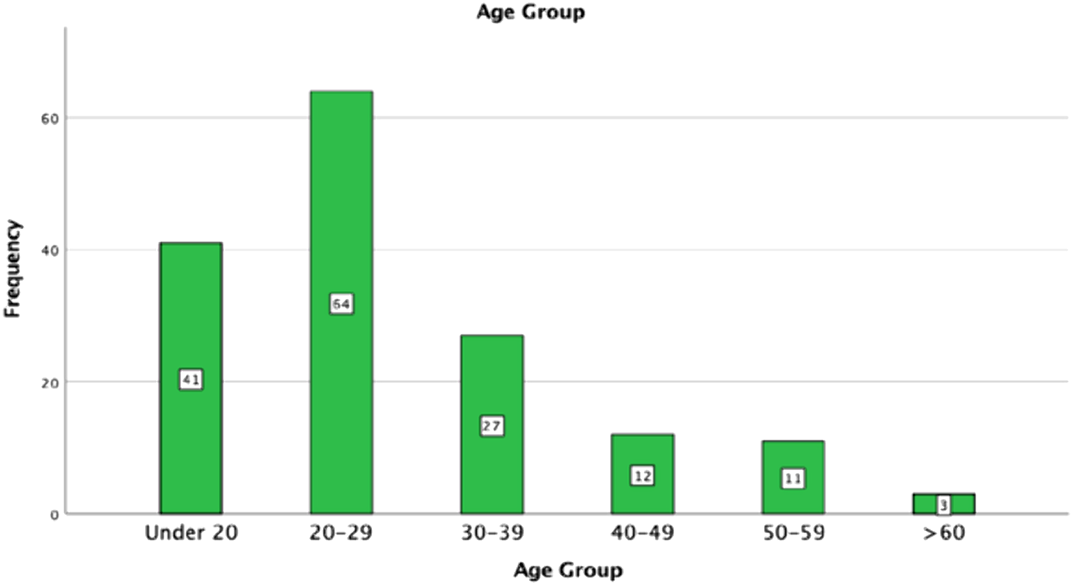
A total of 168 cases were seen of which 10 were excluded due to incomplete data. Of 158 cases gender split was roughly in the middle, with 49.4% males (n=78) and 50.6% females (n=80). The mean age of patients was 27.59 with a range of 12-70, 40.5% belonged to the age group of 20-29 (n=64) (Figure 1).
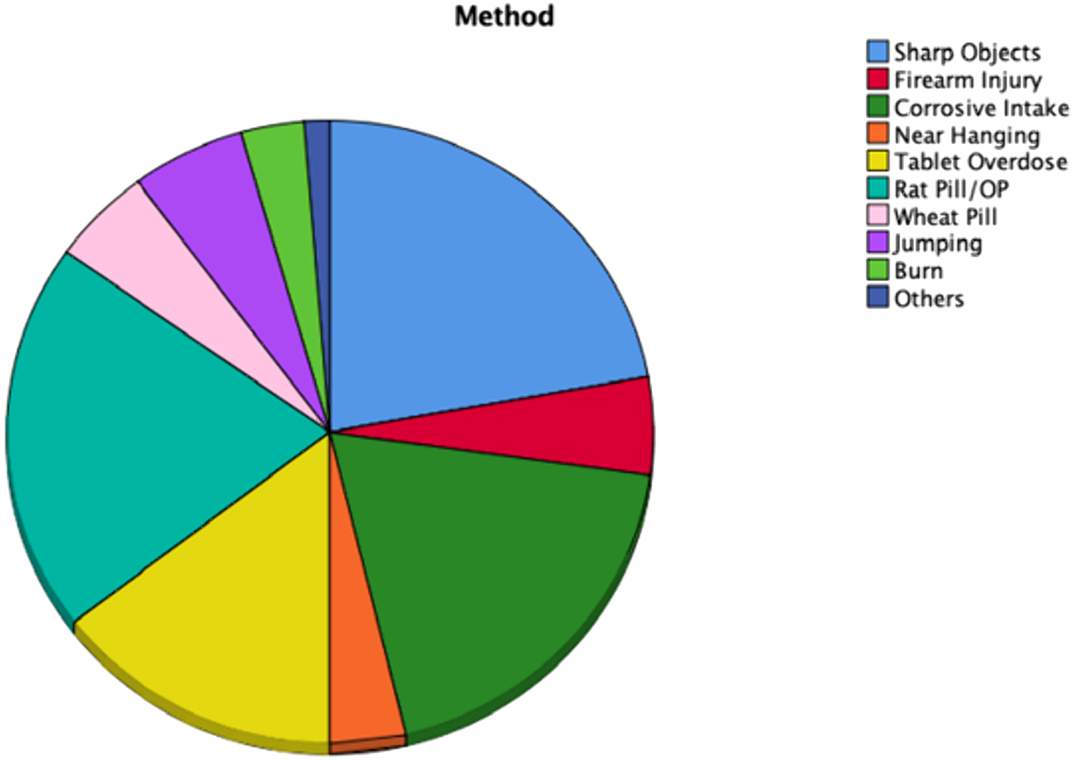
77.8% (n=123) had a past psychiatric history. The most common being depressive disorder 31.6% (n=50) and borderline personality disorder 30.4% (n=48). 35.4% of patients reportedly had previous attempts of self-harm. The most common methods being the use of sharp objects, rat-pill poisoning, and corrosive intake (Figure 2).
Conflicts with family and relationship difficulties were reported to be the most common precipitating factors.
Conclusions
Self-harm is a challenging and frequent presentation. Patients may present with diverse characteristics and varying needs. Hence physicians must be prepared for timely liaison and prompt management.
Managing isolation protocols for distressed, cognitively impaired COVID-19-positive patients presented a range of new challenges to our liaison psychiatry for the elderly service. In this article we present some of the scenarios we have experienced, our own reflections on the needs of this specific group and how this has challenged us in terms of tolerating risk, prescribing off-label, collaborating with distressed colleagues, professional boundaries and being creative in non-pharmacological interventions.
Geometric vertex decomposition and liaison are two frameworks that have been used to produce similar results about similar families of algebraic varieties. In this paper, we establish an explicit connection between these approaches. In particular, we show that each geometrically vertex decomposable ideal is linked by a sequence of elementary G-biliaisons of height $1$ to an ideal of indeterminates and, conversely, that every G-biliaison of a certain type gives rise to a geometric vertex decomposition. As a consequence, we can immediately conclude that several well-known families of ideals are glicci, including Schubert determinantal ideals, defining ideals of varieties of complexes and defining ideals of graded lower bound cluster algebras.
Brain injury, resulting from stroke and traumatic brain injury, is a common occurrence in Australia, with Aboriginal people affected at a significant rate and impact felt by individuals, families and communities. Access to brain injury rehabilitation services for Aboriginal people is reported to be often limited, with very little support outside the hospital environment. Our research involving Aboriginal brain injury survivors and their families to date has revealed that people often manage ‘on their own’ following such events. Following recommendations from survivors and their families, the Healing Right Way clinical trial, currently underway in Western Australia, has created the role of Aboriginal Brain Injury Coordinator (ABIC) to assist in navigating information and services, particularly after discharge from hospital. Eight positions for this role have been instigated across metropolitan and rural regions in the state. Healing Right Way’s aim is to enhance rehabilitation services and improve quality of life for Aboriginal Australians after brain injury. The ABIC’s role is to provide education, support, liaison and advocacy services to participants and their families over a six-month period, commencing soon after the participant’s stroke or injury has occurred. This paper outlines the development of this role, the partnerships involved, experiences to date and identifies some facilitators and barriers encountered that may impact the role’s ongoing sustainability. Details of components of the planned full Process Evaluation of Healing Right Way related to the ABIC role and the partnerships surrounding it are also provided. In combination with the trial’s ultimate results, this detail will assist in future service planning and provide a model of culturally secure care for stroke and brain injury services that can also inform other sub-acute and primary care models.
Healthcare services are increasingly confronted with challenges related to old age mental disorders. The survey aimed to provide an overview of existing psychogeriatric services in Albania, Bulgaria, Greece, and North Macedonia.
Methods
After identification of psychogeriatric units across the four countries, their head physicians were asked to provide data on their clinical, teaching, and research activity, as well as staff composition. Moreover, the attitudes of head physicians to current needs and future service development were explored.
Results
A total of 15 psychogeriatric units were identified (3 in Bulgaria, 8 in Greece, and 4 in North Macedonia). Results show wide variation regarding the location, team size and composition, service availability, numbers of patients attending, and inpatient treatment length. Most head physicians underscored the urgent need for breakthroughs in the graduate and postgraduate education in psychogeriatrics of medical and nonmedical professionals, as well as in the interconnection of their units with community primary healthcare services and long-term care facilities for seniors via telemedicine. They would welcome the development of national standards for psychogeriatric units, potentially embodying clear pointers for action. A number of head physicians advocated the development of nationwide old age mental health registries.
Conclusions
Regional disparities in resources and services for seniors’ mental health services were unveiled. These data may enrich the dialogue on optimizing psychogeriatric services through planning future cross-border collaborations mainly based on telemedicine services, especially in the era of the novel coronavirus pandemic, and training/education in psychogeriatrics of mental health professionals.
A review of the literature demonstrates that relatively little is known about acute psychiatric presentations in children (0–12 years), compared with adolescents or young adults (12 years+). This study aims to review psychiatric presentations of children to a CAMHS Liaison Service at Children’s Hospital Ireland (CHI) at Tallaght University Hospital over a 10-year period.
Methods:
A retrospective study was undertaken of case notes of all children aged 12 years and under who were referred to the CAMHS Liaison Service between January 2009 and December 2018 (n = 318). Data were anonymised and inputted into SPSSv25 for analysis. The relationships between presentations and methods of self-harm over time were measured using Pearson’s correlation. Associations between categorical variables were analysed using chi-squared tests.
Results:
There was a significant increase in presentations of under-12s over the 10-year period (r(8)=0.66, p = 0.02). There was also a significant increase in children presenting with a disturbance of conduct and/or emotions over time (r(8) = 0.79, p < 0.001). There was a significant association between female gender and ingestion (X2 = 12.73, df = 1, p < 0.05) and between male gender and ligature as a method of self-harm (X2 = 5.54, df = 1, p < 0.05). Over half (53%) of children presented with suicidal thoughts and 22% presented with suicidal behaviours. The reported use of ligature as a method of self-harm emerged only from 2012 among cases studied.
Conclusions:
Children aged 12 years and under are presenting in increasing numbers with acute mental health difficulties, including suicidal thoughts and behaviours. There is a worrying trend in methods of self-harm, particularly in high lethality behaviours such as attempted strangulation.
Maladie mentale et équilibre précaire, conditions de détention, réalisation du projet de soin, appréhension du placement en foyer, stigmatisation : ces facettes singulières s’expriment simultanément dans la prise en soin des patients Suisses détenus sous mesure pénale à des fins de placement institutionnel. Le malade psychique incarcéré sous article 59 du Code pénal suisse (20 % des détenus) voit sa peine suspendue au profit d’une incarcération dont la fin dépend, entre autres, de l’évolution du malade sur les critères de reconnaissance de la maladie et ceux de la dangerosité liée à la pathologie. Cette activité naissante (2012) s’adresse en premier lieu aux patients les plus démunis face aux changements (psychose, retard mental), le trouble psychique induisant souvent des mises en échec du patient face aux attentes de l’univers carcéral, incontournable pour accéder à la sortie. Cet accompagnement se veut lier des univers séparés par les murs, les prisons, les hôpitaux psychiatriques et les foyers et accompagner le détenu psychique à retrouver sa place dans la société. En s’appuyant notamment sur le concept de transition décrit par Meleis, et sur la gestion de situations complexes par la méthode de case management, cette liaison accompagne autant les soignants prenant en soin que les patients écroués soumis à cette complexité. Cette activité se trouve à la croisée du monde pénal et psychiatrique, soumis aux enjeux sociétaux actuels et majeurs en Suisse, la place du patient-détenu est un questionnement perpétuel pour eux comme pour nous, soignants. L’équipe actuelle se compose d’un infirmier case-manager de liaison et d’un psychiatre responsable du secteur psychiatrique dans une prison de haute sécurité ; l’activité se porte sur une mise en sens du parcours et du vécu auprès des patients, de coordination pour la cohérence des soins d’un milieu à l’autre.
This article aims to test whether the Theta System of Reinhart (1996, 2000, 2001, 2002) can account for the puzzles associated with psychological verbs in Polish. The first puzzle, called argument linking, relates to the mapping of the Experiencer onto a subject or an object position. The second puzzle, referred to as case linking, concerns the fact that Experiencers may be marked for different cases in the same sentence position. The analysis of Object Experiencer (OE)/Subject Experiencer (SE) alternations in Polish carried out in this article demonstrates that the predictions of the Theta System about Experiencer argument linking are borne out by the Polish data. SE alternants of eventive OE verbs in Polish show unergative properties, which directly follows from the mechanisms of the Theta System. However, the Theta System faces problems when confronted with dyadic OE verbs with dative Experiencers. The model predicts that dative Experiencers are merged internally, as a part of an unaccusative structure. This prediction is untenable for Polish, because dative Experiencers of dyadic predicates show some characteristics of external arguments, and hence must merge externally. Consequently, the conclusion drawn is that the Theta System can provide solutions to some, but not all, of the argument and case-linking puzzles associated with Polish Experiencers.
This article outlines the differences in goals, methods and results that variationist researchers may encounter when exploring and/or documenting a threatened language variety, and underscores special considerations and aspects of the research program that linguists must work to control for when working with endangered varieties of Western languages. In particular, it examines questions and strategies for dealing with sparse data for longitudinal studies; fewer speakers for stratified samples; the inverse relation between linguistic fluency and age; social network constraints in small speech communities; literacy-centric exercises in oral language communities; and larger project protocols designed for stable linguistic communities. Throughout the paper, the collection and analysis of Louisiana French liaison data from 1939, 1977, and 2010 provide an application of the proposed methods.
There are concerns about the quality of care that people with dementia receive in the general hospital. Staff report a lack of confidence and inadequate training in dementia care.
Methods:
A train-the-trainer model was implemented across eight acute hospital trusts in London via a large academic health and science network. Impact was evaluated using mixed methods. Data were collected at (a) individual level: “Sense of Competence in Dementia Care” (SCID), (b) ward level: Person Interaction and Environment (PIE) observations, (c) organization level: use of specific tools, i.e. “This Is Me,” (d) systems level: numbers and types of staff trained per trust. Results were analyzed with descriptive statistics and paired t-test with thematic framework analysis for PIE observations.
Results:
The number of staff trained per trust ranged from 67 to 650 (total 2,020). A total of 1,688 (85%) baseline questionnaires and 456 (27%) three month follow-up questionnaires were completed. Mean SCID score was 43.2 at baseline and 50.7 at follow-up (paired t-test, p < 0.001). All sub-scales showed a small increase in competence, the largest being for “building relationships.” Organizational level data suggested increased use of carer's passport, “This Is Me” documentation, dementia information leaflets, delirium screening scales, and pathways. PIE observations demonstrated improved staff–patient interactions but little change in hospital environments.
Conclusions:
There was a significant improvement in staffs’ sense of competence in dementia care and the quality of interactions with patients. More hospitals adopted person-centered tools and pathways. Work is required to investigate if these changes improve hospital outcomes for people with dementia.
A central problem in liaison theory is to decide whether every arithmetically Cohen–Macaulay subscheme of projective $n$-space can be linked by a finite number of arithmetically Gorenstein schemes to a complete intersection. We show that this can indeed be achieved if the given scheme is also generically Gorenstein and we allow the links to take place in an $(n+ 1)$-dimensional projective space. For example, this result applies to all reduced arithmetically Cohen–Macaulay subschemes. We also show that every union of fat points in projective 3-space can be linked in the same space to a union of simple points in finitely many steps, and hence to a complete intersection in projective 4-space.
