To save content items to your account,
please confirm that you agree to abide by our usage policies.
If this is the first time you use this feature, you will be asked to authorise Cambridge Core to connect with your account.
Find out more about saving content to .
To save content items to your Kindle, first ensure no-reply@cambridge.org
is added to your Approved Personal Document E-mail List under your Personal Document Settings
on the Manage Your Content and Devices page of your Amazon account. Then enter the ‘name’ part
of your Kindle email address below.
Find out more about saving to your Kindle.
Note you can select to save to either the @free.kindle.com or @kindle.com variations.
‘@free.kindle.com’ emails are free but can only be saved to your device when it is connected to wi-fi.
‘@kindle.com’ emails can be delivered even when you are not connected to wi-fi, but note that service fees apply.
This chapter focuses on the connections between sea surfaces, the atmosphere, and outer space. Its upward-oriented perspective to oceanic history traces these connections from early 20th-century visions like the failed idea of floating airports (seadromes), whose horizontal runways were impractical in aquatic conditions, to later orientation changes. Artificial islands served horizontal helicopter take-off and landing, or offshore rocket launches. The chapter argues that these energy-intensive built environments, enabled by the Age of Oil, spatially and sensually marked the emergence of the oceanic Anthropocene. Platform illumination for helicopters operations, rocket launches, and the flares of oil platforms whose radiation is visible from outer space, created massive “light islands” in marine regions, manifesting carbon emissions. Simultaneously, the light island effect turned into a form of placemaking. Light islands became regular offshore destinations and departure points for other vehicles, creating new oceanic equivalents to terrestrial ports, airports, and spaceports. They also indicated the extension of the human habitat to sea surfaces.
The increasing integration of outer space technologies into both civilian life and military operations poses significant challenges to the application of the principles of international humanitarian law. Although these technologies may strengthen military operations, the repurposing of civilian space assets for military ends increases their vulnerability to hostile actions, thereby creating risks that could ultimately impair the civilian infrastructure that is reliant upon them. The present article sets out to explore the growing reliance on space-based assets, such as satellites, for communication, navigation and surveillance purposes in modern conflicts, and explores the evolving role of outer space in armed conflict, emphasizing the humanitarian risks posed by its militarization and the absence of robust legal protections. The article puts forward that the international community’s primary focus should be the protection of civilians, achieved through the safeguarding of space-based assets and the prevention of outer space’s weaponization. Protecting these technologies from the effects of armed conflict is imperative for civilian safety as well as for maintaining global stability and ensuring that outer space remains a domain of peaceful cooperation.
This chapter focuses on the law relating to sovereign territory. The concepts of territory and of territorial sovereignty are examined. The manner in which additional territory may be acquired is analysed. Mechanisms such as boundary treaties and boundary awards are noted, and then the methods of acquisition are discussed. These include an analysis of discovery, accretion, cession, the former use of force and conquest, and the exercise of effective control, including occupation of terra nullius and prescription. The impact of the concepts of the critical date and intertemporal law is noted. Attention then turns to the role of subsequent conduct, such as recognition, acquiescence and estoppel. The principles of territorial integrity and of self-determination in this context are then discussed, together with the doctrine of uti possidetis, both as to the colonial context and more generally. The role of subsequent practice is noted and the importance of sovereign effective control in the circumstances (‘effectivités’). The chapter continues by noting the relevance of leases and servitudes, then turns to international boundary rivers, and then the polar regions. The chapter concludes with a section on the law of outer space.
This chapter concerns international environmental law. It commences with a consideration of an argued human right to a clean environment and the increasing case law on this issue. The relationship between economic development and environmental protection is also addressed, before the key question of state responsibility is surveyed. The appropriate standard, whether or not actual damage is caused, the question of transboundary harm arising from hazardous activities, environmental impact assessments, the precautionary and polluter-pays principles are examined before turning to the range of international treaties on this topic. The question of atmospheric pollution is addressed before the chapter turns to a consideration of climate change and the various international instruments concerning this, including the important Paris Agreement of 2015. Environmental issues and outer space are then discussed, followed by a section on international watercourses and one on ultra-hazardous activities. Questions as to the requirements for the provision of information and assistance are covered.
If change is the only constant, how does the law keep pace with technology? Without a centralized judiciary, international law should be especially susceptible to disruption, yet it can be remarkably resilient in practice. I argue that efforts to minimize legal ambiguity, long seen as integral to compliance, can hinder its application to new technologies. Drawing on first principles from psycholinguistics, my theory differentiates between what I call convergent and divergent forms of flexibility. Unlike divergent flexibility, which gives rise to contestation, convergent flexibility tends to promote consensus, even when (1) technology is unprecedented and (2) regulatory interests sharply diverge. To test the theory, $450$ trained legal professionals were commissioned to take part in a randomized controlled trial (RCT) that varied technological novelty, legal precision, and political incentives. Participants collectively contributed 280,000 words over 10,000 hours in defense of their professional legal opinions, offering a novel (agent-subjective) measure of compliance. To establish external validity, the experiment is complemented with research into the legal impact of two breakthrough chemical weapons technologies: “super tear gas” and novichok. The findings contribute a general theoretical framework for understanding when and why emerging technologies are legally disruptive.
Chapter 3 delves into the functions and foundations of international environmental law. International environmental law is an institution based on the deliberate redundancy of parallel and overlapping networks that contribute to its resilience and to the maintenance of the minimum public order. We analyze the foundational purposes of international environmental law: the quest for equity and the pursuit of effectiveness. We underline that addressing matters of distributive equity successfully is the sine qua non condition for the effective protection of environmental commons. The tragedy of the commons rationale that precipitated the enclosure of common pool resources in national systems is also driving the enclosure of global common resources. This chapter analyzes the specifics of this enclosure, as it has been unfolding in fisheries, marine genetic resources, germplasm resources and related knowledge, deep-seabed resources, freshwater resources, air, seas, chemicals, wastes, and space. The nature of inclusionary and exclusionary enclosures and how these types of enclosure affect perceptions of distributive equity are critically examined. Finally, international environmental regimes are evaluated based on the effectiveness of the enclosure they have commanded and the perceptions of equity held by the stakeholders and participants in the regimes.
The chapter delves into the intricacies of representations of outer space, exposing their entanglement with colonialist narratives. It analyzes the ideology behind space exploration to show that, rather than being something “new” or aligned with futurism, these texts repeat colonialist conquest narratives while proposing alternative methodologies of “worlding” beyond conventional materialist paradigms. By critiquing mainstream notions of space travel, this chapter illuminates the Cartesian–Baconian separation of humans from nature, which, the author argues, perpetuates antiblackness. Through an analysis of Sun Ra’s Space Is the Place, the chapter illuminates how alternative narratives use outer space as a metaphor to oppose notions of the separation of humans from the natural world and anti-blackness. Sun Ra’s film not only challenges traditional modes of travel but also hints at alternative ways of understanding exploration, most especially of oneself. This shift in perspective signifies a departure from the conventional idea of discovering new worlds towards a more profound concept of co-creating realities, emphasizing shifts in consciousness over mere geographical exploration. Drawing upon the work of Katherine McKittrick and others, this chapter also invites a reconsideration of the ways in which geography itself is constructed, rather than an objective material fact of the phenomenological world.
Historians have written copiously about the shift to ‘germ theories’ of disease around the turn of the twentieth century, but in these accounts an entire continent has been left out: Antarctica. This article begins to rebalance our historiography by bringing cold climates back into the story of environmental medicine and germ theory. It suggests three periods of Antarctic (human) microbial research – heroic sampling, systematic studies, and viral space analogue – and examines underlying ideas about ‘purity’ and infection, the realities of fieldwork, and the use of models in biomedicine. It reveals Antarctica not as an isolated space but as a deeply complex, international, well-networked node in global science ranging from the first international consensus on pandemic-naming through to space flight.
Human capacity to explore and shape outer space will increase substantially over the next 50 years. Yet, International Relations (IR) theory still treats outer space as an isolated, unique, or inconsequential realm of political life. This paper moves IR beyond its ‘terrestrial trap’ by theorising planetary politics as inherently embedded in relations with environments and actors that are located beyond Earth. To face the momentous and often alarming political developments taking place in outer space, from space militarisation to space colonisation, we challenge two of IR’s terrestrial biases. First, we confront the assumption that developments in international relations take place only or primarily on Earth. We show how the historically constituted ideologies and political economies of colonisation and domination are extended to – but also transformed within – outer space exploration and settlement. Second, we challenge the notion that developments in outer space form a logical extension of politics as it has emerged on the habitable surface of our planet. We move beyond zones of human habitation and explore how the material conditions of space intersect with situated histories of political governance and control. By analysing politics beyond Earth, we retool IR theory to confront an extraterrestrial political future.
We construct an unfolding path in Outer space which does not converge in the boundary, and instead it accumulates on the entire 1-simplex of projectivized length measures on a nongeometric arational ${\mathbb R}$-tree T. We also show that T admits exactly two dual ergodic projective currents. This is the first nongeometric example of an arational tree that is neither uniquely ergodic nor uniquely ergometric.
This chapter examines China’s differential approach vis-à-vis developing and developed countries in advancing its normative agenda on non-weaponization in outer space before the Conference on Disarmament and the UN General Assembly. Pursuant to the logic of the democratization of international relations, China has gained the majority support of developing countries for its agenda around their commonly shared values of peace and development and through other forms of functional cooperation in their outer space activities – increasing its international legitimacy in their eyes. Conversely, China has yet to gain the trust of technologically advanced – developed – nations in order to give its future regulatory framework governing peaceful relationships in outer space its much-needed normativity. Instead, past disarmament efforts in outer space during the Cold War can guide China’s norm-entrepreneurship where it must seek consensus among the major space powers, the United States in particular, on the basis of trust. Without such a fertile soil, however, any rules on the prevention of an arms race in outer space cannot take root.
The chapter discusses the basics of the law of the global commons (seas, air, outer space), by concentrating on what states can do in which zones or spaces
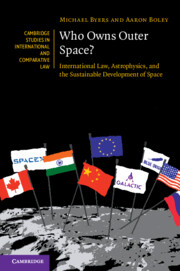
From Space debris to asteroid strikes to anti-satellite weapons, humanity's rapid expansion into Space raises major environmental, safety, and security challenges. In this book, Michael Byers and Aaron Boley, an international lawyer and an astrophysicist, identify and interrogate these challenges and propose actionable solutions. They explore essential questions from, 'How do we ensure all of humanity benefits from the development of Space, and not just the world's richest people?' to 'Is it possible to avoid war in Space?' Byers and Boley explain the essential aspects of Space science, international law, and global governance in a fully transdisciplinary and highly accessible way. Addressing the latest and emerging developments in Space, they equip readers with the knowledge and tools to engage in current and critically important legal, policy, and scientific debates concerning the future development of Space. This title is also available as Open Access on Cambridge Core.
In this chapter Germany’s position on Antarctica, the law of the sea, as well as air and space law will be examined. Concerning the law of the sea, Germany’s critical position on China’s maritime claims in the South China Sea, expressed on many different occasions, will be addressed. Besides that, it will be addressed that Turkey accused Germany of illegally boarding its merchant vessel on the high seas in the Mediterranean. Yet, it will be concluded the boarding and search of the vessel even against the expressed will of Turkey was not illegal under international law. Regarding Turkey’s conduct of seismic surveys in the eastern Mediterranean, Germany’s calls on Turkey to respect international law will be criticised as lacking a legal basis. That Germany joined the UK-led Global Ocean Alliance, will be evaluated as a way for Germany to lobby for greater parts of the ocean being assigned Marine Protected Area status. In the last part, Germany opposing Russian initiatives on the prevention of the placement of weapons in outer space will be assessed a sign of its increasing frustration with the double standards displayed by Russia and the other major space powers.
The 1967 Outer Space Treaty reserved outer space for ‘peaceful purposes’, yet recent decades have witnessed growing competition and calls for new multilateral rules including a proposed ban on the deployment of weapons in space. These diplomatic initiatives have stalled in the face of concerted opposition from the United States. To explain this outcome, we characterise US diplomacy as a form of ‘antipreneurship’, a type of strategic norm-focused competition designed to preserve the prevailing normative status quo in the face of entrepreneurial efforts. We substantially refine and extend existing accounts of antipreneurship by theorising three dominant forms of antipreneurial agency – rhetorical, procedural, and behavioural – and describing the mechanisms and scope conditions though which they operate. We then trace the development of US resistance to proposed restraints on space weapons from 2000–present. Drawing on hundreds of official documents, we show how successive US administrations have employed a range of interlayered diplomatic strategies and tactics to preserve the permissive international legal framework governing outer space and protect US national security priorities. Our study illustrates the specific techniques and impacts of resistance in a domain of growing strategic importance, with implications for further refining understandings of norm competition in other issue areas.
The quantity of man-made space objects, ranging from abandoned launch vehicle stages to fragmentation debris, is remarkable. At the time, the drafters of the Outer Space Treaty did not (and perhaps could not) anticipate how great the problem of debris in outer space would one day become. As a result, they only drafted general provisions for the protection of the space environment which are generally deemed insufficient. This article aims to demonstrate that both general rules of international law and the UNCOPUOS Debris Mitigation Guidelines come to the rescue in addressing the space debris issue as they complement and complete the general obligations contained in the Outer Space Treaty. Particular attention is paid to anti-satellite weapon tests, which have catastrophic consequences in terms of creating debris but nonetheless continue to be carried out. Finally, it ascertains whether an obligation on states to actively remove their space debris exists.
In this paper we consider two piecewise Riemannian metrics defined on the Culler–Vogtmann outer space which we call the entropy metric and the pressure metric. As a result of work of McMullen, these metrics can be seen as analogs of the Weil–Petersson metric on the Teichmüller space of a closed surface. We show that while the geometric analysis of these metrics is similar to that of the Weil–Petersson metric, from the point of view of geometric group theory, these metrics behave very differently than the Weil–Petersson metric. Specifically, we show that when the rank r is at least 4, the action of $\operatorname {\mathrm {Out}}(\mathbb {F}_r)$ on the completion of the Culler–Vogtmann outer space using the entropy metric has a fixed point. A similar statement also holds for the pressure metric.
While nine States in Asia, Europe, and North America retain and modernise their nuclear arsenals, projecting to retain nuclear weapons for the rest of the century, most of the world and beyond is subject to a regional nuclear-weapon-free zone. This chapter describes the different nuclear-weapon-free zones and the global UN ban treaty, which entered into force in January 2021.
How does a ‘space culture’ emerge and evolve, and how can archaeologists study such a phenomenon? The International Space Station Archaeological Project seeks to analyse the social and cultural context of an assemblage relating to the human presence in space. Drawing on concepts from contemporary archaeology, the project pursues a unique perspective beyond sociological or ethnographical approaches. Semiotic analysis of material culture and proxemic analysis of embodied space can be achieved using NASA's archives of documentation, images, video and audio media. Here, the authors set out a method for the study of this evidence. Understanding how individuals and groups use material culture in space stations, from discrete objects to contextual relationships, promises to reveal intersections of identity, nationality and community.
The chapter discusses the basics of the law of the global commons (seas, air, outer space), by concentrating on what states can do in which zones or spaces