Refine search
Actions for selected content:
178596 results in Earth and Environmental Sciences
Multimodal learning–based reconstruction of high-resolution spatial wind speed fields
- Part of
-
- Journal:
- Environmental Data Science / Volume 4 / 2025
- Published online by Cambridge University Press:
- 07 January 2025, e2
-
- Article
-
- You have access
- Open access
- HTML
- Export citation
Dynamics-preserving compression for modal flow analysis
-
- Journal:
- Journal of Fluid Mechanics / Volume 1001 / 25 December 2024
- Published online by Cambridge University Press:
- 06 January 2025, A48
-
- Article
-
- You have access
- Open access
- HTML
- Export citation
Direct statistical simulation using generalised cumulant expansions
-
- Journal:
- Journal of Fluid Mechanics / Volume 1001 / 25 December 2024
- Published online by Cambridge University Press:
- 06 January 2025, A44
-
- Article
-
- You have access
- Open access
- HTML
- Export citation
-
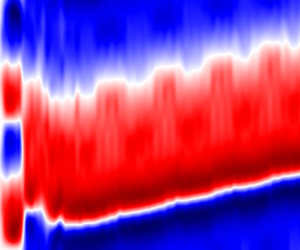
In recent years, the generalised quasilinear (GQL) approximation has been developed and its efficacy tested against purely quasilinear (QL) approximations. GQL systematically interpolates between QL and fully nonlinear dynamics by employing a generalised Reynolds decomposition. Here, we examine an exact statistical closure for the GQL equations on the doubly periodic $\beta$-plane. Closure is achieved at second order using a generalised cumulant approach which we term GCE2. GCE2 is shown to yield improved performance over statistical representations of purely QL dynamics (CE2) and thus enables direct statistical simulation of complex mean flows that do not entirely fall within the remit of pure QL theory. Despite the existence of an exact closure, GCE2 like CE2 admits the possibility of a rank instability that leads to differences with statistics obtained from GQL. Recognition of this instability is a necessary step before further progress can be made with the GCE2 statistical closure.

Late Neoarchaean tectonic environment in the Anshan-Benxi area: evidence of metamorphic supracrustal rocks
-
- Journal:
- Geological Magazine / Volume 161 / 2024
- Published online by Cambridge University Press:
- 06 January 2025, e26
-
- Article
-
- You have access
- Open access
- HTML
- Export citation
FLM volume 1001 Cover and Front matter
-
- Journal:
- Journal of Fluid Mechanics / Volume 1001 / 25 December 2024
- Published online by Cambridge University Press:
- 06 January 2025, p. f1
-
- Article
-
- You have access
- Export citation
A Hamiltonian Dysthe equation for hydroelastic waves in a compressed ice sheet
-
- Journal:
- Journal of Fluid Mechanics / Volume 1002 / 10 January 2025
- Published online by Cambridge University Press:
- 06 January 2025, A24
-
- Article
-
- You have access
- Open access
- HTML
- Export citation
AMIGOS-3 multi-sensor stations and the climate, ice and ocean conditions at Thwaites Eastern Ice Shelf during 2020–22
-
- Journal:
- Journal of Glaciology / Volume 71 / 2025
- Published online by Cambridge University Press:
- 06 January 2025, e60
-
- Article
-
- You have access
- Open access
- HTML
- Export citation
Taxonomic, biogeographic, and biological implications of mammoth teeth from a dynamic Pleistocene landscape in Alberta, Canada
-
- Journal:
- Quaternary Research / Volume 123 / January 2025
- Published online by Cambridge University Press:
- 06 January 2025, pp. 41-58
-
- Article
- Export citation
Dust-free region over horizontal hot surfaces
-
- Journal:
- Journal of Fluid Mechanics / Volume 1001 / 25 December 2024
- Published online by Cambridge University Press:
- 06 January 2025, A45
-
- Article
-
- You have access
- Open access
- HTML
- Export citation
-
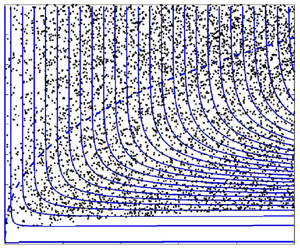
We study the formation of dust-free regions above hot horizontal surfaces of uniform temperature and propose relations for its height in the limit of small particle inertia and gravitational effects. By including particle inertia, thermophoretic, gravitational and viscous effects, we conduct Lagrangian simulations of particle dynamics in a natural convection boundary layer over a horizontal surface. Trajectory analysis of the particles inside the boundary layer on the surface reveals the existence of two separatrices originating from a saddle point, which form the boundary of the dust-free region. These separatrices for low gravitational effects follow the boundary layer thickness, but are of much lower height and also depend on the dimensionless thermophoretic number ( $Th$) and Prandtl number ( $Pr$). We obtain a relation for the dimensionless height of the dust-free region ( $\eta _{df}$) as a function of $Pr$ and $Th$, for low dimensionless gravitational number ( $Gn$); the numerical solution of this equation gives us the dust-free region height for any $Th$ and $Pr$. We then obtain scaling laws for $\eta _{df}$ using the boundary layer equations corresponding to the $Pr \gg 1$ and $Pr \ll 1$ cases; these scaling laws are shown to be valid respectively for $Pr>1$ and $Pr<1$, except in the large $\eta$ limit for $Pr>1$, where $\eta$ is the boundary layer similarity variable. We then obtain an empirical relation in this large $\eta$ limit using the numerical solutions of the boundary layer equations for the intermediate $Pr$ case to obtain scaling laws for dust-free region height for the whole range of $Pr \ll 1$ to $Pr \gg 1$.


Zincorinmanite-(Zn), (Fe3+2Zn)SbZnO7(OH), a new nolanite-supergroup mineral from the Nežilovo ore field, near Veles, Republic of North Macedonia
-
- Journal:
- Mineralogical Magazine / Volume 89 / Issue 3 / June 2025
- Published online by Cambridge University Press:
- 06 January 2025, pp. 347-356
-
- Article
- Export citation
Structure of mushy layers grown from perfectly and imperfectly conducting boundaries. Part 2. Onset of convection
-
- Journal:
- Journal of Fluid Mechanics / Volume 1002 / 10 January 2025
- Published online by Cambridge University Press:
- 03 January 2025, A26
-
- Article
-
- You have access
- Open access
- HTML
- Export citation
A high-resolution record of Late Holocene drought in the eastern Sierra Nevada (California, USA) from June Lake carbonate geochemistry
-
- Journal:
- Quaternary Research / Volume 123 / January 2025
- Published online by Cambridge University Press:
- 03 January 2025, pp. 1-15
-
- Article
-
- You have access
- Open access
- HTML
- Export citation
Estimating high-resolution profiles of wind speeds from a global reanalysis dataset using TabNet
- Part of
-
- Journal:
- Environmental Data Science / Volume 3 / 2024
- Published online by Cambridge University Press:
- 03 January 2025, e32
-
- Article
-
- You have access
- Open access
- HTML
- Export citation

Inverse Leidenfrost impacting drops
-
- Journal:
- Journal of Fluid Mechanics / Volume 1002 / 10 January 2025
- Published online by Cambridge University Press:
- 03 January 2025, A32
-
- Article
- Export citation
Twisted finite wing at low Reynolds number: cellular vortex shedding, wing-tip vortex and aerodynamic performance
-
- Journal:
- Journal of Fluid Mechanics / Volume 1002 / 10 January 2025
- Published online by Cambridge University Press:
- 03 January 2025, A28
-
- Article
-
- You have access
- Open access
- HTML
- Export citation
-
The effect of geometric twist ( $\delta$) of a finite wing of various semi-aspect ratios, on the flow, aerodynamic forces and strength of wing-tip vortex, is investigated. The number of vortex shedding cells increases with increase in $\delta$. In general, the vortex shedding frequency at the root and tip of the wing is approximately the same as that for an untwisted wing. However, close to the $\delta$, where the number of cells changes, the end-cell frequency of the twisted wing undergoes a departure from the value for the untwisted wing. Dislocations at the junction of neighbouring cells are of fork-type for $\delta > -2^\circ$ and of reverse fork-type for $\delta < -2^\circ$. Additional ring-like vortex structures are observed for $\delta =-4^\circ$. Despite a significant effect of the twist on the flow and spanwise variation of the local force coefficients, low to moderate twist of the wing has a relatively minor effect on the span-integrated force coefficients. Larger positive $\delta$, however, results in a significant decrease in the time-averaged force coefficients and rolling moment at the wing root, their unsteadiness and an increase in the strength of the wing-tip vortex. Twist can be utilized as a design parameter for an air vehicle operating at low Reynolds number. Positive twist results in a decrease in unsteadiness in the flow and lower rolling moment at the wing root that can enable lowering the structural weight. Negative twist, on the other hand, weakens the wing-tip vortices that assists in formation and swarm flying by causing lower disturbance to downstream air vehicles.


Linear analysis characterizes pressure gradient history effects in turbulent boundary layers
-
- Journal:
- Journal of Fluid Mechanics / Volume 1002 / 10 January 2025
- Published online by Cambridge University Press:
- 03 January 2025, A20
-
- Article
-
- You have access
- Open access
- HTML
- Export citation
-
Adverse pressure gradient (APG) turbulent boundary layers (TBL) require an understanding of the details of the pressure gradient, or history effect, to characterize the associated variation of spatiotemporal turbulent statistics. The streamwise-varying mean pressure gradient is reflected in the streamwise developing mean flow field and thus resolvent analysis, which captures the amplification of the Navier–Stokes equations linearized about the turbulent mean, can be used to understand linear amplification in APG TBLs. In particular, by using a biglobal approach in which the amplification is characterized by a temporal frequency and spanwise wavenumber, the streamwise and wall-normal inhomogeneities of the APG TBL can be resolved and related to the APG history. The linear response is able to identify multiscale phenomena, identifying a near-wall peak with $\lambda _{z}^+\approx 100$ for zero pressure gradient TBLs and mild to moderate APG TBLs as well as large-scale modes whose amplification increases with APG strength and Reynolds number. It is shown that the monotonic growth in the turbulent statistics with increasing APG is reflected in the linear growth in the associated resolvent amplification. Collapse in the Reynolds stresses is obtained through an augmented hybrid velocity scale, which replaces the local APG strength measure in the hybrid velocity scale presented in Romero et al. (Intl J. Heat Fluid Flow, vol. 93, 2022, 108885) with a velocity that encapsulates the pressure gradient history. While this resolvent approach is applicable to any APG TBL, it is shown from a scaling analysis of the linearized Navier–Stokes equations that the linear growth observed in the resolvent amplification with the history effect is limited to near-equilibrium APG TBLs.

Moment of momentum integral analysis of turbulent boundary layers with pressure gradient
-
- Journal:
- Journal of Fluid Mechanics / Volume 1002 / 10 January 2025
- Published online by Cambridge University Press:
- 03 January 2025, A29
-
- Article
-
- You have access
- Open access
- HTML
- Export citation
Instability of falling films of discontinuously shear-thickening fluid
-
- Journal:
- Journal of Fluid Mechanics / Volume 1002 / 10 January 2025
- Published online by Cambridge University Press:
- 03 January 2025, A34
-
- Article
-
- You have access
- Open access
- HTML
- Export citation
Global drag reduction and local flow statistics in Taylor–Couette turbulence with dilute polymer additives
-
- Journal:
- Journal of Fluid Mechanics / Volume 1002 / 10 January 2025
- Published online by Cambridge University Press:
- 03 January 2025, A33
-
- Article
- Export citation
-
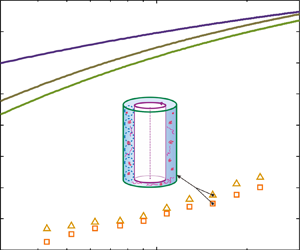
We present an experimental study on the drag reduction by polymers in Taylor–Couette turbulence at Reynolds numbers ( $Re$) ranging from $4\times 10^3$ to $2.5\times 10^4$. In this $Re$ regime, the Taylor vortex is present and accounts for more than 50 % of the total angular velocity flux. Polyacrylamide polymers with two different average molecular weights are used. It is found that the drag reduction rate increases with polymer concentration and approaches the maximum drag reduction (MDR) limit. At MDR, the friction factor follows the $-0.58$ scaling, i.e.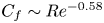 $C_f \sim Re^{-0.58}$, similar to channel/pipe flows. However, the drag reduction rate is about $20\,\%$ at MDR, which is much lower than that in channel/pipe flows at comparable $Re$. We also find that the Reynolds shear stress does not vanish and the slope of the mean azimuthal velocity profile in the logarithmic layer remains unchanged at MDR. These behaviours are reminiscent of the low drag reduction regime reported in channel flow (Warholic et al., Exp. Fluids, vol. 27, no. 5, 1999, pp. 461–472). We reveal that the lower drag reduction rate originates from the fact that polymers strongly suppress the turbulent flow while only slightly weaken the mean Taylor vortex. We further show that polymers steady the velocity boundary layer and suppress the small-scale Görtler vortices in the near-wall region. The former effect reduces the emission rate of both intense fast and slow plumes detached from the boundary layer, resulting in less flux transport from the inner cylinder to the outer one and reduces energy input into the bulk turbulent flow. Our results suggest that in turbulent flows, where secondary flow structures are statistically persistent and dominate the global transport properties of the system, the drag reduction efficiency of polymer additives is significantly diminished.


Structure of mushy layers grown from perfectly and imperfectly conducting boundaries. Part 1. Diffusive solidification
-
- Journal:
- Journal of Fluid Mechanics / Volume 1002 / 10 January 2025
- Published online by Cambridge University Press:
- 03 January 2025, A25
-
- Article
-
- You have access
- Open access
- HTML
- Export citation
