Refine search
Actions for selected content:
178593 results in Earth and Environmental Sciences
The climatic mass balance of glaciers on Franz Josef Land and Novaya Zemlya, 1991–2022
-
- Journal:
- Journal of Glaciology / Volume 71 / 2025
- Published online by Cambridge University Press:
- 08 January 2025, e81
-
- Article
-
- You have access
- Open access
- HTML
- Export citation
Surface melting and chemical analysis of a firn core from South Georgia: Implications for future drilling sites and paleoenvironmental records
-
- Journal:
- Journal of Glaciology / Volume 71 / 2025
- Published online by Cambridge University Press:
- 08 January 2025, e49
-
- Article
-
- You have access
- Open access
- HTML
- Export citation
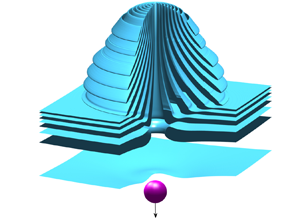
The flow field due to a sphere moving in a viscous, density-stratified fluid
-
- Journal:
- Journal of Fluid Mechanics / Volume 1002 / 10 January 2025
- Published online by Cambridge University Press:
- 08 January 2025, A44
-
- Article
- Export citation
-
In this paper, we study the disturbance velocity and density fields induced by a sphere translating vertically in a viscous density-stratified ambient. Specifically, we consider the limit of a vanishingly small Reynolds number $(Re = \rho U a/\mu \ll 1)$, a small but finite viscous Richardson number $(Ri_v = \gamma a^3g/\mu U\ll 1)$ and large Péclet number $(Pe = Ua/D\gg 1)$. Here, $a$ is the sphere's radius, $U$ its translational velocity, $\rho$ an appropriate reference density within the framework of the Boussinesq approximation, $\mu$ the ambient viscosity, $\gamma$ the absolute value of the background density gradient, g is acceleration due to gravity and $D$ the diffusivity of the stratifying agent. For the scenario where buoyancy forces first become comparable to viscous forces at large distances, corresponding to the Stokes-stratification regime defined by $Re \ll Ri_v^{1/3} \ll 1$ for $Pe \gg 1$, important flow features have been identified by Varanasi & Subramanian (J. Fluid Mech., vol. 949, 2022, A29) – these include a vertically oriented reverse jet, and a horizontal axisymmetric wake, on scales larger than the primary (stratification) screening length of ${O}(aRi_v^{-1/3})$. Here, we study the reverse-jet region in more detail, and show that it is only the central portion of a columnar structure with multiple annular cells concentric about the rear stagnation streamline. In the absence of diffusion, corresponding to $Pe = \infty$ $( \beta _\infty = Ri_v^{1/3}Pe^{-1} = 0)$, this columnar structure extends to downstream infinity with the number of annular cells diverging in this limit. We provide expressions for the boundary of the structure, and the number of cells within, as a function of the downstream distance. For small but finite $\beta _\infty$, two length scales emerge in addition to the primary screening length – a secondary screening length of ${O}(aRi_v^{-1/2}Pe^{1/2})$ where diffusion starts to smear out density variations across cells, leading to exponentially decaying density and velocity fields; and a tertiary screening length, $l_t \sim {O}(aRi_v^{-1/2}Pe^{1/2}[\zeta + \frac {13}{4}\ln {\zeta } + ({13^2}/{4^2})({\ln \zeta }/{\zeta })])$ with $\zeta = \frac {1}{2}\ln ({\sqrt {{\rm \pi} }Ri_v^{-1}Pe^3}/{2160})$, beyond which the columnar structure ceases to exist. The latter causes a transition from a vertical to a predominantly horizontal flow, with the downstream disturbance fields reverting from an exponential to an eventual algebraic decay, analogous to that prevalent at large distances upstream.


The sub-seasonal and interannual spatio-temporal variability of bare-ice albedo of Abramov Glacier, Kyrgyzstan
-
- Journal:
- Journal of Glaciology / Volume 71 / 2025
- Published online by Cambridge University Press:
- 08 January 2025, e32
-
- Article
-
- You have access
- Open access
- HTML
- Export citation
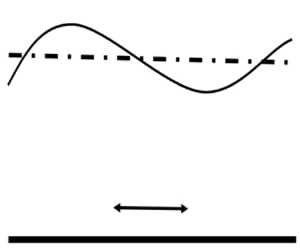
Linear stability analysis of a thin liquid film on a horizontal wall under quasi-periodic oscillation
-
- Journal:
- Journal of Fluid Mechanics / Volume 1002 / 10 January 2025
- Published online by Cambridge University Press:
- 08 January 2025, A39
-
- Article
- Export citation
-
We carry out a linear stability analysis of the flow of a thin layer of Newtonian fluid with a deformable free surface bounded at the bottom by a horizontal wall subjected to quasi-periodic oscillation in its own plane. Or's model (J. Fluid Mech., vol. 335, 1997, pp. 213–232), using a periodic oscillation, is extended to the configuration where oscillation has two incommensurate frequencies, $\omega _1$ and $\omega _2$, with an irrational ratio $\omega ={\omega _2}/{\omega _1}$. Using the long-wave expansion, we derive the asymptotic function involved in the long-wave instability criterion while taking into account the frequency ratio. It turns out that the maximum of this asymptotic function, as well as the frequency parameter at which long-wave instabilities occur, depend strongly on the frequency ratio. For arbitrary wavenumbers, the equations governing the problem under consideration are solved in space using Chebyshev's spectral collocation method, while the temporal resolution is performed using Floquet theory, knowing that an irrational number can be approximated by a rational number. For a large frequency ratio and for a velocity amplitude ratio equal to unity, we obtain, as in Or's work (J. Fluid Mech., vol. 335, 1997, pp. 213–232) considering the same frequency parameter interval, an alternation between the U shape and oblique shape referring respectively to instabilities of long wavelength and finite wavelength appearing in the diagram representing Reynolds number as a function of frequency parameter. By decreasing the frequency ratio towards $1/\sqrt {37}$, the three initial U-shaped and three oblique instabilities merge into a single U-shaped and a single oblique instability. This merging phenomenon also occurs when the ratio of the amplitudes of the superimposed velocities, linked to the introduction of the second frequency, increases from small values to unity. For a fixed frequency parameter, the effect of frequency ratio and velocity amplitude ratio on the marginal stability curves in terms of Reynolds number versus wavenumber is also investigated, focusing on the appearance of long wavelength instability and finite wavelength instability.


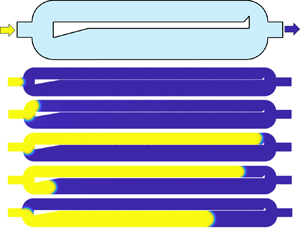
Controlled Haines jumps in a dual-channel multiphase system: inferring fluid properties from the dynamics of interface motion
-
- Journal:
- Journal of Fluid Mechanics / Volume 1002 / 10 January 2025
- Published online by Cambridge University Press:
- 08 January 2025, A40
-
- Article
-
- You have access
- Open access
- HTML
- Export citation
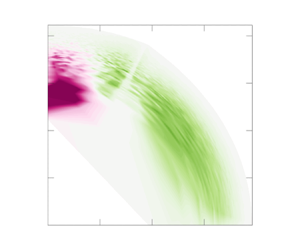
Mode-to-mode nonlinear energy transfer in turbulent channel flows
-
- Journal:
- Journal of Fluid Mechanics / Volume 1002 / 10 January 2025
- Published online by Cambridge University Press:
- 08 January 2025, A42
-
- Article
-
- You have access
- Open access
- HTML
- Export citation
-
We investigate nonlinear energy transfer for channel flows at friction Reynolds numbers $Re_{\tau }=180$ and $590$. The key feature of the analysis is that we quantify the energy transferred from a source mode to a recipient mode, with each mode characterised by a streamwise wavenumber and a spanwise wavenumber. This is achieved through an explicit examination of the triadic interactions of the nonlinear energy transfer term in the spectral turbulent kinetic energy equation. First, we quantify the nonlinear energy transfer gain and loss for individual Fourier modes. The gain and loss cannot be obtained without expanding the nonlinear triadic interactions. Second, we quantify the nonlinear energy transfer budgets for three types of modes. Each type of mode is characterised by a specific region in streamwise–spanwise wavenumber space. We find that a transverse cascade from streamwise-elongated modes to spanwise-elongated modes exists for all three types of modes. Third, we quantify the forward and inverse cascades between resolved scales and subgrid scales in the spirit of large-eddy simulations. For the cutoff wavelength range that we consider, the forward and inverse cascades between the resolved scales and subgrid scales result in a net forward cascade from the resolved scales to the subgrid scales. The shape of the net forward cascade curve with respect to the cutoff wavelength resembles the net forward cascade predicted by the Smagorinsky eddy viscosity.


Forecasting Arctic sea-ice drift: insights from two case studies
- Part of
-
- Journal:
- Annals of Glaciology / Volume 66 / 2025
- Published online by Cambridge University Press:
- 08 January 2025, e7
-
- Article
-
- You have access
- Open access
- HTML
- Export citation
Scalable data assimilation with message passing
- Part of
-
- Journal:
- Environmental Data Science / Volume 4 / 2025
- Published online by Cambridge University Press:
- 08 January 2025, e1
-
- Article
-
- You have access
- Open access
- HTML
- Export citation
Morphological traits and spatial distribution of azooxanthellate corals of Rhizangiidae in the Laccadive Sea
-
- Journal:
- Journal of the Marine Biological Association of the United Kingdom / Volume 104 / 2024
- Published online by Cambridge University Press:
- 07 January 2025, e124
-
- Article
- Export citation
Unveiling a new species of Trapania (Gastropoda: Nudibranchia: Goniodorididae) from the South-eastern Pacific using anatomical and molecular tools
-
- Journal:
- Journal of the Marine Biological Association of the United Kingdom / Volume 104 / 2024
- Published online by Cambridge University Press:
- 07 January 2025, e121
-
- Article
-
- You have access
- Open access
- HTML
- Export citation
A new record of the nudibranch Halgerda batangas from Vietnam confirmed by DNA barcoding
-
- Journal:
- Journal of the Marine Biological Association of the United Kingdom / Volume 104 / 2024
- Published online by Cambridge University Press:
- 07 January 2025, e120
-
- Article
- Export citation
Restricted Euler dynamics in free-surface turbulence
-
- Journal:
- Journal of Fluid Mechanics / Volume 1002 / 10 January 2025
- Published online by Cambridge University Press:
- 07 January 2025, A38
-
- Article
-
- You have access
- Open access
- HTML
- Export citation
A pilot tagging study of yellownose skate (Dipturus chilensis) and roughskin skate (Dipturus trachyderma) off southern Chile
-
- Journal:
- Journal of the Marine Biological Association of the United Kingdom / Volume 104 / 2024
- Published online by Cambridge University Press:
- 07 January 2025, e123
-
- Article
- Export citation
First record of the giant anemone, Relicanthus daphneae, at active hydrothermal vent fields in the Indian Ocean
-
- Journal:
- Journal of the Marine Biological Association of the United Kingdom / Volume 104 / 2024
- Published online by Cambridge University Press:
- 07 January 2025, e122
-
- Article
-
- You have access
- Open access
- HTML
- Export citation
Scaling and dynamics of vortex lock-in for circular cylinders in an oscillating flow
-
- Journal:
- Journal of Fluid Mechanics / Volume 1002 / 10 January 2025
- Published online by Cambridge University Press:
- 07 January 2025, A37
-
- Article
-
- You have access
- Open access
- HTML
- Export citation
-
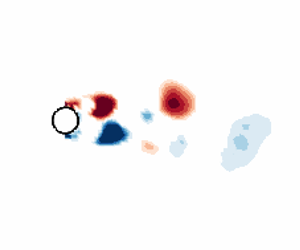
The concept of vortex lock-in for a single circular cylinder in an oscillating flow, induced through acoustic forcing, is revisited. Multiple cylinder diameters are investigated over a Reynolds number range between 500 and 7200. The lock-in behaviour is investigated quantitatively through hot-wire anemometry and planar particle image velocimetry measurements. The results corroborate previous findings describing the frequency range over which vortex lock-in occurs. It is found that the cylinder location in a standing wave (pressure node or velocity node) had a significant influence on the lock-in behaviour. A novel scaling which captures the onset of vortex lock-in is proposed which demonstrates that the Strouhal number is important in predicting the amplitude of the velocity fluctuations required to induce lock-in. Velocity fields also reveal the existence of bimodal vortex shedding during lock-in. This is confirmed using snapshot proper orthogonal decomposition which demonstrates that symmetric and alternate shedding modes are simultaneously present during lock-in and that symmetric shedding is inherent to the near wake region only. Reduced-order reconstruction of the instantaneous velocity fields confirmed that features associated with the forcing frequency control the shear layer roll-up up to $x/d=2.1$ while the influence of the asymmetric mode is simply to skew the trajectory of the vortex pair. Since vortex roll-up and the cylinder wake ends at $x/d=2.1$, the emergence of spectral content at $0.5f_e$ is attributed to a wavelength doubling measured between the vortical structures in the flow field.


Bruce Velde (1938–2024)
-
- Journal:
- Clays and Clay Minerals / Volume 73 / 2025
- Published online by Cambridge University Press:
- 07 January 2025, e1
-
- Article
-
- You have access
- HTML
- Export citation
Multimodal learning–based reconstruction of high-resolution spatial wind speed fields
- Part of
-
- Journal:
- Environmental Data Science / Volume 4 / 2025
- Published online by Cambridge University Press:
- 07 January 2025, e2
-
- Article
-
- You have access
- Open access
- HTML
- Export citation
Dynamics-preserving compression for modal flow analysis
-
- Journal:
- Journal of Fluid Mechanics / Volume 1001 / 25 December 2024
- Published online by Cambridge University Press:
- 06 January 2025, A48
-
- Article
-
- You have access
- Open access
- HTML
- Export citation
Direct statistical simulation using generalised cumulant expansions
-
- Journal:
- Journal of Fluid Mechanics / Volume 1001 / 25 December 2024
- Published online by Cambridge University Press:
- 06 January 2025, A44
-
- Article
-
- You have access
- Open access
- HTML
- Export citation
-
In recent years, the generalised quasilinear (GQL) approximation has been developed and its efficacy tested against purely quasilinear (QL) approximations. GQL systematically interpolates between QL and fully nonlinear dynamics by employing a generalised Reynolds decomposition. Here, we examine an exact statistical closure for the GQL equations on the doubly periodic $\beta$-plane. Closure is achieved at second order using a generalised cumulant approach which we term GCE2. GCE2 is shown to yield improved performance over statistical representations of purely QL dynamics (CE2) and thus enables direct statistical simulation of complex mean flows that do not entirely fall within the remit of pure QL theory. Despite the existence of an exact closure, GCE2 like CE2 admits the possibility of a rank instability that leads to differences with statistics obtained from GQL. Recognition of this instability is a necessary step before further progress can be made with the GCE2 statistical closure.

