To save content items to your account,
please confirm that you agree to abide by our usage policies.
If this is the first time you use this feature, you will be asked to authorise Cambridge Core to connect with your account.
Find out more about saving content to .
To save content items to your Kindle, first ensure no-reply@cambridge.org
is added to your Approved Personal Document E-mail List under your Personal Document Settings
on the Manage Your Content and Devices page of your Amazon account. Then enter the ‘name’ part
of your Kindle email address below.
Find out more about saving to your Kindle.
Note you can select to save to either the @free.kindle.com or @kindle.com variations.
‘@free.kindle.com’ emails are free but can only be saved to your device when it is connected to wi-fi.
‘@kindle.com’ emails can be delivered even when you are not connected to wi-fi, but note that service fees apply.
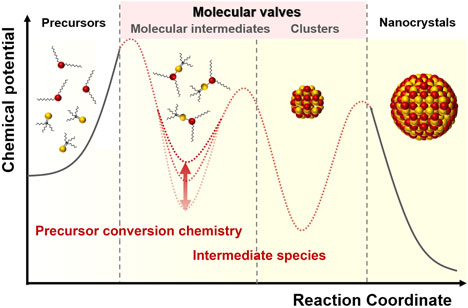
The ability to manipulate matter on the nanometer length scale is an important scientific goal, and the progress in the field of colloidal nanocrystal (NC) growth in the past decades has opened avenue for controlled synthesis of nanoscale materials with many unique physical properties that could enhance existing technologies or give rise to entirely new technologic applications. At the center of the progress is ever-increasing understanding on molecular interactions within colloidal synthesis, in which nucleation and growth each plays a critical role in the control of size, shape, morphology, and structure of NCs. Semiconductor NCs in quantum confinement regime, referred to as quantum dots (QDs), highlight the importance of such control over geometric parameters, since QDs exhibit size- and shape-dependent optical properties. In this paper, we demonstrate important aspects that govern QDs growth in the context of (i) precursor conversion chemistry, and (ii) intermediate species including molecular complex and clusters. Advances in understanding the growth chemistry of QDs have proved the significance of how precursors decompose and produce intermediate species. We review recent progress in regards to the synthetic chemistry of colloidal QDs and discuss our perspective on challenges and promises in the controlled large-scale synthesis of QDs.
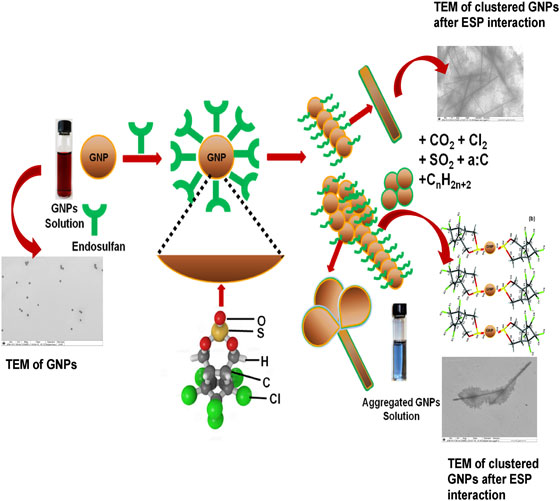
Gold nanoparticles (GNPs) of ~8 nm in diameter were used for the detection of organochlorine endosulfan pesticide (ESP) as colorimetric sensor and the design of GNP-based chemical sensor for its quantitative estimation has also been proposed. The original wine red color of GNPs changes into various shades of blue after the addition of different concentrations of ESP solutions. A GNP-based sensing electrode has been used for designing of ESP detection chemical sensor at ambient temperature. The response and sensitivity of ESP sensor parameters are obtained from their recovery curves of the change in resistance versus time.
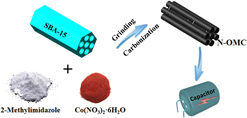
N-doped ordered mesoporous carbon (N-OMC) has been one of the most promising choices as the electrode for supercapacitors due to its large surface area and uniform mesoporous structure. However, there is still a big challenge to prepare N-OMC using a relatively simple method. Here, a straightforward preparation of N-OMC was reported in which the precursor zeoliticimidazolate framework was in situ grown in the SBA-15 template by a fast, solvent-free, and atom economic solid–solid grinding strategy. After pyrolysis and removing of the template, the N-OMC was obtained with ordered mesoporous structure, rich oxygen and nitrogen, and a large specific surface area of 1004 m2/g. As the electrode material for supercapacitors, N-OMC displayed an excellent specific capacitance of 228 F/g at 0.2 A/g and superb charge/discharge cycling stability, which is promising for high-performance energy storage. This solid–solid grinding strategy may offer a low-cost and scalable method to produce high-performance N-OMC for the electrode from the zeoliticimidazolate framework.
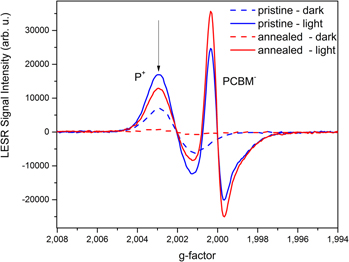
We investigate the photostability of a set of organic semiconductor blends comprising a conjugated polymer as the donor and a fullerene as the acceptor using electron spin resonance (ESR). In the absence of oxygen, all blends show excellent stability. Even after several hundred hours of exposure to solar or UV radiation, the ESR spectra and the recombination of photoinduced charges recorded at low temperature are found to be unchanged. By contrast, the presence of oxygen leads to a fast light-induced degradation rendering the ability of the donor/acceptor system to form photoinduced charge carriers. Our findings suggest that conjugated polymer–fullerene blends exhibit very good photostability and that oxygen needs to be excluded in optoelectronic applications. Our findings also suggest that at low temperature, a universal recombination process of long-lived photoinduced charges is active, which does not depend on the electronic structure or the morphology of the investigated materials.
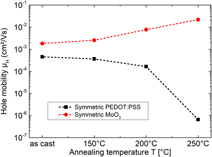
Thin hole transport layers are important elements in organic semiconductor-based devices. Metal oxides are an encouraging material class for this purpose, as they may provide sufficient hole conduction in combination with excellent electron blocking properties. Both, long-term device stability, which may often be limited by the thermal stability of interfaces, and higher temperature processing steps, benefit strongly from the existence of thermally stable metal oxide interlayers. Provided that thermally stable electrodes can be fashioned, the stability of organic active layers—for example, in organic field effect transistors, light emitting diodes, or photovoltaic (OPV) devices can be investigated. Here, we apply this concept and report about the study of hole mobility (µh) in single-carrier-hole-only devices in dependence of thermal annealing up to the above the actual melting temperature of regio-regular poly(3-hexylthiophene-2,5-diyl) (P3HT).
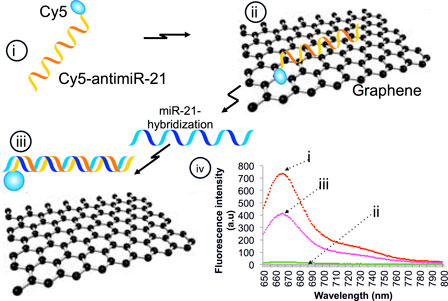
Nanomaterials have been proposed as key components in biosensing, imaging, and drug delivery since they offer distinctive advantages over conventional approaches. The unique chemical and physical properties of graphene make it possible to functionalize and develop protein transducers, therapeutic delivery vehicles, and microbial diagnostics. In this study, we evaluate reduced graphene oxide as a potential nanomaterial for quantification of microRNAs including their structural differentiation in vitro in solution and inside intact cells. Our results provide evidence for the potential use of graphene nanomaterials as a platform for developing devices that can be used for microRNA quantitation as biomarkers for clinical applications.
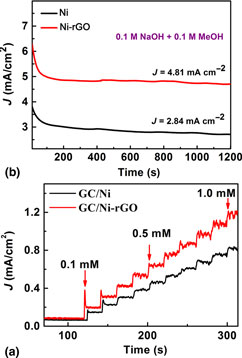
Metal–graphene composites are sought after for various applications. A hybrid light-weight foam of nickel (Ni) and reduced graphene oxide (rGO), called Ni-rGO, is reported here for small molecule oxidations and thereby their sensing. Methanol oxidation and non-enzymatic glucose sensing are attempted with the Ni-rGO foam via electrocatalytically, and an enhanced methanol oxidation current density of 4.81 mA/cm2 is achieved, which is ~1.7 times higher than that of bare Ni foam. In glucose oxidation, the Ni-rGO electrode shows a better sensitivity over bare Ni foam electrode where it could detect glucose linearly over a concentration range of 10 µM to 4.5 mM with a very low detection limit of 3.6 µM. This work demonstrates the synergistic effects of metal and graphene in oxidative processes, and also shows the feasibility of scalable metal–graphene composite inks development for small molecule printable sensors and fuel cell catalysts.
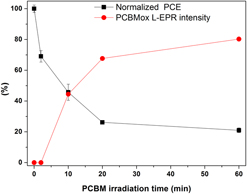
Fullerene derivatives have been ubiquitous as an electron-accepting material in organic photovoltaic solar cells (OSCs). We consider whether and why traces of PCBM oxidation products should be seen as electronic defects impairing the performance of OSCs. Thin PCBM deposits were first illuminated under ambient air for a few minutes, thus revealing the extraordinary easiness of oxidizing PCBM. The charge transfer in polymer:PCBMox bulk heterojunctions was then studied. As a result of a few minutes of PCBM photooxidation, the electron transfer from the polymer to two types of PCBMox species was shown to occur at the expense of the transfer to pristine PCBM. Such modifications to the molecular structure of PCBM and to the charge transfer at the nanoscale were finally correlated with a dramatic loss in the device’s photovoltaic performance at the macroscale. This study clearly indicates the need to integrate photooxidation-resistant electron-accepting materials into OSCs to extend their lifetime.
Contamination by bacterial biofilms has a strong negative impact, especially on the surface of prostheses, implants, pins, and other medical-surgical devices. To prevent their formation, one of the alternatives is the modification of the metal surface incorporating silver by low-energy ion implantation, thus avoiding initial bacteria adhesion to the modified surface and further development of the biofilm. The bactericidal properties of silver atoms incorporated on commercially pure titanium surfaces by low-energy ion implantation (4 keV) were evaluated. The surface modifications were analyzed by Rutherford backscattering spectrometry, glow discharge-optical emission spectroscopy, contact angle measure, optical profilometry, and X-ray photoelectron spectroscopy. The microbiological assays were conducted by using Escherichia coli (E. coli). The results demonstrated a reduction on bacterial counting. No toxic effect of silver was detected on human MG-63 cells. The choice of parameters to obtain a bactericidal and nontoxic biomaterial for human cells should consider the ideal combination “energy + silver concentration”. Therefore, it can be considered for industrial application.
A computational model for the evaluation of the thermomechanical effects that give rise to the catastrophic optical damage of laser diodes has been devised. The model traces the progressive deterioration of the device running in continuous wave conditions. The local heating of the active layer locally leads to the onset of the plastic regime. As a result, dislocations and threads of dislocations grow across the active layers and lead to rapidly growing temperatures in the quantum well. The poor power dissipation under these conditions has been identified as the key factor driving the final degradation of the laser.
Low-cost, earth-abundant magnetocaloric materials (MCMs) are required for energy-efficient, green, and affordable magnetic cooling technology. We investigated the magnetic and magnetocaloric properties of rare-earth-free Fe75−xCrxAl25 (19≤x≤25) arc-melted alloys. The Curie temperature (Tc) of these alloys could be tuned from 220 K up to room temperature by Cr additions. The relative cooling power/US$ was found to be superior to other promising MCMs. Fe50Cr25Al25 ball-milled powders, with an average particle size of ~25 nm, were used to prepare magnetic fluid. Maximum cooling (ΔT) of 5.4°C was observed for Fe50Cr25Al25-based fluids.
The Fe–18.6% Ga alloy (at.%) has a high magnetostriction and an excellent piezomagnetic (PZM) property. However, Fe–Ga has a poor ductility and the addition of B helps to improve this property. The magnetostriction of the Fe–Ga alloy is not appreciably improved by the addition of B; however, the PZM behavior of Fe–Ga–B is unknown up to now. Then, an Fe–Ga alloy with 2% of B was produced to evaluate the effect of boron addition on the PZM property of the Fe–Ga alloy. The PZM force sensing performance coefficient d33* decreased, but the maximum sensitivity is reached for a fixed magnetic field. In addition, d33* values are among 2 and 5 mT/MPa, which is sufficient for many applications. A better ductility compared to Fe–Ga and a good sensitivity at constant field, makes the alloy Fe–Ga–B a good candidate for application as force sensors up to stresses of 80 MPa.
7-Decyl-2-phenyl[1]benzothieno[3,2-b][1]benzothiophene (Ph-BTBT-C10) is a soluble organic semiconductor that can afford high mobility organic thin-film transistors (OTFTs). The material exhibits inherent high layered crystallinity due to the formation of bilayer-type layered-herringbone packing that involves nearly independent π-electron core layers and alkyl-chain layers within the crystals. Here, we discuss that the bottom-gate/top-contact OTFTs composed of single-crystalline Ph-BTBT-C10 channel layers exhibit noticeable effects in the device characteristics caused by the highly insulating nature of the alkyl-chain layers. Notable layer-number (n) dependence was observed in the nonlinear current–voltage characteristics and the device mobility (2–14 cm2/Vs, with TFT ideality factor 15–46%, mainly due to large threshold voltages), which can be clearly ascribed to the tunneling-based interlayer access resistance across the alkyl-chain layers. The gated-four-probe measurements of single-crystalline OTFTs also revealed quite high mobility more than 40 cm2/Vs along the channel semiconducting layer, whereas highly insulating effects due to the alkyl-chain layers were also apparent as the large hysteresis in the gate-off states of OTFTs. We discuss the whole features of the tunneling-based access resistance in the device operations of single-crystalline OTFTs, on the basis of comparison between experimental results and model simulations.
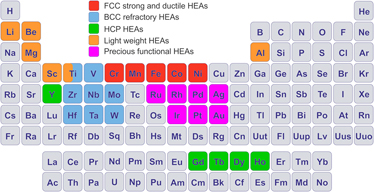
As high-entropy alloys (HEAs) are being actively explored for next-generation structural materials, gaining a comprehensive understanding of their creep, fatigue, and fracture behaviors is indispensable. These three aspects of mechanical properties are particularly important because (i) creep resistance dictates an alloy’s high-temperature applications; (ii) fatigue failure is the most frequently encountered failure mode in the service life of a material; (iii) fracture is the very last step that a material loses its load-carrying capability. In consideration of their importance in designing HEAs toward applicable structural materials, this article offers a comprehensive review on what has been accomplished so far in these three topics. The sub-topics covered include a comparison of different creep testing methods, creep-parameter extraction, creep mechanism, high-cycle fatigue S–N relation, fatigue-crack-growth behavior, fracture toughness, fracture under different loading conditions, and fractography. Directions for future efforts are suggested in the end.
Room-temperature liquid metals, such as eutectic gallium–indium–tin (galinstan), dispersed in a polymer matrix present unique potential as conductors that may have minimal influence on the host polymer mechanical performance while providing enhanced electrical performance. Work described herein systematically evaluates the influence of uncured polydimethylsiloxane (PDMS) viscosity and galinstan loading on final dispersion viscosity and cured modulus. Dispersions of up to 80 vol% galinstan were obtained with relative permittivity values up to 170 that otherwise exhibited similar uncured rheological changes to a solid filler. Cured galinstan-in-PDMS dispersions, however, exhibited a reduced stiffness increase with respect to the host polymer relative to a solid filler. At a critical PDMS viscosity and metal, loading phase inversion to a conductive PDMS-in-metal dispersion was observed. It is anticipated that this work will enable the development of liquid metal polymer composites with independently controlled mechanical and electrical properties for a wide variety of stretchable electronic applications.
Using time-resolved laser-scanning confocal microscopy and ultrafast optical pump/THz probe spectroscopy, we measure photoluminescence (PL) and THz-conductivity in perovskite micro-crystals and films. PL quenching and lifetime variations occur from local heterogeneity. Ultrafast THz-spectra measure sharp quantum transitions from excitonic Rydberg states, providing weakly bound excitons with a binding energy of ~13.5 meV at low temperatures. Ab-initio electronic structure calculations give a direct band gap of 1.64 eV, a dielectric constant of ~18, heavy electrons, and light holes, resulting in weakly bound excitons, consistent with the binding energies from the experiment. The complementary spectroscopy and simulations reveal fundamental insights into perovskite light-matter interactions.