Refine search
Actions for selected content:
26076 results in Abstract analysis
1 - Introduction
-
- Book:
- Eigenvalues, Multiplicities and Graphs
- Published online:
- 09 February 2018
- Print publication:
- 12 February 2018, pp 10-15
-
- Chapter
- Export citation
9 - Double Generalized Stars
-
- Book:
- Eigenvalues, Multiplicities and Graphs
- Published online:
- 09 February 2018
- Print publication:
- 12 February 2018, pp 186-199
-
- Chapter
- Export citation
Eigenvalues, Multiplicities and Graphs
-
- Published online:
- 09 February 2018
- Print publication:
- 12 February 2018
Free and Properly Discontinuous Actions of Groups on Homotopy 2n-spheres
- Part of
-
- Journal:
- Proceedings of the Edinburgh Mathematical Society / Volume 61 / Issue 2 / May 2018
- Published online by Cambridge University Press:
- 08 February 2018, pp. 305-327
-
- Article
- Export citation
On the Quantitative Metric Theory of Continued Fractions in Positive Characteristic
- Part of
-
- Journal:
- Proceedings of the Edinburgh Mathematical Society / Volume 61 / Issue 1 / February 2018
- Published online by Cambridge University Press:
- 07 February 2018, pp. 283-293
-
- Article
-
- You have access
- Open access
- Export citation
-
Let 𝔽q be the finite field of q elements. An analogue of the regular continued fraction expansion for an element α in the field of formal Laurent series over 𝔽q is given uniquely by
where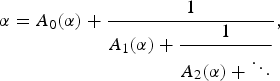 $$\alpha = A_0(\alpha ) + \displaystyle{1 \over {A_1(\alpha ) + \displaystyle{1 \over {A_2(\alpha ) + \ddots }}}},$$ $(A_{n}(\alpha))_{n=0}^{\infty}$ is a sequence of polynomials with coefficients in 𝔽q such that deg(A n (α)) ⩾1 for all n ⩾ 1. In this paper, we provide quantitative versions of metrical results regarding averages of partial quotients. A sample result we prove is that, given any ϵ > 0, we havefor almost everywhere α with respect to Haar measure.
 $$\vert A_1(\alpha ) \ldots A_N(\alpha )\vert ^{1/N} = q^{q/(q - 1)} + o(N^{ - 1/2}(\log N)^{3/2 + {\rm \epsilon }})$$

Spreading in kinetic reaction–transport equations in higher velocity dimensions
-
- Journal:
- European Journal of Applied Mathematics / Volume 30 / Issue 2 / April 2019
- Published online by Cambridge University Press:
- 07 February 2018, pp. 219-247
-
- Article
- Export citation
FRAME-LESS HILBERT C*-MODULES
- Part of
-
- Journal:
- Glasgow Mathematical Journal / Volume 61 / Issue 1 / January 2019
- Published online by Cambridge University Press:
- 07 February 2018, pp. 25-31
-
- Article
-
- You have access
- Export citation
-
We show that if A is a compact C*-algebra without identity that has a faithful *-representation in the C*-algebra of all compact operators on a separable Hilbert space and its multiplier algebra admits a minimal central projection p such that pA is infinite-dimensional, then there exists a Hilbert A1-module admitting no frames, where A1 is the unitization of A. In particular, there exists a frame-less Hilbert C*-module over the C*-algebra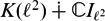 $K(\ell^2) \dotplus \mathbb{C}I_{\ell^2}$.
DISTORTION IN THE FINITE DETERMINATION RESULT FOR EMBEDDINGS OF LOCALLY FINITE METRIC SPACES INTO BANACH SPACES
- Part of
-
- Journal:
- Glasgow Mathematical Journal / Volume 61 / Issue 1 / January 2019
- Published online by Cambridge University Press:
- 06 February 2018, pp. 33-47
-
- Article
-
- You have access
- Export citation
Homogenization of a non-stationary non-Newtonian flow in a porous medium containing a thin fissure
-
- Journal:
- European Journal of Applied Mathematics / Volume 30 / Issue 2 / April 2019
- Published online by Cambridge University Press:
- 05 February 2018, pp. 248-277
-
- Article
- Export citation
-
We consider a non-stationary incompressible non-Newtonian Stokes system in a porous medium with characteristic size of the pores ϵ and containing a thin fissure of width ηϵ. The viscosity is supposed to obey the power law with flow index $\frac{5}{3}\leq q\leq 2$. The limit when size of the pores tends to zero gives the homogenized behaviour of the flow. We obtain three different models depending on the magnitude ηϵ with respect to ϵ: if ηϵ ≪ $\varepsilon^{q\over 2q-1}$ the homogenized fluid flow is governed by a time-dependent non-linear Darcy law, while if ηϵ ≫ $\varepsilon^{q\over 2q-1}$ is governed by a time-dependent non-linear Reynolds problem. In the critical case, ηϵ ≈ $\varepsilon^{q\over 2q-1}$, the flow is described by a time-dependent non-linear Darcy law coupled with a time-dependent non-linear Reynolds problem.


Leibniz Rule on Higher Pages of Unstable Spectral Sequences
- Part of
-
- Journal:
- Proceedings of the Edinburgh Mathematical Society / Volume 61 / Issue 1 / February 2018
- Published online by Cambridge University Press:
- 01 February 2018, pp. 265-282
-
- Article
- Export citation
Maximal Ideals in Some Spaces of Bounded Linear Operators
- Part of
-
- Journal:
- Proceedings of the Edinburgh Mathematical Society / Volume 61 / Issue 1 / February 2018
- Published online by Cambridge University Press:
- 01 February 2018, pp. 251-264
-
- Article
- Export citation
Visualizing Automorphisms of Graph Algebras
- Part of
-
- Journal:
- Proceedings of the Edinburgh Mathematical Society / Volume 61 / Issue 1 / February 2018
- Published online by Cambridge University Press:
- 01 February 2018, pp. 215-249
-
- Article
- Export citation
Singular perturbations in noisy dynamical systems
-
- Journal:
- European Journal of Applied Mathematics / Volume 29 / Issue 4 / August 2018
- Published online by Cambridge University Press:
- 31 January 2018, pp. 570-593
-
- Article
-
- You have access
- Export citation
On the finite-element approximation of ∞-harmonic functions
- Part of
-
- Journal:
- Proceedings of the Royal Society of Edinburgh. Section A: Mathematics / Volume 148 / Issue 4 / August 2018
- Published online by Cambridge University Press:
- 30 January 2018, pp. 819-834
- Print publication:
- August 2018
-
- Article
- Export citation
EXAMPLE OF A GROUP WHOSE QUANTUM ISOMETRY GROUP DOES NOT DEPEND ON THE GENERATING SET
-
- Journal:
- Glasgow Mathematical Journal / Volume 61 / Issue 1 / January 2019
- Published online by Cambridge University Press:
- 28 January 2018, pp. 1-11
-
- Article
-
- You have access
- Export citation
-
In this paper, we have shown that the quantum isometry group of Cr*(ℤ), denoted by ℚ(ℤ, S) as in Goswami and Mandal, Rev. Math. Phys.29(3) (2017), 1750008, with respect to a symmetric generating set S does not depend on the generating set S. Moreover, we have proved that the result is no longer true if the group ℤ is replaced by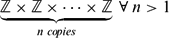 $\underbrace{\mathbb{Z} \times \mathbb{Z} \times\cdots \times \mathbb{Z}}_{n \ copies} \ \forall \ n>1$.
ON SMOOTHNESS OF MINIMAL MODELS OF QUOTIENT SINGULARITIES BY FINITE SUBGROUPS OF SLn(ℂ)
-
- Journal:
- Glasgow Mathematical Journal / Volume 60 / Issue 3 / September 2018
- Published online by Cambridge University Press:
- 28 January 2018, pp. 603-634
-
- Article
-
- You have access
- Export citation
VANISHING THEOREMS FOR HYPERSURFACES IN THE UNIT SPHERE
- Part of
-
- Journal:
- Glasgow Mathematical Journal / Volume 60 / Issue 3 / September 2018
- Published online by Cambridge University Press:
- 28 January 2018, pp. 661-671
-
- Article
-
- You have access
- Export citation
-
Let Mn, n ≥ 3, be a complete hypersurface in $\mathbb{S}$n+1. When Mn is compact, we show that Mn is a homology sphere if the squared norm of its traceless second fundamental form is less than $\frac{2(n-1)}{n}$. When Mn is non-compact, we show that there are no non-trivial L2 harmonic p-forms, 1 ≤ p ≤ n − 1, on Mn under pointwise condition. We also show the non-existence of L2 harmonic 1-forms on Mn provided that Mn is minimal and $\frac{n-1}{n}$-stable. This implies that Mn has only one end. Finally, we prove that there exists an explicit positive constant C such that if the total curvature of Mn is less than C, then there are no non-trivial L2 harmonic p-forms on Mn for all 1 ≤ p ≤ n − 1.


GENERALIZED HARDY–CESÀRO OPERATORS BETWEEN WEIGHTED SPACES
- Part of
-
- Journal:
- Glasgow Mathematical Journal / Volume 61 / Issue 1 / January 2019
- Published online by Cambridge University Press:
- 28 January 2018, pp. 13-24
-
- Article
-
- You have access
- Export citation
-
We characterize those non-negative, measurable functions ψ on [0, 1] and positive, continuous functions ω1 and ω2 on ℝ+ for which the generalized Hardy–Cesàro operator
defines a bounded operator Uψ: L1(ω1) → L1(ω2) This generalizes a result of Xiao [7] to weighted spaces. Furthermore, we extend Uψ to a bounded operator on M(ω1) with range in L1(ω2) ⊕ ℂδ0, where M(ω1) is the weighted space of locally finite, complex Borel measures on ℝ+. Finally, we show that the zero operator is the only weakly compact generalized Hardy–Cesàro operator from L1(ω1) to L1(ω2).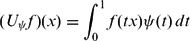 $$\begin{equation*}(U_{\psi}f)(x)=\int_0^1 f(tx)\psi(t)\,dt\end{equation*}$$
POTENTIALS OF A FROBENIUS-LIKE STRUCTURE
- Part of
-
- Journal:
- Glasgow Mathematical Journal / Volume 60 / Issue 3 / September 2018
- Published online by Cambridge University Press:
- 28 January 2018, pp. 681-693
-
- Article
-
- You have access
- Export citation
FREE ACTION OF FINITE GROUPS ON SPACES OF COHOMOLOGY TYPE (0, b)
- Part of
-
- Journal:
- Glasgow Mathematical Journal / Volume 60 / Issue 3 / September 2018
- Published online by Cambridge University Press:
- 28 January 2018, pp. 673-680
-
- Article
-
- You have access
- Export citation
-
Let G be a finite group acting freely on a finitistic space X having cohomology type (0, b) (for example, $\mathbb S$n × $\mathbb S$2n is a space of type (0, 1) and the one-point union $\mathbb S$n ∨ $\mathbb S$2n ∨ $\mathbb S$3n is a space of type (0, 0)). It is known that a finite group G that contains ℤp ⊕ ℤp ⊕ ℤp, p a prime, cannot act freely on $\mathbb S$n × $\mathbb S$2n. In this paper, we show that if a finite group G acts freely on a space of type (0, 1), where n is odd, then G cannot contain ℤp ⊕ ℤp, p an odd prime. For spaces of cohomology type (0, 0), we show that every p-subgroup of G is either cyclic or a generalized quaternion group. Moreover, for n even, it is shown that ℤ2 is the only group that can act freely on X.

