Refine search
Actions for selected content:
26077 results in Abstract analysis
A NOTE ON THE CONNECTEDNESS OF THE BRANCH LOCUS OF RATIONAL MAPS
-
- Journal:
- Glasgow Mathematical Journal / Volume 60 / Issue 1 / January 2018
- Published online by Cambridge University Press:
- 20 March 2017, pp. 199-207
-
- Article
-
- You have access
- Export citation
-
Milnor proved that the moduli space Md of rational maps of degree d ≥ 2 has a complex orbifold structure of dimension 2(d − 1). Let us denote by ${\mathcal S}$ d the singular locus of Md and by ${\mathcal B}$ d the branch locus, that is, the equivalence classes of rational maps with non-trivial holomorphic automorphisms. Milnor observed that we may identify M2 with ℂ2 and, within that identification, that ${\mathcal B}$ 2 is a cubic curve; so ${\mathcal B}$ 2 is connected and ${\mathcal S}$ 2 = ∅. If d ≥ 3, then it is well known that ${\mathcal S}$ d = ${\mathcal B}$ d . In this paper, we use simple arguments to prove the connectivity of ${\mathcal S}$ d .


Three periodic solutions for discontinuous perturbations of the vector p-Laplacian operator
- Part of
-
- Journal:
- Proceedings of the Royal Society of Edinburgh. Section A: Mathematics / Volume 147 / Issue 4 / August 2017
- Published online by Cambridge University Press:
- 20 March 2017, pp. 673-681
- Print publication:
- August 2017
-
- Article
- Export citation
-
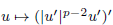
Using a variational approach we obtain the existence of at least three periodic solutions for discontinuous perturbations of the vector p-Laplacian operator
 .
.
 .
.NON-NEGATIVE DEFORMATIONS OF WEIGHTED HOMOGENEOUS SINGULARITIES
-
- Journal:
- Glasgow Mathematical Journal / Volume 60 / Issue 1 / January 2018
- Published online by Cambridge University Press:
- 20 March 2017, pp. 175-185
-
- Article
-
- You have access
- Export citation
DEGREE CONES AND MONOMIAL BASES OF LIE ALGEBRAS AND QUANTUM GROUPS
-
- Journal:
- Glasgow Mathematical Journal / Volume 59 / Issue 3 / September 2017
- Published online by Cambridge University Press:
- 20 March 2017, pp. 595-621
-
- Article
-
- You have access
- Export citation
-
We provide ℕ-filtrations on the negative part Uq ( $\mathfrak{n}$ −) of the quantum group associated to a finite-dimensional simple Lie algebra $\mathfrak{g}$ , such that the associated graded algebra is a skew-polynomial algebra on $\mathfrak{n}$ −. The filtration is obtained by assigning degrees to Lusztig's quantum PBW root vectors. The possible degrees can be described as lattice points in certain polyhedral cones. In the classical limit, such a degree induces an ℕ-filtration on any finite-dimensional simple $\mathfrak{g}$ -module. We prove for type An, Cn, B3, D4 and G2 that a degree can be chosen such that the associated graded modules are defined by monomial ideals, and conjecture that this is true for any $\mathfrak{g}$ .


ON SERRE MICROFIBRATIONS AND A LEMMA OF M. WEISS
-
- Journal:
- Glasgow Mathematical Journal / Volume 59 / Issue 3 / September 2017
- Published online by Cambridge University Press:
- 20 March 2017, pp. 649-657
-
- Article
-
- You have access
- Export citation
AN EFFECTIVE BOUND FOR THE CYCLOTOMIC LOXTON–KEDLAYA RANK
-
- Journal:
- Glasgow Mathematical Journal / Volume 60 / Issue 1 / January 2018
- Published online by Cambridge University Press:
- 20 March 2017, pp. 97-110
-
- Article
-
- You have access
- Export citation
Surprise Probabilities in Markov Chains
- Part of
-
- Journal:
- Combinatorics, Probability and Computing / Volume 26 / Issue 4 / July 2017
- Published online by Cambridge University Press:
- 16 March 2017, pp. 603-627
-
- Article
- Export citation
-
In a Markov chain started at a state x, the hitting time τ(y) is the first time that the chain reaches another state y. We study the probability $\mathbb{P}_x(\tau(y) = t)$ that the first visit to y occurs precisely at a given time t. Informally speaking, the event that a new state is visited at a large time t may be considered a ‘surprise’. We prove the following three bounds.
-
• In any Markov chain with n states, $\mathbb{P}_x(\tau(y) = t) \le {n}/{t}$ .
 -
• In a reversible chain with n states, $\mathbb{P}_x(\tau(y) = t) \le {\sqrt{2n}}/{t}$ for $t \ge 4n + 4$ .
 -
• For random walk on a simple graph with n ≥ 2 vertices, $\mathbb{P}_x(\tau(y) = t) \le 4e \log(n)/t$ .
To prove the bound for random walk on graphs, we establish the following estimate conjectured by Aldous, Ding and Oveis-Gharan (private communication): for random walk on an n-vertex graph, for every initial vertex x,
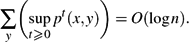 $$\sum_y \biggl( \sup_{t \ge 0} p^t(x, y) \biggr) = O(\log n). $$
 -

Size estimates of unknown boundaries with a Robin-type condition
- Part of
-
- Journal:
- Proceedings of the Royal Society of Edinburgh. Section A: Mathematics / Volume 147 / Issue 4 / August 2017
- Published online by Cambridge University Press:
- 16 March 2017, pp. 727-741
- Print publication:
- August 2017
-
- Article
- Export citation
Numerical Ranges in II1 Factors
- Part of
-
- Journal:
- Proceedings of the Edinburgh Mathematical Society / Volume 61 / Issue 1 / February 2018
- Published online by Cambridge University Press:
- 16 March 2017, pp. 31-55
-
- Article
- Export citation
Rational Conjugacy of Torsion Units in Integral Group Rings of Non-Solvable Groups
- Part of
-
- Journal:
- Proceedings of the Edinburgh Mathematical Society / Volume 60 / Issue 4 / November 2017
- Published online by Cambridge University Press:
- 16 March 2017, pp. 813-830
-
- Article
- Export citation
Congruences concerning truncated hypergeometric series
- Part of
-
- Journal:
- Proceedings of the Royal Society of Edinburgh. Section A: Mathematics / Volume 147 / Issue 3 / June 2017
- Published online by Cambridge University Press:
- 16 March 2017, pp. 599-613
- Print publication:
- June 2017
-
- Article
- Export citation
Initial–boundary-value problems for one-dimensional compressible Navier–Stokes equations with degenerate transport coefficients
- Part of
-
- Journal:
- Proceedings of the Royal Society of Edinburgh. Section A: Mathematics / Volume 147 / Issue 5 / October 2017
- Published online by Cambridge University Press:
- 16 March 2017, pp. 935-969
- Print publication:
- October 2017
-
- Article
- Export citation
The Applications of Critical-Point Theory to Discontinuous Fractional-Order Differential Equations
- Part of
-
- Journal:
- Proceedings of the Edinburgh Mathematical Society / Volume 60 / Issue 4 / November 2017
- Published online by Cambridge University Press:
- 16 March 2017, pp. 1021-1051
-
- Article
- Export citation
Well-posedness of two-dimensional hydroelastic waves
- Part of
-
- Journal:
- Proceedings of the Royal Society of Edinburgh. Section A: Mathematics / Volume 147 / Issue 3 / June 2017
- Published online by Cambridge University Press:
- 16 March 2017, pp. 529-570
- Print publication:
- June 2017
-
- Article
- Export citation
Lotka–Volterra models with fractional diffusion
- Part of
-
- Journal:
- Proceedings of the Royal Society of Edinburgh. Section A: Mathematics / Volume 147 / Issue 3 / June 2017
- Published online by Cambridge University Press:
- 16 March 2017, pp. 505-528
- Print publication:
- June 2017
-
- Article
- Export citation
ASYMPTOTIC BOUNDS FOR THE SIZE OF Hom(A, GLn (q))
- Part of
-
- Journal:
- Glasgow Mathematical Journal / Volume 60 / Issue 1 / January 2018
- Published online by Cambridge University Press:
- 14 March 2017, pp. 51-61
-
- Article
-
- You have access
- Export citation
PURE-INJECTIVITY FROM A DIFFERENT PERSPECTIVE
- Part of
-
- Journal:
- Glasgow Mathematical Journal / Volume 60 / Issue 1 / January 2018
- Published online by Cambridge University Press:
- 14 March 2017, pp. 135-151
-
- Article
-
- You have access
- Export citation
ON THE STANLEY DEPTH AND SIZE OF MONOMIAL IDEALS
- Part of
-
- Journal:
- Glasgow Mathematical Journal / Volume 59 / Issue 3 / September 2017
- Published online by Cambridge University Press:
- 14 March 2017, pp. 705-715
-
- Article
-
- You have access
- Export citation
-
Let $\mathbb{K}$ be a field and S = ${\mathbb{K}}$ [x 1, . . ., xn ] be the polynomial ring in n variables over the field $\mathbb{K}$ . For every monomial ideal I ⊂ S, we provide a recursive formula to determine a lower bound for the Stanley depth of S/I. We use this formula to prove the inequality sdepth(S/I) ≥ size(I) for a particular class of monomial ideals.

FROM COMPLETE TO PARTIAL FLAGS IN GEOMETRIC EXTENSION ALGEBRAS
- Part of
-
- Journal:
- Glasgow Mathematical Journal / Volume 60 / Issue 1 / January 2018
- Published online by Cambridge University Press:
- 13 March 2017, pp. 111-121
-
- Article
-
- You have access
- Export citation
TWO-SIDED ESTIMATES OF THE LEBESGUE CONSTANTS WITH RESPECT TO VILENKIN SYSTEMS AND APPLICATIONS
- Part of
-
- Journal:
- Glasgow Mathematical Journal / Volume 60 / Issue 1 / January 2018
- Published online by Cambridge University Press:
- 13 March 2017, pp. 17-34
-
- Article
-
- You have access
- Export citation
