Refine search
Actions for selected content:
26077 results in Abstract analysis
HOMOGENEOUS SPACE FIBRATIONS OVER SURFACES
- Part of
-
- Journal:
- Journal of the Institute of Mathematics of Jussieu / Volume 18 / Issue 2 / March 2019
- Published online by Cambridge University Press:
- 03 April 2017, pp. 293-327
- Print publication:
- March 2019
-
- Article
- Export citation $L^{p}$-BOUNDS FOR PSEUDO-DIFFERENTIAL OPERATORS ON COMPACT LIE GROUPS
- Part of
-
- Journal:
- Journal of the Institute of Mathematics of Jussieu / Volume 18 / Issue 3 / May 2019
- Published online by Cambridge University Press:
- 03 April 2017, pp. 531-559
- Print publication:
- May 2019
-
- Article
-
- You have access
- Open access
- Export citation
-
Given a compact Lie group $G$, in this paper we establish $L^{p}$-bounds for pseudo-differential operators in $L^{p}(G)$. The criteria here are given in terms of the concept of matrix symbols defined on the noncommutative analogue of the phase space $G\times \widehat{G}$, where $\widehat{G}$ is the unitary dual of $G$. We obtain two different types of $L^{p}$ bounds: first for finite regularity symbols and second for smooth symbols. The conditions for smooth symbols are formulated using $\mathscr{S}_{\unicode[STIX]{x1D70C},\unicode[STIX]{x1D6FF}}^{m}(G)$ classes which are a suitable extension of the well-known $(\unicode[STIX]{x1D70C},\unicode[STIX]{x1D6FF})$ ones on the Euclidean space. The results herein extend classical $L^{p}$ bounds established by C. Fefferman on $\mathbb{R}^{n}$. While Fefferman’s results have immediate consequences on general manifolds for $\unicode[STIX]{x1D70C}>\max \{\unicode[STIX]{x1D6FF},1-\unicode[STIX]{x1D6FF}\}$, our results do not require the condition $\unicode[STIX]{x1D70C}>1-\unicode[STIX]{x1D6FF}$. Moreover, one of our results also does not require $\unicode[STIX]{x1D70C}>\unicode[STIX]{x1D6FF}$. Examples are given for the case of $\text{SU}(2)\cong \mathbb{S}^{3}$ and vector fields/sub-Laplacian operators when operators in the classes $\mathscr{S}_{0,0}^{m}$ and $\mathscr{S}_{\frac{1}{2},0}^{m}$ naturally appear, and where conditions $\unicode[STIX]{x1D70C}>\unicode[STIX]{x1D6FF}$ and $\unicode[STIX]{x1D70C}>1-\unicode[STIX]{x1D6FF}$ fail, respectively.


Degrees of Unsolvability
- Local and Global Theory
-
- Published online:
- 31 March 2017
- Print publication:
- 06 April 2017
K-STABILITY OF FANO MANIFOLDS WITH NOT SMALL ALPHA INVARIANTS
- Part of
-
- Journal:
- Journal of the Institute of Mathematics of Jussieu / Volume 18 / Issue 3 / May 2019
- Published online by Cambridge University Press:
- 30 March 2017, pp. 519-530
- Print publication:
- May 2019
-
- Article
- Export citation
-
We show that any $n$-dimensional Fano manifold $X$ with $\unicode[STIX]{x1D6FC}(X)=n/(n+1)$ and $n\geqslant 2$ is K-stable, where $\unicode[STIX]{x1D6FC}(X)$ is the alpha invariant of $X$ introduced by Tian. In particular, any such $X$ admits Kähler–Einstein metrics and the holomorphic automorphism group $\operatorname{Aut}(X)$ of $X$ is finite.


SUR LA TORSION DANS LA COHOMOLOGIE DES VARIÉTÉS DE SHIMURA DE KOTTWITZ-HARRIS-TAYLOR
- Part of
-
- Journal:
- Journal of the Institute of Mathematics of Jussieu / Volume 18 / Issue 3 / May 2019
- Published online by Cambridge University Press:
- 30 March 2017, pp. 499-517
- Print publication:
- May 2019
-
- Article
- Export citation
-
(Torsion in the cohomology of Kottwitz–Harris–Taylor Shimura varieties) When the level at $l$ of a Shimura variety of Kottwitz–Harris–Taylor is not maximal, its cohomology with coefficients in a $\overline{\mathbb{Z}}_{l}$-local system isn’t in general torsion free. In order to prove torsion freeness results of the cohomology, we localize at a maximal ideal $\mathfrak{m}$ of the Hecke algebra. We then prove a result of torsion freeness resting either on $\mathfrak{m}$ itself or on the Galois representation $\overline{\unicode[STIX]{x1D70C}}_{\mathfrak{m}}$ associated to it. Concerning the torsion, in a rather restricted case than Caraiani and Scholze (« On the generic part of the cohomology of compact unitary Shimura varieties », Preprint, 2015), we prove that the torsion doesn’t give new Satake parameters systems by showing that each torsion cohomology class can be raised in the free part of the cohomology of a Igusa variety.


GMJ volume 59 issue 2 Cover and Front matter
-
- Journal:
- Glasgow Mathematical Journal / Volume 59 / Issue 2 / May 2017
- Published online by Cambridge University Press:
- 29 March 2017, pp. f1-f2
-
- Article
-
- You have access
- Export citation
Stability and Turán Numbers of a Class of Hypergraphs via Lagrangians
- Part of
-
- Journal:
- Combinatorics, Probability and Computing / Volume 26 / Issue 3 / May 2017
- Published online by Cambridge University Press:
- 29 March 2017, pp. 367-405
-
- Article
- Export citation
-
Given a family of r-uniform hypergraphs ${\cal F}$ (or r-graphs for brevity), the Turán number ex(n, ${\cal F})$ of ${\cal F}$ is the maximum number of edges in an r-graph on n vertices that does not contain any member of ${\cal F}$ . A pair {u,v} is covered in a hypergraph G if some edge of G contains {u, v}. Given an r-graph F and a positive integer p ⩾ n(F), where n(F) denotes the number of vertices in F, let HFp denote the r-graph obtained as follows. Label the vertices of F as v 1,. . .,vn (F). Add new vertices vn(F)+1 ,. . .,vp . For each pair of vertices vi, vj not covered in F, add a set Bi,j of r − 2 new vertices and the edge {vi, vj } ∪ Bi,j , where the Bi,j are pairwise disjoint over all such pairs {i, j}. We call HFp the expanded p-clique with an embedded F. For a relatively large family of F, we show that for all sufficiently large n, ex(n,HFp ) = |Tr (n, p − 1)|, where Tr (n, p − 1) is the balanced complete (p − 1)-partite r-graph on n vertices. We also establish structural stability of near-extremal graphs. Our results generalize or strengthen several earlier results and provide a class of hypergraphs for which the Turán number is exactly determined (for large n).

GMJ volume 59 issue 2 Cover and Back matter
-
- Journal:
- Glasgow Mathematical Journal / Volume 59 / Issue 2 / May 2017
- Published online by Cambridge University Press:
- 29 March 2017, pp. b1-b2
-
- Article
-
- You have access
- Export citation
An Inequality for Functions on the Hamming Cube
- Part of
-
- Journal:
- Combinatorics, Probability and Computing / Volume 26 / Issue 3 / May 2017
- Published online by Cambridge University Press:
- 29 March 2017, pp. 468-480
-
- Article
- Export citation
Erdős–Ko–Rado for Random Hypergraphs: Asymptotics and Stability
- Part of
-
- Journal:
- Combinatorics, Probability and Computing / Volume 26 / Issue 3 / May 2017
- Published online by Cambridge University Press:
- 29 March 2017, pp. 406-422
-
- Article
- Export citation
-
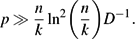
We investigate the asymptotic version of the Erdős–Ko–Rado theorem for the random k-uniform hypergraph $\mathcal{H}$ k (n, p). For 2⩽k(n) ⩽ n/2, let $N=\binom{n}k$ and $D=\binom{n-k}k$ . We show that with probability tending to 1 as n → ∞, the largest intersecting subhypergraph of $\mathcal{H}$ has size for any
 $$(1+o(1))p\ffrac kn N$$ This lower bound on p is asymptotically best possible for k = Θ(n). For this range of k and p, we are able to show stability as well.
 $$p\gg \ffrac nk\ln^2\biggl(\ffrac nk\biggr)D^{-1}.$$
 A different behaviour occurs when k = o(n). In this case, the lower bound on p is almost optimal. Further, for the small interval D −1 ≪ p ⩽ (n/k)1−ϵ D −1, the largest intersecting subhypergraph of
$\mathcal{H}$ k (n, p) has size Θ(ln(pD)ND −1), provided that  $k \gg \sqrt{n \ln n}$ .
Together with previous work of Balogh, Bohman and Mubayi, these results settle the asymptotic size of the largest intersecting family in
$\mathcal{H}$ k , for essentially all values of p and k.


Simply Generated Non-Crossing Partitions
-
- Journal:
- Combinatorics, Probability and Computing / Volume 26 / Issue 4 / July 2017
- Published online by Cambridge University Press:
- 28 March 2017, pp. 560-592
-
- Article
- Export citation
Sharp-interface formation during lithium intercalation into silicon
-
- Journal:
- European Journal of Applied Mathematics / Volume 29 / Issue 1 / February 2018
- Published online by Cambridge University Press:
- 28 March 2017, pp. 118-145
-
- Article
- Export citation
On Regularity Lemmas and their Algorithmic Applications
-
- Journal:
- Combinatorics, Probability and Computing / Volume 26 / Issue 4 / July 2017
- Published online by Cambridge University Press:
- 28 March 2017, pp. 481-505
-
- Article
- Export citation
Uniform s-Cross-Intersecting Families
-
- Journal:
- Combinatorics, Probability and Computing / Volume 26 / Issue 4 / July 2017
- Published online by Cambridge University Press:
- 28 March 2017, pp. 517-524
-
- Article
- Export citation
-
In this paper we study a question related to the classical Erdős–Ko–Rado theorem, which states that any family of k-element subsets of the set [n] = {1,. . .,n} in which any two sets intersect has cardinality at most $\binom{n-1}{k-1}$ .
We say that two non-empty families ${\mathcal A}, {\mathcal B}\subset \binom{[n]}{k}$ are s-cross-intersecting if, for any A ∈ ${\mathcal A}$ , B ∈ ${\mathcal B}$ , we have |A ∩ B| ≥ s. In this paper we determine the maximum of | ${\mathcal A}$ |+| ${\mathcal B}$ | for all n. This generalizes a result of Hilton and Milner, who determined the maximum of | ${\mathcal A}$ |+| ${\mathcal B}$ | for non-empty 1-cross-intersecting families.


Minimum Codegree Threshold for C 6 3-Factors in 3-Uniform Hypergraphs
-
- Journal:
- Combinatorics, Probability and Computing / Volume 26 / Issue 4 / July 2017
- Published online by Cambridge University Press:
- 22 March 2017, pp. 536-559
-
- Article
- Export citation
PERTURBATION OF BANACH SPACE OPERATORS WITH A COMPLEMENTED RANGE
- Part of
-
- Journal:
- Glasgow Mathematical Journal / Volume 59 / Issue 3 / September 2017
- Published online by Cambridge University Press:
- 21 March 2017, pp. 659-671
-
- Article
-
- You have access
- Export citation
-
Let ${\mathcal C}[{\mathcal X}]$ be any class of operators on a Banach space ${\mathcal X}$ , and let ${Holo}^{-1}({\mathcal C})$ denote the class of operators A for which there exists a holomorphic function f on a neighbourhood ${\mathcal N}$ of the spectrum σ(A) of A such that f is non-constant on connected components of ${\mathcal N}$ and f(A) lies in ${\mathcal C}$ . Let ${{\mathcal R}[{\mathcal X}]}$ denote the class of Riesz operators in ${{\mathcal B}[{\mathcal X}]}$ . This paper considers perturbation of operators $A\in\Phi_{+}({\mathcal X})\Cup\Phi_{-}({\mathcal X})$ (the class of all upper or lower [semi] Fredholm operators) by commuting operators in $B\in{Holo}^{-1}({\mathcal R}[{\mathcal X}])$ . We prove (amongst other results) that if πB (B) = ∏m i = 1(B − μi ) is Riesz, then there exist decompositions ${\mathcal X}=\oplus_{i=1}^m{{\mathcal X}_i}$ and $B=\oplus_{i=1}^m{B|_{{\mathcal X}_i}}=\oplus_{i=1}^m{B_i}$ such that: (i) If λ ≠ 0, then $\pi_B(A,\lambda)=\prod_{i=1}^m{(A-\lambda\mu_i)^{\alpha_i}} \in\Phi_{+}({\mathcal X})$ (resp., $\in\Phi_{-}({\mathcal X})$ ) if and only if $A-\lambda B_0-\lambda\mu_i\in\Phi_{+}({\mathcal X})$ (resp., $\in\Phi_{-}({\mathcal X})$ ), and (ii) (case λ = 0) $A\in\Phi_{+}({\mathcal X})$ (resp., $\in\Phi_{-}({\mathcal X})$ ) if and only if $A-B_0\in\Phi_{+}({\mathcal X})$ (resp., $\in\Phi_{-}({\mathcal X})$ ), where B 0 = ⊕m i = 1(Bi − μi ); (iii) if $\pi_B(A,\lambda)\in\Phi_{+}({\mathcal X})$ (resp., $\in\Phi_{-}({\mathcal X})$ ) for some λ ≠ 0, then $A-\lambda B\in\Phi_{+}({\mathcal X})$ (resp., $\in\Phi_{-}({\mathcal X})$ ).


Construction of ray-class fields by smaller generators and their applications
- Part of
-
- Journal:
- Proceedings of the Royal Society of Edinburgh. Section A: Mathematics / Volume 147 / Issue 4 / August 2017
- Published online by Cambridge University Press:
- 20 March 2017, pp. 781-812
- Print publication:
- August 2017
-
- Article
- Export citation
Bifurcation from infinity for reaction–diffusion equations under nonlinear boundary conditions
- Part of
-
- Journal:
- Proceedings of the Royal Society of Edinburgh. Section A: Mathematics / Volume 147 / Issue 3 / June 2017
- Published online by Cambridge University Press:
- 20 March 2017, pp. 649-671
- Print publication:
- June 2017
-
- Article
- Export citation
NON-AFFINE HOPF ALGEBRA DOMAINS OF GELFAND–KIRILLOV DIMENSION TWO
-
- Journal:
- Glasgow Mathematical Journal / Volume 59 / Issue 3 / September 2017
- Published online by Cambridge University Press:
- 20 March 2017, pp. 563-593
-
- Article
-
- You have access
- Export citation
COMPACT FACTORIZATION OF OPERATORS WITH λ-COMPACT ADJOINTS
-
- Journal:
- Glasgow Mathematical Journal / Volume 60 / Issue 1 / January 2018
- Published online by Cambridge University Press:
- 20 March 2017, pp. 123-134
-
- Article
-
- You have access
- Export citation
