Refine search
Actions for selected content:
26076 results in Abstract analysis
Periodic solutions of four-order degenerate differential equations with finite delay in vector-valued function spaces
- Part of
-
- Journal:
- Proceedings of the Royal Society of Edinburgh. Section A: Mathematics / Volume 155 / Issue 2 / April 2025
- Published online by Cambridge University Press:
- 14 September 2023, pp. 395-412
- Print publication:
- April 2025
-
- Article
- Export citation
-
In this paper, we mainly investigate the well-posedness of the four-order degenerate differential equation ($P_4$
 ): $(Mu)''''(t) + \alpha (Lu)'''(t) + (Lu)''(t)$ $=\beta Au(t) + \gamma Bu'(t) + Gu'_t + Fu_t + f(t),\,( t\in [0,\,2\pi ])$
 in periodic Lebesgue–Bochner spaces $L^p(\mathbb {T}; X)$
 and periodic Besov spaces $B_{p,q}^s\;(\mathbb {T}; X)$
 , where $A$
 , $B$
, $B$ , $L$
, $L$ and $M$
 are closed linear operators on a Banach space $X$
 such that $D(A)\cap D(B)\subset D(M)\cap D(L)$
 and $\alpha,\,\beta,\,\gamma \in \mathbb {C}$
 , $G$
, $G$ and $F$
 are bounded linear operators from $L^p([-2\pi,\,0];X)$
 (respectively $B_{p,q}^s([-2\pi,\,0];X)$
 ) into $X$
 , $u_t(\cdot ) = u(t+\cdot )$
 and $u'_t(\cdot ) = u'(t+\cdot )$
 are defined on $[-2\pi,\,0]$
 for $t\in [0,\, 2\pi ]$
 . We completely characterize the well-posedness of ($P_4$
 ) in the above two function spaces by using known operator-valued Fourier multiplier theorems.


Editorial “Symmetries and differential equations”
- Part of
-
- Journal:
- European Journal of Applied Mathematics / Volume 34 / Issue 5 / October 2023
- Published online by Cambridge University Press:
- 13 September 2023, pp. 911-912
-
- Article
-
- You have access
- HTML
- Export citation
The non-autonomous Navier–Stokes–Brinkman–Forchheimer equation with Dirichlet boundary conditions: dissipativity, regularity, and attractors
- Part of
-
- Journal:
- Proceedings of the Royal Society of Edinburgh. Section A: Mathematics / Volume 155 / Issue 1 / February 2025
- Published online by Cambridge University Press:
- 13 September 2023, pp. 352-393
- Print publication:
- February 2025
-
- Article
-
- You have access
- Open access
- HTML
- Export citation
Stabilization of the Kawahara–Kadomtsev–Petviashvili equation with time-delayed feedback
- Part of
-
- Journal:
- Proceedings of the Royal Society of Edinburgh. Section A: Mathematics / Volume 155 / Issue 1 / February 2025
- Published online by Cambridge University Press:
- 11 September 2023, pp. 280-306
- Print publication:
- February 2025
-
- Article
- Export citation
Intersection configurations in free and free times free-abelian groups
- Part of
-
- Journal:
- Proceedings of the Royal Society of Edinburgh. Section A: Mathematics / Volume 154 / Issue 5 / October 2024
- Published online by Cambridge University Press:
- 11 September 2023, pp. 1552-1582
- Print publication:
- October 2024
-
- Article
- Export citation
-
In this paper, we study intersection configurations – which describe the behaviour of multiple (finite) intersections of subgroups with respect to finite generability – in the realm of free and free times free-abelian (FTFA) groups. We say that a configuration is realizable in a group $G$
 if there exist subgroups $H_1,\ldots, H_k \leqslant G$
 realizing it. It is well known that free groups ${\mathbb {F}_{n}}$
 satisfy the Howson property: the intersection of any two finitely generated subgroups is again finitely generated. We show that the Howson property is indeed the only obstruction for multiple intersection configurations to be realizable within nonabelian free groups. On the contrary, FTFA groups ${\mathbb {F}_{n}} \times \mathbb {Z}^m$
 are well known to be non-Howson. We also study multiple intersections within FTFA groups, providing an algorithm to decide, given $k\geq 2$
 finitely generated subgroups, whether their intersection is again finitely generated and, in the affirmative case, compute a ‘basis’ for it. We finally prove that any intersection configuration is realizable in an FTFA group ${\mathbb {F}_{n}} \times \mathbb {Z}^m$
 , for $n\geq 2$
 and large enough $m$
 . As a consequence, we exhibit finitely presented groups where every intersection configuration is realizable.


Asymptotic formulas of the eigenvalues for the linearization of the scalar field equation
- Part of
-
- Journal:
- Proceedings of the Royal Society of Edinburgh. Section A: Mathematics / Volume 155 / Issue 1 / February 2025
- Published online by Cambridge University Press:
- 11 September 2023, pp. 307-344
- Print publication:
- February 2025
-
- Article
-
- You have access
- Open access
- HTML
- Export citation
-
We establish asymptotic formulas for all the eigenvalues of the linearization problem of the Neumann problem for the scalar field equation in a finite interval
\[ \begin{cases} \varepsilon^2u_{xx}-u+u^3=0, & 0< x<1,\\ u_x(0)=u_x(1)=0. \end{cases} \]In the previous paper of the third author [T. Wakasa and S. Yotsutani, J. Differ. Equ. 258 (2015), 3960–4006] asymptotic formulas for the Allen–Cahn case $\varepsilon ^2u_{xx}+u-u^3=0$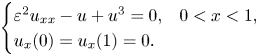
 were established. In this paper, we apply the method developed in the previous paper to our case. We show that all the eigenvalues can be classified into three categories, i.e., near $-3$
 eigenvalues, near $0$
 eigenvalues and the other eigenvalues. We see that the number of the near $-3$
 eigenvalues (resp. the near $0$
 eigenvalues) is equal to the number of the interior and boundary peaks (resp. the interior peaks) of a solution for the nonlinear problem. The main technical tools are various asymptotic formulas for complete elliptic integrals.


Order continuity of Arens extensions of regular multilinear operators
- Part of
-
- Journal:
- Proceedings of the Royal Society of Edinburgh. Section A: Mathematics / Volume 155 / Issue 1 / February 2025
- Published online by Cambridge University Press:
- 11 September 2023, pp. 258-279
- Print publication:
- February 2025
-
- Article
- Export citation
-
First we give a counterexample showing that recent results on separate order continuity of Arens extensions of multilinear operators cannot be improved to get separate order continuity on the product of the whole of the biduals. Then we establish conditions on the operators and/or on the underlying Riesz spaces/Banach lattices so that the extensions are order continuous on the product of the whole biduals. We also prove that all Arens extensions of any regular multilinear operator are order continuous in at least one variable and we study when Arens extensions of regular homogeneous polynomials on a Banach lattice $E$
 are order continuous on $E^{**}$
 .
.


Fixed point conditions for non-coprime actions
- Part of
-
- Journal:
- Proceedings of the Royal Society of Edinburgh. Section A: Mathematics / Volume 155 / Issue 1 / February 2025
- Published online by Cambridge University Press:
- 11 September 2023, pp. 345-351
- Print publication:
- February 2025
-
- Article
-
- You have access
- Open access
- HTML
- Export citation
-
In the setting of finite groups, suppose $J$
 acts on $N$
 via automorphisms so that the induced semidirect product $N\rtimes J$
 acts on some non-empty set $\Omega$
 , with $N$
 acting transitively. Glauberman proved that if the orders of $J$
 and $N$
 are coprime, then $J$
 fixes a point in $\Omega$
 . We consider the non-coprime case and show that if $N$
 is abelian and a Sylow $p$
 -subgroup of $J$
 fixes a point in $\Omega$
 for each prime $p$
 , then $J$
 fixes a point in $\Omega$
 . We also show that if $N$
 is nilpotent, $N\rtimes J$
 is supersoluble, and a Sylow $p$
 -subgroup of $J$
 fixes a point in $\Omega$
 for each prime $p$
 , then $J$
 fixes a point in $\Omega$
 .
.


PRM volume 153 issue 5 Cover and Back matter
-
- Journal:
- Proceedings of the Royal Society of Edinburgh. Section A: Mathematics / Volume 153 / Issue 5 / October 2023
- Published online by Cambridge University Press:
- 08 September 2023, pp. b1-b2
- Print publication:
- October 2023
-
- Article
-
- You have access
- Export citation
On the size of maximal intersecting families
- Part of
-
- Journal:
- Combinatorics, Probability and Computing / Volume 33 / Issue 1 / January 2024
- Published online by Cambridge University Press:
- 08 September 2023, pp. 32-49
-
- Article
- Export citation
-
We show that an $n$-uniform maximal intersecting family has size at most $e^{-n^{0.5+o(1)}}n^n$. This improves a recent bound by Frankl ((2019) Comb. Probab. Comput. 28(5) 733–739.). The Spread Lemma of Alweiss et al. ((2020) Proceedings of the 52nd Annual ACM SIGACT Symposium on Theory of Computing.) plays an important role in the proof.


PRM volume 153 issue 5 Cover and Front matter
-
- Journal:
- Proceedings of the Royal Society of Edinburgh. Section A: Mathematics / Volume 153 / Issue 5 / October 2023
- Published online by Cambridge University Press:
- 08 September 2023, pp. f1-f2
- Print publication:
- October 2023
-
- Article
-
- You have access
- Export citation
PEM series 2 volume 66 issue 3 Cover and Front matter
-
- Journal:
- Proceedings of the Edinburgh Mathematical Society / Volume 66 / Issue 3 / August 2023
- Published online by Cambridge University Press:
- 07 September 2023, pp. f1-f2
-
- Article
-
- You have access
- Export citation
PEM series 2 volume 66 issue 3 Cover and Back matter
-
- Journal:
- Proceedings of the Edinburgh Mathematical Society / Volume 66 / Issue 3 / August 2023
- Published online by Cambridge University Press:
- 07 September 2023, pp. b1-b2
-
- Article
-
- You have access
- Export citation
Stability properties of multidimensional symmetric hyperbolic systems with damping, differential constraints and delay
- Part of
-
- Journal:
- Proceedings of the Royal Society of Edinburgh. Section A: Mathematics / Volume 155 / Issue 1 / February 2025
- Published online by Cambridge University Press:
- 07 September 2023, pp. 199-241
- Print publication:
- February 2025
-
- Article
- Export citation
On the dimension of planar self-affine sets with non-invertible maps
- Part of
-
- Journal:
- Proceedings of the Royal Society of Edinburgh. Section A: Mathematics / Volume 155 / Issue 1 / February 2025
- Published online by Cambridge University Press:
- 07 September 2023, pp. 242-257
- Print publication:
- February 2025
-
- Article
- Export citation
On the linearized Whitham–Broer–Kaup system on bounded domains
- Part of
-
- Journal:
- Proceedings of the Royal Society of Edinburgh. Section A: Mathematics / Volume 155 / Issue 1 / February 2025
- Published online by Cambridge University Press:
- 07 September 2023, pp. 104-123
- Print publication:
- February 2025
-
- Article
- Export citation
-
We consider the system of partial differential equations
\[ \begin{cases} \eta_t - \alpha u_{xxx} - \beta \eta_{xx} = 0 \\ u_t + \eta_x + \beta u_{xx} = 0 \end{cases} \]on bounded domains, known in the literature as the Whitham–Broer–Kaup system. The well-posedness of the problem, under suitable boundary conditions, is addressed, and it is shown to depend on the sign of the number \[ \varkappa=\alpha-\beta^2. \]In particular, existence and uniqueness occur if and only if $\varkappa >0$
 . In which case, an explicit representation for the solutions is given. Nonetheless, for the case $\varkappa \leq 0$
 we have uniqueness in the class of strong solutions, and sufficient conditions to guarantee exponential instability are provided.


Periodic and solitary waves in a Korteweg–de Vries equation with delay
- Part of
-
- Journal:
- Proceedings of the Royal Society of Edinburgh. Section A: Mathematics / Volume 155 / Issue 1 / February 2025
- Published online by Cambridge University Press:
- 07 September 2023, pp. 176-198
- Print publication:
- February 2025
-
- Article
- Export citation
A weighted Trudinger–Moser inequalities and applications to some weighted $(N,q)-$
 Laplacian equation in $\mathbb {R}^N$
 with new exponential growth conditions
- Part of
-
- Journal:
- Proceedings of the Royal Society of Edinburgh. Section A: Mathematics / Volume 155 / Issue 1 / February 2025
- Published online by Cambridge University Press:
- 07 September 2023, pp. 124-175
- Print publication:
- February 2025
-
- Article
- Export citation
-
In this paper, we prove some weighted sharp inequalities of Trudinger–Moser type. The weights considered here have a logarithmic growth. These inequalities are completely new and are established in some new Sobolev spaces where the norm is a mixture of the norm of the gradient in two different Lebesgue spaces. This fact allowed us to prove a very interesting result of sharpness for the case of doubly exponential growth at infinity. Some improvements of these inequalities for the weakly convergent sequences are also proved using a version of the Concentration-Compactness principle of P.L. Lions. Taking profit of these inequalities, we treat in the last part of this work some elliptic quasilinear equation involving the weighted $(N,q)-$
 Laplacian operator where $1 < q < N$
 and a nonlinearities enjoying a new type of exponential growth condition at infinity.


Coupling capacity in C*-algebras
- Part of
-
- Journal:
- Proceedings of the Royal Society of Edinburgh. Section A: Mathematics / Volume 155 / Issue 1 / February 2025
- Published online by Cambridge University Press:
- 07 September 2023, pp. 81-103
- Print publication:
- February 2025
-
- Article
-
- You have access
- Open access
- HTML
- Export citation
The Reidemeister spectrum of finite abelian groups
- Part of
-
- Journal:
- Proceedings of the Edinburgh Mathematical Society / Volume 66 / Issue 4 / November 2023
- Published online by Cambridge University Press:
- 06 September 2023, pp. 940-959
-
- Article
- Export citation
