Refine search
Actions for selected content:
238502 results in Physics and Astronomy
Towards a vacuum birefringence experiment at the Helmholtz International Beamline for Extreme Fields (Letter of Intent of the BIREF@HIBEF Collaboration)
-
- Journal:
- High Power Laser Science and Engineering / Volume 13 / 2025
- Published online by Cambridge University Press:
- 11 March 2025, e7
-
- Article
-
- You have access
- Open access
- HTML
- Export citation

Experimental study of the convection in a thin cylindrical gas layer with imposed bottom and top fluxes and imposed side temperature
-
- Journal:
- Journal of Fluid Mechanics / Volume 1006 / 10 March 2025
- Published online by Cambridge University Press:
- 11 March 2025, A22
-
- Article
- Export citation

A study of turbulent flow over patchy roughness
-
- Journal:
- Journal of Fluid Mechanics / Volume 1006 / 10 March 2025
- Published online by Cambridge University Press:
- 11 March 2025, A28
-
- Article
-
- You have access
- Open access
- HTML
- Export citation
-
Direct numerical simulations in periodic plane channels are used to study turbulent flow over ‘patches’ of roughness distributed on otherwise smooth walls. Circular patches as well as those resembling natural bio-fouling roughness are considered. Roughnesses within the patches are statistically similar and formed by random distribution of roughness elements of truncated cone shape. The two main studied parameters are the characteristic length scale of the patches $\varLambda _P$ and roughness area coverage ratio (CR). To provide a reference, simulations of homogeneous roughness (i.e. with 100 % CR) are performed at different roughness element densities translated into different values of frontal solidity. Results show that when $\varLambda _P$ is of the order of channel half-height $\delta$, the global friction coefficient $C_f$ of patchy roughness is scattered around that of homogeneous roughness with similar ‘mean’ frontal solidity. As $\varLambda _P/\delta$ grows, asymptotic convergence towards an equilibrium value is identified. Considering the present data, a normalised $C_f$ can be satisfactorily correlated by $\varLambda _P/\delta$; the normalisation includes $C_f$ for a homogeneous roughness similar to the patch roughness at two limiting cases. This points towards the possibility to develop a universal heterogeneous roughness correlation based on a knowledge of existing homogeneous roughness correlations. Furthermore, local and global flow statistics are studied, which among others, indicate formation of secondary motions for regular patch arrangement at $\varLambda _P\approx \delta$ with implications on the outer layer similarity of global mean velocity and Reynolds stress profiles.


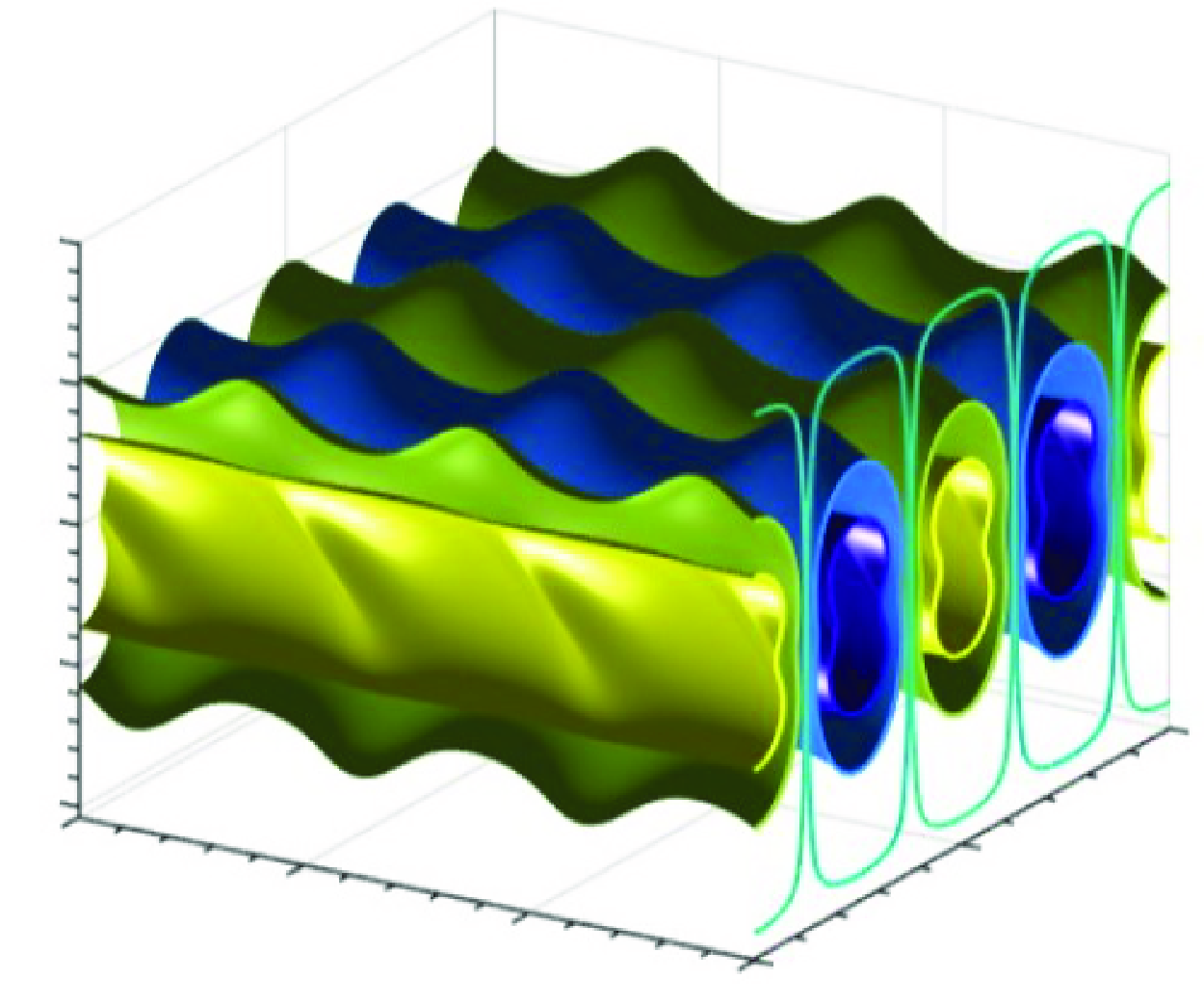
A class of instabilities induced by surface vibrations
-
- Journal:
- Journal of Fluid Mechanics / Volume 1006 / 10 March 2025
- Published online by Cambridge University Press:
- 10 March 2025, A25
-
- Article
-
- You have access
- Open access
- HTML
- Export citation
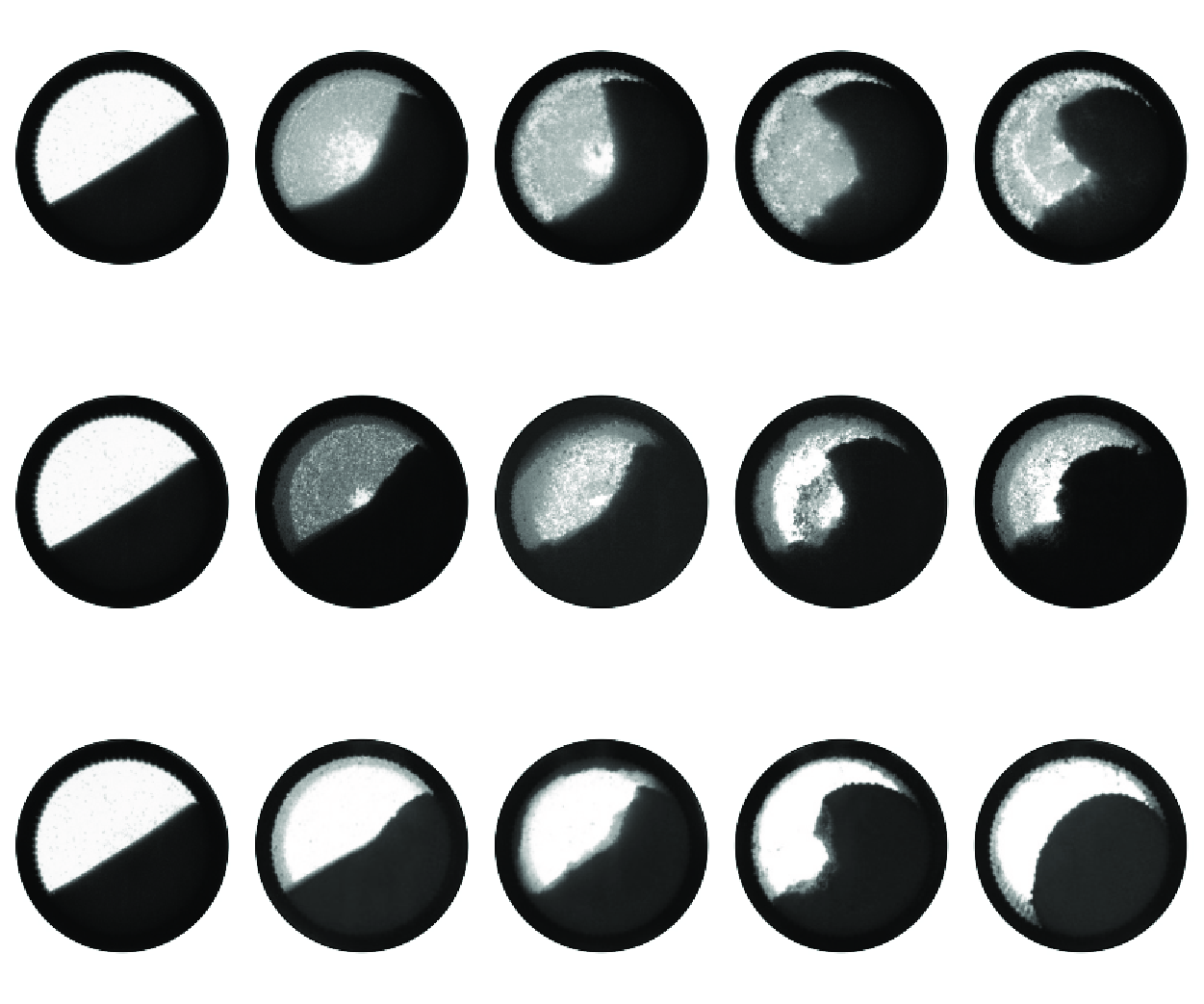
Cohesive granular material in a rotating drum: flow regimes and size effects
-
- Journal:
- Journal of Fluid Mechanics / Volume 1006 / 10 March 2025
- Published online by Cambridge University Press:
- 10 March 2025, A24
-
- Article
-
- You have access
- Open access
- HTML
- Export citation
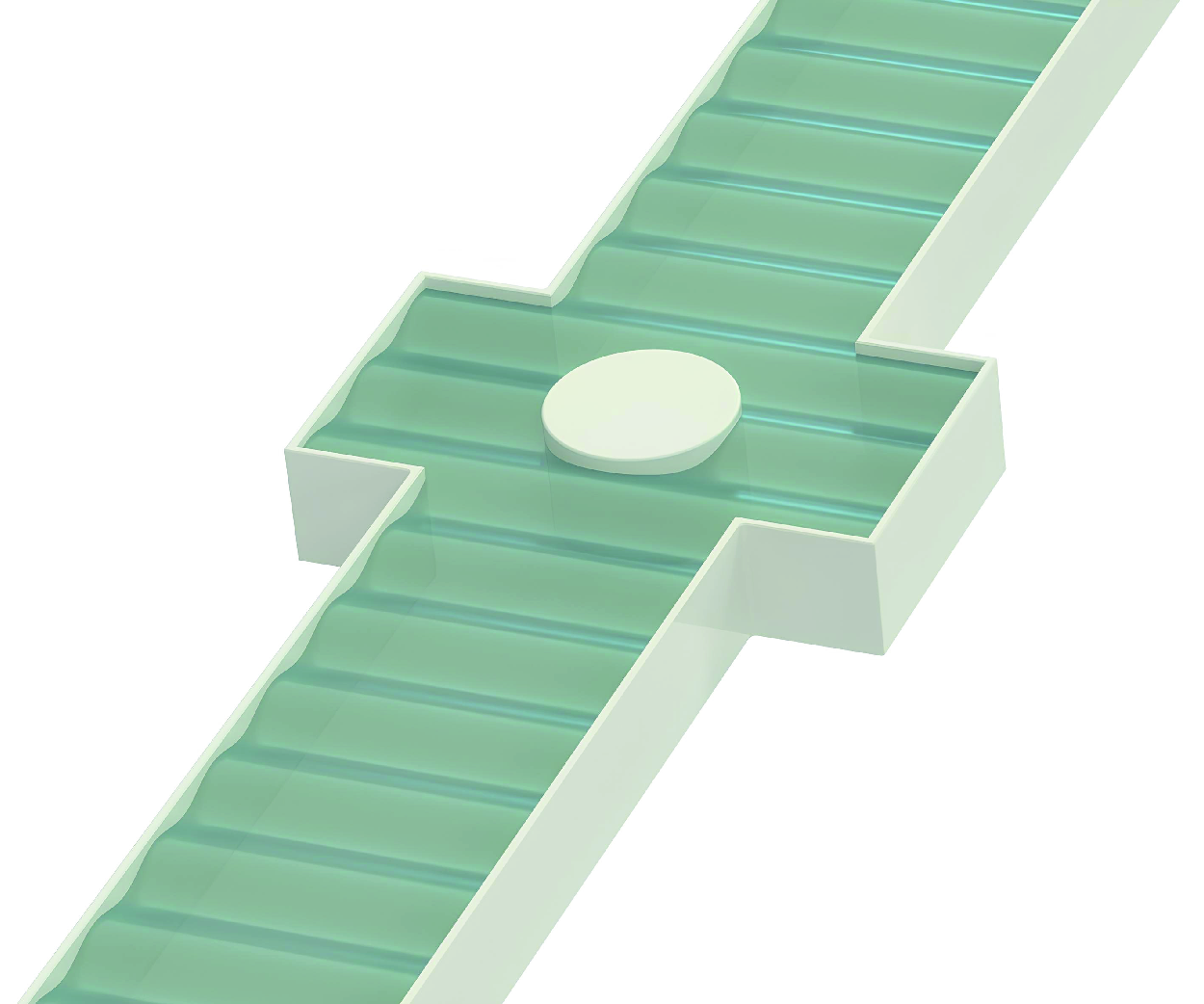
Cloaking waveguide defects at low frequencies using local wall deformations
-
- Journal:
- Journal of Fluid Mechanics / Volume 1006 / 10 March 2025
- Published online by Cambridge University Press:
- 10 March 2025, A26
-
- Article
-
- You have access
- Open access
- HTML
- Export citation
Predicting Sunyaev-Zel’dovich effect observations of galaxy cluster cavities with the Square Kilometre Array
-
- Journal:
- Publications of the Astronomical Society of Australia / Volume 42 / 2025
- Published online by Cambridge University Press:
- 10 March 2025, e031
-
- Article
-
- You have access
- Open access
- HTML
- Export citation
-
Galaxy cluster X-ray cavities are inflated by relativistic jets that are ejected into the intracluster medium by active galactic nuclei (AGN). AGN jets prevent predicted cooling flow establishment at the cluster centre, and while this process is not well understood in existing studies, simulations have shown that the heating mechanism will depend on the type of gas that fills the cavities. Thermal and non-thermal distributions of electrons will produce different cavity Sunyaev Zel’dovich (SZ) effect signals, quantified by the ‘suppression factor’ f. This paper explores potential enhancements to prior constraints on the cavity gas type by simulating suppression factor observations with the Square Kilometre Array (SKA). Cluster cavities across different redshifts are observed to predict the optimum way of measuring f in future observations. We find that the SKA can constrain the suppression factor in the cavities of cluster MS 0735.6+7421 (MS0735) in as little as 4 h, with a smallest observable value of $f \approx 0.42$. Additionally, while the SKA may distinguish between possible thermal or non-thermal suppression factor values within the cavities of MS0735 if it observes for more than 8 h, determining the gas type of other clusters will likely require observations at multiple frequencies. The effect of cavity line of sight (LOS) position is also studied, and degeneracies between LOS position and the measured value of f are found. Finally, we find that for small cavities (radius < 80 kpc) at high redshift ( $z \approx 1.5$), the proposed high frequencies of the SKA (23.75–37.5 GHz) will be optimal, and that including MeerKAT antennas will improve all observations of this type.


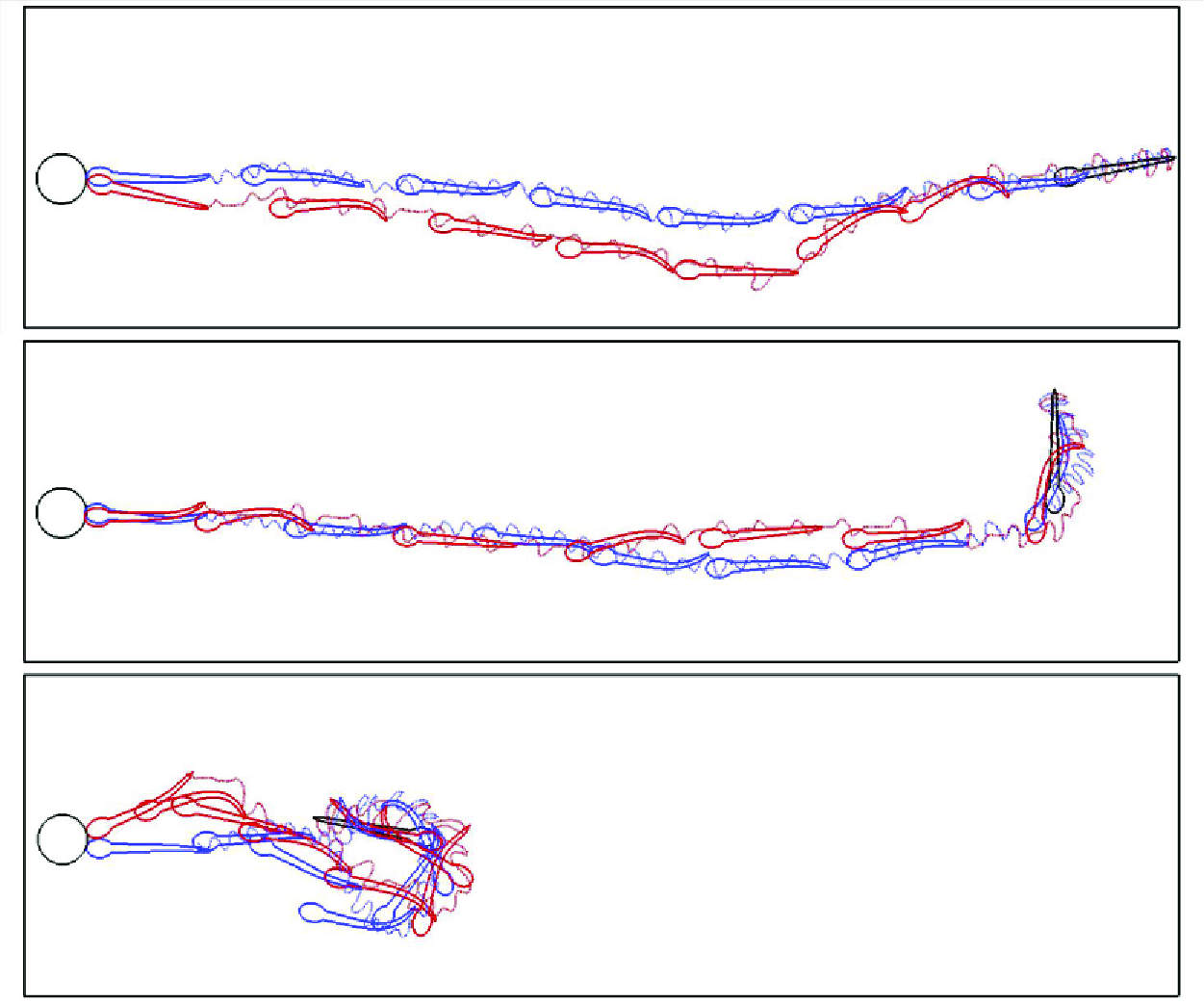
Intermittent swimmers optimize energy expenditure with flick-to-flick motor control
-
- Journal:
- Journal of Fluid Mechanics / Volume 1006 / 10 March 2025
- Published online by Cambridge University Press:
- 10 March 2025, A27
-
- Article
- Export citation

Intrinsic compressibility effects in near-wall turbulence
-
- Journal:
- Journal of Fluid Mechanics / Volume 1006 / 10 March 2025
- Published online by Cambridge University Press:
- 07 March 2025, A14
-
- Article
-
- You have access
- Open access
- HTML
- Export citation

Wall turbulence perturbed by a bump with organized small-scale roughness: coherent structure dynamics
-
- Journal:
- Journal of Fluid Mechanics / Volume 1006 / 10 March 2025
- Published online by Cambridge University Press:
- 07 March 2025, A6
-
- Article
-
- You have access
- Open access
- HTML
- Export citation

Turbulence in a channel with a patchy submerged canopy: the impact of spatial configuration
-
- Journal:
- Journal of Fluid Mechanics / Volume 1006 / 10 March 2025
- Published online by Cambridge University Press:
- 07 March 2025, A15
-
- Article
- Export citation
-
This study investigates how the spatial configuration of submerged three-dimensional patches of vegetation impacts turbulence. Laboratory experiments were conducted in a channel with submerged patches of model vegetation configured with different patch area densities ( $\phi _{p}$), representing the bed area fraction occupied by patches, ranging from 0.13 to 0.78, and different spatial patterns transitioning from two dimensional (channel-spanning patches) to three dimensional (laterally unconfined patches). These configurations produced a range of flow regimes within the canopy, from wake interference flow to skimming flow. At low area density ( $\phi _{p}\lt0.5$), turbulence within the canopy increased with increasing $\phi _{p}$ regardless of spatial configuration, while at high area density ( $\phi _{p}\gt0.5$), the relationship between turbulence and $\phi _{p}$ depended on the spatial configuration of the patches. For the same patch area density, the configuration with smaller lateral gaps generated stronger turbulence within the canopy. The relative contributions of wake and shear production also varied with the spatial configuration of the patches. At low area densities, wake production dominated over shear production, while at high area densities, shear production was more dominant due to an enhanced shear layer at the top of the canopy and reduced mean velocity within the canopy. A new predictive model for the channel-averaged turbulent kinetic energy (TKE) was developed as a function of channel-averaged velocity, canopy geometry, and patch area density, which showed good agreement with the measured TKE.


Reinforcement-learning-based control of turbulent channel flows at high Reynolds numbers
-
- Journal:
- Journal of Fluid Mechanics / Volume 1006 / 10 March 2025
- Published online by Cambridge University Press:
- 07 March 2025, A12
-
- Article
-
- You have access
- Open access
- HTML
- Export citation
-
Deep reinforcement learning (DRL) is employed to develop control strategies for drag reduction in direct numerical simulations of turbulent channel flows at high Reynolds numbers. The DRL agent uses near-wall streamwise velocity fluctuations as input to modulate wall blowing and suction velocities. These DRL-based strategies achieve significant drag reduction, with maximum rates $35.6\,\%$ at $Re_{\tau }\thickapprox 180$, $30.4\,\%$ at $Re_{\tau }\thickapprox 550$, and $27.7\,\%$ at $Re_{\tau }\thickapprox 1000$, outperforming traditional opposition control methods. An expanded range of wall actions further enhances drag reduction, although effectiveness decreases at higher Reynolds numbers. The DRL models elevate the virtual wall through blowing and suction, aiding in drag reduction. However, at higher Reynolds numbers, the amplitude modulation of large-scale structures significantly increases the residual Reynolds stress on the virtual wall, diminishing the drag reduction. Analysis of budget equations provides a systematic understanding of the underlying drag reduction dynamics. The DRL models reduce skin friction by inhibiting the redistribution of wall-normal turbulent kinetic energy. This further suppresses the wall-normal velocity fluctuations, reducing the production of Reynolds stress, thereby decreasing skin friction. This study showcases the successful application of DRL in turbulence control at high Reynolds numbers, and elucidates the nonlinear control mechanisms underlying the observed drag reduction.


How turbulence increases the bubble–particle collision rate
-
- Journal:
- Journal of Fluid Mechanics / Volume 1006 / 10 March 2025
- Published online by Cambridge University Press:
- 07 March 2025, A19
-
- Article
-
- You have access
- Open access
- HTML
- Export citation

Decoherence and Quantum Darwinism
- From Quantum Foundations to Classical Reality
-
- Published online:
- 06 March 2025
- Print publication:
- 13 March 2025

Effects of electrostatic correlations and ion–solvent interactions of finite-sized ions on the electrophoresis of a soft particle
-
- Journal:
- Journal of Fluid Mechanics / Volume 1006 / 10 March 2025
- Published online by Cambridge University Press:
- 06 March 2025, A9
-
- Article
- Export citation

Temporal modulation on mixed convection in turbulent channels
-
- Journal:
- Journal of Fluid Mechanics / Volume 1006 / 10 March 2025
- Published online by Cambridge University Press:
- 06 March 2025, A11
-
- Article
- Export citation
-
We studied flow organization and heat transfer properties in mixed turbulent convection within Poiseuille–Rayleigh–Bénard channels subjected to temporally modulated sinusoidal wall temperatures. Three-dimensional direct numerical simulations were performed for Rayleigh numbers in the range $10^6 \leqslant Ra \leqslant 10^8$, a Prandtl number $Pr = 0.71$ and a bulk Reynolds number $Re_b \approx 5623$. We found that high-frequency wall temperature oscillations had minimal impact on flow structures, while low-frequency oscillations induced adaptive changes, forming stable stratified layers during cooling. Proper orthogonal decomposition (POD) analysis revealed a dominant streamwise unidirectional shear flow mode. Large-scale rolls oriented in the streamwise direction appeared as higher POD modes and were significantly influenced by lower-frequency wall temperature variations. Long-time-averaged statistics showed that the Nusselt number increased with decreasing frequency by up to 96 %, while the friction coefficient varied by less than 15 %. High-frequency modulation predominantly influenced near-wall regions, enhancing convective effects, whereas low frequencies reduced these effects via stable stratified layer formation. Phase-averaged statistics showed that high-frequency modulation resulted in phase-stable streamwise velocity and temperature profiles, while low-frequency modulation caused significant variations due to weakened turbulence. Turbulent kinetic energy (TKE) profiles remained high near the wall during both heating and cooling at high frequency, but decreased during cooling at low frequencies. A TKE budget analysis revealed that during heating, TKE production was dominated by shear near the wall and by buoyancy in the bulk region; while during cooling, the production, distribution and dissipation of TKE were all nearly zero.


A theoretical study of the upper bound of surface elevation variance in the Phillips initial stage during wind-wave generation
-
- Journal:
- Journal of Fluid Mechanics / Volume 1006 / 10 March 2025
- Published online by Cambridge University Press:
- 06 March 2025, A8
-
- Article
-
- You have access
- Open access
- HTML
- Export citation
Pinching relativistic electrons in the quantum degenerate plasmas to enhance the fast heating
-
- Journal:
- High Power Laser Science and Engineering / Volume 13 / 2025
- Published online by Cambridge University Press:
- 06 March 2025, e34
-
- Article
-
- You have access
- Open access
- HTML
- Export citation

A framework for assessing the Reynolds analogy in turbulent forced convection over rough walls
-
- Journal:
- Journal of Fluid Mechanics / Volume 1006 / 10 March 2025
- Published online by Cambridge University Press:
- 06 March 2025, R3
-
- Article
-
- You have access
- Open access
- HTML
- Export citation
-
This study introduces a novel approach to investigate the Reynolds analogy in complex flow scenarios. It is shown that the total mechanical energy $\mathit {B}$, viz. the sum of kinetic energy and pressure work, and the field $\Gamma =\theta ^2/2$ (where $\theta$ is the transported passive scalar) are governed by two equations that are similar in form, when time-averaged for statistically stationary flows. For fully developed channel flows the integral energy balance links the mean bulk velocity and scalar with the volume averages of the respective dissipation rates, allowing the assessment of the Reynolds analogy in terms of the dissipation fields. This approach is tested on direct numerical simulation data of rough-wall turbulent channel flow at two different roughness Reynolds numbers, namely $k^+=15$ and $k^+=90$. For a unit Prandtl number, the same qualitative behaviour is observed for the mean wall-normal distributions of the budget-equation terms of $B$ and $\Gamma$, the latter being larger than the corresponding terms in the mechanical-energy budget. The Reynolds decomposition of the flow into temporal mean and stochastic parts reveals that roughness primarily affects the mean-flow dissipation. For the $k^+=90$ case, the analysis shows that attached-flow and high-shear regions dominate the integral mean scalar and momentum transfer and exhibit the greatest differences between the mean mechanical and scalar dissipation rates. In contrast, well-mixed regions, sheltered by large roughness elements, contribute similarly and minimally to the integral scalar and momentum transfer.


Machine learning phase control of filled-aperture coherent beam combining: principle and numerical demonstration
-
- Journal:
- High Power Laser Science and Engineering / Volume 13 / 2025
- Published online by Cambridge University Press:
- 05 March 2025, e39
-
- Article
-
- You have access
- Open access
- HTML
- Export citation
