Refine search
Actions for selected content:
238141 results in Physics and Astronomy
The Dawes Review 11: From young to old: The evolutionary path of Pulsar Wind Nebulae
-
- Journal:
- Publications of the Astronomical Society of Australia / Volume 40 / 2023
- Published online by Cambridge University Press:
- 14 February 2023, e007
-
- Article
-
- You have access
- HTML
- Export citation
Very long baseline interferometry observations of the high-redshift blazar candidate J0141–5427
-
- Journal:
- Publications of the Astronomical Society of Australia / Volume 40 / 2023
- Published online by Cambridge University Press:
- 14 February 2023, e004
-
- Article
-
- You have access
- Open access
- HTML
- Export citation
-
Active galactic nuclei (AGN) have been observed as far as redshift $z \sim 7$. They are crucial in investigating the early Universe as well as the growth of supermassive black holes at their centres. Radio-loud AGN with their jets seen at a small viewing angle are called blazars and show relativistic boosting of their emission. Thus, their apparently brighter jets are easier to detect in the high-redshift Universe. DES J014132.4–542749.9 is a radio-luminous but X-ray weak blazar candidate at $z = 5$. We conducted high-resolution radio interferometric observations of this source with the Australian Long Baseline Array at $1.7$ and $8.5$ GHz. A single, compact radio-emitting feature was detected at both frequencies with a flat radio spectrum. We derived the milliarcsecond-level accurate position of the object. The frequency dependence of its brightness temperature is similar to that of blazar sources observed at lower redshifts. Based on our observations, we can confirm its blazar nature. We compared its radio properties with those of two other similarly X-ray-weak and radio-bright AGN, and found that they show very different relativistic boosting characteristics.


The high-Reynolds-number stratified wake of a slender body and its comparison with a bluff-body wake
-
- Journal:
- Journal of Fluid Mechanics / Volume 957 / 25 February 2023
- Published online by Cambridge University Press:
- 14 February 2023, A7
-
- Article
-
- You have access
- Open access
- HTML
- Export citation
-
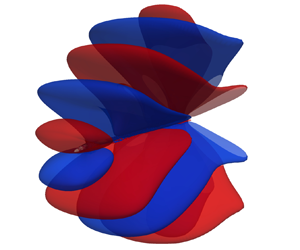
The high-Reynolds-number stratified wake of a slender body is studied using a high-resolution hybrid simulation. The wake generator is a 6 : 1 prolate spheroid with a tripped boundary layer, the diameter-based body Reynolds number is ${Re}= U_\infty D/\nu = 10^5$, and the body Froude numbers are ${Fr}=U_\infty /ND=\{2,10,\infty \}$. The wake defect velocity decays following three stages with different wake decay rates (Spedding, J. Fluid Mech., vol. 337, 1997, pp. 283–301) as for a bluff body. However, the transition points among stages do not follow the expected $Nt = Nx/U_\infty$ values. Comparison with the wake of a circular disk in similar conditions (Chongsiripinyo & Sarkar, J. Fluid Mech., vol. 885, 2020) quantifies the influence of the wake generator – bluff versus slender – in stratified flow. The strongly stratified ${Fr}=2$ wake is in a resonant state. The steady lee waves strongly modulate the mean flow, and relative to the disk, the 6 : 1 spheroid (a high-aspect-ratio shape) wake at ${Fr}=2$ shows an earlier transition from the non-equilibrium (NEQ) stage to the quasi-two-dimensional (Q2D) stage. The NEQ–Q2D transition is followed by a sharp increase in the turbulent kinetic energy and horizontal wake meanders. At ${Fr}=10$, the start of the NEQ stage is delayed for the spheroid. Transfers between kinetic energy and potential energy reservoirs (both mean and turbulence) are analysed, and the flows are compared in phase space (with local Froude and Reynolds numbers as coordinates). Overall, the results of this study point to the difficulty of finding a universal framework for stratified wake evolution, independent of the features of the body, and provide insights into how buoyancy effects depend on the wake generator.


Optimization and control of synchrotron emission in ultraintense laser–solid interactions using machine learning
- Part of
-
- Journal:
- High Power Laser Science and Engineering / Volume 11 / 2023
- Published online by Cambridge University Press:
- 14 February 2023, e34
-
- Article
-
- You have access
- Open access
- HTML
- Export citation
Stability of hypersonic flow over a curved compression ramp
-
- Journal:
- Journal of Fluid Mechanics / Volume 957 / 25 February 2023
- Published online by Cambridge University Press:
- 14 February 2023, A8
-
- Article
-
- You have access
- Open access
- HTML
- Export citation
-
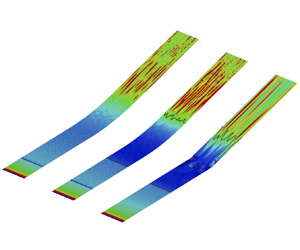
In this work, the stability of hypersonic flow over a curved compression ramp is studied using several stability analysis tools and direct numerical simulations (DNS). The free-stream Mach number and the unit Reynolds number are 7.7 and $4.2 \times 10^6$ m $^{-1}$, respectively. Corner rounding is considered to alter the separation bubble flow so as to suppress the intrinsic instability of the compression-ramp flow. The variation of intrinsic instability is confirmed by global stability analysis. Subsequently, resolvent analysis is employed to examine the response of intrinsically stable flows to external disturbances. It is shown that the considered flows strongly amplify low-frequency streamwise streaks with a preferential spanwise wavelength. This result is verified using DNS by introducing a random forcing upstream of the separation point. Furthermore, both resolvent analysis and DNS demonstrate that the separation bubble contributes little to the selection of the spanwise wavelength of streamwise streaks. The combined effects of convective and intrinsic instabilities are also explored using DNS. A better agreement with experimental data is achieved after introducing upstream disturbances in an inherently unstable flow.


Characterisation of fully developed and equilibrium states of non-electrolyte diffusiophoretic systems via numerical simulations
-
- Journal:
- Journal of Fluid Mechanics / Volume 957 / 25 February 2023
- Published online by Cambridge University Press:
- 14 February 2023, A2
-
- Article
-
- You have access
- Open access
- HTML
- Export citation
Relative Richardson varieties
- Part of
-
- Journal:
- Mathematical Proceedings of the Cambridge Philosophical Society / Volume 175 / Issue 1 / July 2023
- Published online by Cambridge University Press:
- 14 February 2023, pp. 161-186
- Print publication:
- July 2023
-
- Article
-
- You have access
- Open access
- HTML
- Export citation
Divisors computing minimal log discrepancies on lc surfaces
- Part of
-
- Journal:
- Mathematical Proceedings of the Cambridge Philosophical Society / Volume 175 / Issue 1 / July 2023
- Published online by Cambridge University Press:
- 14 February 2023, pp. 107-128
- Print publication:
- July 2023
-
- Article
- Export citation
-
Let $(X\ni x,B)$ be an lc surface germ. If $X\ni x$ is klt, we show that there exists a divisor computing the minimal log discrepancy of $(X\ni x,B)$ that is a Kollár component of $X\ni x$. If $B\not=0$ or $X\ni x$ is not Du Val, we show that any divisor computing the minimal log discrepancy of $(X\ni x,B)$ is a potential lc place of $X\ni x$. This extends a result of Blum and Kawakita who independently showed that any divisor computing the minimal log discrepancy on a smooth surface is a potential lc place.



Time-Sensitive Software
-
- Journal:
- Research Directions: Cyber-Physical Systems / Volume 1 / 2023
- Published online by Cambridge University Press:
- 13 February 2023, e1
-
- Article
-
- You have access
- Open access
- HTML
- Export citation
Equivariant Heegaard genus of reducible 3-manifolds
- Part of
-
- Journal:
- Mathematical Proceedings of the Cambridge Philosophical Society / Volume 175 / Issue 1 / July 2023
- Published online by Cambridge University Press:
- 13 February 2023, pp. 51-87
- Print publication:
- July 2023
-
- Article
-
- You have access
- Open access
- HTML
- Export citation

Quantum Mechanics
- A Paradigms Approach
-
- Published online:
- 11 February 2023
- Print publication:
- 15 September 2022
-
- Textbook
- Export citation
Morphodynamics of active nematic fluid surfaces
-
- Journal:
- Journal of Fluid Mechanics / Volume 957 / 25 February 2023
- Published online by Cambridge University Press:
- 10 February 2023, A4
-
- Article
- Export citation
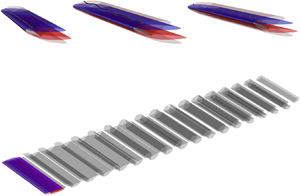
Global stability, sensitivity and passive control of low-Reynolds-number flows around NACA 4412 swept wings
-
- Journal:
- Journal of Fluid Mechanics / Volume 957 / 25 February 2023
- Published online by Cambridge University Press:
- 10 February 2023, A5
-
- Article
-
- You have access
- Open access
- HTML
- Export citation
-
The stability and sensitivity of two- and three-dimensional global modes developing on steady spanwise-homogeneous laminar separated flows around NACA 4412 swept wings are numerically investigated for different Reynolds numbers ${\textit {Re}}$ and angles of attack $\alpha$. The wake dynamics is driven by the two-dimensional von Kármán mode whose emergence threshold in the $\alpha \unicode{x2013}{\textit {Re}}$ plane is computed with that of the three-dimensional centrifugal mode. At the critical Reynolds number, the Strouhal number, the streamwise wavenumber of the von Kármán mode and the spanwise wavenumber of the leading three-dimensional centrifugal mode scale as a power law of $\alpha$. The introduction of a sweep angle attenuates the growth of all unstable modes and entails a Doppler effect in the leading modes’ dynamics and a shift towards non-zero frequencies of the three-dimensional centrifugal modes. These are found to be non-dispersive as opposed to the von Kármán modes. The sensitivity of the leading global modes is investigated in the vicinity of the critical conditions through adjoint-based methods. The growth-rate sensitivity map displays a region on the suction side of the wing, wherein a streamwise-oriented force has a net stabilising effect, comparable to what could have been obtained inside the recirculation bubble. In agreement with the predictions of the sensitivity analysis, a spanwise-homogeneous force suppresses the Hopf bifurcation and stabilises the entire branch of von Kármán modes. In the limit of small amplitudes, passive control via spanwise-wavy forcing produces a stabilising effect similar to that of a spanwise-homogeneous control and is more effective than localised spherical forces.



Stephen H. Davis 7 September 1939 – 12 November 2021
-
- Journal:
- Journal of Fluid Mechanics / Volume 956 / 10 February 2023
- Published online by Cambridge University Press:
- 10 February 2023, E2
-
- Article
-
- You have access
- HTML
- Export citation
Potential analytical interferences when measuring Tmax during temperature programmed pyrolysis of hydrothermally altered volcanoclastic sediment
-
- Journal:
- Experimental Results / Volume 4 / 2023
- Published online by Cambridge University Press:
- 10 February 2023, e5
-
- Article
-
- You have access
- Open access
- HTML
- Export citation
Index
-
- Book:
- Conformal Methods in General Relativity
- Published online:
- 04 November 2022
- Print publication:
- 09 February 2023, pp 587-594
-
- Chapter
-
- You have access
- Open access
- Export citation
15 - Miscellaneous detectors and applications
-
- Book:
- Gaseous Radiation Detectors
- Published online:
- 04 November 2022
- Print publication:
- 09 February 2023, pp 430-440
-
- Chapter
-
- You have access
- Open access
- Export citation
Part 3 - Reference: a compendium of fields
-
- Book:
- Classical Covariant Fields
- Published online:
- 04 November 2022
- Print publication:
- 09 February 2023, pp 397-398
-
- Chapter
-
- You have access
- Open access
- Export citation
14 - Cherenkov ring imaging
-
- Book:
- Gaseous Radiation Detectors
- Published online:
- 04 November 2022
- Print publication:
- 09 February 2023, pp 399-429
-
- Chapter
-
- You have access
- Open access
- Export citation
Appendix E - Symmetry properties of matrix elements
-
- Book:
- Electron Scattering for Nuclear and Nucleon Structure
- Published online:
- 05 November 2022
- Print publication:
- 09 February 2023, pp 308-311
-
- Chapter
-
- You have access
- Open access
- Export citation
