Published on behalf of The London Mathematical Society
We partner with a secure submission system to handle manuscript submissions.
Please note:
Click Proceed to submission system to continue to our partner's website.
Let  $X$ be a smooth projective variety defined over an algebraically closed field of positive characteristic $p$ whose tangent bundle is nef. We prove that $X$ admits a smooth morphism $X \to M$ such that the fibers are Fano varieties with nef tangent bundle and $T_M$ is numerically flat. We also prove that extremal contractions exist as smooth morphisms. As an application, we prove that, if the Frobenius morphism can be lifted modulo $p^2$, then $X$ admits, up to a finite étale Galois cover, a smooth morphism onto an ordinary abelian variety whose fibers are products of projective spaces.
Suppose  $\mathcal {H}$ is an admissible Heegaard diagram for a balanced sutured manifold $(M,\gamma )$. We prove that the number of generators of the associated sutured Heegaard Floer complex is an upper bound on the dimension of the sutured instanton homology $\mathit {SHI}(M,\gamma )$. It follows, in particular, that strong L-spaces are instanton L-spaces.
Let  $G$ be a split reductive group over the ring of integers in a $p$-adic field with residue field $\mathbf {F}$. Fix a representation $\overline {\rho }$ of the absolute Galois group of an unramified extension of $\mathbf {Q}_p$, valued in $G(\mathbf {F})$. We study the crystalline deformation ring for $\overline {\rho }$ with a fixed $p$-adic Hodge type that satisfies an analog of the Fontaine–Laffaille condition for $G$-valued representations. In particular, we give a root theoretic condition on the $p$-adic Hodge type which ensures that the crystalline deformation ring is formally smooth. Our result improves on all known results for classical groups not of type A and provides the first such results for exceptional groups.
We use the tropical geometry approach to compute absolute and relative enumerative invariants of complex surfaces which are  $\mathbb {C} P^1$-bundles over an elliptic curve. We also show that the tropical multiplicity used to count curves can be refined by the standard Block–Göttsche refined multiplicity to give tropical refined invariants. We then give a concrete algorithm using floor diagrams to compute these invariants along with the associated interpretation as operators acting on some Fock space. The floor diagram algorithm allows one to prove the piecewise polynomiality of the relative invariants, and the quasi-modularity of their generating series.
In this paper, we propose a modified Kudla–Rapoport conjecture for the Krämer model of unitary Rapoport–Zink space at a ramified prime, which is a precise identity relating intersection numbers of special cycles to derivatives of Hermitian local density polynomials. We also introduce the notion of special difference cycles, which has surprisingly simple description. Combining this with induction formulas of Hermitian local density polynomials, we prove the modified Kudla–Rapoport conjecture when  $n=3$. Our conjecture, combining with known results at inert and infinite primes, implies the arithmetic Siegel–Weil formula for all non-singular coefficients when the level structure of the corresponding unitary Shimura variety is defined by a self-dual lattice.
We develop the theory of relative regular holonomic  $\mathcal {D}$-modules with a smooth complex manifold $S$ of arbitrary dimension as parameter space, together with their main functorial properties. In particular, we establish in this general setting the relative Riemann–Hilbert correspondence proved in a previous work in the one-dimensional case.
We introduce the notion of refined unramified cohomology of algebraic schemes and prove comparison theorems that identify some of these groups with cycle groups. This generalizes to cycles of arbitrary codimension previous results of Bloch–Ogus, Colliot-Thélène–Voisin, Kahn, Voisin, and Ma. We combine our approach with the Bloch–Kato conjecture, proven by Voevodsky, to show that on a smooth complex projective variety, any homologically trivial torsion cycle with trivial Abel–Jacobi invariant has coniveau  $1$. This establishes a torsion version of a conjecture of Jannsen originally formulated $\otimes \mathbb {Q}$. We further show that the group of homologically trivial torsion cycles modulo algebraic equivalence has a finite filtration (by coniveau) such that the graded quotients are determined by higher Abel–Jacobi invariants that we construct. This may be seen as a variant for torsion cycles modulo algebraic equivalence of a conjecture of Green. We also prove $\ell$-adic analogues of these results over any field $k$ which contains all $\ell$-power roots of unity.
In this paper we develop a new technique for showing that a nonlinear algebraic differential equation is strongly minimal based on the recently developed notion of the degree of non-minimality of Freitag and Moosa. Our techniques are sufficient to show that generic order  $h$ differential equations with non-constant coefficients are strongly minimal, answering a question of Poizat (1980).
We give a new proof of Faltings's  $p$-adic Eichler–Shimura decomposition of the modular curves via Bernstein–Gelfand–Gelfand (BGG) methods and the Hodge–Tate period map. The key property is the relation between the Tate module and the Faltings extension, which was used in the original proof. Then we construct overconvergent Eichler–Shimura maps for the modular curves providing ‘the second half’ of the overconvergent Eichler–Shimura map of Andreatta, Iovita and Stevens. We use higher Coleman theory on the modular curve developed by Boxer and Pilloni to show that the small-slope part of the Eichler–Shimura maps interpolates the classical $p$-adic Eichler–Shimura decompositions. Finally, we prove that overconvergent Eichler–Shimura maps are compatible with Poincaré and Serre pairings.
We describe how the quadratic Chabauty method may be applied to determine the set of rational points on modular curves of genus  $g>1$ whose Jacobians have Mordell–Weil rank $g$. This extends our previous work on the split Cartan curve of level 13 and allows us to consider modular curves that may have few known rational points or non-trivial local height contributions at primes of bad reduction. We illustrate our algorithms with a number of examples where we determine the set of rational points on several modular curves of genus 2 and 3: this includes Atkin–Lehner quotients $X_0^+(N)$ of prime level $N$, the curve $X_{S_4}(13)$, as well as a few other curves relevant to Mazur's Program B. We also compute the set of rational points on the genus 6 non-split Cartan modular curve $X_{\scriptstyle \mathrm { ns}} ^+ (17)$.
We state a conjecture that relates the derived category of smooth representations of a  $p$-adic split reductive group with the derived category of (quasi-)coherent sheaves on a stack of L-parameters. We investigate the conjecture in the case of the principal block of ${\rm GL}_n$ by showing that the functor should be given by the derived tensor product with the family of representations interpolating the modified Langlands correspondence over the stack of L-parameters that is suggested by the work of Helm and of Emerton and Helm.
In this paper we study the  $\mathbb {C}^*$-fixed points in moduli spaces of Higgs bundles over a compact Riemann surface for a complex semisimple Lie group and its real forms. These fixed points are called Hodge bundles and correspond to complex variations of Hodge structure. We introduce a topological invariant for Hodge bundles that generalizes the Toledo invariant appearing for Hermitian Lie groups. An important result of this paper is a bound on this invariant which generalizes the Milnor–Wood inequality for a Hodge bundle in the Hermitian case, and is analogous to the Arakelov inequalities of classical variations of Hodge structure. When the generalized Toledo invariant is maximal, we establish rigidity results for the associated variations of Hodge structure which generalize known rigidity results for maximal Higgs bundles and their associated maximal representations in the Hermitian case.
Let  $G$ be a reductive group over an algebraically closed field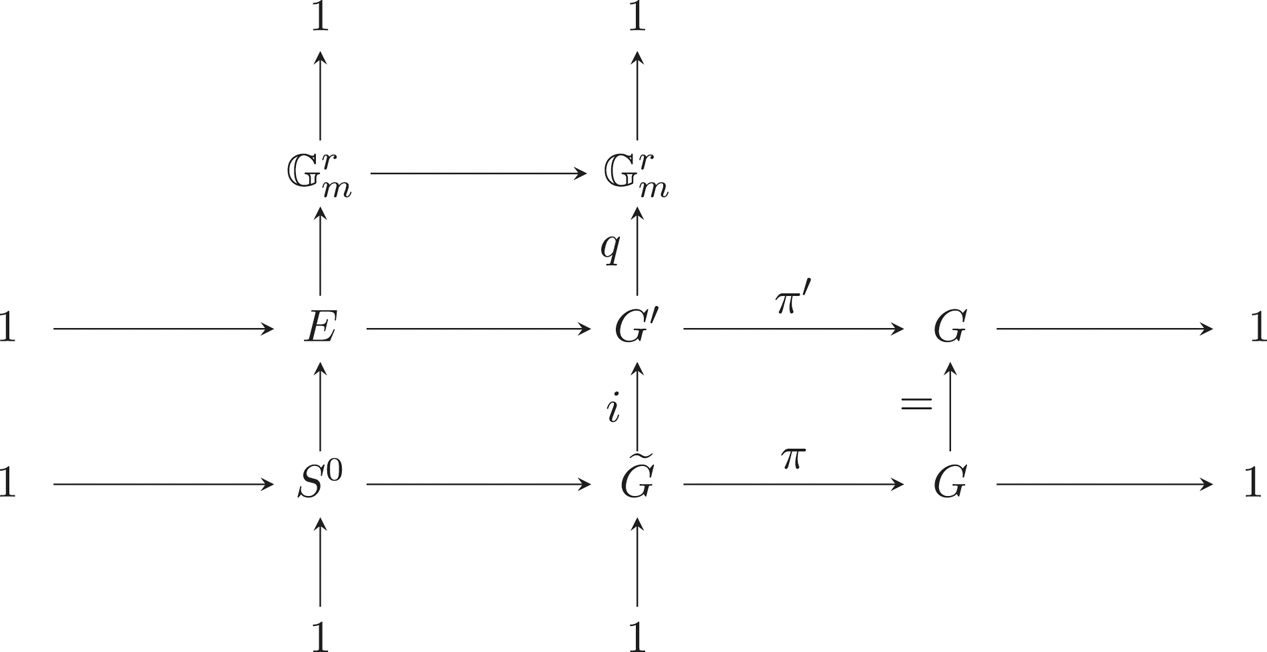 $k$ of separably good characteristic $p>0$ for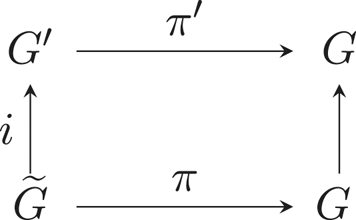 $G$. Under these assumptions, a Springer isomorphism $\phi : \mathcal {N}_{\mathrm {red}}(\mathfrak {g}) \rightarrow \mathcal {V}_{\mathrm {red}}(G)$ from the nilpotent scheme of $\mathfrak {g}$ to the unipotent scheme of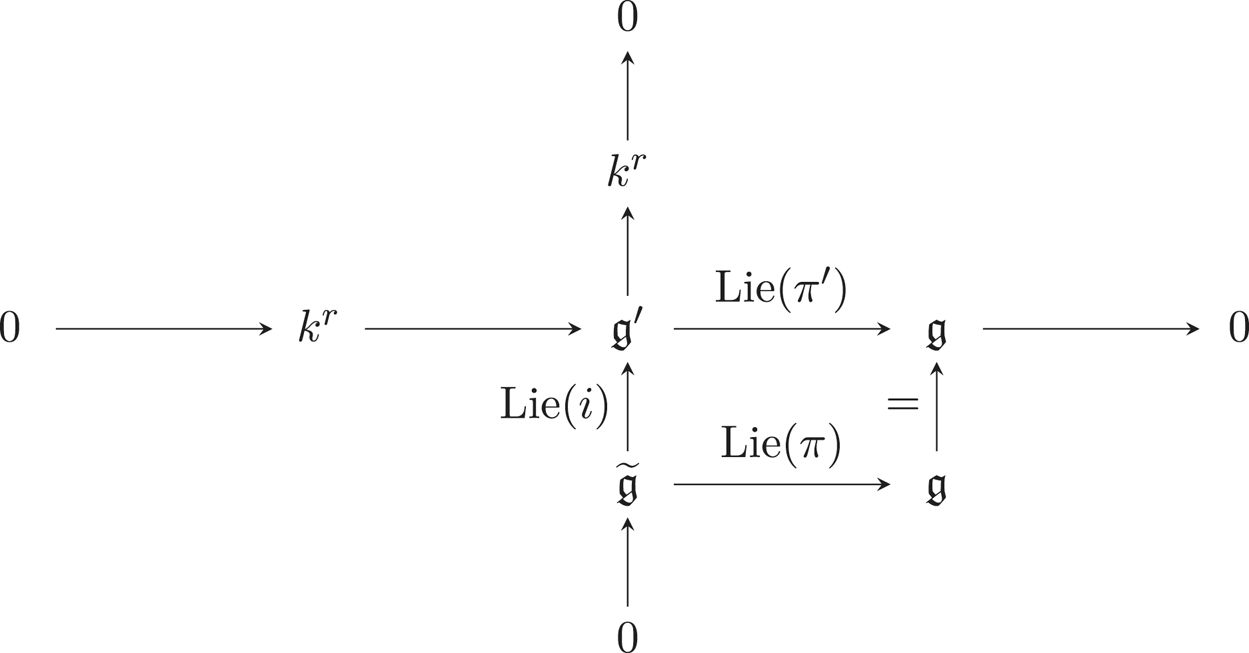 $G$ always exists and allows one to integrate any $p$-nilpotent element of $\mathfrak {g}$ into a unipotent element of $G$. One should wonder whether such a punctual integration can lead to an integration of restricted $p$-nil $p$-subalgebras of $\mathfrak {g}= \operatorname {Lie}(G)$. We provide a counter-example of the existence of such an integration in general, as well as criteria to integrate some restricted $p$-nil $p$-subalgebras of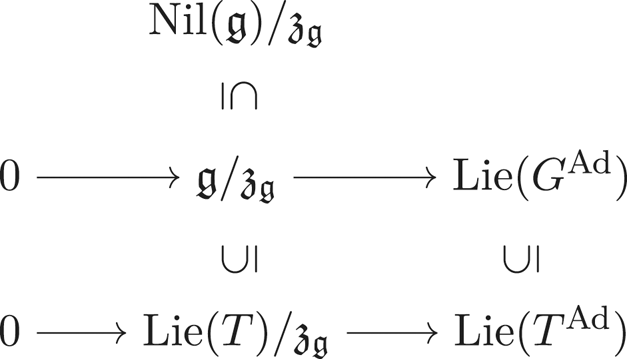 $\mathfrak {g}$ (that are maximal in a certain sense). This requires the generalisation of the notion of infinitesimal saturation first introduced by Deligne and the extension of one of his theorems on infinitesimally saturated subgroups of $G$ to the previously mentioned framework.
We consider the Weil–Petersson gradient vector field of renormalized volume on the deformation space of convex cocompact hyperbolic structures on (relatively) acylindrical manifolds. In this paper we prove the conjecture that the flow has a global attracting fixed point at the unique structure  $M_{\rm geod}$ with minimum convex core volume.
Let  $G_\Gamma \curvearrowright X$ and $G_\Lambda \curvearrowright Y$ be two free measure-preserving actions of one-ended right-angled Artin groups with trivial center on standard probability spaces. Assume they are irreducible, i.e. every element from a standard generating set acts ergodically. We prove that if the two actions are stably orbit equivalent (or merely stably $W^*$-equivalent), then they are automatically conjugate through a group isomorphism between $G_\Gamma$ and $G_\Lambda$. Through work of Monod and Shalom, we derive a superrigidity statement: if the action $G_\Gamma \curvearrowright X$ is stably orbit equivalent (or merely stably $W^*$-equivalent) to a free, measure-preserving, mildly mixing action of a countable group, then the two actions are virtually conjugate. We also use the works of Popa and Ioana, Popa and Vaes to establish the $W^*$-superrigidity of Bernoulli actions of all infinite conjugacy classes groups having a finite generating set made of infinite-order elements where two consecutive elements commute, and one has a nonamenable centralizer: these include one-ended nonabelian right-angled Artin groups, but also many other Artin groups and most mapping class groups of finite-type surfaces. ${B^+_{{\rm dR}}}$-Grassmannian
We establish a Harder–Narasimhan formalism for modifications of  $G$-bundles on the Fargues–Fontaine curve. The semi-stable stratum of the associated stratification of the ${B^+_{{\rm dR}}}$-Grassmannian coincides with the variant of the weakly admissible locus defined by Viehmann, and its classical points agree with those of the basic Newton stratum. When restricted to minuscule affine Schubert cells, the stratification corresponds to the Harder–Narasimhan stratification of Dat, Orlik and Rapoport. We also study basic geometric properties of the strata, and the relation to the Hodge–Newton decomposition.