Published on behalf of The London Mathematical Society
We partner with a secure submission system to handle manuscript submissions.
Please note:
Click Proceed to submission system to continue to our partner's website.
A celebrated result by Orlov states that any fully faithful exact functor between the bounded derived categories of coherent sheaves on smooth projective varieties is of geometric origin, i.e. it is a Fourier–Mukai functor. In this paper we prove that any smooth projective variety of dimension  $\ge 3$ equipped with a tilting bundle can serve as the source variety of a non-Fourier–Mukai functor between smooth projective schemes. ${{\mathbb {P}}}^{3}$
The main goal of this paper is to construct a compactification of the moduli space of degree  $d \geqslant 5$ surfaces in $\mathbb {P}^{3}_{{{\mathbb {C}}}}$, i.e. a parameter space whose interior points correspond to (equivalence classes of) smooth surfaces in $\mathbb {P}^{3}$ and whose boundary points correspond to degenerations of such surfaces. We consider a divisor $D$ on a Fano variety $Z$ as a pair $(Z, D)$ satisfying certain properties. We find a modular compactification of such pairs and, in the case of $Z = {{\mathbb {P}}}^{3}$ and $D$ a surface, use their properties to classify the pairs on the boundary of the moduli space.
The pentagram map takes a planar polygon  $P$ to a polygon $P'$ whose vertices are the intersection points of consecutive shortest diagonals of $P$. This map is known to interact nicely with Poncelet polygons, that is, polygons which are simultaneously inscribed in a conic and circumscribed about a conic. A theorem of Schwartz states that if $P$ is a Poncelet polygon, then the image of $P$ under the pentagram map is projectively equivalent to $P$. In the present paper, we show that in the convex case this property characterizes Poncelet polygons: if a convex polygon is projectively equivalent to its pentagram image, then it is Poncelet. The proof is based on the theory of commuting difference operators, as well as on properties of real elliptic curves and theta functions.
We study derived categories of Gorenstein varieties  $X$ and $X^+$ connected by a flop. We assume that the flopping contractions $f\colon X\to Y$,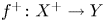 $f^+ \colon X^+ \to Y$ have fibers of dimension bounded by one and $Y$ has canonical hypersurface singularities of multiplicity two. We consider the fiber product $W=X\times _YX^+$ with projections $p\colon W\to X$, $p^+\colon W\to X^+$ and prove that the flop functors $F = Rp^+_*Lp^* \colon {\mathcal {D}}^b(X) \to {\mathcal {D}}^b(X^+)$, $F^+= Rp_*L{p^+}^* \colon {\mathcal {D}}^b(X^+) \to {\mathcal {D}}^b(X)$ are equivalences, inverse to those constructed by Van den Bergh. The composite $F^+ \circ F \colon {\mathcal {D}}^b(X) \to {\mathcal {D}}^b(X)$ is a non-trivial auto-equivalence. When variety $Y$ is affine, we present $F^+ \circ F$ as the spherical cotwist of a spherical couple $(\Psi ^*,\Psi )$ which involves a spherical functor $\Psi$ constructed by deriving the inclusion of the null category $\mathscr {A}_f$ of sheaves ${\mathcal {F}} \in \mathop {{\rm Coh}}\nolimits (X)$ with $Rf_*({\mathcal {F}} )=0$ into $\mathop {{\rm Coh}}\nolimits (X)$. We construct a spherical pair ( ${\mathcal {D}}^b(X)$, ${\mathcal {D}}^b(X^+)$) in the quotient ${\mathcal {D}}^b(W) /{\mathcal {K}}^b$, where ${\mathcal {K}}^b$ is the common kernel of the derived push-forwards for the projections to $X$ and $X^+$, thus implementing in geometric terms a schober for the flop. A technical innovation of the paper is the $L^1f^*f_*$ vanishing for Van den Bergh's projective generator. We construct a projective generator in the null category and prove that its endomorphism algebra is the contraction algebra.
Let  $A$ be a non-isotrivial ordinary abelian surface over a global function field of characteristic $p>0$ with good reduction everywhere. Suppose that $A$ does not have real multiplication by any real quadratic field with discriminant a multiple of $p$. We prove that there are infinitely many places modulo which $A$ is isogenous to the product of two elliptic curves.
Let  $X/\mathbb {F}_{q}$ be a smooth, geometrically connected, quasi-projective scheme. Let $\mathcal {E}$ be a semi-simple overconvergent $F$-isocrystal on $X$. Suppose that irreducible summands $\mathcal {E}_i$ of $\mathcal {E}$ have rank 2, determinant $\bar {\mathbb {Q}}_p(-1)$, and infinite monodromy at $\infty$. Suppose further that for each closed point $x$ of $X$, the characteristic polynomial of $\mathcal {E}$ at $x$ is in $\mathbb {Q}[t]\subset \mathbb {Q}_p[t]$. Then there exists a dense open subset $U\subset X$ such that $\mathcal {E}|_U$ comes from a family of abelian varieties on $U$. As an application, let $L_1$ be an irreducible lisse $\bar {\mathbb {Q}}_l$ sheaf on $X$ that has rank 2, determinant $\bar {\mathbb {Q}}_l(-1)$, and infinite monodromy at $\infty$. Then all crystalline companions to $L_1$ exist (as predicted by Deligne's crystalline companions conjecture) if and only if there exist a dense open subset $U\subset X$ and an abelian scheme $\pi _U\colon A_U\rightarrow U$ such that $L_1|_U$ is a summand of $R^{1}(\pi _U)_*\bar {\mathbb {Q}}_l$. $l \neq p$
We determine the local deformation rings of sufficiently generic mod  $l$ representations of the Galois group of a $p$-adic field, when $l \neq p$, relating them to the space of $q$-power-stable semisimple conjugacy classes in the dual group. As a consequence, we give a local proof of the $l \neq p$ Breuil–Mézard conjecture of the author, in the tame case.
This is the second of a series of two papers dealing with local limit theorems in relatively hyperbolic groups. In this second paper, we restrict our attention to non-spectrally degenerate random walks and we prove precise asymptotics of the probability  $p_n(e,e)$ of going back to the origin at time $n$. We combine techniques adapted from thermodynamic formalism with the rough estimates of the Green function given by part I to show that $p_n(e,e)\sim CR^{-n}n^{-3/2}$, where $R$ is the inverse of the spectral radius of the random walk. This both generalizes results of Woess for free products and results of Gouëzel for hyperbolic groups.
We prove the Kawamata–Viehweg vanishing theorem for surfaces of del Pezzo type over perfect fields of positive characteristic  $p>5$. As a consequence, we show that klt threefold singularities over a perfect base field of characteristic $p>5$ are rational. We show that these theorems are sharp by providing counterexamples in characteristic $5$.
$5$.
For complex simple Lie algebras of types B, C, and D, we provide new explicit formulas for the generators of the commutative subalgebra  $\mathfrak z(\hat {\mathfrak g})\subset {{\mathcal {U}}}(t^{-1}\mathfrak g[t^{-1}])$ known as the Feigin–Frenkel centre. These formulas make use of the symmetrisation map as well as of some well-chosen symmetric invariants of $\mathfrak g$. There are some general results on the rôle of the symmetrisation map in the explicit description of the Feigin–Frenkel centre. Our method reduces questions about elements of $\mathfrak z(\hat {\mathfrak g})$ to questions on the structure of the symmetric invariants in a type-free way. As an illustration, we deal with type G $_2$ by hand. One of our technical tools is the map ${\sf m}\!\!: {{\mathcal {S}}}^{k}(\mathfrak g)\to \Lambda ^{2}\mathfrak g \otimes {{\mathcal {S}}}^{k-3}(\mathfrak g)$ introduced here. As the results show, a better understanding of this map will lead to a better understanding of $\mathfrak z(\hat {\mathfrak g})$.
We show that the completed Hecke algebra of  $p$-adic modular forms is isomorphic to the completed Hecke algebra of continuous $p$-adic automorphic forms for the units of the quaternion algebra ramified at $p$ and $\infty$. This gives an affirmative answer to a question posed by Serre in a 1987 letter to Tate. The proof is geometric, and lifts a mod $p$ argument due to Serre: we evaluate modular forms by identifying a quaternionic double-coset with a fiber of the Hodge–Tate period map, and extend functions off of the double-coset using fake Hasse invariants. In particular, this gives a new proof, independent of the classical Jacquet–Langlands correspondence, that Galois representations can be attached to classical and $p$-adic quaternionic eigenforms.
For a not-necessarily commutative ring  $R$ we define an abelian group $W(R;M)$ of Witt vectors with coefficients in an $R$-bimodule $M$. These groups generalize the usual big Witt vectors of commutative rings and we prove that they have analogous formal properties and structure. One main result is that $W(R) := W(R;R)$ is Morita invariant in $R$. For an $R$-linear endomorphism $f$ of a finitely generated projective $R$-module we define a characteristic element $\chi _f \in W(R)$. This element is a non-commutative analogue of the classical characteristic polynomial and we show that it has similar properties. The assignment $f \mapsto \chi _f$ induces an isomorphism between a suitable completion of cyclic $K$-theory $K_0^{\mathrm {cyc}}(R)$ and $W(R)$.
Let  $Q$ be an acyclic quiver and $w \geqslant 1$ be an integer. Let $\mathsf {C}_{-w}({\mathbf {k}} Q)$ be the $(-w)$-cluster category of ${\mathbf {k}} Q$. We show that there is a bijection between simple-minded collections in $\mathsf {D}^b({\mathbf {k}} Q)$ lying in a fundamental domain of $\mathsf {C}_{-w}({\mathbf {k}} Q)$ and $w$-simple-minded systems in $\mathsf {C}_{-w}({\mathbf {k}} Q)$. This generalises the same result of Iyama–Jin in the case that $Q$ is Dynkin. A key step in our proof is the observation that the heart $\mathsf {H}$ of a bounded t-structure in a Hom-finite, Krull–Schmidt, ${\mathbf {k}}$-linear saturated triangulated category $\mathsf {D}$ is functorially finite in $\mathsf {D}$ if and only if $\mathsf {H}$ has enough injectives and enough projectives. We then establish a bijection between $w$-simple-minded systems in $\mathsf {C}_{-w}({\mathbf {k}} Q)$ and positive $w$-noncrossing partitions of the corresponding Weyl group $W_Q$.
We prove a formula, which, given a principally polarized abelian variety  $(A,\lambda )$ over the field of algebraic numbers, relates the stable Faltings height of $A$ with the Néron–Tate height of a symmetric theta divisor on $A$. Our formula completes earlier results due to Bost, Hindry, Autissier and Wagener. The local non-archimedean terms in our formula can be expressed as the tropical moments of the tropicalizations of $(A,\lambda )$.
We extend the theory of Koszul modules to the bi-graded case, and prove a vanishing theorem that allows us to show that the canonical ribbon conjecture of Bayer and Eisenbud holds over a field of characteristic  $0$ or at least equal to the Clifford index. Our results confirm a conjecture of Eisenbud and Schreyer regarding the characteristics where the generic statement of Green's conjecture holds. They also recover and extend to positive characteristics the results of Voisin asserting that Green's conjecture holds for generic curves of each gonality.