We partner with a secure submission system to handle manuscript submissions.
Please note:
You will need an account for the submission system, which is separate to your Cambridge Core account. For login and submission support, please visit the
submission and support pages.
Please review this journal's author instructions, particularly the
preparing your materials
page, before submitting your manuscript.
Click Proceed to submission system to continue to our partner's website.
To save this undefined to your undefined account, please select one or more formats and confirm that you agree to abide by our usage policies. If this is the first time you used this feature, you will be asked to authorise Cambridge Core to connect with your undefined account.
Find out more about saving content to .
To send this article to your Kindle, first ensure no-reply@cambridge.org is added to your Approved Personal Document E-mail List under your Personal Document Settings on the Manage Your Content and Devices page of your Amazon account. Then enter the ‘name’ part of your Kindle email address below. Find out more about sending to your Kindle.
Find out more about saving to your Kindle.
Note you can select to save to either the @free.kindle.com or @kindle.com variations. ‘@free.kindle.com’ emails are free but can only be saved to your device when it is connected to wi-fi. ‘@kindle.com’ emails can be delivered even when you are not connected to wi-fi, but note that service fees apply.
We show that if G is a finitely generated profinite group such that [x1, x2, …, xk] is Engel for any x1, x2, …, xk ∈ G, then γ(G) is locally nilpotent, and if [x1, x2, …, xk] has finite order for any x1, x2, …, xk ∈ G then, under some additional assumptions, γk(G) is locally finite.
Let X be a locally convex space. Kluvánek associated to each X-valued countably additive vector measure a conical measure on X; this can also be done for finitely additive bounded vector measures. We prove that every conical measure u on X, whose associated zonoform Ku is contained in X, is associated to a bounded additive vector measure σ(u) defined on X, and satisfying σ(u)(H) ∈ H, for every finite intersection H of closed half-spaces. When X is a complete weak space, we prove that σ(u) is countably additive. This allows us to recover two results of Kluvánek: for any X, every conical measure u on it with Ku ⊆ X is associated to a countably additive X-valued vector measure; and every conical measure on a complete weak space is localizable. When X is a Banach space, we prove that σ(u) is countably additive if and only if u is the conical measure associated to a Pettis differentiable vector measure.
We study DeLeeuw type theorems for certain multilinear operators on the Lebesgue spaces and on the Hardy spaces. As applications, on the torus we obtain an analog of Lacey—Thiele's theorem on the bilinear Hilbert transform, as well as analogies of some recent theorems on multilinear singular integrals by Kenig—Stein and by Grafakos—Torres.
This note gives a necessary condition, in terms of graded actions, for an inverse semigroup to be a full amalgam. Under a mild additional hypothesis, the condition becomes sufficient.
In a group G, um (G) denotes the subgroup of the elements which normalize every subnormal subgroup of G with defect at most m. The m-Wielandt series of G is then defined in a natural way. G is said to have finite m-Wielandt length if it coincides with a term of its m-Wielandt series. We investigate the structure of infinite groups with finite m-Wielandt length.
In this paper we treat two non-linear differential equations which come from complex dynamics theory. We give a complete classification of the equations when they possess transcendental meromorphic solutions.
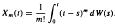
Let {W(t), t ≥ 0} be a standard Brownian motion. For a positive integer m, define a Gaussian process Watanabe and Lachal gave some asymptotic properties of the process Xm(·), m ≥ 1. In this paper, we study the bounds of its moduli of continuity and large increments by establishing large deviation results.
Two projective nonsingular complex algebraic curves X and Y defined over the field R of real numbers can be isomorphic while their sets X(R) and Y(R) of R-rational points could be even non homeomorphic. This leads to the count of the number of real forms of a complex algebraic curve X, that is, those nonisomorphic real algebraic curves whose complexifications are isomorphic to X. In this paper we compute, as a function of genus, the maximum number of such real forms that a complex algebraic curve admits.