To save content items to your account,
please confirm that you agree to abide by our usage policies.
If this is the first time you use this feature, you will be asked to authorise Cambridge Core to connect with your account.
Find out more about saving content to .
To save content items to your Kindle, first ensure no-reply@cambridge.org
is added to your Approved Personal Document E-mail List under your Personal Document Settings
on the Manage Your Content and Devices page of your Amazon account. Then enter the ‘name’ part
of your Kindle email address below.
Find out more about saving to your Kindle.
Note you can select to save to either the @free.kindle.com or @kindle.com variations.
‘@free.kindle.com’ emails are free but can only be saved to your device when it is connected to wi-fi.
‘@kindle.com’ emails can be delivered even when you are not connected to wi-fi, but note that service fees apply.
To provide a useful contextual backdrop to an exhibition at the Royal College of Psychiatrists this summer, we used a question and answer format to summarise the thoughts of its curator, Gavin Miller. Gavin has chosen 12 books published by Penguin between 1949 and 1975 to illuminate the relationship between psychiatrists, psychologists, psychotherapists and the British media. He reflects on the opportunities and pitfalls that come with the association, the motivations of previous writers and provides practical advice for any media psychiatrists considering such a role in the future. The exhibition is open to visitors to the College building in London.
The HTAi Health Technology Assessment (eHTA) Working Group’s (WG) development of a consensus definition of early eHTA, as reported in Grutters et al. (1), represents a major step towards the establishment of eHTA as a distinct subdiscipline of HTA. In a global landscape in which growth in pharmaceutical spending is driven by the increasing number of high-cost specialty drugs (2–6), and where the cost of new entrants is not systematically associated with their clinical benefit (7;8), broader uptake of eHTA by pharmaceutical innovators offers a route to improving the value delivered by our collective investments in drug research and development (R&D). As we argue in this commentary, the WG’s report provides a coherent framework within which to further define appropriate eHTA methods for specific use cases as well as eHTA’s relationship to other decision-making tools currently used by health technology innovators and funders.
Plants exhibit diverse morphological, anatomical and physiological responses to hypoxia stress from soil waterlogging, yet coordination between these responses is not fully understood. Here, we present a mechanistic model to simulate how rooting depth, root aerenchyma -porous tissue arising from localized cell death-, and root barriers to radial oxygen loss (ROL) interact to influence waterlogging survival. Our model revealed an interaction between rooting depth and the relative effectiveness of aerenchyma and ROL barriers for prolonging waterlogging survival. As the formation of shallow roots increases waterlogging survival time, the positive effect of aerenchyma becomes more apparent with increased rooting depth. While ROL barriers further increased survival in combination with aerenchyma in deep-rooted plants, ROL barriers had little positive effect in the absence of aerenchyma. Furthermore, as ROL barriers limit root-to-soil oxygen diffusion bidirectionally, our model revealed optimality in the timing of ROL formation. These findings highlight the importance of coordination between morphological and anatomical responses in waterlogging resilience of plants.
Therapeutic adherence during pregnancy is critical for maternal and fetal health. This study examines personality traits, sensitivity to stimuli and socio-demographic factors influencing adherence among Italian women with high-risk pregnancies.
Methods
Ninety women from “Villa Sofia—V. Cervello Hospital”, in Palermo, Italy, participated. Personality traits were assessed via the Personality Inventory (PI), covering Extraversion, Conscientiousness, Neuroticism, Mental Openness, and Friendliness. Sensitivity to stimuli was evaluated using the Highly Sensitive Person (HSP) Scale, which includes Low Sensory Threshold (LST), Ease of Excitement (EOE), and Aesthetic Sensitivity (AES). Treatment adherence was measured using the Morisky Medication Adherence Scale (MMAS).
Results
Conscientiousness was identified as a positive predictor of medication adherence (OR = 1.08, p = .010), while Mental Openness (OR = 0.81, p = .003) and EOE (OR = 0.92, p = .014) were negative predictors. Higher education levels were associated with better adherence (OR = 2.34, p = .006). Significant occupational differences emerged, with office clerks exhibiting higher adherence compared to housekeepers (OR = 3.18, p = .008). Planned (OR = 0.38, p = .025) and unplanned but wanted pregnancies (OR = 0.42, p = .045) showed lower adherence. Regression analysis indicated that Neuroticism (β = −0.21, p = .032) and EOE (β = −0.28, p = .008) negatively impacted adherence.
Conclusion
Specific personality traits, sensitivity, education, occupation, and pregnancy significantly influence adherence. Tailored interventions that enhance conscientiousness, address mental openness and sensitivity, and consider individual socio-demographic context are needed to promote better adherence and improve maternal and fetal health outcomes in high-risk pregnancies.
Detecting structural changes in economic relationships has been a longstanding challenge in econometrics. Most of the literature on structural breaks has considered abrupt structural breaks. Existing tests for detecting smooth structural change typically rely on kernel estimation. In this article, we introduce a novel tuning-parameter-free test that minimizes a criterion function over all possible nondecreasing or nonincreasing structural change functions. This test is pivotal (after appropriate scaling) in the scalar case and remains computationally simple even in multivariate settings. Compared to existing nonparametric tests, our method offers superior power against local monotonic structural changes and does not involve the choice of a bandwidth parameter. A simulation study and two empirical examples highlight the merits of the proposed test relative to some popular tests for structural changes in the literature.
Expressive writing interventions (EWIs) are associated with important psychological and physical outcomes in patients with cancer. However, EWIs have not been widely integrated into routine psychosocial care of cancer populations. A review of the current literature on EWIs’ impact on the cancer patient experience, including qualitative analyses of patient perspectives, will increase our understanding of barriers and facilitators to adoption in clinical settings.
Objectives
To bridge existing gaps in the literature by examining quantitative and qualitative studies on EWIs for patients with cancer. To present recent data examining the benefits of EWI’s for patients with cancer.To provide strategies for clinicians engaging in EWI’s for their patients.
Methods
Informed by the Preferred Reporting Items for Systematic reviews and Meta-Analysis (PRISMA) guidelines, we completed a scoping review of relevant quantitative and qualitative articles published from 2015 to 2025 to assess the impact of EWIs on health-related outcomes (e.g., physical symptoms and quality of life [QOL]) as well as approaches to improve their use in patients with cancer.
Results
Of the 28 studies with 3527 patients that we analyzed, 24 were quantitative and 4 were qualitative. Most studies were conducted in the USA (42.8%) or China (28.6%) and included patients with breast cancer (71.4%) or only included women (71.4%). Of the patients in the studies, 46.8% identified as White, 42.8% as Asian, 5.5% as Black, and 4.5% as Latino. Twenty-one of the quantitative studies found that EWIs were positively associated with cancer patients’ QOL and/or physical health outcomes. Of the 4 qualitative studies, themes of narrative reconstruction, cultural disclosure norms, and intervention delivery format emerged. The characteristics of EWI methods can be tailored to maximize therapeutic benefits through cultural adaptation, timing, and privacy.
Significance of results
Despite promising associations between EWIs and health-related outcomes in patients with cancer, EWIs for cancer populations are heterogeneous and randomized clinical trials are limited. Larger trials that establish the efficacy of EWIs in diverse cancer populations are warranted.
Modelling the nonlinear forcing is critical for linear models based on resolvent or input–output analyses. For compressible wall-bounded turbulence, little is known on what the real forcing looks like due to limited data, so the prediction agrees more qualitatively than quantitatively with direct numerical simulations (DNSs). Here, we present detailed forcing statistics of stochastic linear models, derived from elaborate DNS datasets for channel flows with bulk Mach number reaching 3. These statistics directly explain the success and failure of current models and provide guidance for further improvements. The benchmark linearised Navier–Stokes (LNS) and eLNS models are considered; the latter is assisted by eddy-viscosity-related terms. First, we prove the self-consistency of the models by using DNS-computed forcing as the input. Second, we present the spectral distributions of the forcing and its components. Third, we quantify the acoustic components, absent in incompressible cases, within the linear models. We reveal that the LNS forcing can exhibit relatively high coherence and low rank, very different from the modelled diagonal full-rank forcing. The eddy-viscosity-related term is not partial modelling of the LNS forcing; contrarily, the former is much larger than the latter, serving to disrupt the low-rank feature, enhance diagonal dominance and increase robustness across scales. The scales narrow in either horizontal direction are most susceptible to acoustic modes, while the others are little affected (${\lt}2\,\%$ in energy). Furthermore, the extended strong Reynolds analogy is assessed in predicting the density and temperature components.
Given a Hamiltonian torus action on a symplectic manifold, Teleman and Fukaya have proposed that the Fukaya category of each symplectic quotient should be equivalent to an equivariant Fukaya category of the original manifold. We lay out new conjectures that extend this story – in certain situations – to singular values of the moment map. These include a proposal for how, in some cases, we can recover the non-equivariant Fukaya category of the original manifold starting from data on the quotient.
To justify our conjectures, we pass through the mirror and work out numerous examples, using well-established heuristics in toric mirror symmetry. We also discuss the algebraic and categorical structures that underlie our story.
While the previous studies of the world history of literature are mostly concerned with the cross-cultural dissemination of literature, this article intends to analyse the intermediality of world literature in light of intermedial studies. It argues that the cross-cultural transmissions of literature are often entangled with and empowered by the intermedial interactions between literature and different forms of art. Under the theoretical framework of cross-cultural and intermedial studies, two representative Chinese literary works are discussed at length, namely Mulan ci (The Ballad of Mulan, sixth century) and Hong gaoliang (Red Sorghum, 1987). In addition to a careful analysis of their respective history of overseas transmissions, a comparative study of the two, an ancient poem and a modern novel, is carried out to show how the evolution of media has contributed to the cross-cultural transmissions of literature.
The intensity of the turbulence in tokamaks and stellarators depends on its ability to excite and sustain zonal flows. Insight into this physics may be gained by studying the ‘residual’, i.e. the late-time linear response of the system to an initial perturbation. We investigate this zonal-flow residual in the limit of a small magnetic mirror ratio, where we find that the typical quadratic approximation to RH (Rosenbluth & Hinton, 1998 Phys. Rev. Lett. vol. 80, issue 4, pp. 724–727) breaks down. Barely passing particles are in this limit central in determining the resulting level of the residual, which we estimate analytically. The role played by the population with large orbit width provides valuable physical insight into the response of the residual beyond this limit. Applying this result to tokamak, quasi-symmetric and quasi-isodynamic equilibria, using a near-axis approximation, we identify the effect to be more relevant (although small) in the core of quasi-axisymmetric fields, where the residual is smallest. The analysis in the paper also clarifies the relationship between the residual and the geodesic acoustic mode, whose typical theoretical set-ups are similar.
It is thought that isolated neutron stars receive a natal kick velocity at birth nearly aligned with their spin axis. Direct observational confirmation of this alignment is currently limited to a single source in a supernova remnant (PSR J0538+2817), for which the three-dimensional velocity has been well constrained. Meanwhile, pulsar polarisation statistics suggest the existence of a spin-kick correlation, though both aligned and orthogonal cases remain possible. However, if the velocities of radiopulsars are predominantly aligned with their spin axes, a systematic difference in the observed transverse velocities of pulsars with small and large magnetic obliquities would be expected. In particular, due to projection effects, weakly oblique rotators should exhibit smaller, less scattered transverse velocities. Conversely, the transverse velocities of pulsars with large magnetic inclination should reflect their actual three-dimensional velocities. This study uses this idea to analyse samples of 13 weakly and 25 strongly oblique pulsars with known distances and proper motions. We find that their peculiar velocities are distributed differently, with statistical confidence levels of 0.007 and 0.016 according to the Anderson–Darling and Kolmogorov–Smirnov tests, respectively. We performed a detailed population synthesis of isolated pulsars, considering the evolution of their viewing geometry in isotropic and spin-aligned kick scenarios. The observed split in the transverse velocity distributions and its amplitude are consistent with the spin-aligned kick model, but not with the isotropic case. At the same time, an orthogonal kick would predict a similar effect, but with the opposite sign. This provides robust support for pulsar spin kick alignment based on statistics, independently of polarisation.
This article offers a four-part argument in favor of settlers adopting an ethics of recognition in negotiations with Indigenous peoples to support decolonization in North America. Part 1 examines theories of decolonization offered by Indigenous scholars, who show that ethical practices within Indigenous communities are necessary for decolonization. Part 2 focuses on James Tully’s revision of the liberal politics of recognition (LPR), arguing that Tully brings the LPR closer to the aims of decolonization. Part 3 argues that his innovations do not sufficiently acknowledge how inequality undermines the freedom he champions. Part 4 draws on Judith Butler’s interpretation of Hegelian recognition and Leanne Betasamosake Simpson’s idea of recognition to sketch an ethics that minimizes the inequalities of participants in the political negotiations Tully theorizes. Minimizing inequality will promote the greater freedom needed for the legitimacy of negotiations, making them a possible vehicle for decolonization.
The increasing relevance of horizon scanning (HS), early awareness (EA), and disinvestment (DIS) highlights the need for a structured approach to capacity building. Although these fields are essential for evidence-based policy decisions, a harmonized education and training framework to develop necessary competencies is lacking. This article presents the development of a curriculum designed to address this gap in training.
Methods
A transdisciplinary working group was established, drawing on international stakeholders from academia, the public sector, and industry. Using an iterative consensus-driven approach, the group developed a modular curriculum. The curriculum design incorporated best practices from existing education programs in related fields and emphasized case-based learning strategies to ensure contextual adaptability.
Results
The resulting curriculum covers theoretical foundations, practical applications, and decision-making processes related to HS, EA, and DIS in eight modules. It supports diverse learner needs, including trainees, training institutions, and public and private organizations, and is designed to be flexible, scalable, and applicable across different regional and organizational contexts.
Conclusions
This curriculum initiative represents a major step toward harmonizing capacity building in HS, EA, and DIS. It fosters sustainability, enhances global health system preparedness, and provides a structured educational platform to support the effective integration of emerging health technologies and evidence-based disinvestment strategies.
New musical instruments of the electronic and digital eras have explored spatialisation through multidimensional speaker arrays. Many facets of 2D and 3D sound localisation have been investigated, often in tandem with immersive fixed-media compositions: spatial trajectory and panning; physics-based effects such as artificial acoustics, reverberation and Doppler shifts; and spatially derived synthesis methods. Within the realm of augmented spatial string instruments, the EV distinguishes itself through a unique realisation of the possibilities afforded by these technologies. Initially conceived as a tool for convolving the timbres of synthesised and acoustic string signals, the EV’s exploration of spatial sound has led to new experiments with timbre. Over time, additional sound-generation modules have been integrated, resulting in an increasingly versatile palette for immersive composition. Looking forward, the EV presents compelling opportunities for sonic innovation.
In many countries, overall animal experimentation is not significantly decreasing or becoming less severe. Does this show that these countries’ programs to promote alternatives and the “three Rs” of “replace, reduce, refine” are failing? Scholars and activists sometimes take this for granted, but representatives of “three Rs” programs have disagreed. This article makes two contributions to the debate: one conceptual and one normative. First, it draws attention to the distinction between evaluating impact (whether a program makes a difference) and evaluating sufficiency (whether a program makes enough of a difference to achieve its goals). Total numbers are typically unhelpful in assessing impact, but depending on goals, they can be relevant in assessing sufficiency. Second, this article argues that an overall decrease in harm to animals in experimentation is a sensible policy goal. This article concludes with suggestions for how to go beyond the “three Rs” to effect overall change.
We prove lower bounds on the density of regular minimal cones of dimension less than seven provided the complements of the cones are topologically nontrivial.
The wake merging of two side-by-side porous discs with varying disc spacing is investigated experimentally in a wind tunnel. Two disc designs used in the literature are employed: a non-uniform disc and a mesh disc. Hot-wire anemometry is utilised to acquire two spanwise profiles at 8 and 30 disc diameters downstream and along the centreline between the dual-disc configuration up to 40 diameters downstream. The spanwise Castaing parameter profiles confirm the appearance of rings of internal intermittency at the outermost parts of the wakes. These rings are the first feature to interact between the discs. After this point, the turbulence develops to a state whereby an inertial range is observable in the spectra. Farther downstream, the internal intermittency shows the classical features of homogeneous, isotropic turbulence. These events are repeatable and occur in the same order for both types of porous discs. This robustness allows us to develop a general map of the merging of the two wakes.
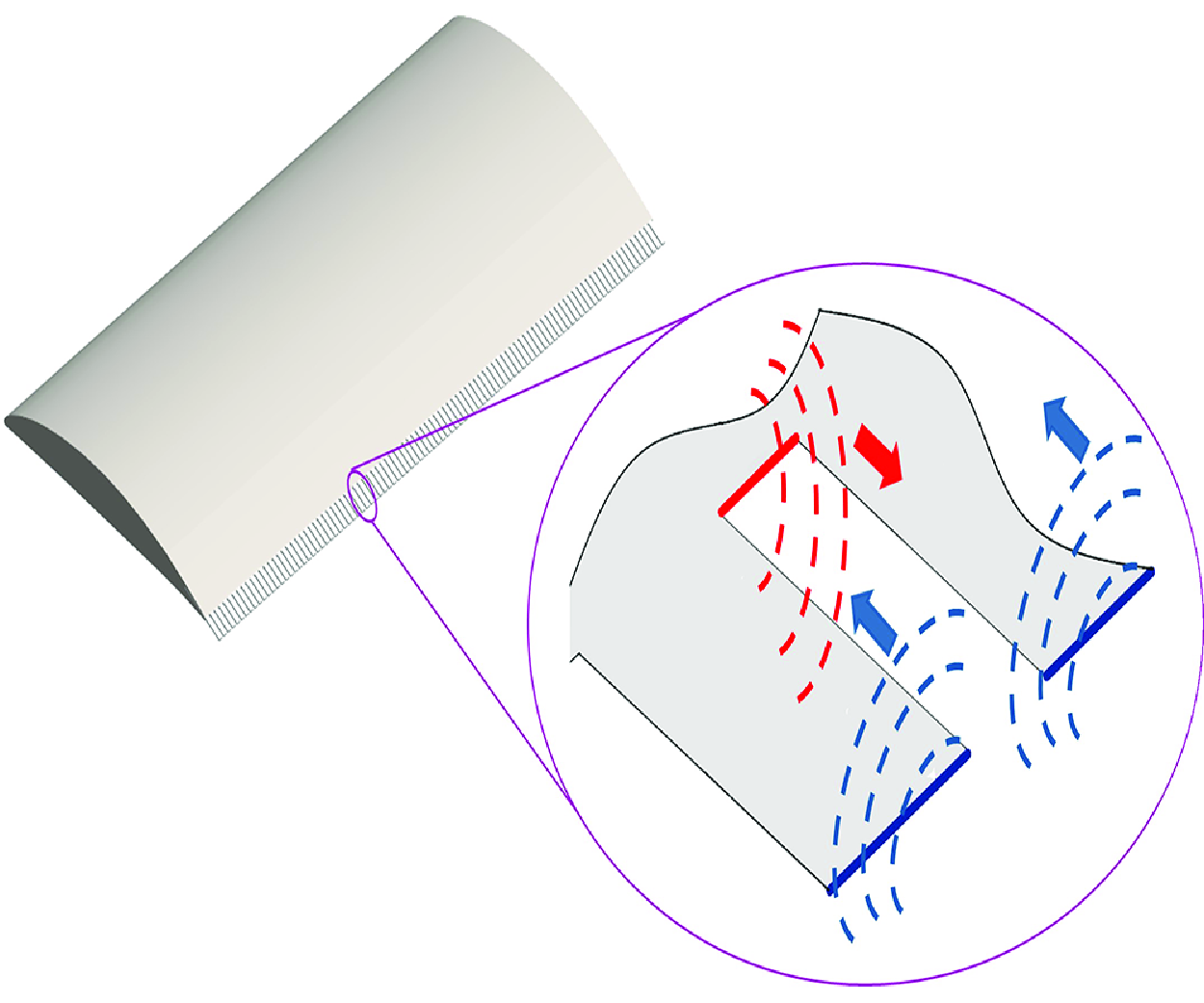
This paper presents an experimental and analytical investigation into the use of trailing edge slits for the reduction of aerofoil trailing edge noise. The noise reduction mechanism is shown to be fundamentally different from conventional trailing edge serrations, relying on destructive interference from highly compact and coherent sources generated at either ends of the slit. This novel approach is the first to exploit the coherence intrinsic to the boundary layer turbulence. Furthermore, the study demonstrates that trailing edge slits not only achieve superior noise reductions compared with sawtooth serrations of the same amplitude at certain conditions, but also offer frequency-tuning capability for noise reduction. Noise reduction is driven by the destructive interference between acoustic sources at the root and tip of the slit, which radiate with a phase difference determined by the difference in times taken for the boundary layer flow to convect between the root and tip. Maximum noise reductions occur at frequencies where the phase difference between these sources is $180^\circ$. The paper also presents a detailed parametric study into the variation in noise reductions due to the slit length, slit wavelength and slit root width. Additionally, a simple two-source analytic model is proposed to explain the observed results. Wind tunnel measurements of the unsteady flow field around the trailing edge slits are also presented, providing insights into the underlying flow physics.
We compared indices for cerebrovascular health (i.e., physiological responses to tilts by measuring regional cerebral oxygenation [rcSO2], cerebrovascular stability, and cerebral fractional tissue oxygen extraction [FTOE]) in infants with congenital heart disease (CHD) versus healthy controls (HC) at neonatal and 3-month ages.
Study design:
Our cohort study included 101 neonates (52 CHD, 49 HC) and 108 infants at 3-months (45 CHD, 63 HC). We used an innovative and replicable evaluation tool to noninvasively and rapidly measure indices of cerebrovascular health. Changes in near infrared spectroscopy measures of rcSO2 after tilting (from supine to sitting, ∼150 values) assessed cerebrovascular stability. Mixed-effects regression models examined rcSO2 and FTOE differences between groups, and group-by-posture interactions, adjusting for postconceptional age, sex, ethnicity, and preductal systemic oxygenation (SpO2) at both ages.
Results:
Infants with CHD had significantly lower rcSO2 (13% at neonatal and 11% at 3-months, both p < 0.001), increased FTOE (∼0.14 points higher at neonatal and ∼ 0.09 points at 3-months, both p < 0.001), and reduced cerebrovascular stability compared with HC at both ages (both p < 0.001).
Conclusions:
CHD infants had persistently poorer indices of cerebrovascular health (i.e., lower rcSO2, increased FTOE, and reduced cerebrovascular stability) through the 3-month age compared to controls. Sustained cerebral hypoxia, reduced cerebrovascular stability, and increased FTOE may contribute to neurodevelopmental delays (NDDs) and could serve as early biomarkers for identifying infants at higher risk for NDD.
Both gesture and talk are basic building blocks of face-to-face conversation. In this study, we address the temporal dynamics of hand gesture phases relative to places and types of turn transition. We annotated gesture features and measured temporal aspects of gesture related to speech in two languages, German and Swedish. We found variation in the temporal relationships of gesture types and alignment of gesture phases that relate to the management of turn-taking in conversation. Specifically, the frequency of different gesture phases accompanying the offset of speech differed depending on whether the same speaker held the floor or whether a new speaker took up a turn. In addition, we found that differences in temporal alignment of gesture phases can distinguish between the type of turn transition that is upcoming up to a second before the place of transition is reached. Our results emphasize the importance of the interaction of the verbal and the gestural modality to maintain the smooth flow of conversation.