To save content items to your account,
please confirm that you agree to abide by our usage policies.
If this is the first time you use this feature, you will be asked to authorise Cambridge Core to connect with your account.
Find out more about saving content to .
To save content items to your Kindle, first ensure no-reply@cambridge.org
is added to your Approved Personal Document E-mail List under your Personal Document Settings
on the Manage Your Content and Devices page of your Amazon account. Then enter the ‘name’ part
of your Kindle email address below.
Find out more about saving to your Kindle.
Note you can select to save to either the @free.kindle.com or @kindle.com variations.
‘@free.kindle.com’ emails are free but can only be saved to your device when it is connected to wi-fi.
‘@kindle.com’ emails can be delivered even when you are not connected to wi-fi, but note that service fees apply.
The material in this section sets the stage for the content in the subsequent chapters. Key notions, including ideology, are pointed out, and the focal geographic area, the Balkan peninsula of Southeast Europe, is identified as a hotspot for multilingualism and language contact, with specific reference to the structural and lexical parallelism seen in the Balkans and to the key construct of the “Balkanism”, i.e., a contact-induced convergent feature. Mention is made as well of the range of handbook-like presentations about the language situation in the Balkans. Finally, in light of the many works on the Balkans, a justification is provided for the present volume, and the place that it aspires to in treatments of the Balkans from a linguistic perspective.
Edited by
Lisa Vanhala, University College London,Elisa Calliari, International Institute for Applied Systems Analysis, Vienna and Euro-Mediterranean Centre on Climate Change, Venice
The case of The Bahamas highlights the institutionally disruptive impacts of climate change. Despite pioneering efforts in national adaptation legislation in the mid 2000s, the chapter finds that The Bahamas has largely focused on relatively conservative programs concerned with climate change mitigation rather than adaptation or loss and damage. Yet drawing on semi-structured interviews and an analysis of relevant policy documents, the chapter also suggests that climate change has impacted the configuration of relevant institutional bodies in The Bahamas. As the analysis demonstrates, the loss and damage associated with several extreme weather events in the late 2010s led to the establishment of the Ministry of Disaster Preparedness, Management and Reconstruction; the strengthening of the legal framework for environmental protection; and the growing resonance among civil society organizations of the implications of climate change for their humanitarian and nature preservation work. The chapter argues that while much of The Bahamas’ loss and damage policy agenda is focused on developing the knowledge, resources, skills, and governance frameworks to grapple with the impacts of climate change, it is also worth paying attention to how climate change impacts are reshaping political institutions and defining the possible contours of knowledge generation.
We investigated the effects of maternal vitamin and mineral supplementation throughout gestation on gene expression in the jejunal mucosa of neonatal calves. Crossbred Angus heifers (n = 14) were estrus synchronized, bred to female-sexed semen, and randomly assigned to a basal diet (Control, CON; n = 7) or the basal diet plus vitamin and mineral supplement (Treatment, VTM; n = 7). After parturition, calves were removed from their dams before suckling, fed colostrum replacer, and euthanized 30 h after the first feeding. A subsample of the mucosa of the mid-jejunum was collected, and total RNA was isolated. Gene expression was measured using RNA-Seq, and differentially expressed genes (DEGs) were identified using DESeq2. We identified 528 DEGs from the jejunal mucosa between the VTM and CON calves (P ≤ 0.05 and |log2FC| ≥ 0.5). The DEGs were associated with nutrient transport, lipid metabolism, and immune-related biological processes and pathways. Interestingly, genes underlying the complement and coagulation cascades were mostly downregulated in calves born to VTM dams. On the other hand, the cytokine-cytokine receptor interaction KEGG pathway showed most genes upregulated (LIFR, KDR, TNFRSF4, TNFSF18, FLT1, and TNFRSF12A). Our results show that vitamin and mineral supplementation throughout gestation affects genes underlying tissue structure, nutrient transport and metabolism, and immune system pathways in neonates. The implications of such changes and the long-term outcomes on herd health and performance warrant further research.
This study investigated surface energy fluxes of the Huayna-Potosí Glacier in Bolivia to validate existing empirical melt estimates, including degree-day models and enhanced temperature-index models. A multilayer energy balance model of the snowpack was employed to estimate melt energy and analyze its correlation with meteorological variables. The energy balance analysis revealed that melt energy peaked in October and November, the period corresponding to the progressive development toward the core wet season. Most of the net radiation was consumed by the conductive heat flux into the snowpack or glacier ice, contributing to surface temperature increases. The remaining energy was used for melt. An analysis of diurnal variation indicated that atmospheric longwave radiation suppresses melt during the dry season while driving melt during the wet season. Variables such as specific humidity and relative humidity, which are related to atmospheric longwave radiation, emerged as primary controlling factors after solar radiation in estimating melt based on meteorological variables. This study highlights that a combination of solar radiation and specific humidity outperforms existing empirical melt models that depend exclusively on temperature or a combination of temperature and solar radiation.
Recent studies portray civil servants as potential guardians against populist attempts to undermine liberal democracy. However in polarized societies, bureaucrats, like citizens, tend to hold divergent perceptions of the threat that politicians’ actions pose to democracy. This, in turn, likely shapes bureaucrats’ responses. We examine this in the context of the attempt by Israel’s extreme right-wing populist government to curtail the powers and independence of the Israeli Supreme Court and replace legal advisors with political appointees (hereafter the “legal overhaul”). We employ a mixed-methods design, combining a survey, interviews, and a focus group with career civil servants, showing that those who perceive the legal overhaul as a threat to democracy are more inclined to exit government and less likely to voice and exert effort at work. These findings are attributed to respondents’ views of the legal overhaul as leading to future politicization, curtailed influence, and a threat to their role as civil servants.
We determine the geometric monodromy groups attached to various families, both one-parameter and multi-parameter, of exponential sums over finite fields, or, more precisely, the geometric monodromy groups of the $\ell $-adic local systems on affine spaces in characteristic $p> 0$ whose trace functions are these exponential sums. The exponential sums here are much more general than we previously were able to consider. As a byproduct, we determine the number of irreducible components of maximal dimension in certain intersections of Fermat surfaces. We also show that in any family of such local systems, say parameterized by an affine space S, there is a dense open set of S over which the geometric monodromy group of the corresponding local system is a fixed known group.
The virtues of the scapular tip free flap for reconstruction of complex midface oncologic defects have been claimed by many. To obtain optimal functional and aesthetic results, precise positioning of the free flap used for reconstruction is paramount.
Methods
Four cases illustrate our approach to midface reconstruction with angular branch-based scapular tip flaps. A standard surgical navigation device was used both to plan bone cuts for the oncologic resection and to optimise the positioning of the flap.
Results
Case 1 illustrates the usefulness of navigation for reconstruction of total palato-septectomy defects, using a horizontally positioned flap. Optimal neo-palate height, alignment of the anterior nasal spine and nasal projection were obtained. For cases 2–4, vertical inset of the flap yielded optimal midface projection and orbital floor position.
Conclusion
Surgical navigation systems are useful adjuncts for midface reconstruction.
Edited by
Lisa Vanhala, University College London,Elisa Calliari, International Institute for Applied Systems Analysis, Vienna and Euro-Mediterranean Centre on Climate Change, Venice
We present a systematic search for Odd Radio Circles (ORCs) and other unusual radio morphologies using data from the first year of the Evolutionary Map of the Universe (EMU) survey. ORCs are rare, enigmatic objects characterised by edge-brightened rings of radio emission, often found in association with distant galaxies. To identify these objects, we employ a hybrid methodology combining supervised object detection techniques and visual inspection of radio source candidates. This approach leads to the discovery of five new ORCs and two additional candidate ORCs, expanding the known population of these objects. In addition to ORCs, we also identify 55 Galaxies with Large-scale Ambient Radio Emission (GLAREs), which feature irregular, rectangular, or circular shapes of diffuse radio emission mostly surrounding central host galaxies. These GLAREs may represent different evolutionary stages of ORCs and studying them could offer valuable insights into their evolutionary processes. We also highlight a subset of Starburst Radio Ring Galaxies, which are star-forming galaxies exhibiting edge-brightened radio rings surrounding their central star-forming regions. We emphasise the importance of multi-wavelength follow-up observations to better understand the physical properties, host galaxy characteristics, and evolutionary pathways of these radio sources.
EU’s political mediation in internal constitutional matters as part of its evolving vision of the rule of law – Dimensions of the EU’s dialogic rule of law: ontological, organic, and legitimising – The idea of the rule of law as embedded in intrincate political and social processes – The rule of law as the core driving force in creating spaces and boundaries for dialogue, interaction, and definition of the EU’s multilevel constitutional system – Balancing inherent dialogue with decisive and strong action against member states breaching the rule of law – Multiple forms of the ideal of the rule of law within the EU’s composite constitutional framework – No one-size-fits-all response: context-sensitive approaches to rule of law deviations – Institutionalising and legally integrating mediation as an instrument in the EU’s Rule of Law Framework.
Spousal age differences are highest in Sub-Saharan Africa, where trends in age at first marriage indicate an increase for both men and women. However, the net outcome for spousal age difference is difficult to predict without explicit analysis of these distributions. This study examines differentials in spousal age for women in first union. Further, it examines differences within population sub-groups and across countries, focusing on the influence of age at marriage and educational attainment. The analysis pools 144 survey datasets from the Demographic and Health Surveys (DHS) and Multiple Indicator Cluster Surveys (MICS) conducted between 1980 and 2020 in 34 countries. OLS regression analysis was used to predict the spousal age difference at marriage with five-year cohorts used to study time trends. The analysis finds a decline of 1.7 years in the spousal age difference at first marriage between the earliest (1980–1984) and most recent (2014–2019), indicating that there has been minimal reduction in age at first marriage over four decades, despite rising ages at marriage for females. Increasing age at first marriage and educational attainment of women partly explain the decline observed over time.
While existing research on policy diffusion has provided substantial evidence regarding the drivers of policy adoption across jurisdictions, limited attention has been given to the dynamics of policy textual learning across different levels of government. We fill this gap by using regression analysis to examine the patterns of policy textual learning evident in the clause similarity of seven environmental statutory policies in China. Within China’s decentralized and multilevel environmental governance, our findings reveal that horizontal policy textual learning is more prominent than vertical learning. Temporal distance negatively impacts policy textual learning, whereas spatial distance, contrary to traditional policy diffusion perspectives, does not universally explain multilevel policy textual learning. Additionally, subsequent versions of policy texts are not necessarily similar to earlier ones, challenging conventional assumptions about the adoption and adaptation of policies over time.
Edited by
Lisa Vanhala, University College London,Elisa Calliari, International Institute for Applied Systems Analysis, Vienna and Euro-Mediterranean Centre on Climate Change, Venice
This chapter provides a detailed overview of the broad theoretical framework developed for the book. It begins by reviewing the extensive literature on climate change policy adoption and argues that existing theories have been overly focused on mitigation policies in the Global North. It details the broad-based analytical framework which guides the case study analysis and which incorporates considerations of: (a) countries’ vulnerability to climate change impacts; (b) international engagement on the issue of loss and damage; (c) national institutional factors; and (d) the role of ideas, including knowledge and norms. The chapter delves into each element of the framework and discusses the limitations of the research design. It then turns to describing the book’s abductive and iterative methodological approach, which moves between existing theoretical propositions and data gathered through the analysis of law and policy documents and more than seventy-five interviews with national stakeholders across the case studies. The chapter concludes by highlighting the epistemic value of the book’s approach, which has involved partnering with researchers in the Global South to co-develop, undertake, and write up the research.
In South America, investment chapters have been used by some governments, notably in Chile, Colombia and Peru, to replace outdated bilateral investment treaties and extend countries’ investment protection commitments. In other countries, such as Brazil, investment chapters are a means to rethink the governance of foreign investment altogether. This chapter traces the evolution of South America’s PTA investment chapters from 2001 to 2022, focusing on the types of reforms adopted and the domestic factors that shape the reforms governments are willing to accept. It finds that PTA investment chapters exhibit an increasing diversity of reforms over time, although the vast majority of agreements are designed to maintain traditional investment protection standards. This variation is partly driven by the legitimacy crisis of international investment law. Arguably, this crisis has created more political space for South American preferences in investment treaty lawmaking. However, who dominates reform debates is just as important for countries’ reform preferences as their experience with investor-state arbitration. Regardless of reform preferences, the main outcome of PTA investment chapters has been further fragmentation in an already complex and incomplete area of international economic law. This fragmentation, if allowed to continue, may exacerbate the very challenges that governments are seeking to address through their reform efforts in order to promote sustainable and inclusive development.
The addition and refreezing of liquid water to Greenland’s accumulation area are increasingly important processes for assessing the ice sheet’s present and future mass balance, but uncertain initial conditions, complex infiltration physics and limited field data pose challenges. Satellite-based L-band radiometry offers a promising new tool for observing liquid water in the firn layer, although further validation is needed. This paper compares time series of liquid water amount (LWA) from three percolation zone sites generated by a localized point-model, a regional climate model, in situ measurement, and L-band radiometric retrievals. LWA integrates the interplay of liquid water generation and refreezing, which often occur simultaneously and repeatedly within firn layers on diurnal, episodic, and seasonal scales offering insights into methods for measuring and modeling meltwater processes. The four LWA records showed average discrepancies of up to 62% nRMSE, reflecting shortcomings inherent to each method. Better agreement between series occurred after excluding the regional climate model record, lowering nRMSE to 8–13%. The agreement between L-band radiometry and other LWA records inspires confidence in this observational tool for understanding firn meltwater processes and serving as a validation target for simulations of water processes in Greenland’s melting firn layer.
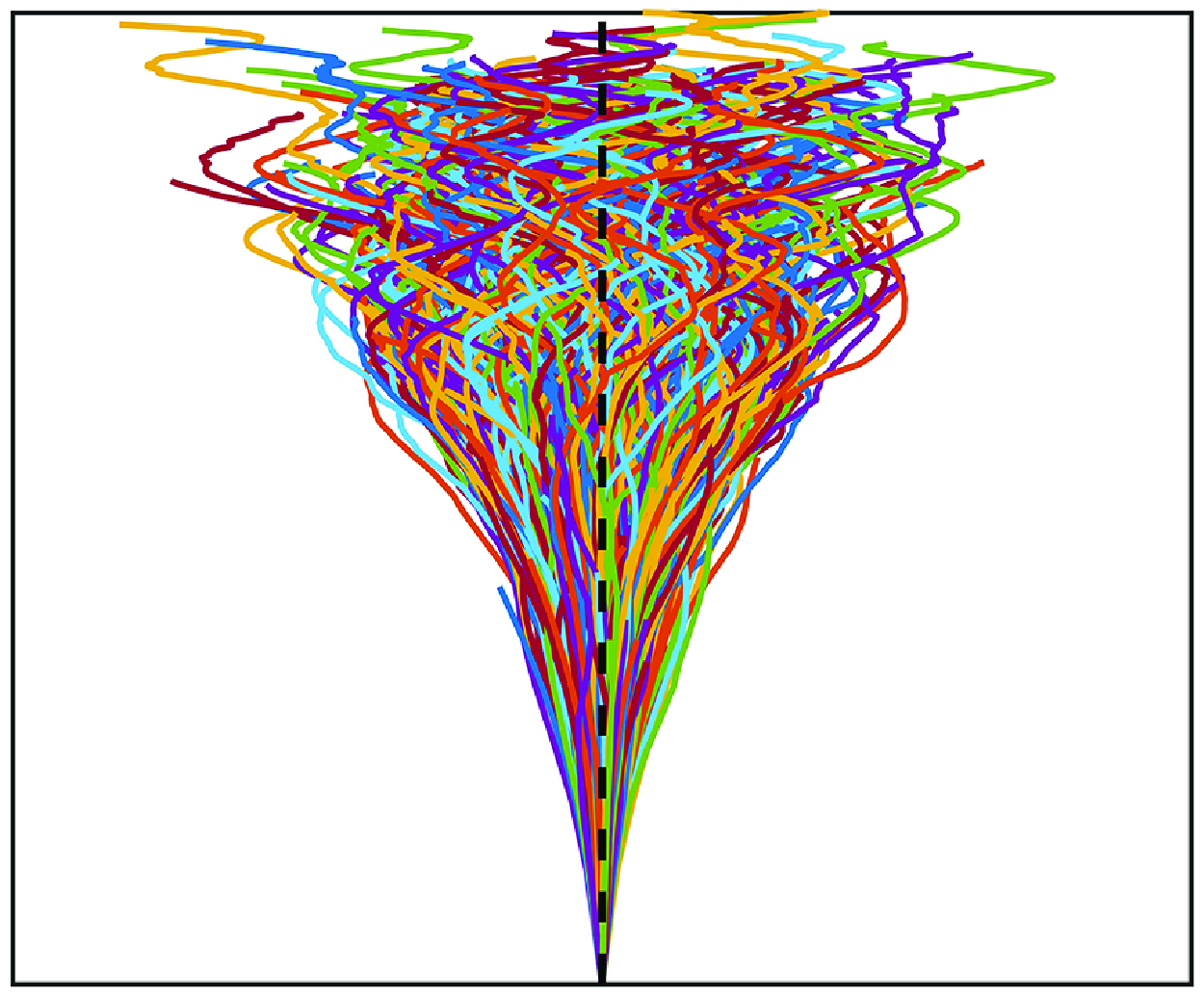
We study the dispersion of bubble swarms rising in initially quiescent water using three-dimensional Lagrangian tracking of deformable bubbles and tracer particles in an octagonal bubble column. Two different bubble sizes (3.5 mm and 4.4 mm) and moderate gas volume fractions ($0.52\,\%{-}1.20\,\%$) are considered. First, we compare the dispersion inside bubble swarms with that for single-bubble cases, and find that the horizontal mean squared displacement (MSD) in the swarm cases exhibits oscillations around the asymptotic scaling predicted for a diffusive regime. This occurs due to wake-induced bubble motion; however, the oscillatory behaviour is heavily damped compared to the single-bubble cases due to the presence of bubble-induced turbulence (BIT) and bubble–bubble interactions in the swarm. The vertical MSD in bubble swarms is nearly an order of magnitude faster than in the single-bubble cases, due to the much higher vertical fluctuating bubble velocities in the swarms. We also investigate tracer dispersion in BIT, and find that concerning the time to transition away from the ballistic regime, larger bubbles with a higher gas void fraction transition earlier than tracers, consistent with Mathai et al. (2018, Phys. Rev. Lett., vol. 121, 054501). However, for bubble swarms with smaller bubbles and a lower gas void fraction, they transition at the same time. This differing behaviour is due to the turbulence being more well-mixed for the larger bubble case, whereas for the smaller bubble case, the tracer dispersion is highly dependent on the wake fluctuations generated by the oscillating motion of nearby bubbles.

Edited by
Lisa Vanhala, University College London,Elisa Calliari, International Institute for Applied Systems Analysis, Vienna and Euro-Mediterranean Centre on Climate Change, Venice
Chapter 5 presents the facts concerning phonological convergence among the Balkan languages, focusing on shared processes affecting consonants and vowels, on prosodic units (including clitic behavior), on morphophonemic alternations, and on expressive uses of sounds. The vast majority of phonological Balkanisms are highly localized in nature, leading to the conclusion that we see here not Balkan phonology but rather Balkan phonologies. Despite the general inattentiveness on the part of scholars to phonology in the Balkan sprachbund, it is demonstrated here that there is robust convergence in this domain of grammar, albeit at local levels.
The first year of university is a developmentally significant transition that involves substantial stressor exposure and, for some, heightened anxiety. Parenting may influence the association between stressor exposure and anxiety symptoms, with some research showing that parental care and overprotection throughout childhood and adolescence are associated with the experience of anxiety. However, how these factors interact and relate to anxiety symptoms in early adulthood is not clear. To address this issue, we examined interactions between parenting characteristics (care and overprotection) and stressors experienced during the transition to university, and how they relate to anxiety symptoms in 240 first-year undergraduates (Mage = 18.2, SD = 1.18, 75% female, 51.7% White). Results revealed a significant interaction between parental overprotection and stressor exposure, such that higher parental overprotection and higher levels of recent stressor exposure were associated with more anxiety symptoms (β = 0.52, p = .008). These findings demonstrate continued evidence for associations between experiences of parenting and psychopathology in emerging adulthood and suggest that overprotective parenting behaviors may exacerbate effects of stress exposure.