Refine listing
Actions for selected content:
144976 results in Open Access
Every Trait Counts: Marginal Maximum Likelihood Estimation for Novel Multidimensional Count Data Item Response Models with Rotation or $\boldsymbol{\ell}_{\mathbf{1}}$–Regularization for Simple Structure
-
- Journal:
- Psychometrika / Volume 90 / Issue 1 / March 2025
- Published online by Cambridge University Press:
- 03 January 2025, pp. 304-330
-
- Article
-
- You have access
- Open access
- HTML
- Export citation
-
Multidimensional item response theory (MIRT) offers psychometric models for various data settings, most popularly for dichotomous and polytomous data. Less attention has been devoted to count responses. A recent growth in interest in count item response models (CIRM)—perhaps sparked by increased occurrence of psychometric count data, e.g., in the form of process data, clinical symptom frequency, number of ideas or errors in cognitive ability assessment—has focused on unidimensional models. Some recent unidimensional CIRMs rely on the Conway–Maxwell–Poisson distribution as the conditional response distribution which allows conditionally over-, under-, and equidispersed responses. In this article, we generalize to the multidimensional case, introducing the Multidimensional Two-Parameter Conway–Maxwell–Poisson Model (M2PCMPM). Using the expectation-maximization (EM) algorithm, we develop marginal maximum likelihood estimation methods, primarily for exploratory M2PCMPMs. The resulting discrimination matrices are rotationally indeterminate. Recently, regularization of the discrimination matrix has been used to obtain a simple structure (i.e., a sparse solution) for dichotomous and polytomous data. For count data, we also (1) rotate or (2) regularize the discrimination matrix. We develop an EM algorithm with lasso ( $\ell _1$) regularization for the M2PCMPM and compare (1) and (2) in a simulation study. We illustrate the proposed model with an empirical example using intelligence test data.


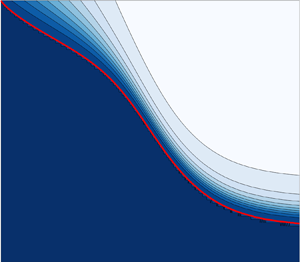
Structure of mushy layers grown from perfectly and imperfectly conducting boundaries. Part 1. Diffusive solidification
-
- Journal:
- Journal of Fluid Mechanics / Volume 1002 / 10 January 2025
- Published online by Cambridge University Press:
- 03 January 2025, A25
-
- Article
-
- You have access
- Open access
- HTML
- Export citation
Coleoptera associated with intermittent streams and their riparian zones in south coastal British Columbia – CORRIGENDUM
-
- Journal:
- The Canadian Entomologist / Volume 156 / 2024
- Published online by Cambridge University Press:
- 03 January 2025, e43
-
- Article
-
- You have access
- Open access
- HTML
- Export citation
Neural Voices of Patients with Severe Brain Injury?
-
- Journal:
- Cambridge Quarterly of Healthcare Ethics , First View
- Published online by Cambridge University Press:
- 03 January 2025, pp. 1-22
-
- Article
-
- You have access
- Open access
- HTML
- Export citation
IMU as an input versus a measurement of the state in inertial-aided state estimation
-
- Article
-
- You have access
- Open access
- HTML
- Export citation
Disaster Health Care and Resiliency: A Systematic Review of the Application of Social Network Data Analytics
-
- Journal:
- Disaster Medicine and Public Health Preparedness / Volume 18 / 2024
- Published online by Cambridge University Press:
- 03 January 2025, e334
-
- Article
-
- You have access
- Open access
- HTML
- Export citation
Diagnostic accuracy of the Montreal Cognitive Assessment in screening for cognitive impairment in initially hospitalized COVID-19 patients: Findings from the prospective multicenter NeNeSCo study
-
- Journal:
- Journal of the International Neuropsychological Society / Volume 31 / Issue 1 / January 2025
- Published online by Cambridge University Press:
- 03 January 2025, pp. 59-66
-
- Article
-
- You have access
- Open access
- HTML
- Export citation
Robust Inference for Generalized Linear Mixed Models: A “Two-Stage Summary Statistics” Approach Based on Score Sign Flipping
- Part of
-
- Journal:
- Psychometrika / Volume 90 / Issue 2 / April 2025
- Published online by Cambridge University Press:
- 03 January 2025, pp. 531-553
-
- Article
-
- You have access
- Open access
- HTML
- Export citation
A psychological contract perspective of supervisors’ satisfaction with employees
-
- Journal:
- Journal of Management & Organization / Volume 31 / Issue 4 / July 2025
- Published online by Cambridge University Press:
- 03 January 2025, pp. 1934-1957
-
- Article
-
- You have access
- Open access
- HTML
- Export citation
Introducing youth to clinical research: Development and pilot implementation of a children’s activity book
-
- Journal:
- Journal of Clinical and Translational Science / Volume 9 / Issue 1 / 2025
- Published online by Cambridge University Press:
- 03 January 2025, e34
-
- Article
-
- You have access
- Open access
- HTML
- Export citation
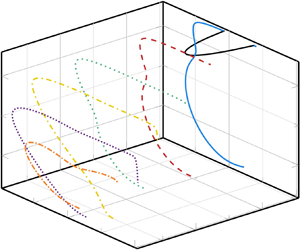
Nonlinear coherent structures in 2-D plane Couette flow with constant throughflow
-
- Journal:
- Journal of Fluid Mechanics / Volume 1002 / 10 January 2025
- Published online by Cambridge University Press:
- 03 January 2025, A30
-
- Article
-
- You have access
- Open access
- HTML
- Export citation
-
The nonlinear stability of two-dimensional (2-D) plane Couette flow subject to a constant throughflow is analysed at finite and asymptotically large Reynolds numbers $\textit {Re}$. The speed of this throughflow is quantified by the non-dimensional throughflow number $\eta$. The base flow exhibits a linear instability provided $\eta \gtrsim 3.35$, with multi-deck upper and lower branch structures developing in the limit $1\ll \eta \ll \mathit {O}(\textit {Re})$. This instability provides a springboard for the computation of nonlinear travelling waves which bifurcate subcritically from the linear neutral curve, allowing us to map out a neutral surface at different values of $\eta$. Using strongly nonlinear critical layer theory, we investigate the waves that bifurcate from the upper branch at asymptotically large $\textit {Re}$. This asymptotic structure exists provided the throughflow number is larger than the critical value of $\eta _c\approx 1.20$ and is shown to give quantitatively similar results to the numerical solutions at Reynolds numbers of $\mathit {O}(10^5)$.


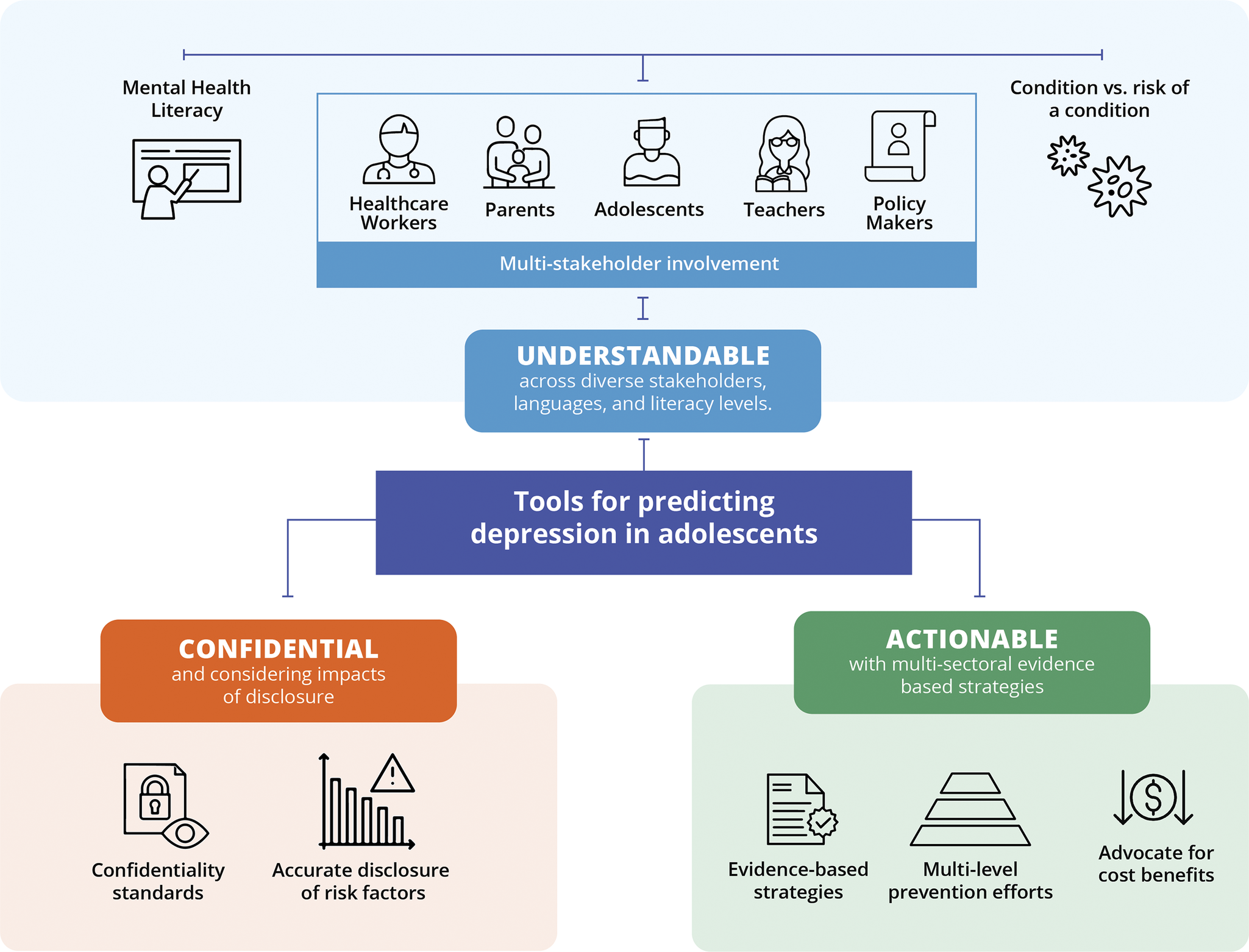
No prediction without prevention: A global qualitative study of attitudes toward using a prediction tool for risk of developing depression during adolescence
-
- Journal:
- Cambridge Prisms: Global Mental Health / Volume 11 / 2024
- Published online by Cambridge University Press:
- 03 January 2025, e129
-
- Article
-
- You have access
- Open access
- HTML
- Export citation
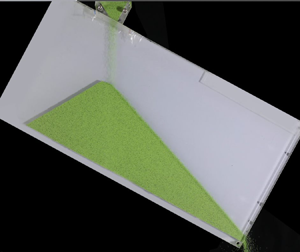
On the formation of super-stable granular heaps
-
- Journal:
- Journal of Fluid Mechanics / Volume 1002 / 10 January 2025
- Published online by Cambridge University Press:
- 03 January 2025, A27
-
- Article
-
- You have access
- Open access
- HTML
- Export citation
-
A super-stable granular heap is a pile of grains whose free surface is inclined above the angle of repose, and which forms when particles are poured onto a plane that is confined laterally by frictional sidewalls that are separated by a narrow gap. During continued mass supply, the heap free surface gradually steepens until all the inflowing grains can flow out of the domain. As soon as the supply of grains is stopped, the heap is progressively eroded, and if the base of the domain is inclined above the angle of repose, then all the grains eventually flow out. This phenomenology is modelled using a system of two-dimensional width-averaged mass and momentum balances that incorporate the sidewall friction. The granular material is assumed to be incompressible and satisfy the partially regularized $\mu (I)$-rheology. This is implemented in OpenFOAM $^{\circledR}$ and compared against small-scale experiments that study the formation, steady-state behaviour and drainage of a super-stable heap. The simulations accurately capture the dense liquid-like flows as well as the evolving heap shape. The steady uniform flow that develops along the heap surface has non-trivial inertial number dependence through its depth. Super-stable heaps are therefore a sensitive rheometer that can be used to determine the dependence of the friction $\mu$ on the inertial number $I$. However, these flows are challenging to simulate because the free-surface inertial number is high, and can exceed the threshold for ill-posedness even for the partially regularized theory.


Investigation and Analysis of Disaster Preparedness among Nurses in Chinese Non-First-tier (Inland) Cities: A Case Study from Yongcheng City, Henan Province
-
- Journal:
- Disaster Medicine and Public Health Preparedness / Volume 18 / 2024
- Published online by Cambridge University Press:
- 03 January 2025, e342
-
- Article
-
- You have access
- Open access
- HTML
- Export citation
Assessing the Post-Lisbon European Union’s System of Delegated Powers at Fifteen
-
- Journal:
- European Journal of Risk Regulation / Volume 15 / Issue 4 / December 2024
- Published online by Cambridge University Press:
- 03 January 2025, pp. 781-792
-
- Article
-
- You have access
- Open access
- HTML
- Export citation
Interpretation of the amplitude modulation coefficient and a new transport-based coefficient
-
- Journal:
- Journal of Fluid Mechanics / Volume 1002 / 10 January 2025
- Published online by Cambridge University Press:
- 03 January 2025, A35
-
- Article
-
- You have access
- Open access
- HTML
- Export citation
-
The amplitude modulation coefficient, $R$, that is widely used to characterize nonlinear interactions between large- and small-scale motions in wall-bounded turbulence is not compatible with detecting the convective nonlinearity of the Navier–Stokes equations. Through a spectral decomposition of $R$ and a simplified model of triadic convective interactions, we show that $R$ suppresses the signature of convective scale interactions, but is strongly influenced by linear interactions between large-scale motions and the background mean flow. We propose an additional coefficient that is specifically designed for the detection of convective nonlinearities, and we show how this new coefficient, $R_T$, quantifies the turbulent kinetic energy transport involved in turbulent scale interactions and reveals a classical energy cascade across widely separated scales.


From high to low: Simulating nondeterminism and state with state
- Part of
-
- Journal:
- Journal of Functional Programming / Volume 34 / 2024
- Published online by Cambridge University Press:
- 03 January 2025, e16
-
- Article
-
- You have access
- Open access
- HTML
- Export citation
Contextual learning and retention of phrasal verbs: The effects of definition placement and typographic enhancement
-
- Journal:
- Studies in Second Language Acquisition / Volume 47 / Issue 1 / March 2025
- Published online by Cambridge University Press:
- 03 January 2025, pp. 157-180
-
- Article
-
- You have access
- Open access
- HTML
- Export citation
Information Disclosure and Peer Innovation: Evidence from Mandatory Reporting of Clinical Trials
-
- Journal:
- Journal of Financial and Quantitative Analysis / Volume 60 / Issue 7 / November 2025
- Published online by Cambridge University Press:
- 03 January 2025, pp. 3267-3310
- Print publication:
- November 2025
-
- Article
-
- You have access
- Open access
- Export citation
Bayesian Analysis of the Ordinal Markov Random Field
-
- Journal:
- Psychometrika / Volume 90 / Issue 1 / March 2025
- Published online by Cambridge University Press:
- 03 January 2025, pp. 146-182
-
- Article
-
- You have access
- Open access
- HTML
- Export citation
