To save content items to your account,
please confirm that you agree to abide by our usage policies.
If this is the first time you use this feature, you will be asked to authorise Cambridge Core to connect with your account.
Find out more about saving content to .
To save content items to your Kindle, first ensure no-reply@cambridge.org
is added to your Approved Personal Document E-mail List under your Personal Document Settings
on the Manage Your Content and Devices page of your Amazon account. Then enter the ‘name’ part
of your Kindle email address below.
Find out more about saving to your Kindle.
Note you can select to save to either the @free.kindle.com or @kindle.com variations.
‘@free.kindle.com’ emails are free but can only be saved to your device when it is connected to wi-fi.
‘@kindle.com’ emails can be delivered even when you are not connected to wi-fi, but note that service fees apply.
Can the best arguments for a privation theory of evil be parodied, with equal plausibility, as arguments for a privation theory of good? The privation theory of evil claims that evil has no positive existence, and it is but a privation of good. The privation theory of good claims the opposite. I approach this topic as one element in the so-called evil-God Challenge. Stephen Law has argued that the epistemic support for belief in an omniscient, omnipotent, and morally perfect God (theism) is on a par with the epistemic support for belief in an omniscient, omnipotent, but completely evil-God (maltheism). In fact, he concludes, the arguments for an evil God are symmetrical with, and isomorphic to, those for a good God. The privation theory of evil has often been used to defend theism against the argument from evil. Thus, part of the evil-God Challenge is to evaluate arguments for the privation theory of evil for their vulnerability to maltheist parody. I consider a broad range of arguments for the privation theory of evil, and I argue that most of them are vulnerable to parodic neutralization. Furthermore, I argue that although the thesis of the convertibility of being and goodness is often held to entail the privation theory of evil, or to be entailed by it (or to be equivalent to it), it is independent of the privation theory. I do find that David Oderberg’s recent argument for the privation theory of evil resists any easy maltheist parody, but I argue that it has a defect. I sketch an argument according to which his good-as-fulfillment account is compatible with a perfectly evil god. My tentative conclusion is that the privation theory of evil enjoys little more plausibility than does the privation theory of good.
Three new species of Ypresian (early Eocene) Odonata are described: Paradysagrion sosbyaegen. and sp. nov. from the Klondike Mountain Formation at Republic, Washington, United States of America, and Dysagrionites allenbyensissp. nov. and Allenby gen. and sp. A from the Allenby Formation near Princeton, British Columbia, Canada. All three are assigned to the Dysagrionidae and Cephalozygoptera but only tentatively, as key diagnostic morphology is missing from their incomplete fossils. The definition of the collective genus Dysagrionites is broadened to include odonates tentatively assigned to the Dysagrioninae (Dysagrionidae) that are distinct as species but have unclear nominal genus affinity.
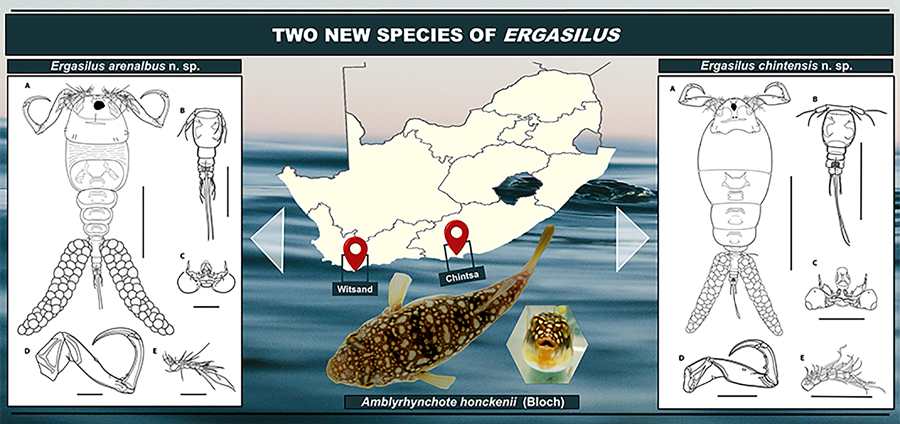
Marine parasites remain understudied in South Africa with little information available on their diversity and the effects these parasites may have on their hosts. This is especially true for parasitic copepods within the family Ergasilidae. Among the 4 genera known in Africa, Ergasilus Nordmann, 1832 is the most speciose with 19 reported species. However, this represents only 12% (19/163) of the global diversity. Furthermore, only 5 known African species are reported from marine environments, and only 1 is reported from the South African coastline. Given the rich biodiversity along this coastline, a high marine parasite diversity could be expected from these shores. As a case study, the Evileye blaasop, Amblyrhynchote honckenii (Bloch), a marine and brackish fish species, was screened for parasites along the South African coastline. This resulted in the discovery of 2 species of Ergasilus new to science (Ergasilus arenalbus n. sp. and Ergasilus chintensis n. sp.), which makes them the second and third ergasilid species reported for tetraodontid pufferfishes worldwide. Although genetically distinct, the 2 newly described species clustered in the same subclade within the Ergasilidae based on 18S rDNA, 28S rDNA and COI mtDNA phylogenies. The newly described species differ morphologically from each other, and their respective congeners based on the size and armature of the antenna; body segmentation; and general ornamentation throughout the entire body. The addition of these 2 new species from a single host species indicates that South Africa's marine fishes contain most probably a hidden parasitic copepod diversity that is worth exploring.
The chapter begins with the observation that global history has an ambivalent attitude towards explanation. In many cases, the mere presentation of sources and voices from many different parts of the world seems sufficient to justify a global approach. The need for explanation is ignored or even denied. In other cases, global explanation is eagerly pursued, but often at the expense of more complex explanatory models that incorporate factors at different scales. In this perspective, global explanations are claimed to be inherently superior and a privileged way of explaining historical phenomena. After a cursory survey of current positions on causality and explanation in general methodology and ‘formal’ historical theory, the chapter proposes a brief typology of explanatory strategies. It goes on to discuss the peculiarities of explanation within a framework of connections across great distances and cultural boundaries. The much-exclaimed concept of narrative explanation is found to be of limited value, as it underestimates the difficulties of producing coherent narratives on a global scale. Concepts offered in the social science literature, such as the analysis of mechanisms and temporal sequences, could be helpful in refining purely narrative approaches to explanation.
This paper focuses on a group of Old Tibetan manuscripts from Dunhuang that are currently in the Stein and Pelliot Collections, some of which will be reordered and reunited. These texts were previously believed to concern the offering to the seven Tathāgatas or the texts about the former aspirations of the seven Buddhas. However, as my study shows, they actually pertain to liturgies for the seven Tathāgatas including Bhaiṣajyaguru. Based on earlier studies, this research seeks to establish a stronger connection between “pre-canonical” texts and canonical works in Tibetan and Chinese, and to establish a hitherto unknown link in the chain of the textual transmission of this liturgy. After revealing the structure of the liturgy, it seeks to fill the gap between the Bhaiṣajyaguru-sūtra itself and the religious practices of worshipping the seven Tathāgatas including Bhaiṣajyaguru. These are done through a two-dimensional textual analysis, i.e.: 1) identifying the connection between the Old Tibetan materials and the Tibetan canonical version; and 2) analysing the process of the liturgicalization of the sūtra.
Increased rehabilitation intensity, the number of minutes of therapy per day, is associated with improved outcomes. However, it is unclear whether males and females receive the same inpatient stroke rehabilitation intensity. A sub-analysis of a retrospective population-based cohort study of adults (5877 females, 6893 males) with stroke discharged to inpatient rehabilitation between 2017 and 2021 was conducted. The mean rehabilitation intensity was 75.86 min/day for males and 73.33 min/day for females (p < .0001). Males <80 years of age were more likely to receive higher rehabilitation intensity than females. Future research should explore what factors account for this sex difference.
This study examined the sour grapes/sweet lemons rationalization through 2 conditions: ‘attainable’ (sweet lemons) and ‘unattainable’ (sour grapes), reflecting China’s 2019-nCoV vaccination strategy. The aim was to find ways to change people’s beliefs and preferences regarding vaccines by easing their safety concerns and encouraging more willingness to get vaccinated. An online survey was conducted from January 22 to 27, 2021, with 3,123 residents across 30 provinces and municipalities in the Chinese mainland. The direction of belief and preference changed in line with the sour grapes/sweet lemons rationalization. Using hypothetical and real contrasts, we compared those for whom the vaccine was relatively unattainable (‘sour grapes’ condition) with those who could get the vaccine easily (‘sweet lemons’). Whether the vaccine was attainable was determined in the early stage of the vaccine roll-out by membership in a select group of workers that was supposed to be vaccinated to the greatest extent possible, or, by being in the second stage when the vaccine was available to all. The attainable conditions demonstrated higher evaluation in vaccine safety, higher willingness to be vaccinated, and lower willingness to wait and see. Hence, we propose that the manipulation of vaccine attainability, which formed the basis of the application of sour grapes/sweet lemons rationalization, can be utilized as a means to manipulate the choice architecture to nudge individuals to ease vaccine safety concerns, reducing wait-and-see tendencies, and enhancing vaccination willingness. This approach can expedite universal vaccination and its associated benefits in future scenarios resembling the 2019-nCoV vaccine rollout.
The introduction outlines the volume’s main impetus: to encourage historians, global and not, to reflect on ‘their daily task’, as Marc Bloch put it – on their methods, craftsmanship, and conceptual basics. It is an invitation to rethink the field’s forms of inquiry and argumentation and the tacit assumptions underlying its practice, at a time when the ground under global historians’ feet – with globalisation in crisis – is moving fast.
Global history and other relational approaches to history, the introduction holds, have methodological implications and require theoretical reflection: because many of the classic analytical instruments commonly employed by historians require some reduction of complexity – to explain, to periodise, or to compare – a task naturally more difficult when scholars deal with an unusual abundance of factors; because the field’s assault on Eurocentrism requires reflection on the matter of perspective and authorial vantage point; or, indeed, because of the field’s inherent teleology, with its understanding of history inseparable from the telos of continuously increasing global integration.
This chapter analyzes the interconnections between energy policy and security and defense policies in Estonia with respect to energy transition. After explaining the key characteristics of energy and security regimes, it examines administrative interaction and policy coherence. The interconnections pertaining to energy transitions and security are visible via three cases: the oil shale phaseout and stability of Ida-Viru County, wind power expansion and the defense radar operation, and the desynchronization of the electricity network from Russia. Russia has formed the prevalent landscape pressure on the energy regime, although other landscape pressures have been noted, for example, climate change. Administrative coordination between energy and security has often relied on informal means, which are employed for agility but lack transparency. The security implications of the expanding energy “niches,” such as solar and wind power, have been little covered, although this has clearly increased via newly emerging attention on critical materials.
In this chapter, I explore the imaginaries of prosperity underlying the European Union’s (EU) approach to industrial law and policy. Long considered a taboo in European politics, the EU began to rediscover industrial policy after the 2008 great financial crisis, gradually increasing its ambitions when it came to shaping the relations between the state and the market. Having reviewed an array of EU measures, starting with the 2010 industrial policy and including the more recent burst of legislative proposals (Chips Act, Batteries Act, Critical Minerals Act, and Net Zero Industry Act), this chapter aims to do two things. First, it identifies shifts in the background understanding of political economy, including the role and appropriate objectives of markets, politics, law, and government, that lie behind successive policy interventions. Second, this chapter sketches the contours of the new synthesis of prosperity that emerges from these recent proposals and measures, while at the same time, and in no ambiguous terms, drawing attention to its considerable limitations.
Online reviews have a significant impact on the purchasing decisions of potential consumers. Positive reviews often sway buyers, even when faced with higher prices. This phenomenon has given rise to a deceptive industry dedicated to crafting counterfeit reviews. Companies frequently indulge in procuring bulk fake reviews, employing them to tarnish their rivals’ reputations or artificially bolster their credibility. These spurious reviews materialize through automated systems or compensated individuals. Thus, detecting fake reviews is becoming increasingly important due to their deceptive nature, as they are extremely difficult for humans to identify. To address this issue, current work has focused on machine learning and deep learning techniques to identify fake reviews. However, they have several limitations, including a lack of sufficient training data, inconsistency in providing accurate solutions across different datasets, concept drift, and inability to address new methods that evolved to create fake reviews over time. The objective of this review paper is to find the gaps in the existing research in the field of fake review detection and provide future directions. This paper provides the latest, comprehensive overview and analysis of research efforts focusing on various techniques employed so far, distinguishing characteristics utilized, and the existing datasets used.
This chapter analyzes the interconnections between energy policy and security and defense policies in the UK, zooming in on Scotland. It explains the energy and security regimes and analyzes policy interplay. The links between hydrocarbon energy, energy transition, and security are complex, with relatively fragmented governance in place. While some instances of policy integration were found, broader policy coherence regarding security and the zero-carbon energy transition was lacking. Before 2022, coordination efforts were focused on external, global energy questions instead of domestic energy. Domestic energy security was driven by market-based values. Post-2022, security and energy transition links pertaining to domestic energy production and use became more important in political and policy agendas. Scotland has had a differing worldview on security in relation to energy transition than the rest of the UK, with more focus on the environmental and health security effects of energy policy choices and just transitions, evident, for instance, in its opposition to nuclear power.
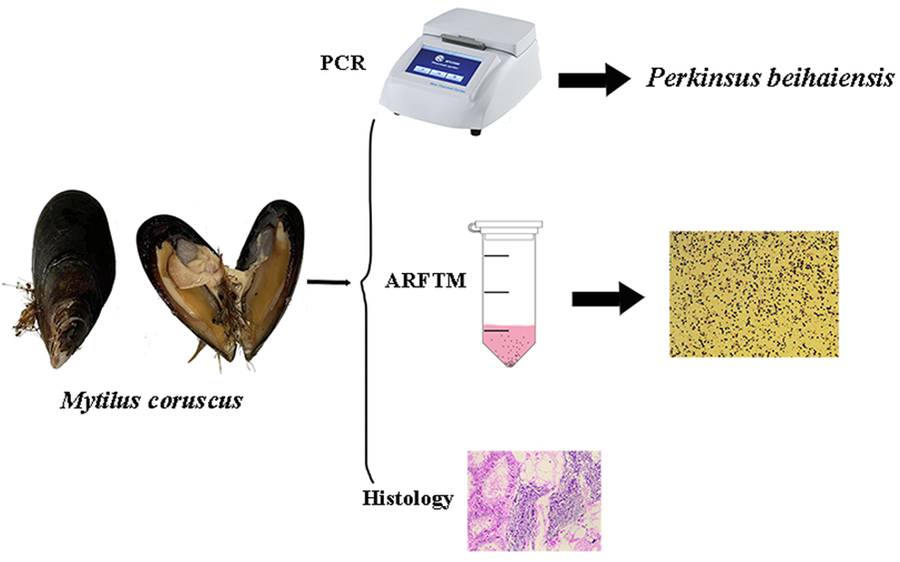
During the investigation of parasitic pathogens of Mytilus coruscus, infection of a Perkinsus-like protozoan parasite was detected by alternative Ray's Fluid Thioglycolate Medium (ARFTM). The diameter of hypnospores or prezoosporangia was 8–27 (15.6 ± 4.0, n = 111) μm. The prevalence of the Perkinsus-like species in M. coruscus was 25 and 12.5% using ARFTM and PCR, respectively. The ITS1-5.8S-ITS2 fragments amplified by PCR assay had 100% homology to that of P. beihaiensis, suggesting that the protozoan parasite was P. beihaisensis and M. coruscus was its new host in East China Sea (ECS). Histological analysis showed the presence of trophozoites of P. beihaiensis in gill, mantle and visceral mass, and the schizonts only found in visceral mass. Perkinsus beihaiensis infection led to inflammatory reaction of hemocyte and the destruction of digestive tubules in visceral mass, which had negative effect on health of the farmed M. coruscus and it deserves more attention.
Wherever there is power, there is secrecy. (Taussig 1999)
How did devout followers of a saint respond when a dominant reform organisation deemed their beliefs and ritual practices as impure? Did they abandon all the ‘impure’ beliefs, or did they find ways to navigate the influence and power of the reformist ideology? In such circumstances, faith begins to operate through acts of concealment and secrecy, which become potent tools for managing societal and religious pressures. Some of these practices of concealment/secrecy among the Muslims of Mewat ran afoul of the puritanical Tablighi Jamaat, which discouraged the veneration of saints as bidat (innovation/heresy) and shirk (polytheism), considering them as antithetical to Islam. Concealment and secrecy practices represent a significant form of social knowledge that helps sustain social institutions and human relationships (Simmel 1906).
Fluidity across religious boundaries between ‘Hinduism’ and ‘Islam’ is not a new idea; it has been analysed in a large number of scholarly works (Amin 2016; Assayag 2004; Bigelow 2010; Flueckiger 2006; Gilmartin and Lawrence 2000; Gottschalk 2000; D. Khan 2004a; Mayaram 1997a). While these works effectively display the flexibility of religious boundaries, they fail to delve into the implications when reformist groups arise and promote the notion of a rigid, uniform and pure religious boundary. In Mewat, as in other parts of India, reformist groups strongly emphasised the segregation of religious communities based on their identities and ritual practices. However, little attention has been given to the phenomenon of resistance to, or passive negotiation with, these powerful reformist forces that oppose religious blending.
Many Meo and non-Meo Muslims, mostly women, still venerate these saints, although they conceal their devotion to evade the wrath of Meo men and other Tablighis. Their stories of concealment reveal intricate processes of contestation and accommodation between the Sufi and Tablighi Jamaat ideologies, the divergent beliefs of male and female in a family, and different dynamics of the relationships between the powerful and the powerless. To operate effectively, secrecy as a type of societal knowledge relies on three essential elements: individual actors who engage in concealment; an audience, from whom the secret is concealed; and a power structure that the secret undermines or challenges.