To save content items to your account,
please confirm that you agree to abide by our usage policies.
If this is the first time you use this feature, you will be asked to authorise Cambridge Core to connect with your account.
Find out more about saving content to .
To save content items to your Kindle, first ensure no-reply@cambridge.org
is added to your Approved Personal Document E-mail List under your Personal Document Settings
on the Manage Your Content and Devices page of your Amazon account. Then enter the ‘name’ part
of your Kindle email address below.
Find out more about saving to your Kindle.
Note you can select to save to either the @free.kindle.com or @kindle.com variations.
‘@free.kindle.com’ emails are free but can only be saved to your device when it is connected to wi-fi.
‘@kindle.com’ emails can be delivered even when you are not connected to wi-fi, but note that service fees apply.
The circulation of data ranked high among the objectives adopted by CGIAR at its founding in 1971. This chapter considers how agricultural experts attempted to realize a desired “full exchange of information” among scientists working at geographically distant sites, in different languages and cultural contexts, with different organisms and research interests from the 1970s to the early 2000s. The chapter focuses on the historical development of “crop descriptors,” today defined as providing an “international format and a universally understood language for plant genetic resources data.” Developers of descriptors aspire to agree on traits and terms that will allow users from diverse institutions and backgrounds to contribute to and extract information from an integrated data infrastructure. The chapter examines crop descriptors as a critical component of CGIAR’s earliest efforts to create “system-wide” research tools and agendas, emphasizing the scientific and political agendas that shaped this top-down systematizing work, finding that it provided an opportunity for CGIAR to instantiate and consolidate its central position in a web of international development initiatives.
What role does reasoning about moral principles play in people’s judgments about what is right or wrong? According to one view, reasoning usually plays little role. People tend to do what suits their self-interests and concoct moral reasons afterward to justify their own behavior. Thus, in this view, people are far more forgiving of their own violations than of others’ violations. According to a contrasting view, principled reasoning generally guides judgments and decisions about our own and others’ actions. This view predicts that people usually can, and do, articulate the principles that guide their moral judgments and decisions. The present research examined a phenomenon at the center of these debates: students’ evaluations of academic cheating. Across three studies, we used structured interviews and online surveys to examine first- and third-party judgments and reasoning about cheating events. Third-party scenarios were derived from students’ own accounts of cheating events and manipulated based on the reasons students provided. Findings supported the view that reasoning is central to evaluations of cheating. Participants articulated reasons consistent with their judgments about their own and others’ actions. The findings advance classic debates about reasoning in morality and exemplify a paradigm that can bring further advances.
Placebo and nocebo effects are widely reported across psychiatric conditions, yet have seldom been examined in the context of gambling disorder. Through meta-analysis, we examined placebo effects, their moderating factors, and nocebo effects, from available randomised, controlled pharmacological clinical trials in gambling disorder.
Methods:
We searched, up to 19 February 2024, a broad range of databases, for double-blind randomised controlled trials (RCTs) of medications for gambling disorder. Outcomes were gambling symptom severity and quality of life (for efficacy), and drop outs due to medication side effects in the placebo arms.
Results:
We included 16 RCTs (n = 833) in the meta-analysis. The overall effect size for gambling severity reduction in the placebo arms was 1.18 (95%CI 0.91–1.46) and for quality of life improvement was 0.63 (0.42-0.83). Medication class, study sponsorship, trial duration, baseline severity of gambling and publication year significantly moderated effect sizes for at least some of these outcome measures. Author conflict of interest, placebo run-in, gender split, severity scale choice, age of participants or unbalanced randomisation did not moderate effect sizes. Nocebo effects leading to drop out from the trial were observed in 6% of participants in trials involving antipsychotics, while this was less for other medication types.
Conclusion:
Placebo effects in trials of pharmacological treatment of gambling disorder are large, and there are several moderators of this effect. Nocebo effects were measureable and may be influenced by medication class being studied. Practical implications of these new findings for the field are discussed, along with recommendations for future clinical trials.
Phelan-McDermid syndrome is a rare genetic disorder characterised by various neurodevelopmental, medical, and psychiatric issues. Although bipolar disorder-like presentations and catatonia are particularly common, psychosis has also been reported but is less well described. As such, this systematic review sought to characterise the phenomenology of psychosis in Phelan-McDermid syndrome, clarify the association of psychotic symptoms with other neuropsychiatric features of the disorder, and describe antipsychotic treatment response.
Methods:
A literature search was completed in July 2024 using PubMed and Scopus. Only English-language articles that reported the occurrence of psychotic symptoms in Phelan-McDermid syndrome were eligible for inclusion. 18 articles describing 35 individuals were included in the main analyses. Three additional articles of relevance are discussed separately, as they either provided limited clinical information or did not present data in a patient-specific manner.
Results:
The average age of psychosis onset was ∼17 years, and 65% of individuals developed symptoms at or before age 15. ∼69% of individuals also experienced catatonia, ∼81% experienced mood symptoms, and 50% experienced both. Visual hallucinations were the most commonly reported psychotic symptom. Where reported, ∼76% of individuals exhibited at least a partial and/or temporary response to antipsychotic therapy.
Conclusion:
Psychotic presentations in Phelan-McDermid syndrome may qualitatively differ from schizophrenia. Although numerous antipsychotics may be efficacious in the treatment of Phelan-McDermid syndrome-associated psychosis, this review most importantly highlights the paucity of available high-quality evidence to guide treatment decisions in this respect, and as such indicates the need for more reports to be published.
In the Anthropocene, recognising nature’s role in human well-being is pivotal for biodiversity conservation. Despite their significance, knowledge gaps persist regarding ecosystem services, even for well-studied species like vultures. Our study focuses on the Griffon Vulture Gyps fulvus in Sardinia, Italy, exploring their cultural and regulating services, including carcass disposal and resulting greenhouse gas (GHG) mitigation. Through surveys of natural reserve visitors and data on carcass provision and GHG emissions, we assess public perception, economic value, and environmental impacts associated with vultures. The public perception of Griffon Vultures is predominantly positive, with a strong acknowledgment of their role in disease prevention and carcass disposal, highlighting their contribution to regulation services. Furthermore, vultures are widely recognised as a key element characterising the agropastoral landscapes of Sardinia, underscoring their cultural importance. The economic evaluation, through willingness to pay for vulture-watching and photography opportunities, indicates a significant appreciation of these birds, with almost three-quarters of respondents willing to pay an entrance fee at vulture observation sites. We also show that supplanting the disposal role of vultures at studied feeding sites (during 2017–2022) would result in the emission of 96 tons of CO2 equivalent, which highlights the critical role of vultures in climate mitigation. This study not only sheds light on the ecological and cultural significance of Griffon Vultures in Sardinia but also underscores the economic and environmental benefits of their conservation. It emphasises the need for continued efforts in vulture conservation, integrating ecological, cultural, and economic perspectives to foster a sustainable coexistence between humans and wildlife.
During a 2019 Chilean Antarctic Scientific Expedition (ECA 55) studying crustose coralline algae (CCA) diversity on the Antarctic Peninsula, bleaching of these algae was observed for the first time in this region. Here, we present initial findings on the physiological state of bleached and normally pigmented CCA (Clathromorphum sp.) assessed using chlorophyll-a fluorescence induction pulse amplitude modulation. The study site experienced high light exposure and salinity in the water column. Our analyses found that bleached CCA have relatively healthy photophysiology responses but lower photosynthetic efficiency, which could be associated with the low salinities recorded in the study area. However, seasonal monitoring and mesocosm experiments across the southern polar latitudes are urgently required to confirm this hypothesis.
The Father is God, the Son is God, the Holy Spirit is God, but there is only one God – this is the traditional problem of the Trinity. Recently, a new problem for the doctrine of the Trinity has been developed. God is triune, the Son is God, but the Son is not triune – that’s the new Triunity Problem. In this article, I show that adopting any solution to a traditional problem makes it possible to solve the new problem without incurring additional costs. I distinguish possible types of solutions to the traditional problem and point out the costs involved. I then show how each of these solutions can be used and developed to solve the new problem.
Canadians overwhelmingly do not want to live in long-term care institutions (LTCIs) when they age; yet many end up there for lack of home care, because family care partners burn out, or because they and their professional advisors are unaware of alternatives to institutions. Not only is institutional dementia care riven with problems, it segregates disabled people, thereby abrogating human rights. Because systemic ageism and ableism cloud seniors’ care, institutions remain the default option for Canadians with dementia. Yet, decades of deinstitutionalization enabled younger disabled Canadians to live in the community with supports. Why not seniors? We describe a plethora of noninstitutional dementia-care alternatives. We then present a roadmap for considering all relevant care options in service plans, one that incorporates supported decision making by people with dementia. We propose a paradigm shift in how Canada serves its senior citizens – not just the current generation, but those to come, including ourselves.
Epidemiological samples provide opportunity to understand the development of mental health trajectories to better understand whether such epidemiological data can help to plan and modify service delivery for youth mental health. Variation between countries is not well understood and thus applying evidence from other countries to national strategies limits support service policy and planning. We therefore examine developmental patterns of youth mental health across different countries using the Growing Up in Ireland (GUI) Cohorts, with comparison to existing UK longitudinal cohort data (Millennium Cohort Study, MCS; Growing up in Scotland, GUS).
Methods
Youth mental health problems within each cohort across development (5–17/18 years) were assessed using parent reported Strengths and Difficulties Questionnaire (SDQ) scores. Using latent growth curve analyses, we examined trajectories of emotional, conduct, and hyperactivity problems for boys and girls, separately for each cohort.
Results
Across cohorts, we observed similar developmental patterns for emotional, conduct, and hyperactivity problems. However, the GUI emotional problems in Ireland emerged earlier than in the UK. By adolescence, GUI emotional scores were similar to the UK, suggesting that the differences in emotional problems between the ROI and UK had narrowed by adolescence. Covariates also had different associations with youth mental health trajectories across cohorts.
Conclusions
Utilizing multiple nationally representative cohort longitudinal datasets can help inform clinically meaningful conclusions and potential recommendations on population level multi-tiered service needs and development in the area of child and adolescent mental health support and future provision.
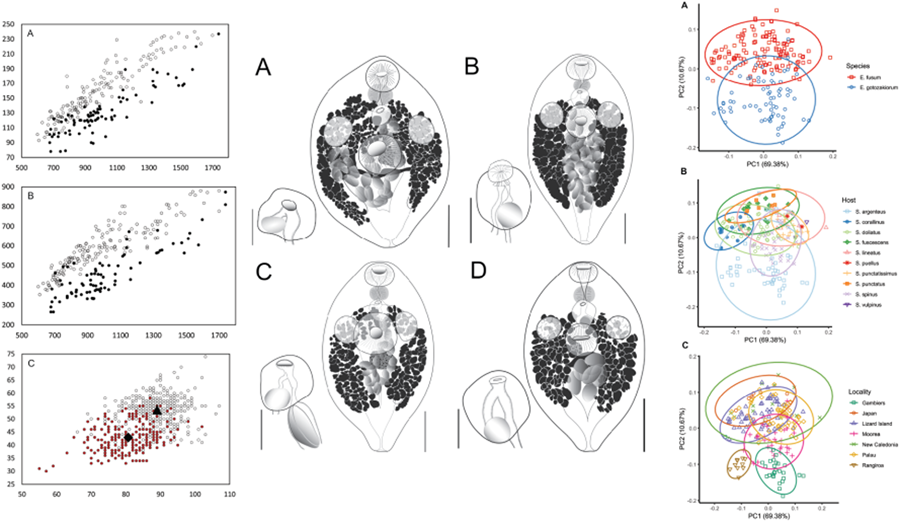
Emprostiotrema contains just 3 species: E. fusum, E. kuntzi and E. sigani. As adults, all 3 species infect rabbitfishes (Siganidae: Siganus). New collections from 11 species of Siganus from northern Australia, Indonesia, New Caledonia, French Polynesia, Palau and Japan enabled an exploration of species composition within this genus. Phylogenetic analyses demonstrate a deep distinction between 2 major clades; clade 1 comprises most of the sequences of specimens from Australia as well as all of those from Japan, Palau and New Caledonia and clade 2 comprises all sequences of specimens from French Polynesia, 2 sequences from Australia and the single sequence from Bali. In all analyses, both major clades have genetic structuring leading to distinct geographic lineages. Morphologically, specimens relating to clades 1 and 2 differ but overlap in body shape, oral sucker and egg size. Principle component analysis shows a general (but not complete) separation between specimens relating to the 2 clades. We interpret the 2 clades as representing 2 species: clade 1 is identified as E. fusum and is reported in this study from 10 species of siganids from Australia, Japan, Palau and New Caledonia; clade 2 is described as E. gotozakiorum n. sp., for all specimens from French Polynesia and rare specimens from Australia and Indonesia. We recognize E. sigani as a junior synonym of E. fusum. Although species of Emprostiotrema occur widely in the tropical Indo-Pacific, they have not been detected from Ningaloo Reef (Western Australia), the southern Great Barrier Reef or Moreton Bay (southern Queensland).
The roles and potential value of patient preference (PP) data in health technology assessment (HTA) remain to be fully realized despite an expanding literature and various efforts to establish their utility. This article reports lessons learned through a series of collaborative workshops with HTA representatives, organized by the Health Technology Assessment International’s Patient Preferences Project Subcommittee.
Methods
Five online workshops were conducted between June 2022 and June 2023, seeking to facilitate collaborative learning and reflection on ways that PP data can be integrated into HTA. Participants included nine HTA representatives from the United States, Canada, Australia, England, and the Netherlands. Workshops were recorded, transcribed, and thematically analyzed.
Results
Despite appreciating the value of PP data, participants were ambivalent about their use in HTA. Some felt that they were already getting the information they needed from the cost-effectiveness analysis or existing patient involvement processes. Others thought that PP data would be very helpful at the initial and final stage of the decision-making process and, particularly, in the following cases: (a) when technology has important non-health benefits; (b) when the clinical and/or cost-effectiveness evidence is marginal; and (c) when treatment is indicated for a large and heterogeneous population. Issues related to the validity and reliability of PP studies were frequently raised, with preference heterogeneity at the core of these concerns.
Conclusions
Collaborating with HTA representatives in the “co-creation” of PP research can help address their concerns and facilitate mutual learning about how PP data can be used in HTA.
Most information about the association between childhood maltreatment (CM) and subsequent psychiatric morbidity is based on retrospective self-reports. Findings from longitudinal studies using prospective reports to statutory agencies may be subject to attrition. We therefore compared the prevalence to age 30 of inpatient psychiatric diagnoses in those who experienced agency-reported CM with those of the rest of the cohort using administrative data to minimise loss to follow-up.
Methods
We used linked administrative data for two birth cohorts of all individuals born in Queensland, Australia in 1983 and 1984 (N = 83,050) and followed to age 30 years. This was the entire cohort aside from 312 people who died. Information on CM came from statewide child protection data and psychiatric diagnoses from all public and private hospital admissions in Queensland.
Results
On adjusted analyses, the 4,703 participants (5.7%) who had been notified to the statewide child protection authority had three to eight times the odds of being admitted for any of the following psychiatric diagnoses by age 30 years old: schizophrenia-spectrum disorders, bipolar affective disorders, depression, anxiety and post-traumatic stress disorders (PTSD). There were similar findings for all the CM subtypes. Associations were especially strong for PTSD with between a seven – and nine-fold increase in the odds of admission.
Conclusions
This is one of the largest studies of the long-term effects of CM, covering an entire jurisdiction. All types of maltreatment are significantly related to a range of psychiatric disorders requiring hospitalisation. Early identification, intervention and providing appropriate support to individuals who have experienced CM may help mitigate the long-term consequences and reduce the risk of subsequent mental health problems.
Social innovation has broadly been defined as citizen-led initiatives aimed at improving community welfare through collaborative relationships. However, numerous studies demonstrate that social innovation might actually create new inequalities. In this paper, we address the following questions: how might socially innovative projects influence public policy? How can we understand a policy shift leading to institutions not only giving support to social innovation projects but even promoting their own social innovation schemes? Is institution-led social innovation different from citizen-led efforts? If so, how? We provide evidence of local public policy change occurring in 0–3 education and care in Barcelona between 2015 and 2021. We explain how this happened, examining who redefined the issue and how, how the policy domain was reorganized, and how the policy subsystem was restructured. Our conclusions show how and why citizens and institutions define social innovation differently and how innovative 0–3 policy in Barcelona was adopted.
At the moment of independence, the Karamoja region of northeastern Uganda occupied a unique position within the Ugandan state. Local communities existed largely outside the sovereignty of the state and remained disinvested from its politico-economic institutions, and policymakers saw Karamoja as a problematic challenge to their agendas of development, security, and nation-building. I contend that, in the years surrounding Uganda's independence, government officials, rural communities, and a small emergent local elite fiercely debated Karamoja's place in the Ugandan state in state spaces such as government headquarters, trading centers, and barazas. Examining these contestations in state spaces allows us to map the indigenous political epistemologies of Karamoja against the epistemology of statehood and demonstrates the diversity of political thought that existed in Karamoja. A look at political debates in Karamoja at the moment of independence also sheds light on gaps within the historiographies of belonging and marginality in African states and addresses Karamoja's exclusion from the historiography of Uganda.
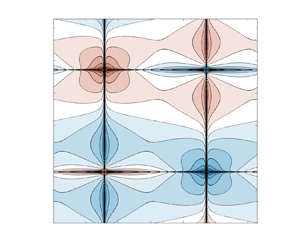
We consider Euler flows on two-dimensional (2-D) periodic domain and are interested in the stability, both linear and nonlinear, of a simple equilibrium given by the 2-D Taylor–Green vortex. As the first main result, numerical evidence is provided for the fact that such flows possess unstable eigenvalues embedded in the band of the essential spectrum of the linearized operator. However, the unstable eigenfunction is discontinuous at the hyperbolic stagnation points of the base flow and its regularity is consistent with the prediction of Lin (Intl Math. Res. Not., vol. 2004, issue 41, 2004, pp. 2147–2178). This eigenfunction gives rise to an exponential transient growth with the rate given by the real part of the eigenvalue followed by passage to a nonlinear instability. As the second main result, we illustrate a fundamentally different, non-modal, growth mechanism involving a continuous family of uncorrelated functions, instead of an eigenfunction of the linearized operator. Constructed by solving a suitable partial differential equation (PDE) optimization problem, the resulting flows saturate the known estimates on the growth of the semigroup related to the essential spectrum of the linearized Euler operator as the numerical resolution is refined. These findings are contrasted with the results of earlier studies of a similar problem conducted in a slightly viscous setting where only the modal growth of instabilities was observed. This highlights the special stability properties of equilibria in inviscid flows.
“INTELLECTUAL LIGHTENING”: A tribute to John Harris through a collection of memories, imaginary books, fictional reviews, and an interview. John Harris’ impressive and diverse academic career is illustrated and remembered by his colleagues who each contribute with a special memory, story or fake book review, in order to thank John and to cherish the memories. A good philosopher, a kind person, a teacher, different aspects of his work are discussed.
In 2021, the Ntaganda case introduced a new approach to evaluating the monetary liability for reparations in the International Criminal Court (ICC) by explicitly recognizing joint and several liability and centring the determination of the quantum of reparations on the harm suffered by the victims and the costs to repair it. As suggested by the Ntaganda Trial Chamber, these two innovations promote a stronger separation between the reparation process and the criminal trial, in order to consolidate a compensatory and victim-centred approach to reparations awarded by the ICC. This article critically appraises the innovations in Ntaganda through the lens of Article 21 of the Rome Statute, focussing on three elements: (i) the evolving jurisprudence on monetary liability in the ICC prior to the Ntaganda case; (ii) the case law on reparations of hybrid criminal courts; and (iii) the notion of general principles of law derived from the national legal systems of the world, in the sense of Article 21(1)(c) of the Statute. The article argues that, despite its victim friendly veneer, the approach introduced in Ntaganda should not be taken for granted. Besides the fact that multiple important aspects and ramifications of this approach remain unaddressed, those two innovations may have serious implications for the victims, the convicted persons, and the ICC’s reparations process as a whole.
There is a strong link between trauma exposure and serious mental health conditions (SMHCs), such as schizophrenia and bipolar disorder. The majority of research in the field has focused on childhood trauma as a risk factor for developing an SMHC and on samples from high-income countries. There is less research on having an SMHC as a risk factor for exposure to traumatic events, and particularly on populations in low- and middle-income countries (LMICs).
This scoping review aimed to synthesize the nature and extent of research on traumatic events that adults with SMHCs face in LMICs. It was conducted across five databases: PubMed, Embase, PsycINFO, Web of Science Core Collection and Africa-Wide Information/NiPad in December 2023 and by hand searching citation lists.
Findings
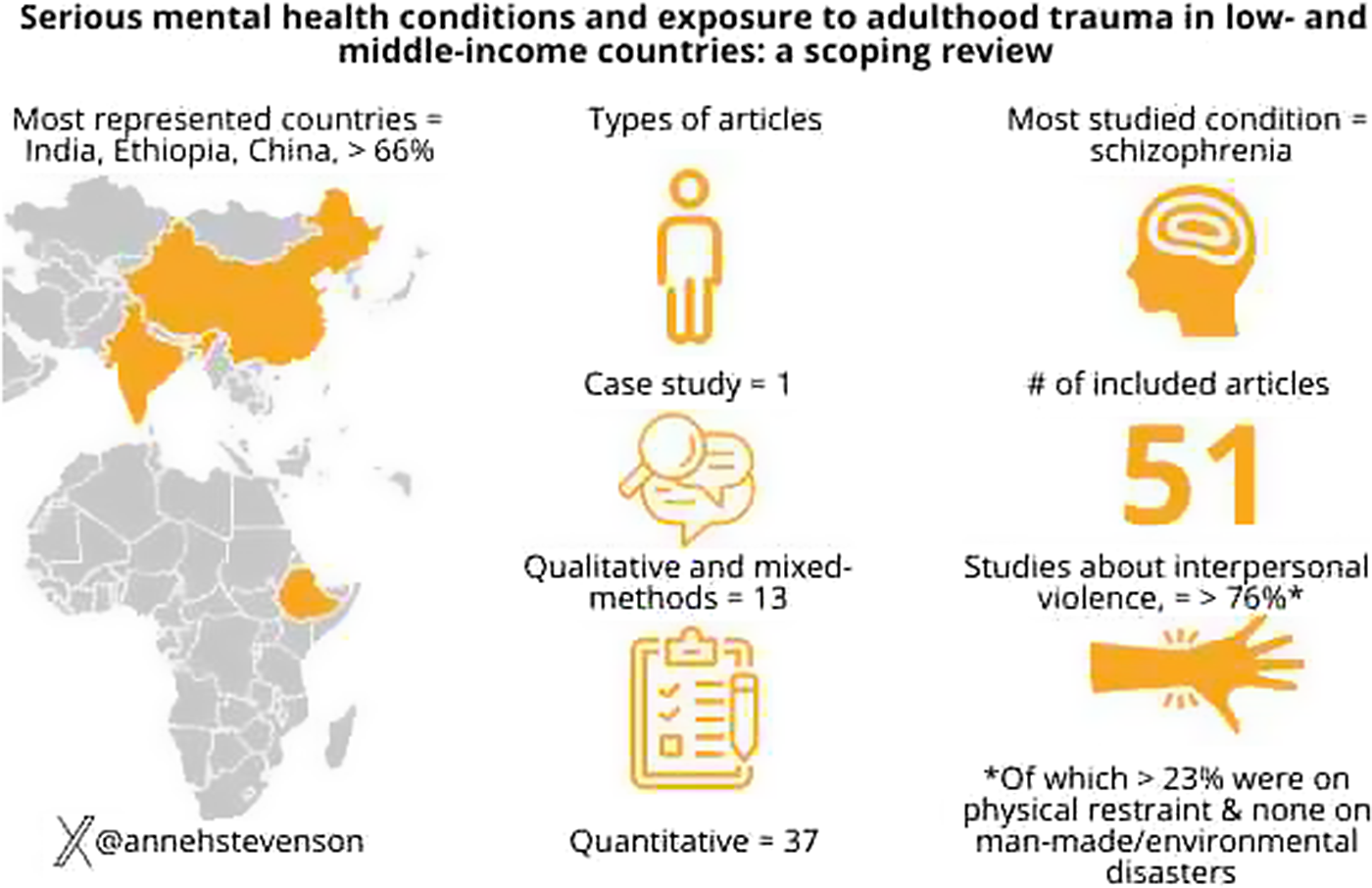
The database search returned 4,111 articles. After removing duplicates and following a rigorous screening process, 51 articles met criteria for inclusion. There was one case study, one mixed methods study, 12 qualitative studies and 37 quantitative studies. Ten countries were represented, with the most studies from India (n = 19), Ethiopia (n = 9) and China (n = 6). Schizophrenia was the most studied type of SMHC. Of the trauma exposures, more than 76% were on interpersonal violence, such as sexual and physical violence. Of the studies on interpersonal violence, more than 23% were on physical restraint (e.g., shackling) in the community or in hospital settings. There were no studies on man-made or natural disasters.
Implications
Much of our data in this population are informed by a small subset of countries and by certain types of interpersonal violence. Future research should aim to expand to additional countries in LMICs. Additional qualitative research would likely identify and contextualize other trauma types among adults with SMHCs in LMICs.