Refine listing
Actions for selected content:
143443 results in Open Access
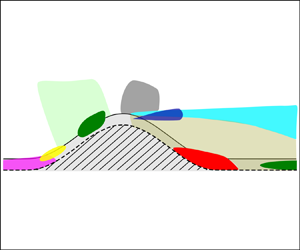
Wall turbulence perturbed by a bump with organized small-scale roughness: flow statistics
-
- Journal:
- Journal of Fluid Mechanics / Volume 989 / 25 June 2024
- Published online by Cambridge University Press:
- 29 July 2024, A13
-
- Article
-
- You have access
- Open access
- HTML
- Export citation
Rise of the beta-lactams: a retrospective, comparative cohort of oral beta-lactam antibiotics as step-down therapy for hospitalized adults with acute pyelonephritis
-
- Journal:
- Antimicrobial Stewardship & Healthcare Epidemiology / Volume 4 / Issue 1 / 2024
- Published online by Cambridge University Press:
- 26 July 2024, e102
-
- Article
-
- You have access
- Open access
- HTML
- Export citation
The impact of the FilmArray meningitis/encephalitis panel on empiric antibiotic prescriptions in patients with suspected community-acquired meningitis
-
- Journal:
- Antimicrobial Stewardship & Healthcare Epidemiology / Volume 4 / Issue 1 / 2024
- Published online by Cambridge University Press:
- 26 July 2024, e104
-
- Article
-
- You have access
- Open access
- HTML
- Export citation
Women, Men, and Elections: Policy Supply and Gendered Voting Behaviour in Western Democracies. By Rosalind Shorrocks. New York: Routledge, 2022. 258 pp. $48.95 (paperback), $136.00 (hardcover). ISBN: 9780367353605.
-
- Journal:
- Politics & Gender / Volume 20 / Issue 4 / December 2024
- Published online by Cambridge University Press:
- 26 July 2024, pp. 1031-1033
-
- Article
-
- You have access
- Open access
- HTML
- Export citation
The role of neurocognitive testing in the assessment of fitness to stand trial
-
- Journal:
- BJPsych Advances / Volume 30 / Issue 6 / November 2024
- Published online by Cambridge University Press:
- 26 July 2024, pp. 410-413
- Print publication:
- November 2024
-
- Article
-
- You have access
- Open access
- HTML
- Export citation
Tail asymptotics and precise large deviations for some Poisson cluster processes
- Part of
-
- Journal:
- Advances in Applied Probability / Volume 57 / Issue 1 / March 2025
- Published online by Cambridge University Press:
- 26 July 2024, pp. 204-240
- Print publication:
- March 2025
-
- Article
-
- You have access
- Open access
- HTML
- Export citation
The clinical characteristics of autistic women with restrictive eating disorders
-
- Journal:
- BJPsych Open / Volume 10 / Issue 4 / July 2024
- Published online by Cambridge University Press:
- 26 July 2024, e131
-
- Article
-
- You have access
- Open access
- HTML
- Export citation
First record of Diapterus brevirostris (Teleostei: Gerridae) in Atlantic European waters: a case of introduced species
-
- Journal:
- Journal of the Marine Biological Association of the United Kingdom / Volume 104 / 2024
- Published online by Cambridge University Press:
- 26 July 2024, e61
-
- Article
-
- You have access
- Open access
- HTML
- Export citation
Cognitive testing and the hazards of cut-offs
-
- Journal:
- BJPsych Advances / Volume 31 / Issue 1 / January 2025
- Published online by Cambridge University Press:
- 26 July 2024, pp. 20-27
- Print publication:
- January 2025
-
- Article
-
- You have access
- Open access
- HTML
- Export citation
Guillermo Rivera: Cuídate de la justicia Boliviana
-
- Journal:
- BJPsych Bulletin / Volume 48 / Issue 5 / October 2024
- Published online by Cambridge University Press:
- 26 July 2024, pp. 314-317
- Print publication:
- October 2024
-
- Article
-
- You have access
- Open access
- HTML
- Export citation
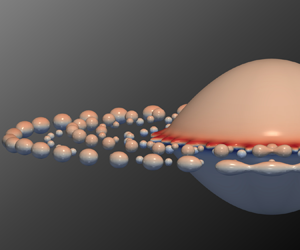
Lattice Boltzmann modelling and study of droplet equatorial streaming in an electric field
- Part of
-
- Journal:
- Journal of Fluid Mechanics / Volume 988 / 10 June 2024
- Published online by Cambridge University Press:
- 26 July 2024, A40
-
- Article
-
- You have access
- Open access
- HTML
- Export citation
Measuring the efficacy of standard and novel disinfection methods on frequently used physical therapy equipment: a 2-phase prospective randomized controlled trial
-
- Journal:
- Infection Control & Hospital Epidemiology / Volume 45 / Issue 10 / October 2024
- Published online by Cambridge University Press:
- 26 July 2024, pp. 1219-1224
- Print publication:
- October 2024
-
- Article
-
- You have access
- Open access
- HTML
- Export citation
Healthcare staff perceptions of an electronic hand hygiene monitoring system within a large university system
-
- Journal:
- Antimicrobial Stewardship & Healthcare Epidemiology / Volume 4 / Issue 1 / 2024
- Published online by Cambridge University Press:
- 26 July 2024, e103
-
- Article
-
- You have access
- Open access
- HTML
- Export citation
Convergence of hybrid slice sampling via spectral gap
- Part of
-
- Journal:
- Advances in Applied Probability / Volume 56 / Issue 4 / December 2024
- Published online by Cambridge University Press:
- 25 July 2024, pp. 1440-1466
- Print publication:
- December 2024
-
- Article
-
- You have access
- Open access
- HTML
- Export citation
Against digital constitutionalism
-
- Journal:
- European Law Open / Volume 3 / Issue 2 / June 2024
- Published online by Cambridge University Press:
- 25 July 2024, pp. 336-352
-
- Article
-
- You have access
- Open access
- HTML
- Export citation

A model for frequency scaling of flow oscillations in high-speed double cones
-
- Journal:
- Journal of Fluid Mechanics / Volume 988 / 10 June 2024
- Published online by Cambridge University Press:
- 25 July 2024, A37
-
- Article
-
- You have access
- Open access
- HTML
- Export citation
-
Coherent small-amplitude unsteadiness of the shock wave and the separation region over a canonical double cone flow, termed in literature as oscillation-type unsteadiness, is experimentally studied at Mach 6. The double cone model is defined by three non-dimensional geometric parameters: fore- and aft-cone angles ( $\theta _1$ and $\theta _2$), and ratio of the conical slant lengths ( $\varLambda$). Previous studies of oscillations have been qualitative in nature, and mostly restricted to a special case of the cone model with fixed $\theta _1 = 0^\circ$ and $\theta _2 = 90^\circ$ (referred to as the spike-cylinder model), where $\varLambda$ becomes the sole governing parameter. In the present effort we investigate the self-sustained flow oscillations in the $\theta _1$- $\varLambda$ parameter space for fixed $\theta _2 = 90^\circ$ using high-speed schlieren visualisation. The experiments reveal two distinct subtypes of oscillations, characterised by the motion (or lack thereof) of the separation point on the fore-cone surface. The global time scale associated with flow oscillation is extracted using spectral proper orthogonal decomposition. The non-dimensional frequency (Strouhal number) of oscillation is seen to exhibit distinct scaling for the two oscillation subtypes. The relationship observed between the local flow properties, instability of the shear layer, and geometric constraints on the flow suggests that an aeroacoustic feedback mechanism sustains the oscillations. Based on this understanding, a simple model with no empiricism is developed for the Strouhal number. The model predictions are found to match well with experimental measurements. The model provides helpful physical insight into the nature of the self-sustained flow oscillations over a double cone at high speeds.


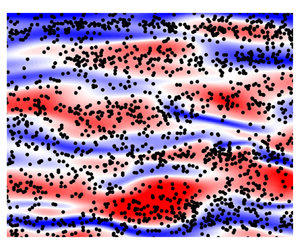
On the relevance of lift force modelling in turbulent wall flows with small inertial particles
-
- Journal:
- Journal of Fluid Mechanics / Volume 988 / 10 June 2024
- Published online by Cambridge University Press:
- 25 July 2024, A47
-
- Article
-
- You have access
- Open access
- HTML
- Export citation
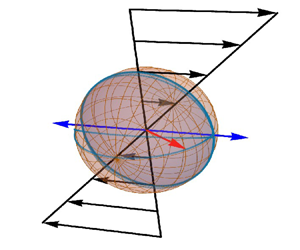
Dynamics of a magnetic particle in an oscillating magnetic field subject to a shear flow
-
- Journal:
- Journal of Fluid Mechanics / Volume 988 / 10 June 2024
- Published online by Cambridge University Press:
- 25 July 2024, A49
-
- Article
-
- You have access
- Open access
- HTML
- Export citation
-
The orientational dynamics of a spherical magnetic particle in linear shear flow subjected to an oscillating magnetic field in the flow plane is analysed in the viscous limit. The shear is in the $X$–
$X$– $Y$ plane, the magnetic field is in the $X$ direction and the vorticity is perpendicular to the flow in the $Z$ direction. The relevant dimensionless groups are $\omega ^\ast$, the ratio of the frequency of the magnetic field and the strain rate, and $\varSigma$, the ratio of the magnetic and hydrodynamic torques. As $\varSigma$ is decreased, there is a transition from in-plane rotation, where the rotation is in the flow ( $X$–
$X$– $Y$) plane, to out-of-plane rotation, where the orientation vector is not necessarily in the $X$–
$X$– $Y$ plane and the dynamics depends on the initial orientation. The particle rotation is phase-locked for in-plane rotation with discrete odd rotation number (number of rotations in one period of magnetic field oscillation), while the orbits are quasi-periodic with non-integer rotation number for out-of-plane rotation. For $\varSigma \gg 1$, regions of odd rotation number $n_o$ are bound by the lines $8 (n_o-1) \varSigma \omega ^\ast = 1$ and $8 (n_o+1) \varSigma \omega ^\ast = 1$, and there are discontinuous changes in the rotation number and mean and root-mean-square torque at these lines. For $\varSigma \ll 1$, the domains of in-plane rotation of finite width in the $\omega ^\ast$– $\varSigma$ plane extend into downward cusps at $\omega ^\ast = {1}/{2 n_o}$. The orbits are quasi-periodic between these domains, where the rotation is out of plane.


Bridging the gap: national virtual education programme for professionals caring for adults with intellectual and developmental disabilities at the time of COVID-19
-
- Journal:
- BJPsych Open / Volume 10 / Issue 4 / July 2024
- Published online by Cambridge University Press:
- 25 July 2024, e130
-
- Article
-
- You have access
- Open access
- HTML
- Export citation
Reflections on working as and supervising trial therapists on trials of psychosocial interventions
-
- Journal:
- BJPsych Open / Volume 10 / Issue 4 / July 2024
- Published online by Cambridge University Press:
- 25 July 2024, e129
-
- Article
-
- You have access
- Open access
- HTML
- Export citation
