Refine listing
Actions for selected content:
141953 results in Open Access
Expressive writing interventions in patients with cancer: A scoping literature review
-
- Journal:
- Palliative & Supportive Care / Volume 23 / 2025
- Published online by Cambridge University Press:
- 21 July 2025, e132
-
- Article
-
- You have access
- Open access
- HTML
- Export citation

Uncovering the forcing statistics in stochastic linear models for compressible wall-bounded turbulence
-
- Journal:
- Journal of Fluid Mechanics / Volume 1015 / 25 July 2025
- Published online by Cambridge University Press:
- 21 July 2025, A40
-
- Article
-
- You have access
- Open access
- HTML
- Export citation
-
Modelling the nonlinear forcing is critical for linear models based on resolvent or input–output analyses. For compressible wall-bounded turbulence, little is known on what the real forcing looks like due to limited data, so the prediction agrees more qualitatively than quantitatively with direct numerical simulations (DNSs). Here, we present detailed forcing statistics of stochastic linear models, derived from elaborate DNS datasets for channel flows with bulk Mach number reaching 3. These statistics directly explain the success and failure of current models and provide guidance for further improvements. The benchmark linearised Navier–Stokes (LNS) and eLNS models are considered; the latter is assisted by eddy-viscosity-related terms. First, we prove the self-consistency of the models by using DNS-computed forcing as the input. Second, we present the spectral distributions of the forcing and its components. Third, we quantify the acoustic components, absent in incompressible cases, within the linear models. We reveal that the LNS forcing can exhibit relatively high coherence and low rank, very different from the modelled diagonal full-rank forcing. The eddy-viscosity-related term is not partial modelling of the LNS forcing; contrarily, the former is much larger than the latter, serving to disrupt the low-rank feature, enhance diagonal dominance and increase robustness across scales. The scales narrow in either horizontal direction are most susceptible to acoustic modes, while the others are little affected ( ${\lt}2\,\%$ in energy). Furthermore, the extended strong Reynolds analogy is assessed in predicting the density and temperature components.

Equivariant Fukaya categories at singular values
- Part of
-
- Journal:
- Glasgow Mathematical Journal , First View
- Published online by Cambridge University Press:
- 21 July 2025, pp. 1-25
-
- Article
-
- You have access
- Open access
- HTML
- Export citation
Reconsidering the World History of Literature as an Entanglement of Cross-cultural and Intermedial Transmissions
-
- Journal:
- European Review / Volume 33 / Issue 3 / June 2025
- Published online by Cambridge University Press:
- 21 July 2025, pp. 350-359
-
- Article
-
- You have access
- Open access
- HTML
- Export citation
The zonal-flow residual does not tend to zero in the limit of small mirror ratio
-
- Journal:
- Journal of Plasma Physics / Volume 91 / Issue 4 / August 2025
- Published online by Cambridge University Press:
- 21 July 2025, E102
-
- Article
-
- You have access
- Open access
- HTML
- Export citation
Evidence for the spin-kick alignment of pulsars from the statistics of their magnetic inclinations
-
- Journal:
- Publications of the Astronomical Society of Australia / Volume 42 / 2025
- Published online by Cambridge University Press:
- 21 July 2025, e106
-
- Article
-
- You have access
- Open access
- HTML
- Export citation
Recognition, Decolonization, and the Limitations of James Tully’s Public Philosophy
-
- Journal:
- The Review of Politics / Volume 87 / Issue 4 / Fall 2025
- Published online by Cambridge University Press:
- 21 July 2025, pp. 505-528
-
- Article
-
- You have access
- Open access
- HTML
- Export citation
Building capacity in horizon scanning, early awareness, and disinvestment: a framework for education and training
- Part of
-
- Journal:
- International Journal of Technology Assessment in Health Care / Volume 41 / Issue 1 / 2025
- Published online by Cambridge University Press:
- 21 July 2025, e51
-
- Article
-
- You have access
- Open access
- HTML
- Export citation
Exploration of Spatial Composition with a New Electronic Stringed Instrument
-
- Journal:
- Organised Sound / Volume 30 / Issue 2 / August 2025
- Published online by Cambridge University Press:
- 21 July 2025, pp. 215-220
- Print publication:
- August 2025
-
- Article
-
- You have access
- Open access
- HTML
- Export citation
Why (and how) total numbers should matter for animal experimentation policy
-
- Journal:
- Politics and the Life Sciences , First View
- Published online by Cambridge University Press:
- 21 July 2025, pp. 1-11
-
- Article
-
- You have access
- Open access
- HTML
- Export citation
Lower bounds on density for topologically nontrivial minimal cones up to dimension six
- Part of
-
- Journal:
- Forum of Mathematics, Sigma / Volume 13 / 2025
- Published online by Cambridge University Press:
- 21 July 2025, e122
-
- Article
-
- You have access
- Open access
- HTML
- Export citation

Wake merging and turbulence transition downstream of side-by-side porous discs
-
- Journal:
- Journal of Fluid Mechanics / Volume 1015 / 25 July 2025
- Published online by Cambridge University Press:
- 21 July 2025, A39
-
- Article
-
- You have access
- Open access
- HTML
- Export citation
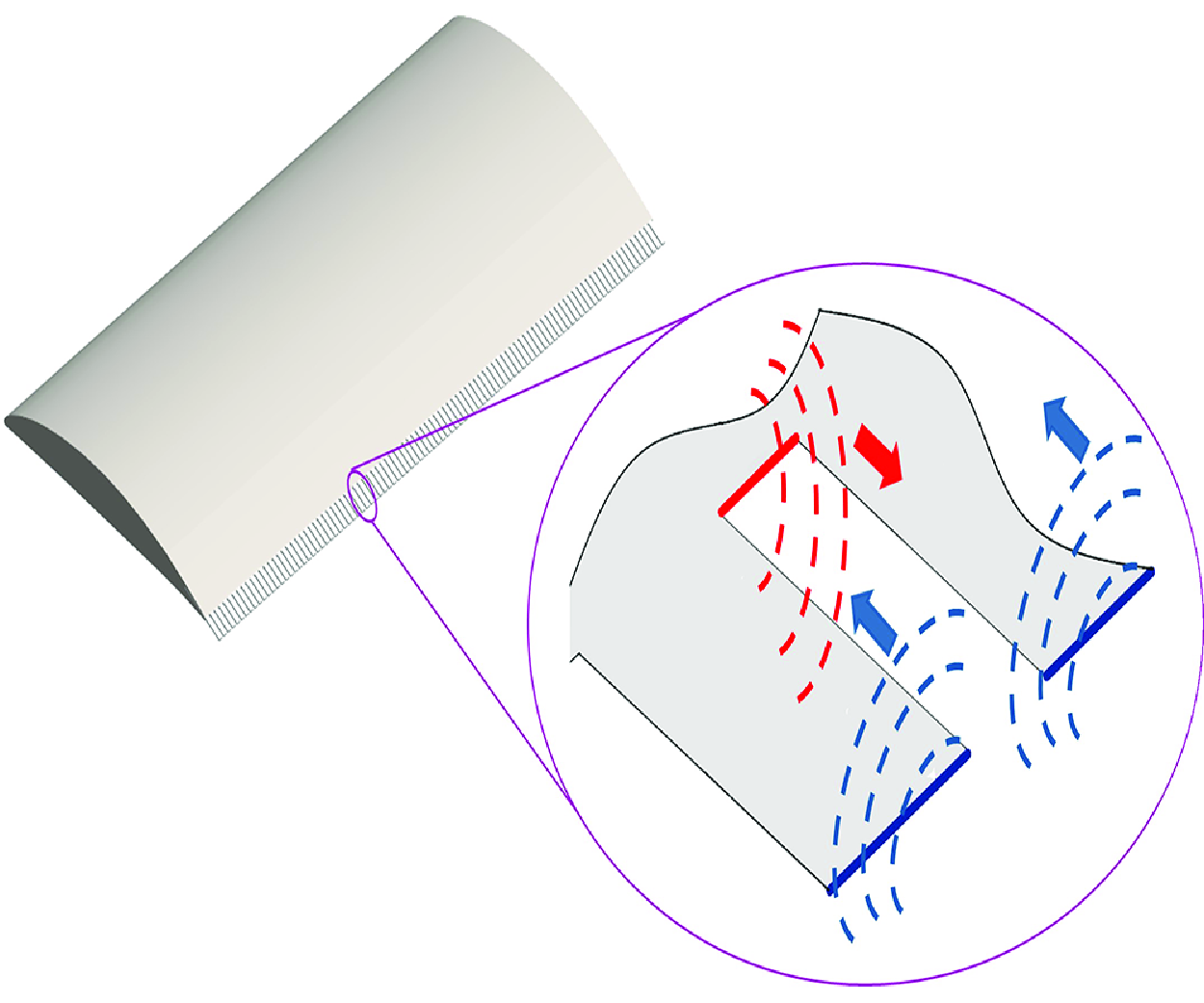
On the slit trailing edges for aerofoil self-noise reduction
-
- Journal:
- Journal of Fluid Mechanics / Volume 1015 / 25 July 2025
- Published online by Cambridge University Press:
- 21 July 2025, A43
-
- Article
-
- You have access
- Open access
- HTML
- Export citation
-
This paper presents an experimental and analytical investigation into the use of trailing edge slits for the reduction of aerofoil trailing edge noise. The noise reduction mechanism is shown to be fundamentally different from conventional trailing edge serrations, relying on destructive interference from highly compact and coherent sources generated at either ends of the slit. This novel approach is the first to exploit the coherence intrinsic to the boundary layer turbulence. Furthermore, the study demonstrates that trailing edge slits not only achieve superior noise reductions compared with sawtooth serrations of the same amplitude at certain conditions, but also offer frequency-tuning capability for noise reduction. Noise reduction is driven by the destructive interference between acoustic sources at the root and tip of the slit, which radiate with a phase difference determined by the difference in times taken for the boundary layer flow to convect between the root and tip. Maximum noise reductions occur at frequencies where the phase difference between these sources is $180^\circ$. The paper also presents a detailed parametric study into the variation in noise reductions due to the slit length, slit wavelength and slit root width. Additionally, a simple two-source analytic model is proposed to explain the observed results. Wind tunnel measurements of the unsteady flow field around the trailing edge slits are also presented, providing insights into the underlying flow physics.

Neonatal and 3-month cerebrovascular oxygenation, stability, and extraction in congenital heart disease versus control infants
-
- Journal:
- Journal of Clinical and Translational Science / Volume 9 / Issue 1 / 2025
- Published online by Cambridge University Press:
- 21 July 2025, e175
-
- Article
-
- You have access
- Open access
- HTML
- Export citation
Temporal relationships between speech and hand gestures in the vicinity of potential turn boundaries in German and Swedish conversation
-
- Journal:
- Language and Cognition / Volume 17 / 2025
- Published online by Cambridge University Press:
- 21 July 2025, e57
-
- Article
-
- You have access
- Open access
- HTML
- Export citation
RIGID INNER FORMS OVER GLOBAL FUNCTION FIELDS
- Part of
-
- Journal:
- Journal of the Institute of Mathematics of Jussieu / Volume 24 / Issue 6 / November 2025
- Published online by Cambridge University Press:
- 21 July 2025, pp. 2181-2256
- Print publication:
- November 2025
-
- Article
-
- You have access
- Open access
- HTML
- Export citation
-
We construct an fpqc gerbe $\mathcal {E}_{\dot {V}}$ over a global function field F such that for a connected reductive group G over F with finite central subgroup Z, the set of $G_{\mathcal {E}_{\dot {V}}}$-torsors contains a subset $H^{1}(\mathcal {E}_{\dot {V}}, Z \to G)$ which allows one to define a global notion of (Z-)rigid inner forms. There is a localization map $H^{1}(\mathcal {E}_{\dot {V}}, Z \to G) \to H^{1}(\mathcal {E}_{v}, Z \to G)$, where the latter parametrizes local rigid inner forms (cf. [8, 6]) which allows us to organize local rigid inner forms across all places v into coherent families. Doing so enables a construction of (conjectural) global L-packets and a conjectural formula for the multiplicity of an automorphic representation $\pi $ in the discrete spectrum of G in terms of these L-packets. We also show that, for a connected reductive group G over a global function field F, the adelic transfer factor $\Delta _{\mathbb {A}}$ for the ring of adeles $\mathbb {A}$ of F serving an endoscopic datum for G decomposes as the product of the normalized local transfer factors from [6].


Is adult-onset separation anxiety disorder a trauma-stress-related disorder? A preliminary report
-
- Journal:
- CNS Spectrums / Volume 30 / Issue 1 / 2025
- Published online by Cambridge University Press:
- 21 July 2025, e58
-
- Article
-
- You have access
- Open access
- HTML
- Export citation
Development and implementation of a value framework for rapid health technology assessment reports: enhancing evidence-informed decision making in resource-constrained settings
-
- Journal:
- International Journal of Technology Assessment in Health Care / Volume 41 / Issue 1 / 2025
- Published online by Cambridge University Press:
- 21 July 2025, e58
-
- Article
-
- You have access
- Open access
- HTML
- Export citation
Social policy support for families in South Korea during and after the pandemic of COVID-19, from a comparative perspective
-
- Journal:
- Journal of International and Comparative Social Policy / Volume 40 / Issue 3 / November 2024
- Published online by Cambridge University Press:
- 21 July 2025, pp. 237-245
-
- Article
-
- You have access
- Open access
- HTML
- Export citation
Density jump as a function of the field for parallel relativistic collisionless shocks
-
- Journal:
- Journal of Plasma Physics / Volume 91 / Issue 4 / August 2025
- Published online by Cambridge University Press:
- 21 July 2025, E106
-
- Article
-
- You have access
- Open access
- HTML
- Export citation
-
Collisionless shocks are frequently analysed using the magnetohydrodynamic (MHD) formalism, even though the required collisionality hypothesis is not fulfilled. In a previous work (Bret & Narayan, 2018 J. Plasma Phys. vol. 84, p. 905840604), we presented a model of collisionless shock displaying an important departure from the expected MHD behaviour, in the case of a strong flow aligned magnetic field. This model was non-relativistic. Here, it is extended to the relativistic regime, considering zero upstream pressure and upstream Lorentz factor $\gg 1$. The result agrees satisfactorily with Particle-in-Cell simulations and shows a similar, and important, departure from the MHD prediction. In the strong field regime, the density jump $r$, seen in the downstream frame, behaves like $r \sim 2 + 1/\gamma _{\mathrm{up}}$, while MHD predicts 4 ( $\gamma _{\mathrm{up}}$ is the Lorentz factor of the upstream measured in the downstream frame). Only pair plasmas are considered.


