To save content items to your account,
please confirm that you agree to abide by our usage policies.
If this is the first time you use this feature, you will be asked to authorise Cambridge Core to connect with your account.
Find out more about saving content to .
To save content items to your Kindle, first ensure no-reply@cambridge.org
is added to your Approved Personal Document E-mail List under your Personal Document Settings
on the Manage Your Content and Devices page of your Amazon account. Then enter the ‘name’ part
of your Kindle email address below.
Find out more about saving to your Kindle.
Note you can select to save to either the @free.kindle.com or @kindle.com variations.
‘@free.kindle.com’ emails are free but can only be saved to your device when it is connected to wi-fi.
‘@kindle.com’ emails can be delivered even when you are not connected to wi-fi, but note that service fees apply.
Methods of quantifying distance between sound sequences are known as phonological distance measures. Despite the wide application across subfields, phonological distance has been calculated mainly with features related to consonants and vowels. This research report establishes new measurements of phonological distance that incorporate lexical tone through experimental approaches and modeling, using Hong Kong Cantonese as a case study. Results show correspondences between the experimental data and predictions from information-theoretic measures, including entropy measures and functional load, suggesting that lexical components which play a more crucial role in phonological distance judgments are lexically less predictable as well. Implications for phonological distance measures are discussed.
Recent years have witnessed considerable interest in (dynamic) issue ownership. While new insights have been gained, progress is stifled by two factors. One, research on issue ownership is typically subject to data sparsity, which has often restricted analyses to few issues. Two, research has mostly studied issue ownership as simple percentages, which are prone to random sampling error, thus disregarding uncertainty in estimating public attributions of issue ownership. To overcome both shortcomings, we propose a Bayesian multilevel model. The model can be flexibly specified to recover dynamic issue ownership. The model is applied to data from the German Longitudinal Election Study. Substantively, the model shows that parties’ issue competences display some malleability, but that changes unfold gradually over time.
Archaeological investigations in the Prut-Dniester region during the Roman Imperial Period have yielded numerous Sarmatian culture necropolises and isolated graves. Establishing a precise chronology for these remains has long been a challenge due to the limitations of typological dating alone. This study integrates radiocarbon (14C) analysis of 11 human bone samples from selected funerary contexts with traditional typological methods, refining the chronological framework of the Sarmatian culture in this region. The radiocarbon analyses were subjected to Bayesian modeling, which allowed for the delineation of these samples into distinct phases, thereby adjusting and improving the periodization established through traditional methods. The results not only confirm but also refine previously established chronologies, offering deeper insights into the cultural, social, and economic dynamics of Sarmatian communities in the Prut-Dniester Barbaricum. These findings represent a significant contribution to the broader understanding of the Roman Imperial Period beyond the Eastern Limes.
Ocmulgee Mounds National Historical Park, located in Macon, Georgia, is one of the most iconic cultural sites in the Southeast and is a Traditional Cultural Place (TCP) of the Muscogee Nation and other federally recognized Tribal Nations. Early work (1933–1941) revealed a network of earthen monuments and other features. Prior to our work, there were only two radiocarbon dates from the primary Native American occupation of Ocmulgee. Both were run in the 1960s—and only one is from the famous Earthlodge community building. These assays contributed to a general chronological assignment of the site to AD 1015. Our new dating program—including wiggle-matched radiocarbon dates from one of the timbers of this building—indicates a later construction for the Earthlodge and likely continuous occupation for other areas of the site, calling into question beliefs about Ocmulgee and its place in interpretative constructs. This work is a collaborative effort that includes Muscogee Nation, academics, National Park Service archaeologists, and private citizens. The results have implications for understanding not only the Muskogean-speaking people’s histories and their relationship to TCPs but also how we can begin to conduct archaeology in a way that strengthens descendants’ connections to ancestral homelands.
The notions of “emergence” and “becoming” have become widely adopted in relational studies in archaeology, but their definition and application remain nebulous. We advocate a middle-range approach to the incorporation of these related concepts into the study of migration and pronounced cultural shifts. Our study relies on the Bayesian modeling of a significant corpus of radiocarbon dates from Mississippian sites in the Tombigbee Valley of southeastern North America. This investigation has identified the likelihood of two broad migration episodes that we hypothesize are related to cultural rephrasings of landscape and temporality.
The Salapunku archaeological site is located within the Historic Sanctuary – National Archaeological Park of Machu Picchu (HS-NAPM) in the Cusco area of Peru. Although Salapunku is related to the Inca settlements of the HS-NAPM, during archaeological excavations, we distinguished different moments of cultural occupation from the earliest human presence to complex pre-Hispanic societies such as the Inca and finally to the colonial period. Previous research on the site’s chronology was based on typological analyses of pottery and other artifacts found during archaeological research. This radiocarbon analysis, the first of its kind in this area, establishes a chronology of the cultural history of this significant settlement, considered the gateway to the Cordillera of Vilcabamba.
Judging an individual’s loyalty in security-sensitive roles is a high-stakes task, yet little is known about the extent and sources of variability in such judgments. This study examined how 58 participants with experience in personnel security assessment evaluated applicant profiles connected to five different countries. Each participant reviewed five protocols and judged whether the case contained information relevant to a personnel security clearance, then rated the applicant’s loyalty on a 7-point scale. Using Bayesian probit regression and an ordinal item response model with hierarchical structure, we analyzed both binary judgments and rating patterns, accounting for country of connection, applicant gender, and participant-specific variability. Results revealed substantial between-participant variability (‘noise’) in how likely judges were to flag foreign ties as relevant. Pattern noise, reflecting idiosyncratic differences in how individuals interpret the same case, was evident in loyalty ratings. Connections to Brazil and Thailand were associated with systematically lower loyalty ratings and heightened disagreement between judges, reflecting both bias and pattern noise. Contrary to policy guidance, fewer than half of foreign connections were judged as relevant, and this tendency did not vary by participant gender. The findings underscore the risk of inconsistency in high-stakes assessments and highlight the need for structured conceptual calibration in personnel vetting.
Cultural consensus theory (CCT) leverages shared knowledge between individuals to optimally aggregate answers to questions for which the underlying truth is unknown. Existing CCT models have predominantly focused on unidimensional point truths using dichotomous, polytomous, or continuous response formats. However, certain domains, such as risk assessment or interpretation of verbal quantifiers, may require a consensus focused on intervals, capturing a range of relevant values. We introduce the interval consensus model (ICM), a novel extension of CCT designed to estimate consensus intervals from continuous bounded interval responses. We use a Bayesian hierarchical modeling approach to estimate latent consensus intervals. In a simulation study, we show that, under the conditions studied, the ICM performs better than using simple means and medians of the responses. We then apply the model to empirical judgments of verbal quantifiers.
Whether bilingualism confers non-linguistic cognitive advantages continues to generate both interest and debate in the psychological sciences. In response to mixed reports and methodological critiques, researchers have embraced more rigorous practices when investigating bilingual effects, including those in the domain of cognitive control. Despite considerable advances, one significant issue persists: the assumption that task performance remains stable over time. To address this, the present study investigated the relationship between bilingual language experience and Simon task performance modeled as a continuous function of time. In a sample of Mandarin-English bilingual young adults, we identified distinct patterns of results across both conventional and time-sensitive performance trajectory measures with each supporting a different relationship between language experience and cognitive control. Results suggest that reliance on conventional performance measures may be partially responsible for mixed results, necessitating reevaluation of how bilingual effects on cognitive control manifest and which analysis methods best support their identification.
The transformation of the Birnirk culture into the Thule culture is essential in reconstructing the emergence of modern Inuit across Alaska and the larger Bering Strait. To this end, two adjacent semi-subterranean houses of late Birnirk and early Thule affiliation, respectively, at the Rising Whale (KTZ-304) site at Cape Espenberg were recently excavated and dated by radiocarbon and tree-ring measurements. We present the Bayesian analysis of the resulting large series of dates, demonstrating the lack of contemporaneity between the two features: the Birnirk house was occupied in the late twelfth to early thirteenth centuries AD, whereas the occupation of the Thule house occurred in the second half of the thirteenth into the early fourteenth century. With the increased precision made possible by coupling dendrochronology with radiocarbon, our results place the Birnirk-Thule transition more that 200 years later than the generally accepted date of AD 1000. A transition in the second half of the thirteenth century has major implications for the timing of Thule presence along the coast of Alaska and for their migration into the Alaska interior. It aligns with a thirteenth-century migration into the western Canadian Arctic and farther east and a brief early or “initial” Thule period.
We seek to understand the factors that drive mortality in the contiguous United States using data that are indexed by county and year and grouped into 18 different age bins. We propose a model that adds two important contributions to existing mortality studies. First, we treat age as a random effect. This is an improvement over previous models because it allows the model in one age group to borrow information from other age groups. Second, we utilize Gaussian Processes to create nonlinear covariate effects for predictors such as unemployment rate, race, and education level. This allows for a more flexible relationship to be modeled between mortality and these predictors. Understanding that the United States is expansive and diverse, we allow for many of these effects to vary by location. The flexibility in how predictors relate to mortality has not been used in previous mortality studies and will result in a more accurate model and a more complete understanding of the factors that drive mortality. Both the multivariate nature of the model as well as the spatially varying non-linear predictors will advance the study of mortality and will allow us to better examine the relationships between the predictors and mortality.
Understanding the developmental and occupational histories of Ancestral Maya settlements is crucial for interpreting their roles in broader social, political, and economic dynamics. This article presents 62 new accelerator mass spectrometry (AMS) 14C dates from residential groups in the outlying settlement zone at Alabama, a major inland Ancestral Maya center in East-Central Belize. Alabama is a rare example of a “boomtown” in the Maya lowlands, experiencing rapid development primarily during the 8th and 9th century CE, corresponding to the Late to Terminal Classic periods. Using Bayesian stratigraphic sequence models, we construct detailed developmental and occupational histories for the townsite, clarifying the timing of its development, occupation, and abandonment. Our analysis reveals complex residential histories, confirming a rapid tempo of Late and Terminal Classic settlement growth and indicating continuities in occupation into the 10th century CE and beyond. Furthermore, we identify two separate periods of occupation during the Early Classic (cal AD 345–545) and the Late Postclassic (cal AD 1325–1475), demonstrating that parts of the settlement were inhabited at different intervals over many centuries. These results offer the first detailed deep-history perspective for the East-Central Belize region, establishing a framework that addresses challenges in chronology-building posed by poor pottery preservation and the complexities of earthen-core architecture at the site and enabling future chronological modeling in this lesser-known frontier of the eastern Maya lowlands.
Peer grading is an educational system in which students assess each other’s work. It is commonly applied under Massive Open Online Course (MOOC) and offline classroom settings. With this system, instructors receive a reduced grading workload, and students enhance their understanding of course materials by grading others’ work. Peer grading data have a complex dependence structure, for which all the peer grades may be dependent. This complex dependence structure is due to a network structure of peer grading, where each student can be viewed as a vertex of the network, and each peer grade serves as an edge connecting one student as a grader to another student as an examinee. This article introduces a latent variable model framework for analyzing peer grading data and develops a fully Bayesian procedure for its statistical inference. This framework has several advantages. First, when aggregating multiple peer grades, the average score and other simple summary statistics fail to account for grader effects and, thus, can be biased. The proposed approach produces more accurate model parameter estimates and, therefore, more accurate aggregated grades by modeling the heterogeneous grading behavior with latent variables. Second, the proposed method provides a way to assess each student’s performance as a grader, which may be used to identify a pool of reliable graders or generate feedback to help students improve their grading. Third, our model may further provide insights into the peer grading system by answering questions such as whether a student who performs better in coursework also tends to be a more reliable grader. Finally, thanks to the Bayesian approach, uncertainty quantification is straightforward when inferring the student-specific latent variables as well as the structural parameters of the model. The proposed method is applied to two real-world datasets.
We present a dataset of 1,119 radiocarbon dates and their contexts for Oaxaca, Mexico, a best effort to include all published dates, plus hundreds of unpublished samples. We illustrate its potential and limitations with five examples: (1) dated stratigraphy in stream cutbanks show how aggradation, downcutting, and stability responded to global climate and human activities; (2) 14C samples from Late/Terminal Formative contexts allow interregional comparisons of temple and palace construction, use, and abandonment; (3) new 14C dates provide better understanding of events during the Late Classic/Epiclassic, a problematic time in the ceramic chronology; (4) individual Classic/Postclassic residential contexts had long durations—several hundred years; and (5) model constraints from other data permit refinement at times of calibration curve deviation, as during AD 1400–1600. We recommend further chronological refinement with best-practice standards, new samples, existing collections, and statistical modeling.
This article is the first to quantify the interindividual effects of different major life events (MLEs) on retrospective perceptions of individual-level linguistic change across the adult lifespan. In this cross-sectional study, 701 German-speaking participants from Austria completed an online survey measuring the extent to which MLEs in the educational, occupational, and personal domain are associated with perceived changes in productive and affective-attitudinal aspects of the sociolinguistic repertoire. Bayesian modeling revealed that events such as beginning a tertiary degree, entry into the workforce, and retirement were perceived to impact participants’ varietal use. Overall, however, affective-attitudinal factors such as dialect identity appear to be more readily susceptible to perceived MLE-related change. These results help pave a new path for variationist agendas that approach lifespan linguistic change not as a result of chronological age, but rather as a phenomenon influenced by individual experiential factors complexly intertwined with the process of aging.
This paper presents the radiocarbon context of the megalithic monument El Amarejo 1, situated in the corridor of Almansa in the southern region of La Meseta in Spain. The monument was constructed using small and medium-sized masonry, comprising a short corridor and two separate chambers in which burials were carried out. The results of the 14C analyses of each of the 11 individuals documented indicate that the monument was in use between approximately 1900 and 1200 cal BC. Bayesian modeling of the radiocarbon dates allows for the proposition of hypotheses regarding the construction, utilisation dynamics, and abandonment of the monument. The combination of these new data with the analysis of the 14C dating of other burials from the Bronze Age of La Mancha reveals a complex and heterogeneous panorama. The evidence presented and analyzed in this paper suggests that burial practices associated with fortified settlements and their domestic areas shared space and time with the construction of megalithic monuments located near settlements.
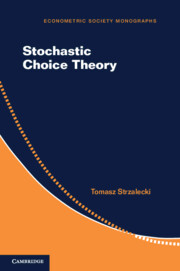
Models of stochastic choice are studied in decision theory, discrete choice econometrics, behavioral economics and psychology. Numerous experiments show that perception of stimuli is not deterministic, but stochastic (randomly determined). A growing body of evidence indicates that the same is true of economic choices. Whether trials are separated by days or minutes, the fraction of choice reversals is substantial. Stochastic Choice Theory offers a systematic introduction to these models, unifying insights from various fields. It explores mathematical models of stochastic choice, which have a variety of applications in game theory, industrial organization, labor economics, marketing, and experimental economics. Offering a systematic introduction to the field, this book builds up from scratch without any prior knowledge requirements and surveys recent developments, bringing readers to the frontier of research.
Missing values at the end of a test typically are the result of test takers running out of time and can as such be understood by studying test takers’ working speed. As testing moves to computer-based assessment, response times become available allowing to simulatenously model speed and ability. Integrating research on response time modeling with research on modeling missing responses, we propose using response times to model missing values due to time limits. We identify similarities between approaches used to account for not-reached items (Rose et al. in ETS Res Rep Ser 2010:i–53, 2010) and the speed-accuracy (SA) model for joint modeling of effective speed and effective ability as proposed by van der Linden (Psychometrika 72(3):287–308, 2007). In a simulation, we show (a) that the SA model can recover parameters in the presence of missing values due to time limits and (b) that the response time model, using item-level timing information rather than a count of not-reached items, results in person parameter estimates that differ from missing data IRT models applied to not-reached items. We propose using the SA model to model the missing data process and to use both, ability and speed, to describe the performance of test takers. We illustrate the application of the model in an empirical analysis.
Iroquoian groups inhabiting the St. Lawrence Valley in the fifteenth and sixteenth centuries AD practiced agriculture and supplemented their diet with fish and a variety of wild plants and terrestrial animals. Important gaps remain in our knowledge of Iroquoian foodways, including how pottery was integrated to culinary practices and the relative importance of maize in clay-pot cooking. Lipid analyses carried out on 32 potsherds from the Dawson site (Montreal, Canada) demonstrate that pottery from this village site was used to prepare a range of foodstuffs—primarily freshwater fish and maize, but possibly also other animals and plants. The importance of aquatic resources is demonstrated by the presence of a range of molecular compounds identified as biomarkers for aquatic products, whereas the presence of maize could only be detected through isotopic analysis. Bayesian modeling suggests that maize is present in all samples and is the dominant product in at least 40% of the potsherds analyzed. This combination of analytical techniques, applied for the first time to Iroquoian pottery, provides a glimpse into Iroquoian foodways and suggests that sagamité was part of the culinary traditions at the Dawson site.
The information criterion AIC was introduced to extend the method of maximum likelihood to the multimodel situation. It was obtained by relating the successful experience of the order determination of an autoregressive model to the determination of the number of factors in the maximum likelihood factor analysis. The use of the AIC criterion in the factor analysis is particularly interesting when it is viewed as the choice of a Bayesian model. This observation shows that the area of application of AIC can be much wider than the conventional i.i.d. type models on which the original derivation of the criterion was based. The observation of the Bayesian structure of the factor analysis model leads us to the handling of the problem of improper solution by introducing a natural prior distribution of factor loadings.