To save content items to your account,
please confirm that you agree to abide by our usage policies.
If this is the first time you use this feature, you will be asked to authorise Cambridge Core to connect with your account.
Find out more about saving content to .
To save content items to your Kindle, first ensure no-reply@cambridge.org
is added to your Approved Personal Document E-mail List under your Personal Document Settings
on the Manage Your Content and Devices page of your Amazon account. Then enter the ‘name’ part
of your Kindle email address below.
Find out more about saving to your Kindle.
Note you can select to save to either the @free.kindle.com or @kindle.com variations.
‘@free.kindle.com’ emails are free but can only be saved to your device when it is connected to wi-fi.
‘@kindle.com’ emails can be delivered even when you are not connected to wi-fi, but note that service fees apply.
Although active flow control based on deep reinforcement learning (DRL) has been demonstrated extensively in numerical environments, practical implementation of real-time DRL control in experiments remains challenging, largely because of the critical time requirement imposed on data acquisition and neural-network computation. In this study, a high-speed field-programmable gate array (FPGA) -based experimental DRL (FeDRL) control framework is developed, capable of achieving a control frequency of 1–10 kHz, two orders higher than that of the existing CPU-based framework (10 Hz). The feasibility of the FeDRL framework is tested in a rather challenging case of supersonic backward-facing step flow at Mach 2, with an array of plasma synthetic jets and a hot-wire acting as the actuator and sensor, respectively. The closed-loop control law is represented by a radial basis function network and optimised by a classical value-based algorithm (i.e. deep Q-network). Results show that, with only ten seconds of training, the agent is able to find a satisfying control law that increases the mixing in the shear layer by 21.2 %. Such a high training efficiency has never been reported in previous experiments (typical time cost: hours).
One Health is an approach to managing complex health threats by promoting multisectoral and multidisciplinary collaboration, engaging stakeholders, and contributing to sustainable development, while fostering equity and socioecological equilibrium across sectors and living species. Legislation is crucial for advancing One Health by establishing structures that foster collaboration, define roles and responsibilities, and support sustainable outcomes. To enhance its effectiveness, One Health must be integrated into legal frameworks addressing global challenges at the intersection of human, animal, plant, and ecosystem health, through flexible, context-specific legal frameworks adaptable to emerging and evolving threats.
This paper identifies four legal elements for embedding One Health into legislation: (i) normative integration (bridging different legal domains); (ii) multisectoral and multidisciplinary collaboration; (iii) stewardship and the sustainable management of common goods beyond human interests; and (iv) stakeholder engagement, ensuring inclusive participation. These elements are interconnected and interdependent, collectively forming a comprehensive foundation for integrating One Health into legal frameworks. They have the potential to dismantle sectoral silos, foster multidisciplinary collaboration, and advance stakeholder engagement and the recognition of the intrinsic value of all species. At the same time, these elements also function as strategies, offering practical pathways for legislative design and implementation. The paper also provides examples of their implementation and suggests avenues for future research.
A millimetric droplet may bounce and self-propel across the surface of a vertically vibrating liquid bath, guided by the slope of its accompanying Faraday wave field. The ‘walker’, consisting of a droplet dressed in a quasi-monochromatic wave form, is a spatially extended object that exhibits many phenomena previously thought exclusive to the quantum realm. While the walker dynamics can be remarkably complex, steady and periodic states arise in which the energy added by the bath vibration necessarily balances that dissipated by viscous effects. The system energetics may then be characterised in terms of the exchange between the bouncing droplet and its guiding or ‘pilot’ wave. We here characterise this energy exchange by means of a theoretical investigation into the dynamics of the pilot-wave system when time-averaged over one bouncing period. Specifically, we derive simple formulae characterising the dependence of the droplet’s gravitational potential energy and wave energy on the droplet speed. Doing so makes clear the partitioning between the gravitational, wave and kinetic energies of walking droplets in a number of steady, periodic and statistically steady dynamical states. We demonstrate that this partitioning depends exclusively on the ratio of the droplet speed to its speed limit.
Recent studies have revealed significant hidden diversity and a high incidence of cryptic speciation in Antarctic marine gastropods. Originally, philinoid cephalaspideans in the Southern Ocean were classified within the genus Philine. However, molecular and morphological studies have shown that three genera encompass all known diversity instead. These are Antarctophiline, Waegelea and Spiraphiline, the first two belonging to the recently erected family Antarctophilinidae. In this study, 55 specimens were collected from the South Shetland Islands, across the South Atlantic Antarctic Ridge to Bouvet Island, and from the South Sandwich Islands and Bransfield Strait, between 134 and 4548 m depth. We conducted morpho-anatomical and phylogenetic analyses to describe two new Antarctophiline species: Antarctophiline abyssalis sp. nov. and Antarctophiline malaquiasi sp. nov. Molecular results support the validity of the two distinct species, consistent with observed morpho-anatomical differences in the digestive system (i.e. the shape of gizzard plates and salivary glands), shell shape and other external characters. Additionally, we evaluate the morphological affinities of the most common Antarctic species, Antarctophiline alata, throughout its distribution range. Overall biogeographical distributions are discussed in a systematic context. Our study is yet another example of how Antarctica keeps revealing itself as a cornerstone of gastropod diversity.
A single particle representation of a self-propelled microorganism in a viscous incompressible fluid is derived based on regularised Stokeslets in three dimensions. The formulation is developed from a limiting process in which two regularised Stokeslets of equal and opposite strength but with different size regularisation parameters approach each other. A parameter that captures the size difference in regularisation provides the asymmetry needed for propulsion. We show that the resulting limit is the superposition of a regularised stresslet and a potential dipole. The model framework is then explored relative to the model parameters to provide insight into their selection. The particular case of two identical particles swimming next to each other is presented and their stability is investigated. Additional flow characteristics are incorporated into the modelling framework with in the addition of a rotlet double to characterise rotational flows present during swimming. Lastly, we show the versatility of deriving the model in the method of regularised Stokeslets framework to model wall effects of an infinite plane wall using the method of images.
The present study documents coastal processes of movement and subsidence that affect the clayey sediments of the exposed mudflats (‘mudflat sediments’) on the receding western shore of the Deep Dead Sea (‘western Dead Sea shore’) and the formation of subsidence features: subsidence strips and clustered sinkholes. The properties of the clayey sediments that promote movement and subsidence and the development of the subsidence features in the exposed mudflats are the unconsolidated fine-particle texture composed of clay and carbonate minerals, their being dry near the surface and wet at the subsurface, their soaking with saline water and brine and the abundance of smectitic clays saturated with sodium and magnesium. Field observations indicate that narrow subsidence strips with/without clustered sinkholes were developed by movement and subsidence in mudflat sediments via lateral spreading. Wide subsidence strips with clustered sinkholes were developed via increased subsidence in mudflat sediments due to the progress of dissolution within a subsurface rock–salt unit. The emergence of sinkholes occurs via subsidence of mudflat sediments into subsurface cavities resulting from dissolution within a subsidence rock–salt unit. The coastal processes on the receding Dead Sea shore and the formation of the subsidence features are part of the adjustment of the Dead Sea periphery to the lowering of the base level. A contribution of slow mass movement seaward to the coastal processes on the receding Dead Sea shore is indicated.
The hydrodynamic analysis of motion of small particles (e.g. proteins) within lipid bilayers appears to be naturally suitable for the framework of two-dimensional Stokes flow. Given the Stokes paradox, the problem in an unbounded domain is ill-posed. In his classical paper, Saffman (J. Fluid Mech., vol. 73, 1976, pp. 593–602) proposed several possible remedies, one of them based upon the finite extent of the membrane. Considering a circular boundary, that regularisation was briefly addressed by Saffman in the isotropic configuration, where the particle is concentrically positioned in the membrane. We investigate here the hydrodynamic problem in bounded membranes for the general case of eccentric particle position and a rectilinear motion in an arbitrary direction. Symmetry arguments provide a representation of the hydrodynamic drag in terms of ‘radial’ and ‘transverse’ coefficients, which depend upon two parameters: the ratio $\lambda$ of particle to membrane radii and the eccentricity $\beta$. Using matched asymptotic expansions we obtain closed-form approximations for these coefficients in the limit where $\lambda$ is small. In the isotropic case ($\beta = 0$) we find that the drag coefficient is $4\pi /(\ln ({1}/{\lambda })- {1})$, contradicting the value $4\pi /(\ln ({1}/{\lambda })- {1}/{2})$ obtained by Saffman. We explain the oversight in Saffman’s argument.
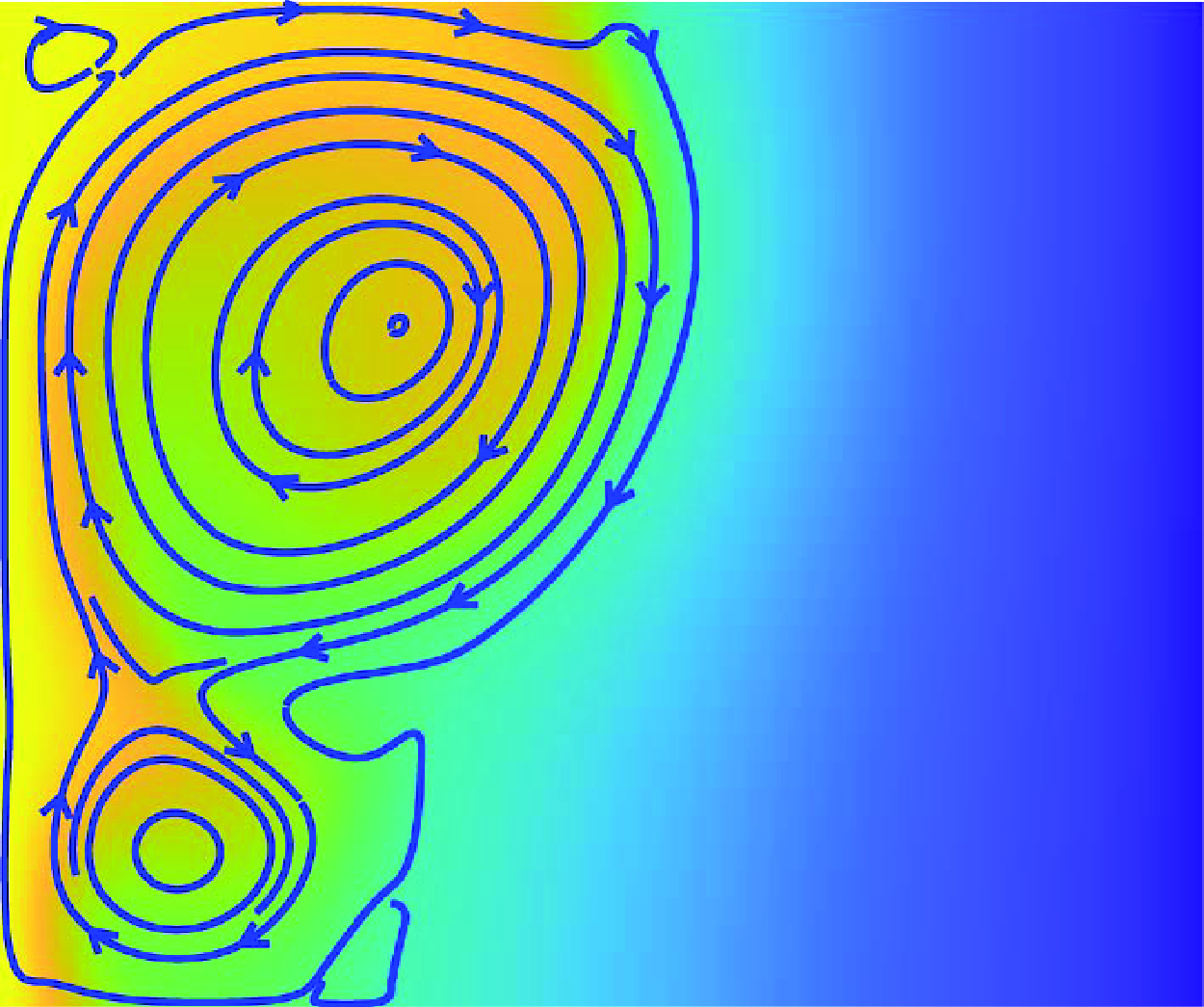
We conducted a series of pore-scale numerical simulations on convective flow in porous media, with a fixed Schmidt number of 400 and a wide range of Rayleigh numbers. The porous media are modeled using regularly arranged square obstacles in a Rayleigh–Bénard (RB) system. As the Rayleigh number increases, the flow transitions from a Darcy-type regime to an RB-type regime, with the corresponding $Sh$–$Ra_D$ relationship shifting from sublinear scaling to the classical 0.3 scaling of RB convection. Here, $Sh$ and $Ra_D$ represent the Sherwood number and the Rayleigh–Darcy number, respectively. For different porosities, the transition begins at approximately $Ra_D = 4000$, at which point the characteristic horizontal scale of the flow field is comparable to the size of a single obstacle unit. When the thickness of the concentration boundary layer is less than approximately one-sixth of the pore spacing, the flow finally enters the RB regime. In the Darcy regime, the scaling exponent of $Sh$ and $Ra_D$ decreases as porosity increases. Based on the Grossman–Lohse theory (J. Fluid Mech. vol. 407, 2000, pp. 27–56; Phys. Rev. Lett. vol. 86, 2001, p. 3316), we provide an explanation for the scaling laws in each regime and highlight the significant impact of mechanical dispersion effects during the development of the plumes. Our findings provide some new insights into the validity range of the Darcy model.
The evolution of a Lamb–Oseen vortex is studied in a stratified rotating fluid under the complete Coriolis force. In a companion paper, it was shown that the non-traditional Coriolis force generates a vertical velocity field and a vertical vorticity anomaly at a critical radius when the Froude number is larger than unity. Below a critical non-traditional Rossby number $\widetilde {Ro}$, a two-dimensional shear instability was next triggered by the vorticity anomaly. Here, we test the robustness of this two-dimensional evolution against small three-dimensional perturbations. Direct numerical simulations (DNS) show that the two-dimensional shear instability then develops only in an intermediate range of non-traditional Rossby numbers for a fixed Reynolds number $Re$. For lower $\widetilde {Ro}$, the instability is three-dimensional. Stability analyses of the flows in the DNS prior to the instability onset fully confirm the existence of these two competing instabilities. In addition, stability analyses of the local theoretical flows at leading order in the critical layer demonstrate that the three-dimensional instability is due to the shear of the vertical velocity. For a given Froude number, its growth rate scales as $Re^{2/3}/\widetilde {Ro}$, whereas the growth rate of the two-dimensional instability depends on $Re/\widetilde {Ro}^2$, provided that the critical layer is smoothed by viscous effects. However, the growth rate of the three-dimensional instability obtained from such local stability analyses agrees quantitatively with those of the DNS flows only if second-order effects due to the traditional Coriolis force and the buoyancy force are taken into account. These effects tend to damp the three-dimensional instability.
Analytical expressions are derived for the velocity field, and effective slip lengths, associated with pressure-driven longitudinal flow in a circular superhydrophobic pipe whose boundary is patterned with a general arrangement of longitudinal no-shear stripes not necessarily possessing any rotational symmetry. First, the flow in a superhydrophobic pipe with $M$ different no-shear stripes in general position is found for $M=1, 2, 3$. The method, which is based on use of so-called prime functions, is such that with these cases covered, generalisation to any $M \geqslant 1$ follows in a straightforward manner. It is shown how any one of these solutions can be generalised to solve for flow along superhydrophobic pipes where that pattern of $M$ menisci is repeated $N \geqslant 1$ times around the boundary in a rotational symmetric arrangement. The work provides an extension of the canonical pipe flow solution for an $N$-fold rotationally symmetric pattern of no-shear stripes due to Philip (Angew. Math. Phys., vol. 23, 1972, pp. 353–372). The novel solution method, and the solutions that it produces, have significance for a wide range of mixed boundary value problems involving Poisson’s equation arising in other applications.
We analyse the steady viscoelastic fluid flow in slowly varying contracting channels of arbitrary shape and present a theory based on the lubrication approximation for calculating the flow rate–pressure drop relation at low and high Deborah ($De$) numbers. Unlike most prior theoretical studies leveraging the Oldroyd-B model, we describe the fluid viscoelasticity using a FENE-CR model and examine how the polymer chains’ finite extensibility impacts the pressure drop. We employ the low-Deborah-number lubrication analysis to provide analytical expressions for the pressure drop up to $O(De^4)$. We further consider the ultra-dilute limit and exploit a one-way coupling between the parabolic velocity and elastic stresses to calculate the pressure drop of the FENE-CR fluid for arbitrary values of the Deborah number. Such an approach allows us to elucidate elastic stress contributions governing the pressure drop variations and the effect of finite extensibility for all $De$. We validate our theoretical predictions with two-dimensional numerical simulations and find excellent agreement. We show that, at low Deborah numbers, the pressure drop of the FENE-CR fluid monotonically decreases with $De$, similar to the previous results for the Oldroyd-B and FENE-P fluids. However, at high Deborah numbers, in contrast to a linear decrease for the Oldroyd-B fluid, the pressure drop of the FENE-CR fluid exhibits a non-monotonic variation due to finite extensibility, first decreasing and then increasing with $De$. Nevertheless, even at sufficiently high Deborah numbers, the pressure drop of the FENE-CR fluid in the ultra-dilute and lubrication limits is lower than the corresponding Newtonian pressure drop.
This edited work provides the first comprehensive account of how connectivity concepts and methods are applied in geomorphology. Addressing both qualitative and quantitative aspects, this volume demonstrates how the powerful conceptual framework of connectivity can be used to effectively describe material transfer between geomorphic system components. The book begins by introducing the key elements of connectivity science, drawing from a broad range of disciplines. The latest research on connectivity is then presented for each major process domain, including hillslopes, rivers and glaciers. Methods of quantification and measurement are described, providing an overview of methodologies and indices that can be used to assess connectivity as a property of soils and landscapes, and approaches for modelling connectivity are reviewed. The book concludes with an examination of applications of connectivity thinking in environmental management. Accessible and self-contained, this text is a key resource for practitioners, researchers and graduate students in geomorphology.
This book provides insight into the impact of climate change on human mobility - including both migration and displacement - by synthesizing key concepts, research, methodology, policy, and emerging issues surrounding the topic. It illuminates the connections between climate change and its implications for voluntary migration, involuntary displacement, and immobility by providing examples from around the world. The chapters use the latest findings from the natural and social sciences to identify key interactions shaping current climate-related migration, displacement, and immobility; predict future changes in those patterns and methods used to model them; summarize key policy and governance instruments available to us to manage the movements of people in a changing climate; and offer directions for future research and opportunities. This book will be valuable for students, researchers, and policy makers of geography, environmental science, climate and sustainability studies, demography, sociology, public policy, and political science.
Peru hosts a significant portion of the world’s tropical glaciers, which are undergoing rapid mass loss due to climate change. Knowledge of the ice volume and bedrock topography of these glaciers is important for predicting changes in glacier dynamics, runoff, and interpreting ice-core records. This study presents results from glaciological and geophysical surveys conducted during a 2019 expedition to Nevado Huascarán, Peru’s highest mountain when four ice cores were extracted from the col and summit. Ground-penetrating radar measurements provided detailed ice thickness and snow accumulation data, highlighting complex internal glacier structure and indicated that the climatic records obtained from ice cores recovered in 2019 were continuous and extended past the Holocene. Ice flow modeling enabled investigation of glacier dynamics. It was shown that the upstream effect on ice-core record is minimal. Comparison with ice thickness modeling data for Huascarán from various sources revealed significant discrepancies with measured ice thicknesses, suggesting that the inversion methods underestimate ice thickness for the accumulation zones of mountain glaciers. This research contributes data for understanding glacier behavior in the context of climate change and for modeling efforts for better assessments of water resources, potential geohazards and paleoclimatic interpretations.
Randomness is one of the most important characteristics of turbulence, but its origin remains an open question. By means of a ‘thought experiment’ via several clean numerical experiments based on the Navier–Stokes equations for two-dimensional turbulent Kolmogorov flow, we reveal a new phenomenon, which we call the ‘noise-expansion cascade’ whereby all micro-level noises/disturbances at different orders of magnitudes in the initial condition of Navier–Stokes equations enlarge consistently, say, one by one like an inverse cascade, to macro level. More importantly, each noise/disturbance input may greatly change the macro-level characteristics and statistics of the resulting turbulence, clearly indicating that micro-level noise/disturbance might have great influence on macro-level characteristics and statistics of turbulence. In addition, the noise-expansion cascade closely connects randomness of micro-level noise/disturbance and macro-level disorder of turbulence, thus revealing an origin of randomness of turbulence. This also highly suggests that unavoidable thermal fluctuations must be considered when simulating turbulence, even if such fluctuations are several orders of magnitudes smaller than other external environmental disturbances. We hope that the ‘noise-expansion cascade’, as a fundamental property of the Navier–Stokes equations, could greatly deepen our understandings about turbulence, and also be helpful for attacking the fourth millennium problem posed by the Clay Mathematics Institute in 2000.
Glacier collapse features, linked to subglacial cavities, are increasingly common on retreating Alpine glaciers. These features are hypothesized to result from glacier downwasting and subsurface ablation processes but the understanding regarding their distribution, formation and contribution to glacier mass loss remains limited. We present a Swiss-wide inventory of 223 collapse features observed over the past 50 years, revealing a sharp increase in their occurrence since the early 2000s. Using high-resolution digital elevation models, we derive a relationship between collapse feature area and ice ablation and estimate the Swiss-wide contribution of collapse features to glacier mass loss to be $19.8\times 10^6\,\text{m}^3$ of ice between 1971 and 2023. Based on extensive observations at Rhonegletscher, including surface displacement, ground-penetrating radar and drone-based elevation models, we quantify subsurface ablation rates of up to 27 cm d−1 and provide a detailed description of the collapse processes. We propose that glacier downwasting, enhanced energy supply through subglacial conduits and locally increased basal melt are key components to subglacial cavity growth. Our results highlight the importance of collapse features in the ongoing retreat of Alpine glaciers, stressing the need for further research to understand their formation and long-term implications for glacier dynamics under climate change.
An optimal microswimmer with a given geometry has a surface velocity profile that minimises energy dissipation for a given swimming speed. An axisymmetric swimmer can be puller-, pusher- or neutral-type depending on the sign of the stresslet strength. We numerically investigate the type of optimal surface-driven active microswimmers using a minimum dissipation theorem for optimum microswimmers. We examine the hydrodynamic resistance and stresslet strength with nonlinear dependence on various deformation modes. Optimum microswimmers with fore-and-aft symmetry exhibit neutral-type behaviour. Asymmetrical geometries exhibit pusher-, puller- or neutral-type behaviour, depending on the dominant deformation mode and the nonlinear dependence of the stresslet for an optimum microswimmer on deformation mode and amplitude.
The Tertiary Sierra La Vasca intrusive complex of the Mexican Eastern Alkaline Province consists of diverse alkaline-to-peralkaline granitoids and syenites and is a rare example of silica oversaturated peralkaline magmatism characterized by eudialyte. The intrusion of these peralkaline rocks into Cretaceous carbonate country rocks resulted in the development of a unique cuspidine, Zr-bearing cuspidine, hiortdahlite and wollastonite exoskarn. This study is focussed on a eudialyte-bearing vein and accompanying banded exoskarn which illustrates the unusual skarn-forming metasomatic effects of Zr mobilization. The skarn consists of six mineralogically distinct zones: (1) a parental Nb-poor eudialyte-bearing quartz granitoid vein; (2) a region of eudialyte pseudomorphed by intergrown Zr-sorosilicates; (3) an andradite–cuspidine–hiortdahlite–wöhlerite zone; (4) a zone of skeletal-to-prismatic cuspidine plus wollastonite which is transitional to zone (5); a coarser grained and heterogeneous zone consisting of complex intergrowths of tabular and prismatic cuspidine–hiortdahlite solid solutions, wollastonite, fluorite, apatite and rare calcite; (6) a contact calcite marble lacking any metasomatic silicates, phosphates or fluorite. Skarn formation was the result of alteration of eudialyte and separation of Si-rich hydrothermal fluids with high F/H2O ratios from the parental Si-oversaturated peralkaline magma and subsequent infiltration of Si–Zr–REE–P-bearing fluids into the country rock carbonates. Zircon was probably transported as Zr-fluoride and chloride complexes and the acidic fluids reacted with calcite to form cuspidine–hiortdahlite solid solutions and wollastonite as the principal skarn minerals. All of the Si required to form this unique skarn assemblage was derived from the hydrothermal fluids as the country rocks do not contain Si-bearing minerals. Skarn formation is considered to have occurred at temperatures below 500°C.
Glacier dirt cones are meter-scale cones of ice covered with sediment and rock. The cones develop through a process known as differential melt, whereby ice underlying thick debris melts more slowly than bare ice. We report observations of dirt cones on the Kuskulana Glacier, Alaska and develop a model that simulates the growth of dirt cones from debris-filled pits in the ice. With this model, we vary ice melt rates, hillslope debris diffusion rates and pit geometry. Cone heights scale with the square root of debris volume and growth occurs in three distinct stages: emergence, flux-controlled growth and melt-controlled growth. Using dimensional analysis, we derive a characteristic length composed of the ratio of the debris diffusion rate (D) and the bare ice melt rate (b0). Shorter characteristic lengths produce taller, steeper cones. The characteristic length ($\ell = D/b_0$) determines, in part, the relative duration of each growth stage because it controls debris flux as relief increases. These experiments suggest increasing melt rates and low-mobility debris increase relief on hummocky debris-covered glaciers. Furthermore, the modeling approach demonstrates a method for handling debris transport over an irregular ice surface and could serve as a component in more comprehensive debris-covered glacier models.