Refine search
Actions for selected content:
179468 results in Earth and Environmental Sciences

Breaking wave impacts on an elastic plate
-
- Journal:
- Journal of Fluid Mechanics / Volume 1015 / 25 July 2025
- Published online by Cambridge University Press:
- 24 July 2025, A54
-
- Article
-
- You have access
- Open access
- HTML
- Export citation
-
Breaking wave impacts on rigid structures have been extensively studied, yet the role of structural elasticity in shaping the impact and response remains insufficiently understood. In this study, we experimentally investigate the hydroelastic behaviour of a vertical cantilever plate subjected to multimodal solitary breaking wave impacts. The plate is mounted near the still water level on a 1 : 10 sloping beach, and the wave height-to-depth ratio ( $H/h$) is varied from 0.15 to 0.40 to systematically control the impact type from non-breaking to highly aerated wave impacts. We show that aeration significantly affects hydroelastic impacts. The spatio-temporal extent of the impact pressure on the elastic plate increases with air entrapment, while the peak pressure becomes highly sensitive as the wave approaches the flip-through regime. Pressure oscillations associated with bubble formation induce high-frequency structural vibrations, particularly under low-aeration conditions. Furthermore, we find that the elasticity has a limited effect on the peak pressure, impact duration and impulse, but increases the maximum quasi-hydrostatic force on the plate for the scenarios investigated. Following the impact, two distinct free-top deflections are identified, i.e. a deflection $\Delta x_{\textit{imp}}$ with high acceleration induced by the impact pressure and a deflection $\Delta x_{{hp}}$ with high magnitude caused by the maximum quasi-hydrostatic pressure. These deflections scale with the Cauchy number as $\Delta x_{\textit{imp}}/l \sim Ca_{\textit{imp}}/6$ and $\Delta x_{{hp}}/l \sim Ca_{{hp}}/12$ (where l is the plate length), exhibiting parabolic and linear trends with $H/h$, respectively. This work presents a benchmark dataset and introduces a predictive law for structural deflection, providing practical insights into hydroelastic effects across various impact regimes.


Why do we need (another) universal tracers portal in Astrobiology?
-
- Journal:
- International Journal of Astrobiology / Volume 24 / 2025
- Published online by Cambridge University Press:
- 24 July 2025, e11
-
- Article
-
- You have access
- Open access
- HTML
- Export citation
Amazonian forest conservation through sustainable use: evidence based on Brazil nut life histories linked to human occupation
-
- Journal:
- Environmental Conservation / Volume 52 / Issue 3 / September 2025
- Published online by Cambridge University Press:
- 24 July 2025, pp. 98-107
-
- Article
- Export citation

Non-monotonic effect of Stokes number on turbulence modulation in particle-laden channel flow
-
- Journal:
- Journal of Fluid Mechanics / Volume 1015 / 25 July 2025
- Published online by Cambridge University Press:
- 24 July 2025, A55
-
- Article
- Export citation
-
The effect of Stokes number on turbulence modulation in particle-laden channel flow is investigated through four-way coupled point-particle direct numerical simulations, with the mass loading fixed at 0.6 and the friction Stokes number $St^+$ varying from 3 to 300. A full transition pathway is observed, from a drag-enhanced to a drag-reduced regime, eventually approaching the single-phase state as $St^+$ increases towards 300. A set of transport equations for the particle phase is derived analytically to characterise the interphase coupling, within the framework of the point-based statistical description of particle-laden turbulence. By virtue of this, two dominant mechanisms are identified and quantitatively characterised: a positive, particle-induced extra transport that decreases monotonically with increasing $St^+$, and a negative, particle-induced extra dissipation that varies non-monotonically with $St^+$. The coupling of these two mechanisms leads to a direct contribution of the particle phase to the shear stress balance, the turbulent kinetic energy budgets and the Reynolds stress budgets. Consequently, as $St^+$ increases, the self-sustaining cycle of near-wall turbulence transitions from being augmented to being suppressed and, eventually, returns to the single-phase state. This gives rise to an indirect effect, manifested as a non-monotonic modulation of Reynolds shear stress and turbulence production rate. Taken together, complex interplays between particle-modified turbulent transport, particle-induced extra transport and extra dissipation are analysed and summarised, providing a holistic physical picture composed of consistent interpretations of turbulence modulation induced by small heavy particles.


Deformation of the Paleoproterozoic Lower Vindhyan Group in Central India: synsedimentary origin or associated with the Mesoproterozoic convergence between the Bundelkhand and Bastar Cratons?
-
- Journal:
- Geological Magazine / Volume 162 / 2025
- Published online by Cambridge University Press:
- 24 July 2025, e21
-
- Article
-
- You have access
- Open access
- HTML
- Export citation
Phylogenetic position and stratigraphic uncertainty of a new flexible crinoid from the Ordovician–Silurian boundary of Anticosti Island (Québec, Canada)
-
- Journal:
- Journal of Paleontology / Volume 99 / Issue 2 / March 2025
- Published online by Cambridge University Press:
- 24 July 2025, pp. 358-368
-
- Article
-
- You have access
- Open access
- HTML
- Export citation

Undulatory underwater swimming: linking vortex dynamics, thrust and wake structure with a biorobotic fish
-
- Journal:
- Journal of Fluid Mechanics / Volume 1015 / 25 July 2025
- Published online by Cambridge University Press:
- 23 July 2025, A53
-
- Article
- Export citation

Ill posedness in shallow multi-phase debris-flow models
-
- Journal:
- Journal of Fluid Mechanics / Volume 1015 / 25 July 2025
- Published online by Cambridge University Press:
- 23 July 2025, A52
-
- Article
-
- You have access
- Open access
- HTML
- Export citation
MoTiF: a self-supervised model for multi-source forecasting with application to tropical cyclones
- Part of
-
- Journal:
- Environmental Data Science / Volume 4 / 2025
- Published online by Cambridge University Press:
- 23 July 2025, e36
-
- Article
-
- You have access
- Open access
- HTML
- Export citation

Characterisation of sea ice kinematics over oceanic eddies
-
- Journal:
- Journal of Fluid Mechanics / Volume 1015 / 25 July 2025
- Published online by Cambridge University Press:
- 23 July 2025, A51
-
- Article
-
- You have access
- Open access
- HTML
- Export citation
Fossil snakes from the Eocene of India: new material with comments on phylogenetic relations and biogeographic and paleoecological implications
-
- Journal:
- Journal of Paleontology / Volume 99 / Issue 2 / March 2025
- Published online by Cambridge University Press:
- 23 July 2025, pp. 403-429
-
- Article
- Export citation

Newtonian-like behaviour of starting vortex flow in superfluid helium at high Reynolds numbers
-
- Journal:
- Journal of Fluid Mechanics / Volume 1015 / 25 July 2025
- Published online by Cambridge University Press:
- 23 July 2025, A57
-
- Article
-
- You have access
- Open access
- HTML
- Export citation
-
We study experimentally the starting vortices shed by airfoils accelerating uniformly from rest in superfluid helium-4 (He II). The vortices behave apparently as if they were moving in a classical Newtonian fluid, such as air or water. Specifically, the starting vortex positions obtained from the experimental data are found to be very close to those computed numerically in a Newtonian fluid, at sufficiently small times, when self-similar behaviour is expected to occur, and for Reynolds numbers ranging between approximately $5 \times 10^2$ and $5 \times 10^5$. The result indicates neatly that turbulent flows of He II can be very similar to classical flows of Newtonian fluids, when thermal effects can be neglected and at sufficiently large flow scales, i.e. the study demonstrates that He II could also be employed to study classical Newtonian flows.


Internal shear layers generated by a vertically oscillating cylinder in unbounded and bounded rotating fluids
- Part of
-
- Journal:
- Journal of Fluid Mechanics / Volume 1015 / 25 July 2025
- Published online by Cambridge University Press:
- 22 July 2025, A38
-
- Article
- Export citation
-
In rotating fluids, the viscous smoothing of inviscid singular inertial waves leads to the formation of internal shear layers. In previous works, we analysed the internal shear layers excited by a viscous forcing (longitudinal libration) in a spherical shell geometry (He et al., 2022 J. Fluid Mech. 939, A3; He et al., 2023 J. Fluid Mech. 974, A3). We now consider the stronger inviscid forcing corresponding to the vertical oscillation of the inner boundary. We limit our analysis to two-dimensional geometries but examine three different configurations: freely propagating wave beams in an unbounded domain and two wave patterns (a periodic orbit and an attractor) in a cylindrical shell geometry. The asymptotic structures of the internal shear layers are assumed to follow the similarity solution of Moore & Saffman (1969 Phil. Trans. R. Soc. Lond. A, 264, 597–634) in the small viscous limit. The two undefined parameters of the similarity solution (singularity strength and amplitude) are derived by asymptotically matching the similarity solution with the inviscid solution. For each case, the derivation of the latter is achieved either through separation of variables combined with analytical continuation or the method of characteristics. Global inviscid solutions, when obtained, closely match numerical solutions for small Ekman numbers far from the critical lines, while viscous asymptotic solutions show excellent performance near those lines. The amplitude scalings of the internal shear layers excited by an inviscid forcing are found to be divergent as the Ekman number $E$ decreases, specifically $O(E^{-1/6})$ for the critical-point singularity and $O(E^{-1/3})$ for attractors, in contrast to the convergent scalings found for a viscous forcing.


Act boldly or fail: Academic perspectives at a pivotal moment in global plastics treaty negotiations
- Part of
-
- Journal:
- Cambridge Prisms: Plastics / Volume 3 / 2025
- Published online by Cambridge University Press:
- 22 July 2025, e28
-
- Article
-
- You have access
- Open access
- HTML
- Export citation

Interfacial arrest in buoyant viscoplastic injections
-
- Journal:
- Journal of Fluid Mechanics / Volume 1015 / 25 July 2025
- Published online by Cambridge University Press:
- 22 July 2025, A45
-
- Article
-
- You have access
- Open access
- HTML
- Export citation
-
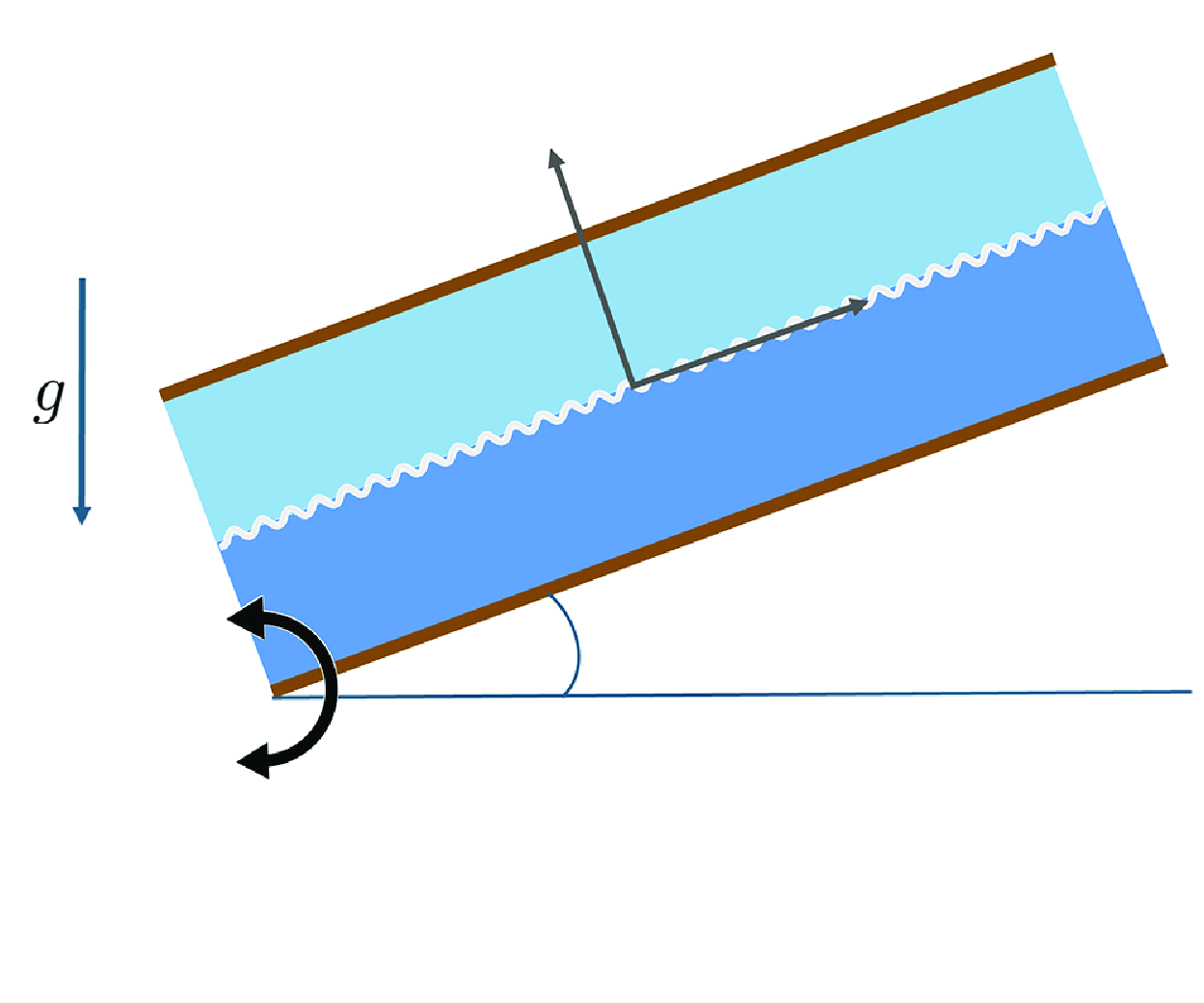
We study buoyant miscible injections of dense viscoplastic fluids into lighter Newtonian fluids in inclined closed-end pipes, at the high-Péclet-number regime. We integrate experiments involving camera imaging and ultrasound Doppler velocimetry, and computational fluid dynamics simulations, to provide a detailed analysis of interfacial dynamics, flow phases/regimes, velocity field, yielded and unyielded zones, and interfacial arrest mechanisms. The flow dynamics is governed by Reynolds ( $Re$), Froude ( $Fr$) and Bingham ( $B$) numbers, the viscosity ratio ( $M$), inclination angle ( $\beta$), or their combinations, such as $\chi \equiv 2Re/Fr^2$. As the interface evolves, our results reveal a transition from an inertial-dominated phase, characterised by linear front advancement at the injection velocity, to a viscoplastic-dominated phase, marked by deceleration and eventual interfacial arrest governed by the yield stress. The critical transition length between these phases $(\mathcal{L} \approx 1.26 Fr^{0.14})$ is determined by a balance between inertial and buoyant stresses. Experimental findings confirm buoyancy-driven slumping in our flows, consistent with the theoretical yield number criterion ( $Y \equiv B/\chi$), with maximum interfacial arrest lengths scaling as $L_s \sim 1/Y$. These results also classify arrested and unhalted interfacial flow regimes on a plane involving ${\chi \cos (\beta )}/{B}$ and $Y$. Furthermore, we demonstrate that the interfacial arrest mechanism arises from interactions between buoyancy, rheology and geometry, as diminishing shear stresses promote unyielded zone expansion near the interface, progressively encompassing the viscoplastic layer and halting flow when stresses fall below the yield stress.


Stability analysis of time-periodic shear flow generated by an oscillating density interface
-
- Journal:
- Journal of Fluid Mechanics / Volume 1015 / 25 July 2025
- Published online by Cambridge University Press:
- 22 July 2025, A27
-
- Article
-
- You have access
- Open access
- HTML
- Export citation
-
We consider the conceptual two-layered oscillating tank of Inoue & Smyth (2009 J. Phys. Oceanogr. vol. 39, no. 5, pp. 1150–1166), which mimics the time-periodic parallel shear flow generated by low-frequency (e.g. semi-diurnal tides) and small-angle oscillations of the density interface. Such self-induced shear of an oscillating pycnocline may provide an alternate pathway to pycnocline turbulence and diapycnal mixing in addition to the turbulence and mixing driven by wind-induced shear of the surface mixed layer. We theoretically investigate shear instabilities arising in the inviscid two-layered oscillating tank configuration and show that the equation governing the evolution of linear perturbations on the density interface is a Schrödinger-type ordinary differential equation with a periodic potential. The necessary and sufficient stability condition is governed by a non-dimensional parameter $\beta$ resembling the inverse Richardson number; for two layers of equal thickness, instability arises when $\beta \,{\gt}\,1/4$. When this condition is satisfied, the flow is initially stable but finally tunnels into the unstable region after reaching the time marking the turning point. Once unstable, perturbations grow exponentially and reveal characteristics of Kelvin–Helmholtz (KH) instability. The modified Airy function method, which is an improved variant of the Wentzel–Kramers–Brillouin theory, is implemented to obtain a uniformly valid, composite approximate solution to the interface evolution. Next, we analyse the fully nonlinear stages of interface evolution by modifying the circulation evolution equation in the standard vortex blob method, which reveals that the interface rolls up into KH billows. Finally, we undertake real case studies of Lake Geneva and Chesapeake Bay to provide a physical perspective.


Observations of the bowmouth guitarfish (Rhina ancylostoma) by-catches by the tropical tuna purse seine fleet in the Indian Ocean’s open waters
-
- Journal:
- Journal of the Marine Biological Association of the United Kingdom / Volume 105 / 2025
- Published online by Cambridge University Press:
- 22 July 2025, e83
-
- Article
- Export citation
Zosterophyllum spathulatum Li and Cai from the Lower Devonian of Yunnan Province, China, is Adoketophyton subverticillatum (Li and Cai) Li and Edwards, 1992, with a discussion of spatial–temporal distribution of Adoketophyton
-
- Journal:
- Journal of Paleontology / Volume 99 / Issue 2 / March 2025
- Published online by Cambridge University Press:
- 22 July 2025, pp. 275-282
-
- Article
- Export citation

Nonlinear optimals and their role in sustaining turbulence in channel flow
-
- Journal:
- Journal of Fluid Mechanics / Volume 1015 / 25 July 2025
- Published online by Cambridge University Press:
- 22 July 2025, A50
-
- Article
-
- You have access
- Open access
- HTML
- Export citation
-
We investigate the energy transfer from the mean profile to velocity fluctuations in channel flow by calculating nonlinear optimal disturbances, i.e. the initial condition of a given finite energy that achieves the highest possible energy growth during a given fixed time horizon. It is found that for a large range of time horizons and initial disturbance energies, the nonlinear optimal exhibits streak spacing and amplitude consistent with direct numerical simulation (DNS) at least at ${Re}_\tau = 180$, which suggests that they isolate the relevant physical mechanisms that sustain turbulence. Moreover, the time horizon necessary for a nonlinear disturbance to outperform a linear optimal is consistent with previous DNS-based estimates using eddy turnover time, which offers a new perspective on how some turbulent time scales are determined.

A multidisciplinary approach to resolve the taxonomy of the historically extinct sea mink (Neogale macrodon) (Maine, USA) – CORRIGENDUM
-
- Journal:
- Quaternary Research / Volume 127 / September 2025
- Published online by Cambridge University Press:
- 22 July 2025, p. 122
-
- Article
-
- You have access
- HTML
- Export citation
