Refine search
Actions for selected content:
212663 results in Engineering

Optimising branched fluidic networks: a unifying approach including laminar and turbulent flows, rough walls and non-Newtonian fluids
-
- Journal:
- Journal of Fluid Mechanics / Volume 1011 / 25 May 2025
- Published online by Cambridge University Press:
- 15 May 2025, A42
-
- Article
-
- You have access
- Open access
- HTML
- Export citation
-
Power minimisation in branched fluidic networks has gained significant attention in biology and engineering. The optimal network is defined by channel radii that minimise the sum of viscous dissipation and the volumetric energetic cost of the fluid. For limit cases including laminar flows, high-Reynolds-number turbulence or smooth-channel approximations, optimal solutions are known. However, current methods do not allow optimisation for a large intermediate part of the parameter space which is typically encountered in realistic fluidic networks that exhibit turbulent flow. Here, we present a unifying optimisation approach based on the Darcy friction factor, which has been determined for a wide range of flow regimes and fluid models and is applicable to the entire parameter space: (i) laminar and turbulent flows, including networks that exhibit both flow types, (ii) non-Newtonian fluids (powerlaw, Bingham and Herschel–Bulkley) and (iii) networks with arbitrary wall roughness, including non-uniform relative roughness. The optimal channel radii are presented analytically and graphically. All existing limit cases are recovered, and a concise framework is presented for systematic optimisation of fluidic networks. Finally, the parameter $x$ in the optimisation relationship $Q\propto R^{x}$, with $Q$ the flow rate and $R$ the channel radius, was approximated as a function of the Reynolds number, revealing in which case the entire network can be optimised based on one optimal channel radius, and in which case all radii must be optimised individually. Our approach can be extended to a wide range of fluidic networks for which the friction factor is known, such as different channel curvatures, bubbly flows or specific wall slip conditions.



Hands-On Mathematical Optimization with Python
-
- Published online:
- 14 May 2025
- Print publication:
- 16 January 2025
-
- Textbook
- Export citation
Turbulent boundary layers under spatially and temporally varying pressure gradients
-
- Journal:
- Journal of Fluid Mechanics / Volume 1010 / 10 May 2025
- Published online by Cambridge University Press:
- 14 May 2025, A61
-
- Article
-
- You have access
- Open access
- HTML
- Export citation
-
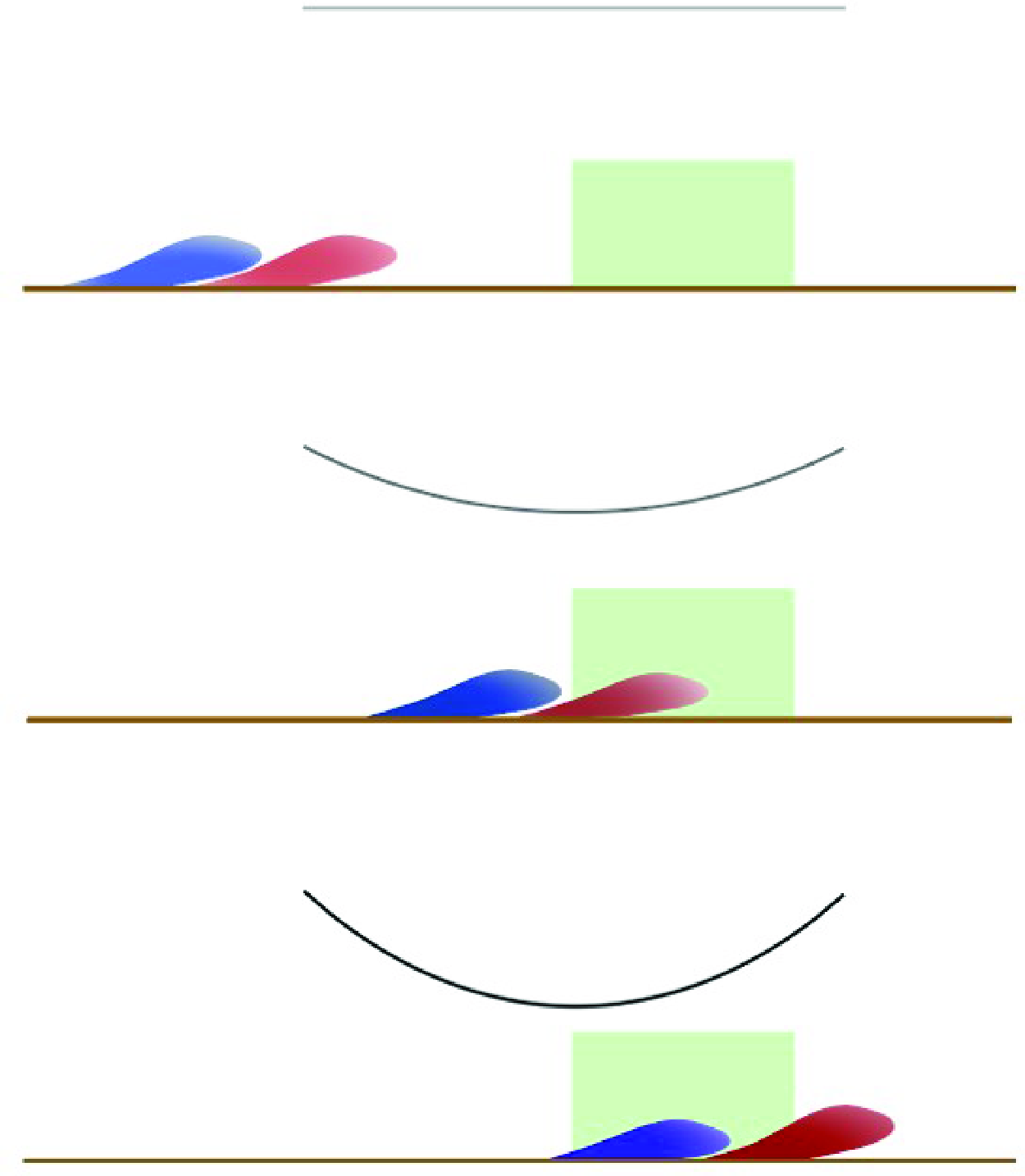
The spatiotemporal dynamics of a turbulent boundary layer subjected to an unsteady pressure gradient are studied. A dynamic sequence of favourable to adverse pressure gradients (FAPGs) is imposed by deforming a section of the wind tunnel ceiling, transitioning the pressure gradient from zero to a strong FAPG within 0.07 s. At the end of the transient, the acceleration parameter is $K$ =
$K$ =  $6 \times 10^{-6}$ in the favourable pressure gradient (FPG) region and $K$ =
$K$ =  $-4.8 \times 10^{-6}$ in the adverse pressure gradient (APG) region. The resulting unsteady response of the boundary layer is compared with equivalent steady pressure gradient cases in terms of turbulent statistics and coherent structures. While the steady FAPG effects, as shown by Parthasarathy & Saxton-Fox (2023), caused upstream stabilisation in the FPG, a milder APG response downstream, and the formation of an internal layer, the unsteady case presented in this paper shows a reduced stabilisation in the FPG region, a stronger APG response and a weaker internal layer. This altered response is hypothesised to stem from the different spatiotemporal pressure gradient histories experienced by turbulent structures when the pressure gradient changes at a time scale comparable to their convection.


Obliquely interacting solitary waves and wave wakes in free-surface flows
-
- Journal:
- Journal of Fluid Mechanics / Volume 1011 / 25 May 2025
- Published online by Cambridge University Press:
- 14 May 2025, A8
-
- Article
- Export citation

Refinements in the nonlinear term of a turbulence predictive model based on atmospheric surface layer observations
-
- Journal:
- Journal of Fluid Mechanics / Volume 1011 / 25 May 2025
- Published online by Cambridge University Press:
- 14 May 2025, A25
-
- Article
- Export citation
Aerodynamic assessment of wingtip-mounted propeller and distributed propulsion system
- Part of
-
- Journal:
- The Aeronautical Journal / Volume 129 / Issue 1338 / August 2025
- Published online by Cambridge University Press:
- 14 May 2025, pp. 2179-2198
-
- Article
-
- You have access
- Open access
- HTML
- Export citation

A multi-horizon peridynamics for coupled fluid flow and heat transfer
-
- Journal:
- Journal of Fluid Mechanics / Volume 1010 / 10 May 2025
- Published online by Cambridge University Press:
- 14 May 2025, A66
-
- Article
-
- You have access
- Open access
- HTML
- Export citation
Multi-scale dynamics of scalar transfer in Rayleigh–Taylor turbulent mixing
-
- Journal:
- Journal of Fluid Mechanics / Volume 1011 / 25 May 2025
- Published online by Cambridge University Press:
- 14 May 2025, A4
-
- Article
-
- You have access
- Open access
- HTML
- Export citation
-
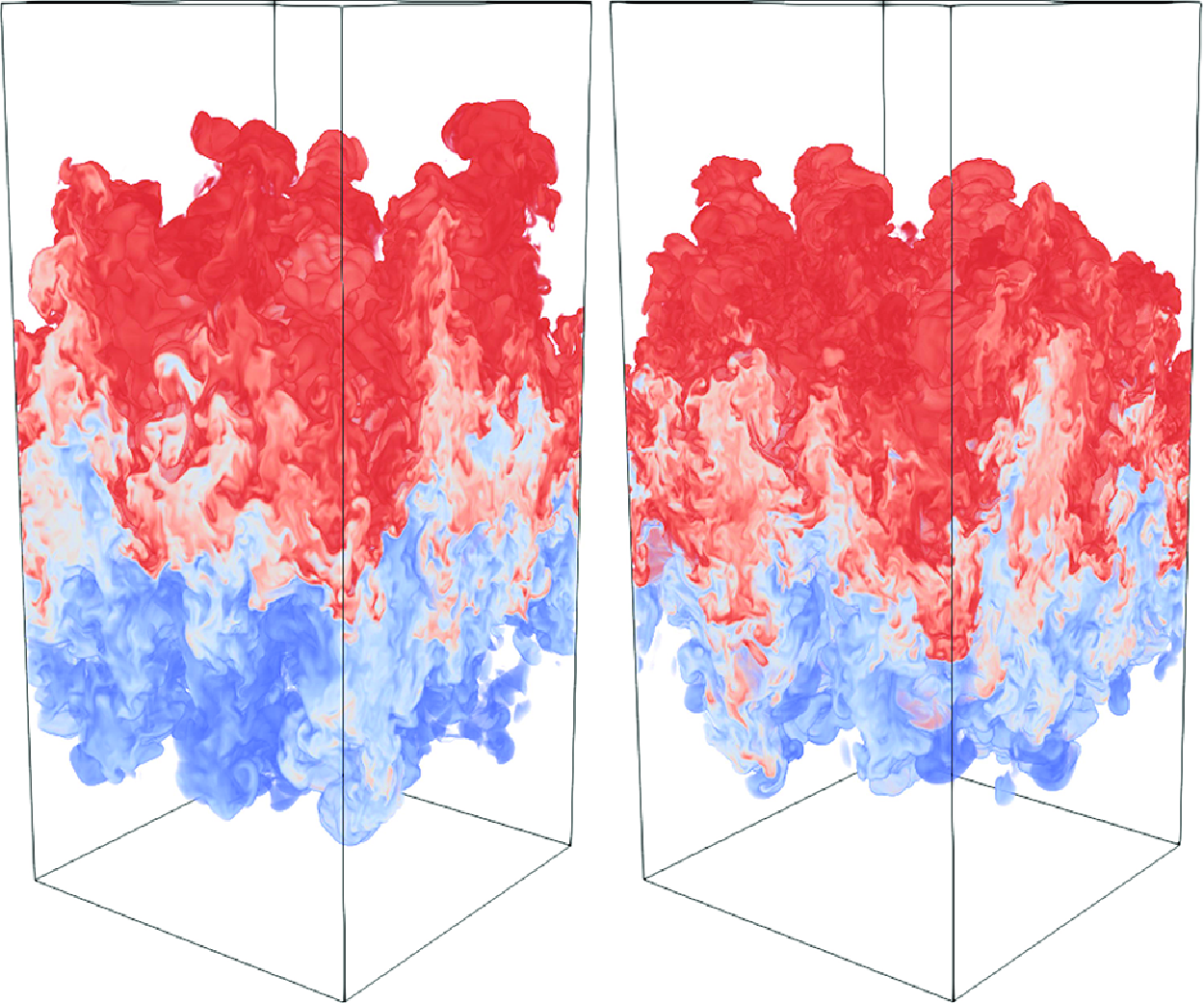
Miscible Rayleigh–Taylor (RT) turbulence exhibits a wide range of length scales in both the velocity and density fields, leading to complex deformations of isoscalar surfaces and enhanced mixing due to nonlinear interactions among different scales. Through high-resolution numerical simulations and a coarse-graining analysis, we demonstrate that the variance of the heavy fluid concentration, initially maximised by the unstable stratification, progressively cascades from larger to smaller scales, eventually dissipates at the smallest scale. The transfer of scalar variance, $\Pi ^Y$, primarily governed by the filtered strain rate tensor, is effectively captured by a nonlinear model that links $\Pi ^Y$ to the isoscalar surface stretching. On the other hand, the backscatter of scalar variance transfer, represented by the negative component of $\Pi ^Y$, is influenced by the filtered vorticity field. Furthermore, we examine the directional anisotropy of scalar transfer in RT turbulence, enhancing the accuracy of the nonlinear model by separating the horizontal mean of the mass fraction from its fluctuating part.


Taylor dispersion for coupled electroosmotic and pressure-driven flows in all time regimes
-
- Journal:
- Journal of Fluid Mechanics / Volume 1011 / 25 May 2025
- Published online by Cambridge University Press:
- 14 May 2025, A36
-
- Article
-
- You have access
- Open access
- HTML
- Export citation

Optimised flow control based on automatic differentiation in compressible turbulent channel flows
-
- Journal:
- Journal of Fluid Mechanics / Volume 1011 / 25 May 2025
- Published online by Cambridge University Press:
- 14 May 2025, A1
-
- Article
-
- You have access
- Open access
- HTML
- Export citation
-
This study presents an automatic differentiation (AD)-based optimisation framework for flow control in compressible turbulent channel flows. Using a differentiable solver, JAX-Fluids, we designed fully differentiable boundary conditions that allow for the precise calculation of gradients with respect to boundary control variables. This facilitates the efficient optimisation of flow control methods. The framework’s adaptability and effectiveness are demonstrated using two boundary conditions: opposition control and tunable permeable walls. Various optimisation targets are evaluated, including wall friction and turbulent kinetic energy (TKE), across different time horizons. In each optimisation, there were around $4\times 10^4$ control variables and $3\times 10^{9}$ state variables in a single episode. Results indicate that TKE targeted opposition control achieves a more stable and significant reduction in drag, with effective suppression of turbulence throughout the channel. In contrast, strategies that focus directly on minimising wall friction were found to be less effective, exhibiting instability and increased turbulence in the outer region. The tunable permeable walls also show potential to achieve stable drag reduction through a ‘flux-inducing’ mechanism. This study demonstrates the advantages of AD-based optimisation in complex flow control scenarios and provides physical insight into the choice of the quantity of interest for improved optimisation performance.


Non-modal analysis of Rayleigh–Bénard convection with and without bounded shear flows in viscoelastic fluids
-
- Journal:
- Journal of Fluid Mechanics / Volume 1011 / 25 May 2025
- Published online by Cambridge University Press:
- 14 May 2025, A37
-
- Article
- Export citation
Implementation of an intelligent solution for acquiring telemetry from Alsat-2 satellites: leveraging machine learning for polarisation drive
-
- Journal:
- The Aeronautical Journal / Volume 129 / Issue 1339 / September 2025
- Published online by Cambridge University Press:
- 14 May 2025, pp. 2480-2496
-
- Article
- Export citation

Feigenbaum universality in subcritical Taylor–Couette flow
-
- Journal:
- Journal of Fluid Mechanics / Volume 1010 / 10 May 2025
- Published online by Cambridge University Press:
- 14 May 2025, A36
-
- Article
-
- You have access
- Open access
- HTML
- Export citation

Gravitational effects on Faraday instability in a viscoelastic liquid
-
- Journal:
- Journal of Fluid Mechanics / Volume 1011 / 25 May 2025
- Published online by Cambridge University Press:
- 14 May 2025, A28
-
- Article
-
- You have access
- Open access
- HTML
- Export citation

Dynamics of inviscid droplets on fibres: from instability to oscillations
-
- Journal:
- Journal of Fluid Mechanics / Volume 1011 / 25 May 2025
- Published online by Cambridge University Press:
- 14 May 2025, A34
-
- Article
- Export citation

An insulating plate drifting over a thermally convecting fluid: the effect of heating mode on plate motion and coupling mode
-
- Journal:
- Journal of Fluid Mechanics / Volume 1010 / 10 May 2025
- Published online by Cambridge University Press:
- 14 May 2025, A33
-
- Article
- Export citation
Mean field lattice Boltzmann model for reactive mixtures in porous media
-
- Journal:
- Journal of Fluid Mechanics / Volume 1011 / 25 May 2025
- Published online by Cambridge University Press:
- 14 May 2025, A9
-
- Article
-
- You have access
- Open access
- HTML
- Export citation
Cavitation nucleation dynamics in structured turbulence
-
- Journal:
- Journal of Fluid Mechanics / Volume 1011 / 25 May 2025
- Published online by Cambridge University Press:
- 14 May 2025, R4
-
- Article
-
- You have access
- Open access
- HTML
- Export citation
-
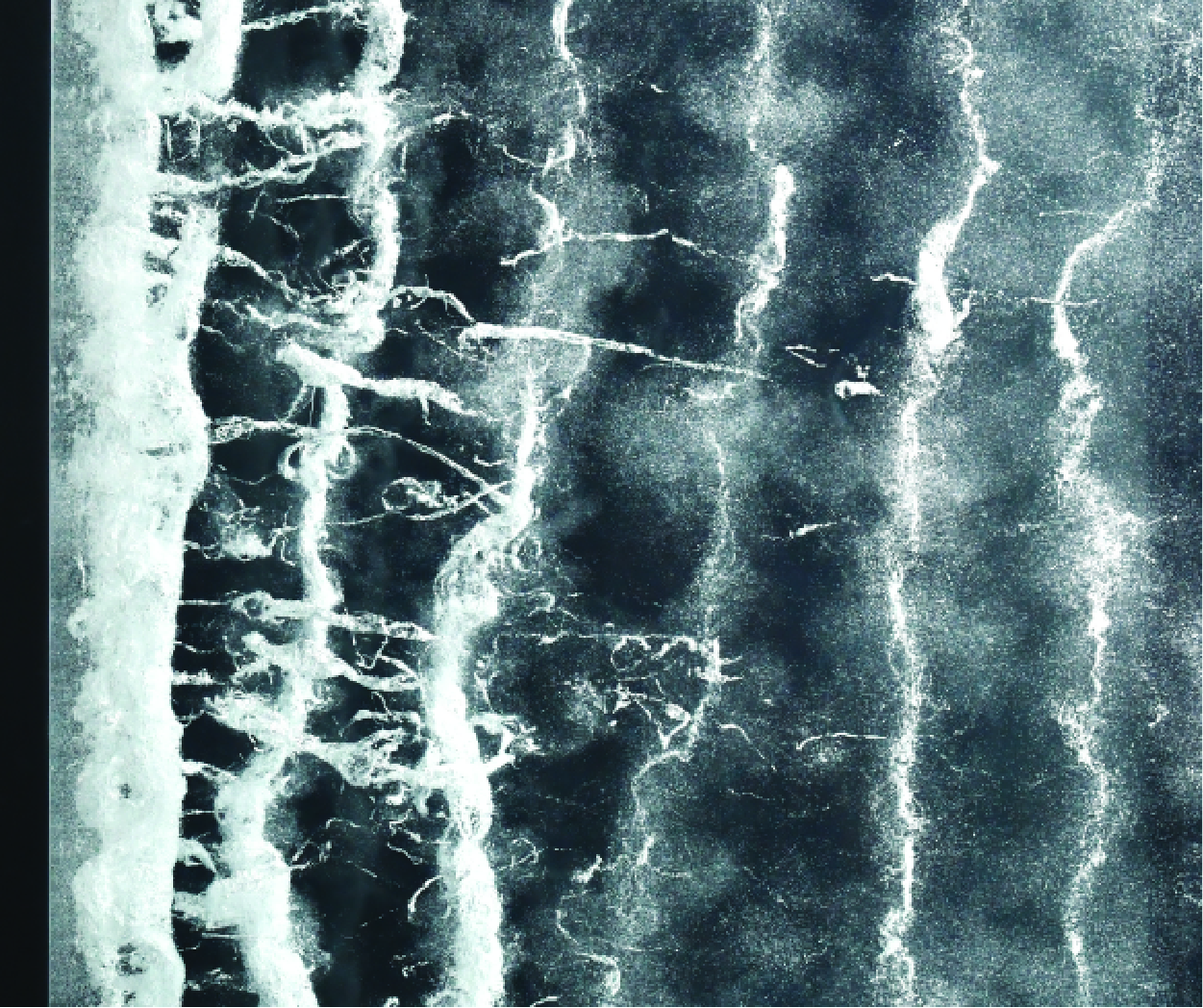
The effect of nucleation on cavitation inception in a high-Reynolds-number von Kármán wake from a bluff two-dimensional hydrofoil is studied experimentally in a variable pressure water tunnel. Nucleation effects are studied by seeding the flow with sparse monodisperse nuclei populations, with the critical pressure nominally equal to vapour pressure. The injected nuclei population and incipient cavitation events were imaged simultaneously using high-speed cameras to precisely quantify the number of activated nuclei of the total available. Three-dimensional spatial characterisation (orientation and location) of the incipient structures is obtained using two high-speed cameras mounted to the side and below the tunnel test section. Inception was observed predominantly in the stretched cores of secondary structures, with a negligible proportion of events occurring in the primary vortices. A broad peak in the vertical angle distribution is observed about the streamwise axis; however, events at all angles are seen. A symmetric distribution was observed for the horizontal angle, with a dominant orientation $45^{\circ }$ from the free-stream direction. The majority of events occur at approximately one hydrofoil thickness downstream of the hydrofoil trailing edge, with a bimodal symmetric distribution about the hydrofoil vertical centre plane. Nuclei activation rate is determined from the acoustic measurements, and was found to be proportional to the number of the injected nuclei. A power law increase in activation rate was observed following a decrease in cavitation number and an increase in Reynolds number. The nuclei activation rate was of the order of $0.1{-}10 \, \mathrm {s^{-1}}$, which combined with seeding rates of the orderof $100{-}1000 \, \mathrm {s^{-1}}$ reveals inception to be a rare occurrence (0.001 %–10 % of nuclei being activated), requiring the confluence of two unlikely events, the occurrence of a subvapour pressure vortex core with capture of a sufficiently weak nuclei. The presented study provides new insights into the physics of cavitation nucleation and inception and provides a comprehensive dataset for development of computational models.


Applicability of heat pipes and impingement cooling for axial compressor tip clearance control: a preliminary investigation
-
- Journal:
- The Aeronautical Journal / Volume 129 / Issue 1339 / September 2025
- Published online by Cambridge University Press:
- 14 May 2025, pp. 2523-2543
-
- Article
-
- You have access
- Open access
- HTML
- Export citation

Motion of a single microalga with one defective flagellum
-
- Journal:
- Journal of Fluid Mechanics / Volume 1010 / 10 May 2025
- Published online by Cambridge University Press:
- 14 May 2025, A20
-
- Article
- Export citation
-
We experimentally identify a rotational motion of a single microalga (Chlamydomonas reinhardtii) within a microcontainer believed to be induced by one defective flagellum. We numerically adapt the classic two-dimensional squirmer model to replicate this unique motion by partially inhibiting the slip velocity on the boundaries of the squirmer. Subsequently, we employ a lattice Boltzmann method to simulate the motion of the single microalga with one defective flagellum. We examine the influence of swimming Reynolds numbers, self-propelling strength ( $\beta$) and angle ( $\alpha$) on the locomotion of the squirmer with one defective flagellum. The results indicate that a large $\beta$ leads to a large rotational diameter, positively correlating with the speed. Additionally, we observe that a low self-propelling strength ( $\beta =0.5$) yields a monotonically increasing speed for the squirmer with $\alpha$. In general, high $\beta$ values result in fast speeds for the squirmer. This differs from the behaviour observed in a classic squirmer ( $\alpha =360^{\circ }$), where high $\beta$ leads to a slow speed of puller ( $\beta \gt 0$) owing to weak fluid inertia effects. Meanwhile, the energy expenditure increases monotonically with $\alpha$, contrasting with the non-monotonic trends observed for swimming speed and rotational diameter.


