Refine search
Actions for selected content:
106117 results in Materials Science
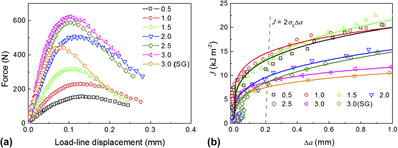
Thickness effect on fracture behavior of columnar-grained Cu with preferentially oriented nanoscale twins
-
- Journal:
- Journal of Materials Research / Volume 32 / Issue 24 / 28 December 2017
- Published online by Cambridge University Press:
- 22 August 2017, pp. 4554-4562
- Print publication:
- 28 December 2017
-
- Article
- Export citation
Fundamentals of silico-ferrite of calcium and aluminium (SFCA) and SFCA-I iron ore sinter bonding phase formation: effects of mill scale addition
-
- Journal:
- Powder Diffraction / Volume 32 / Issue S2 / December 2017
- Published online by Cambridge University Press:
- 22 August 2017, pp. S85-S89
-
- Article
- Export citation

Nanocrystalline high-entropy alloys
-
- Journal:
- Journal of Materials Research / Volume 32 / Issue 18 / 28 September 2017
- Published online by Cambridge University Press:
- 22 August 2017, pp. 3435-3444
- Print publication:
- 28 September 2017
-
- Article
- Export citation
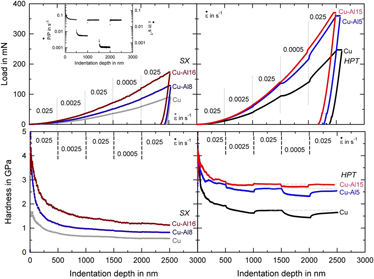
Influence of solid solution strengthening on the local mechanical properties of single crystal and ultrafine-grained binary Cu–AlX solid solutions
-
- Journal:
- Journal of Materials Research / Volume 32 / Issue 24 / 28 December 2017
- Published online by Cambridge University Press:
- 22 August 2017, pp. 4583-4591
- Print publication:
- 28 December 2017
-
- Article
- Export citation

Efficiency potential and recent activities of high-efficiency solar cells
-
- Journal:
- Journal of Materials Research / Volume 32 / Issue 18 / 28 September 2017
- Published online by Cambridge University Press:
- 22 August 2017, pp. 3445-3457
- Print publication:
- 28 September 2017
-
- Article
- Export citation
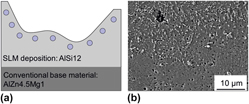
High and very high cycle fatigue failure mechanisms in selective laser melted aluminum alloys
-
- Journal:
- Journal of Materials Research / Volume 32 / Issue 23 / 14 December 2017
- Published online by Cambridge University Press:
- 22 August 2017, pp. 4296-4304
- Print publication:
- 14 December 2017
-
- Article
- Export citation
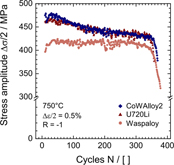
High temperature properties and fatigue strength of novel wrought γ/γ′ Co-base superalloys
-
- Journal:
- Journal of Materials Research / Volume 32 / Issue 24 / 28 December 2017
- Published online by Cambridge University Press:
- 22 August 2017, pp. 4475-4482
- Print publication:
- 28 December 2017
-
- Article
- Export citation

Strain landscapes and self-organization of free surfaces in complex oxide epitaxy
-
- Journal:
- Journal of Materials Research / Volume 32 / Issue 21 / 14 November 2017
- Published online by Cambridge University Press:
- 22 August 2017, pp. 3958-3976
- Print publication:
- 14 November 2017
-
- Article
- Export citation
Temperature-dependent structural behaviour of samarium cobalt oxide
-
- Journal:
- Powder Diffraction / Volume 32 / Issue S2 / December 2017
- Published online by Cambridge University Press:
- 22 August 2017, pp. S38-S42
-
- Article
- Export citation
-
The crystal structure and thermal expansion of the perovskite samarium cobalt oxide (SmCoO3) have been determined over the temperature range 295–1245 K by Rietveld analysis of X-ray powder diffraction data. Polycrystalline samples were prepared by a sol–gel synthesis route followed by high-temperature calcination in air. SmCoO3 is orthorhombic (Pnma) at all temperatures and is isostructural with GdFeO3. The structure was refined as a distortion mode of a parent $ Pm{\bar 3}m $ structure. The thermal expansion was found to be non-linear and anisotropic, with maximum average linear thermal expansion coefficients of 34.0(3) × 10−6, 24.05(17) × 10−6, and 24.10(18) × 10−6 K−1 along the a-, b-, and c-axes, respectively, between 814 and 875 K.


Advanced mechanical properties of powder metallurgy commercially pure titanium with a high oxygen concentration
-
- Journal:
- Journal of Materials Research / Volume 32 / Issue 19 / 16 October 2017
- Published online by Cambridge University Press:
- 22 August 2017, pp. 3769-3776
- Print publication:
- 16 October 2017
-
- Article
- Export citation
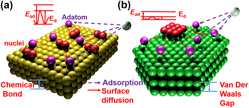
A review on low dimensional metal halides: Vapor phase epitaxy and physical properties
-
- Journal:
- Journal of Materials Research / Volume 32 / Issue 21 / 14 November 2017
- Published online by Cambridge University Press:
- 21 August 2017, pp. 3992-4024
- Print publication:
- 14 November 2017
-
- Article
- Export citation
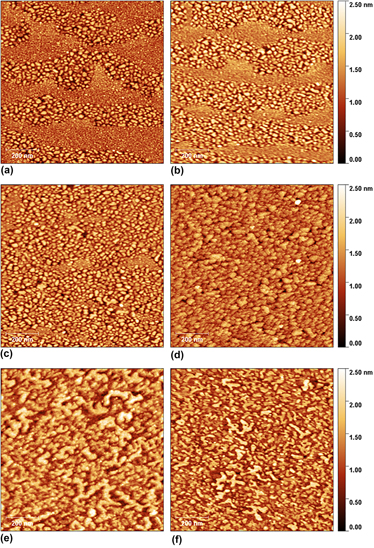
Nucleation and growth of metamorphic epitaxial aluminum on silicon (111) 7 × 7 and $\sqrt 3 \times \sqrt 3$ surfaces
-
- Journal:
- Journal of Materials Research / Volume 32 / Issue 21 / 14 November 2017
- Published online by Cambridge University Press:
- 21 August 2017, pp. 4067-4075
- Print publication:
- 14 November 2017
-
- Article
- Export citation
-
The nucleation and growth of Al on 7 × 7 and $\sqrt 3 \times \sqrt 3$ R30 Al reconstructed Si(111) that result in strain-free Al overgrown films grown with an atomically abrupt metamorphic interface are compared. The reconstructed surfaces and abrupt strain relaxations are verified using reflection high-energy electron diffraction. The topography of evolution is examined with atomic force microscopy. The growth of Al on both the surfaces exhibits 3D island growth, but the island evolution of growth is dramatically different. On the 7 × 7 surface, mounds formed are uniformly distributed across the substrate, and growth appears to proceed uniformly. Alternatively, on the $\sqrt 3 \times \sqrt 3$ R30 surface, Al atoms exhibit a clear preference to form mounds near the step edges. During Al growth, mounds increase in size and number, expanding out from step edges until they cover the whole substrate. Consistent expression of a mounded nucleation and growth mode imparts a physical limitation to the achievable surface roughness that may impact the ultimate performance of layered devices such as Josephson junctions that are critical components of superconducting quantum circuits.


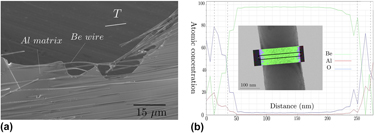
Deformation mechanisms in submicron Be wires
-
- Journal:
- Journal of Materials Research / Volume 32 / Issue 24 / 28 December 2017
- Published online by Cambridge University Press:
- 21 August 2017, pp. 4616-4625
- Print publication:
- 28 December 2017
-
- Article
- Export citation
-
Plastic deformation of small metallic single crystals has focused a lot of attention because of their enhanced or specific mechanical properties. Here, submicron beryllium wires, obtained from selective etching of an Al/Be eutectic alloy, were deformed in tension in situ using a transmission electron microscope. Our observations indicate that wires oriented parallel to their 〈c〉 axis and containing almost no dislocations present a fragile-like behavior associated to a high stress level. $\left\{ {10\bar 12} \right\}$ 〈1011〉 twins were also frequently observed near fractured wires, indicating that this deformation mode is important in small-scale Be. In a twinned area, a locally ductile behavior was observed due to the favorable orientation for prismatic slip. We also stress out the importance of a remaining outer layer, made of Al oxide, in the plastic deformation. On the basis of finite element modeling, we show that the deformation of the wire may involve dislocations moving along the wire axis, in or close to the Be/Al oxide interface, in agreement with in situ observations. Thus, even in naturally oxidized wires, the outer layer is supposed to play an important role in the deformation, not only in modifying a stress/strain field but also presumably in facilitating diffusional processes, such as dislocation climb or dislocation nucleation.


Hardening mechanisms in irradiated Cu–W alloys
-
- Journal:
- Journal of Materials Research / Volume 32 / Issue 16 / 28 August 2017
- Published online by Cambridge University Press:
- 18 August 2017, pp. 3156-3164
- Print publication:
- 28 August 2017
-
- Article
- Export citation
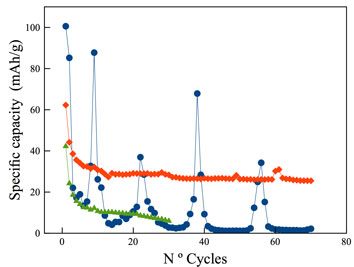
Improvement of the electrochemical performance of LiFePO4 cathode by Y-doping
-
- Journal:
- MRS Communications / Volume 7 / Issue 3 / September 2017
- Published online by Cambridge University Press:
- 17 August 2017, pp. 515-522
- Print publication:
- September 2017
-
- Article
- Export citation
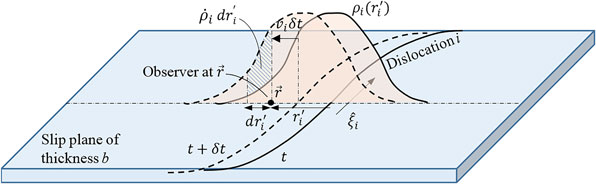
Dislocation-density kinematics: a simple evolution equation for dislocation density involving movement and tilting of dislocations
-
- Journal:
- MRS Communications / Volume 7 / Issue 3 / September 2017
- Published online by Cambridge University Press:
- 17 August 2017, pp. 583-590
- Print publication:
- September 2017
-
- Article
- Export citation
The TMS 2017 146th Annual Meeting and Exhibition
-
- Journal:
- Powder Diffraction / Volume 32 / Issue 3 / September 2017
- Published online by Cambridge University Press:
- 16 August 2017, pp. 217-218
-
- Article
- Export citation
PDJ volume 32 issue 3 Cover and Back matter
-
- Journal:
- Powder Diffraction / Volume 32 / Issue 3 / September 2017
- Published online by Cambridge University Press:
- 16 August 2017, pp. b1-b8
-
- Article
-
- You have access
- Export citation
PDJ volume 32 issue 3 Cover and Front matter
-
- Journal:
- Powder Diffraction / Volume 32 / Issue 3 / September 2017
- Published online by Cambridge University Press:
- 16 August 2017, pp. f1-f6
-
- Article
-
- You have access
- Export citation
Report on the To.Sca.Lake 2.0 Workshop, Total Scattering for Nanotechnology on the Como Lake
-
- Journal:
- Powder Diffraction / Volume 32 / Issue 3 / September 2017
- Published online by Cambridge University Press:
- 16 August 2017, pp. 213-216
-
- Article
- Export citation
