To save content items to your account,
please confirm that you agree to abide by our usage policies.
If this is the first time you use this feature, you will be asked to authorise Cambridge Core to connect with your account.
Find out more about saving content to .
To save content items to your Kindle, first ensure no-reply@cambridge.org
is added to your Approved Personal Document E-mail List under your Personal Document Settings
on the Manage Your Content and Devices page of your Amazon account. Then enter the ‘name’ part
of your Kindle email address below.
Find out more about saving to your Kindle.
Note you can select to save to either the @free.kindle.com or @kindle.com variations.
‘@free.kindle.com’ emails are free but can only be saved to your device when it is connected to wi-fi.
‘@kindle.com’ emails can be delivered even when you are not connected to wi-fi, but note that service fees apply.
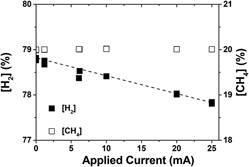
Refractory carbides possess metal-like electronic and catalytic properties, which make them interesting candidates for anodes in solid oxide fuel cells. However, significant challenges include phase instability due to electrochemical potential gradient driven oxidation. This requires an understanding of both the chemical thermodynamics in operating environments along with direct measurement of the catalytic activity in fuel mixtures. Here, we present an experimental study on nanostructured WC as an anode for solid oxide fuel cells operating at 300–500 °C. This is enabled by combining calculated thermochemical equilibria validated against experiments at the material level and in fuel cell devices combined with flow reactor studies on fuel-selective catalytic activity directly at working anode interfaces. With an optimized anode microstructure and hydrogen–methane fuel mixtures, WC anode-based solid oxide fuel cells are shown to achieve a near-ideal open circuit voltage of 1.1 V at 500 °C.
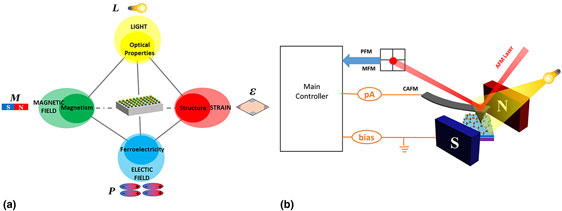
Multiferroic nanostructures have been attracting tremendous attention not only for novel phenomena associated with fundamental physics, but also due to exciting application potentials in future nanoelectronic devices. In this mini-review, we first introduce several fabrication techniques recently developed for single phase and composite multiferroic nanostructures. Then, the topologic vortex domain structures in various ferroic nanostructures, which may bring about additional fundamental discoveries and applications in ultrahigh density recording, are discussed. Particular attention is paid to magnetoelectric effects in multiferroic nanodots, including room temperature electric field induced magnetic domain switching. Finally, existing challenges and new directions, e.g., cross-couplings among multiple functionalities, are prospected. We genuinely hope that this mini-review will arouse the readers' interest in this fascinating field.
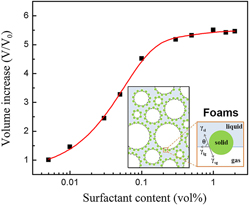
Novel porous Yb3Al5O12 ceramics are successfully fabricated via a green and simple foam-gelcasting approach. Using a nontoxic water-soluble copolymer of isobutylene and maleic anhydride (Isobam), together with a surfactant EMAL TD (Surf-E), 50 vol% solid loading Yb3Al5O12 aqueous ceramic slurries are prepared. Thanks to the small contents of organic additives (0.4 wt% Isobam and 1 vol% Surf-E) added, low linear shrinkage (∼13.9%), and mass loss (∼2.21 wt%) are obtained after pressureless sintering of gelcasted green body at 1600 °C for 4 h under an air atmosphere. Furthermore, porous Yb3Al5O12 ceramics with controlled porosity and spherical-like cells possess excellent structural and shape stability. The flexural strength and compressive strength of the as-prepared porous Yb3Al5O12 ceramics with a relative density of 20% remain as high as 6.3 and 19.7 MPa, respectively, and the gas permeability can be tuned between 4.3 × 10⁻¹³ and 7.8 × 10⁻¹¹ m2 with exponentially increasing porosity from 58% to 84%.
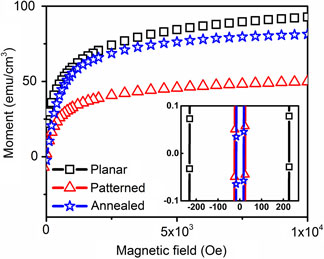
Surface patterned NiFe2O4 thin films exhibited large reduction in coercivity as compared with the films without surface patterning. Chemical analysis of the films revealed that there was no diffusion between the film and the substrate. Additional heating was shown to improve saturation magnetization without adverse effect on coercivity. The process of imprinting was eliminated as the possible cause of the phenomena as the flat stamp did not alter the magnetic properties of the film. Finally, it was shown that the orientation of the features with respect to the magnetic field does not have a significant effect on the magnetic response.
Herein, we present a method for decorating multi-walled carbon nanotubes (MWCNTs) with gold nanoparticles (AuNPs) using ethylenediamine (en) as a linker between MWCNTs and AuNPs. The amine group in en is as growth points for synthesis of AuNPs through electrostatic attraction between the amine groups and ${\rm{AuCl}}_4^ -$ anion while sodium citrate act as reducing agent. The influence of HAuCl4 concentration on the size and distribution of AuNPs in the structure of the Au-decorated nanotubes were investigated. Morphology of the decorated nanotubes was characterized by field emission scanning electron microscopy and transmission electron microscopy while the elemental composition of the decorated tubes and crystallography were investigated by energy dispersive x-ray, x-ray diffraction, Raman spectroscopy, and Fourier transform infrared techniques. Cyclic voltammetric and electrochemical impedance spectroscopic analysis revealed that the Au-decorated nanotubes have increased the electro-active surface area and conductivity of electrochemical substrate.
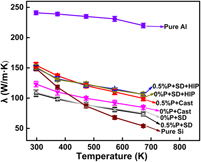
The Al–50Si alloy, as a kind of potential electronic packaging material, is manufactured by different methods, such as casting and spray deposition. The possible influences of the P refiner on the microstructure of the Al–50Si alloy are investigated at different cooling rates. The refinement mechanism of primary Si phase is discussed in view of the P refiner addition, and the variation of the cooling rates. The thermal conductivity (TC), as a key parameter for electronic materials, is measured. The coupled effects of the cooling rate and the addition of the P refiner during the solidification of the Al–50Si alloy on the TC are elucidated based on structural observations. Furthermore, the porosity in the Al–50Si alloy is treated as a second phase influencing the TC.
A diamond film was deposited on YT14 cemented carbide cutting tools with a chemical vapor deposition, the surface-interface morphologies, compositions of chemical elements, phases, atomic bonding energies, and structures of the films were analyzed with a scanning electron microscopy, energy dispersive spectrometer, x-ray diffraction, x-ray photoelectron spectroscopy, and Raman, respectively, and the mechanical properties of the film were characterized with a nanoindentation and scratch test, respectively. The results show that the surface of diamond film is continuous and dense, the surface roughness of the film is 79.2 nm, and the average grain size is 478.2 nm. The atomic binding energies of C1s are composed of sp2 at the Raman shift of 1363.01 cm−1 and sp3 at the Raman shift of 1556.26 cm−1. The hardness and equivalent elastic modulus of the film is 16.27397 GPa and 166.1791 GPa, respectively, and the binding strength of the film-substrate is 26.2 N, showing a high anti-scratch ability.
H3PW12O40/polymethylmethacrylate (PMMA)/polycaprolactam (PA6) nanofibrous membrane with a sandwich structure was prepared by electrospinning. Characterization with Fourier transformation infrared spectroscopy (FT-IR), energy-dispersive x-ray spectroscopy (EDX), and x-ray photoelectron spectroscopy (XPS) indicated that H3PW12O40 has been successfully loaded into the upper and bottom layers of the sandwich membrane and its Keggin structure was not destroyed. The photocatalytic efficiency of the sandwich membranes were much higher (≥87.2%) than that of H3PW12O40 only (15.6%) and H3PW12O40/PMMA composite nanofibrous membrane (11.6%) in the degradation of methyl orange (MO) under ultraviolet irradiation. It may be caused by two factors: one was the photoreduction mechanism induced by the electron donating from PA6 to H3PW12O40, the other was the double contact area between H3PW12O40 and MO due to the sandwich structure of the laminated membrane. What is noteworthy is that the sandwich membranes were stable in water, so that they could be easily separated from the aqueous MO solution and reused without appreciable losses in photocatalytic activity after three photocatalytic cycles. In view of this, H3PW12O40/PMMA/PA6 sandwich nanofibrous membrane is promising as a photocatalyst to remove organic pollutants from practical wastewater.
The effect of magnesium nitrate on the thermo-foaming of powder dispersions in molten sucrose for the preparation of alumina foams has been studied. The magnesium nitrate decreases the melting point of sucrose from 180 to 160 °C and acts as a blowing and setting agent. The foaming time and setting time decreases with an increase in foaming temperature as well as an increase in magnesium nitrate concentration. The rapid foaming followed by foam collapse is observed beyond 140 °C. The accelerated foaming and setting is due to an increase in the rate of –OH condensation because of the catalytic effect of H+ generated by the hydrolysis of magnesium nitrate. The porosity of alumina foam increases while cell size and grain size decrease with an increase in magnesium nitrate concentration. A change in foam structure, from partially interconnected cellular to completely interconnected reticulate-like, occurs when the magnesium nitrate concentration increase from 4 to 8 wt%.
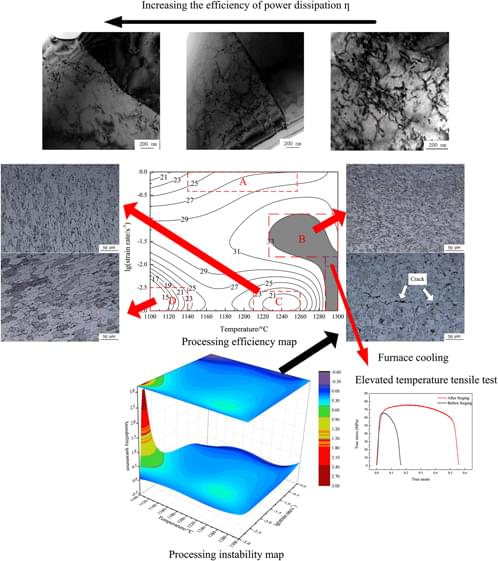
Hot deformation is an effective way to tackle major problems in powder metallurgy, i.e., inferior mechanical properties and low relative density. To characterize the hot deformation behavior of NiAl-based alloy manufactured by hot pressing sintering, the isothermal compression tests were performed in the deformation temperature range of 1100–1300 °C with strain rate of 0.001–1 s−1. The result indicates that calculated hot activation energy Q is 326.31 kJ/mol. The processing efficiency maps and instability maps of NiAl-based alloy were established to optimize deformation parameters on the basis of dynamic material model. They were validated through microstructure evolution. The microstructure observation revealed that fine grains, dislocation pile-up, cracks appear in high efficiency, low efficiency, and instability domains, respectively. According to effective processing window revealed by processing maps, hot forging of sintered billets was performed. The elevated temperature elongation increases from 17.86% to 74.87% after forging. The stripping feature is found on fracture surface after forging.
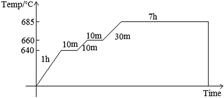
A dense monolithic intermetallic Al3Ti alloy was successfully synthesized via reactive sintering in vacuum using TC4 alloy and pure aluminum foils with appropriate initial thickness. Energy dispersive spectroscopy (EDS), x-ray diffractometry (XRD), and scanning electron microscopy (SEM) were used to characterize the phase and microstructure of Al3Ti alloy. Ultrasonic measurement was performed to evaluate the physical property of Al3Ti alloy. Different thermal analysis, thermogravimetry (TG) and differential scanning calorimetry (DSC) were used to assess the thermal property of Al3Ti alloy. The compressive tests were carried out on a universal load frame to determine the mechanical properties, including the compressive strength and failure strain of the fabricated intermetallic Al3Ti alloy. The current results indicated that the density of Al3Ti alloy is slightly higher than the theoretical density, the average Young's modulus is lower than the theoretical value. A trace of aluminum in Al3Ti alloy was detected, which is distinctly affected on the density, Young's modulus and mechanical properties of this titanium aluminide alloy. The stress–strain curves of Al3Ti alloy shows a linear elastic behavior without any plastic deformation, and the fracture features are the mixed fracture of transgranular and intergranular. Some other fundamental physical and mechanical properties of the Al3Ti alloy were also obtained in the present study.
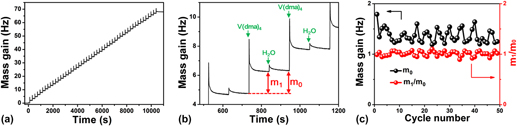
Atomic layer deposition (ALD) of vanadium oxide (VOx) thin films, using tetrakis(dimethylamino)vanadium as the vanadium precursor, is comprehensively reported in this work. The vanadium precursor is highly volatile and can be used at room temperature for deposition. Either H2O or O3 can be used as the coreactant for depositing VOx at 50–200 °C. However, partial precursor decomposition is suggested for the deposition temperature higher than 160 °C. The as-deposited VOx films are pure, smooth, and amorphous, and can be crystallized into monoclinic VO2 phase by postdeposition annealing under N2 ambient. The minimum annealing temperature for film to crystallize is found, by in situ high-temperature X-ray diffraction experiments, at around 550–600 °C. In situ quartz crystal microbalance experiments are performed to further analyze the surface reaction mechanism involved in this ALD process.
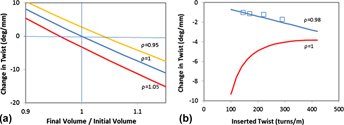
Soft robots are being developed to mimic the movement of biological organisms and as wearable garments to assist human movement in rehabilitation, training, and tasks encountered in functional daily living. Stretchable artificial muscles are well suited as the active mechanical element in soft wearable robotics, and here the performance of highly stretchable and compliant polymer coil muscles are described and analyzed. The force and displacements generated by a given stimulus are shown to be determined by the external loading conditions and the main material properties of free stroke and stiffness. Spring mechanics and a model based on a single helix are used to evaluate both the coil stiffness and the mechanism of coil actuation. The latter is directly coupled to a torsional actuation in the twisted fiber that forms the coil. The single helix model illustrates how fiber volume changes generate a partial fiber untwist, and spring mechanics shows how this fiber untwist generates large tensile strokes and high gravimetric work outputs in the polymer coil muscles. These analyses highlight possible as yet unexplored means for further enhancing the performance of these systems.
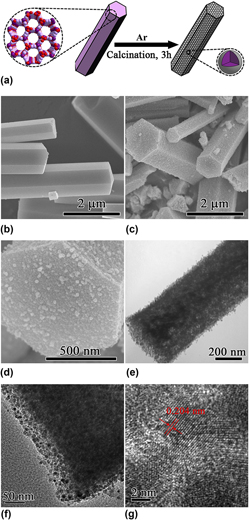
There has been a continuous call for active, durable, and low-cost catalysts for a range of catalysis reactions. In this paper, porous Co@C composed of uniformly dispersed Co metal nanoparticles in hexagonal-shaped prisms carbon matrix were fabricated by in situ pyrolysis of hexagonal-shaped prismatic Co-MOF-74 crystals. The obtained nanoporous carbons have a high surface area of 195.2 m2/g and a strong magnetic response, thereby realizing fast molecular diffusion of reactant and easy magnetic separation. The resulting Co@C catalyst show a superior and durable catalytic activity for reduction of 4-nitrophenol (4-NP) to 4-aminophenol (4-AP). Moreover, Co@C can be recycled and still retains more than 75% of its original catalytic activity after 6 cycles. Therefore, it is reasonable to believe that such Co@C nanocomposites have great potential as a highly efficient and low-cost heterogeneous catalyst. It is believed that MOFs can be used to produce other catalysts with high porosity and uniformly dispersed active sites.
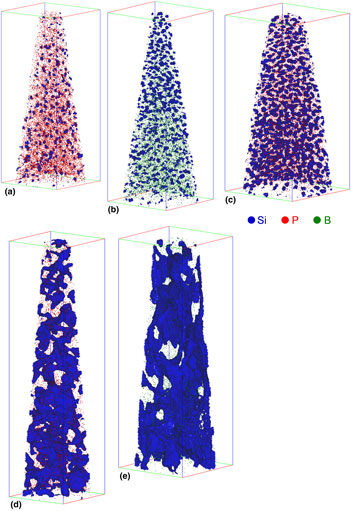
We analyze phosphorus (P)- and boron (B)-doped silicon nanocrystals (Si NCs) with various compositions of silicon-rich oxide using atom probe tomography. By creating Si iso-concentration surfaces, it is confirmed that there are two types of Si NC networks depending on the amount of excess Si. A proximity histogram shows that P prefers to locate inside the Si NCs, whereas B is more likely to reside outside the Si NCs. We discuss the difference in a preferential location between P and B by a segregation coefficient.
Hierarchical design draws inspiration from analysis of biological materials and has opened new possibilities for enhancing performance and enabling new functionalities and extraordinary properties. With the development of nanotechnology, the necessary technological requirements for the manufacturing of hierarchical materials are advancing at a fast pace, opening new challenges and opportunities. This article presents an overview of possible applications of and perspectives on hierarchical materials.
Hierarchical design down to the nanoscale has become possible in structural composite materials with the discovery of carbon nanomaterials such as carbon nanotubes (CNTs) and graphene. Composites that simultaneously combine microscopic continuous fibers and nanoscale reinforcements are known in the field as hierarchical or nanoengineered composites. The additional reinforcement at the nanoscale promises high-performance composites with unique combinations of mechanical properties and new functionalities. Here, we review advances in fiber-reinforced polymers modified with CNTs. Three routes for integration of CNTs in composites are discussed: deposition on fibers/plies, dispersion in the matrix, and assembly into fibers. We highlight opportunities and challenges focusing on mechanical performance and processing.