Refine search
Actions for selected content:
26077 results in Abstract analysis
Algebras with representable representations
- Part of
-
- Journal:
- Proceedings of the Edinburgh Mathematical Society / Volume 64 / Issue 3 / August 2021
- Published online by Cambridge University Press:
- 24 June 2021, pp. 555-573
-
- Article
-
- You have access
- Open access
- HTML
- Export citation
-
Just like group actions are represented by group automorphisms, Lie algebra actions are represented by derivations: up to isomorphism, a split extension of a Lie algebra $B$
 by a Lie algebra $X$
 corresponds to a Lie algebra morphism $B\to {\mathit {Der}}(X)$
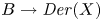 from $B$
 to the Lie algebra ${\mathit {Der}}(X)$
 of derivations on $X$
 . In this article, we study the question whether the concept of a derivation can be extended to other types of non-associative algebras over a field ${\mathbb {K}}$
 , in such a way that these generalized derivations characterize the ${\mathbb {K}}$
 -algebra actions. We prove that the answer is no, as soon as the field ${\mathbb {K}}$
 is infinite. In fact, we prove a stronger result: already the representability of all abelian actions – which are usually called representations or Beck modules – suffices for this to be true. Thus, we characterize the variety of Lie algebras over an infinite field of characteristic different from $2$
 as the only variety of non-associative algebras which is a non-abelian category with representable representations. This emphasizes the unique role played by the Lie algebra of linear endomorphisms $\mathfrak {gl}(V)$
 as a representing object for the representations on a vector space $V$
 .
.


Direction-dependent turning leads to anisotropic diffusion and persistence
- Part of
-
- Journal:
- European Journal of Applied Mathematics / Volume 33 / Issue 4 / August 2022
- Published online by Cambridge University Press:
- 23 June 2021, pp. 729-765
-
- Article
- Export citation
Self-adjoint extensions of bipartite Hamiltonians
- Part of
-
- Journal:
- Proceedings of the Edinburgh Mathematical Society / Volume 64 / Issue 3 / August 2021
- Published online by Cambridge University Press:
- 22 June 2021, pp. 433-447
-
- Article
- Export citation
-
We compute the deficiency spaces of operators of the form $H_A{\hat {\otimes }} I + I{\hat {\otimes }} H_B$
 , for symmetric $H_A$
 and self-adjoint $H_B$
 . This enables us to construct self-adjoint extensions (if they exist) by means of von Neumann's theory. The structure of the deficiency spaces for this case was asserted already in Ibort et al. [Boundary dynamics driven entanglement, J. Phys. A: Math. Theor. 47(38) (2014) 385301], but only proven under the restriction of $H_B$
 having discrete, non-degenerate spectrum.


On convex holes in d-dimensional point sets
- Part of
-
- Journal:
- Combinatorics, Probability and Computing / Volume 31 / Issue 1 / January 2022
- Published online by Cambridge University Press:
- 18 June 2021, pp. 101-108
-
- Article
- Export citation
-
Given a finite set $A \subseteq \mathbb{R}^d$, points $a_1,a_2,\dotsc,a_{\ell} \in A$ form an $\ell$-hole in A if they are the vertices of a convex polytope, which contains no points of A in its interior. We construct arbitrarily large point sets in general position in $\mathbb{R}^d$ having no holes of size $O(4^dd\log d)$ or more. This improves the previously known upper bound of order $d^{d+o(d)}$ due to Valtr. The basic version of our construction uses a certain type of equidistributed point sets, originating from numerical analysis, known as (t,m,s)-nets or (t,s)-sequences, yielding a bound of $2^{7d}$. The better bound is obtained using a variant of (t,m,s)-nets, obeying a relaxed equidistribution condition.


TOROIDAL q-OPERS
-
- Journal:
- Journal of the Institute of Mathematics of Jussieu / Volume 22 / Issue 2 / March 2023
- Published online by Cambridge University Press:
- 18 June 2021, pp. 581-642
- Print publication:
- March 2023
-
- Article
- Export citation
-
We define and study the space of q-opers associated with Bethe equations for integrable models of XXZ type with quantum toroidal algebra symmetry. Our construction is suggested by the study of the enumerative geometry of cyclic quiver varieties, in particular the ADHM moduli spaces. We define $\left (\overline {GL}(\infty ),q\right )$-opers with regular singularities and then, by imposing various analytic conditions on singularities, arrive at the desired Bethe equations for toroidal q-opers.

Clustered 3-colouring graphs of bounded degree
- Part of
-
- Journal:
- Combinatorics, Probability and Computing / Volume 31 / Issue 1 / January 2022
- Published online by Cambridge University Press:
- 18 June 2021, pp. 123-135
-
- Article
- Export citation
-
A (not necessarily proper) vertex colouring of a graph has clustering c if every monochromatic component has at most c vertices. We prove that planar graphs with maximum degree $\Delta$ are 3-colourable with clustering $O(\Delta^2)$. The previous best bound was $O(\Delta^{37})$. This result for planar graphs generalises to graphs that can be drawn on a surface of bounded Euler genus with a bounded number of crossings per edge. We then prove that graphs with maximum degree $\Delta$ that exclude a fixed minor are 3-colourable with clustering $O(\Delta^5)$. The best previous bound for this result was exponential in $\Delta$.


6 - Range and Support of a Measure
-
- Book:
- Counterexamples in Measure and Integration
- Published online:
- 27 May 2021
- Print publication:
- 17 June 2021, pp 123-137
-
- Chapter
- Export citation
12 - Convergence Theorems
-
- Book:
- Counterexamples in Measure and Integration
- Published online:
- 27 May 2021
- Print publication:
- 17 June 2021, pp 235-246
-
- Chapter
- Export citation
14 - Integration and Differentiation
-
- Book:
- Counterexamples in Measure and Integration
- Published online:
- 27 May 2021
- Print publication:
- 17 June 2021, pp 261-279
-
- Chapter
- Export citation
User’s Guide
-
- Book:
- Counterexamples in Measure and Integration
- Published online:
- 27 May 2021
- Print publication:
- 17 June 2021, pp xxv-xxvii
-
- Chapter
- Export citation
11 - Modes of Convergence
-
- Book:
- Counterexamples in Measure and Integration
- Published online:
- 27 May 2021
- Print publication:
- 17 June 2021, pp 221-234
-
- Chapter
- Export citation
List of Topics and Phenomena
-
- Book:
- Counterexamples in Measure and Integration
- Published online:
- 27 May 2021
- Print publication:
- 17 June 2021, pp xxviii-xxx
-
- Chapter
- Export citation
16 - Product Measures
-
- Book:
- Counterexamples in Measure and Integration
- Published online:
- 27 May 2021
- Print publication:
- 17 June 2021, pp 295-316
-
- Chapter
- Export citation
3 - Riemann Is Not Enough
-
- Book:
- Counterexamples in Measure and Integration
- Published online:
- 27 May 2021
- Print publication:
- 17 June 2021, pp 55-72
-
- Chapter
- Export citation
Operator equalities and Characterizations of Orthogonality in Pre-Hilbert C*-Modules
- Part of
-
- Journal:
- Proceedings of the Edinburgh Mathematical Society / Volume 64 / Issue 3 / August 2021
- Published online by Cambridge University Press:
- 17 June 2021, pp. 594-614
-
- Article
- Export citation
-
In the first part of the paper, we use states on $C^{*}$
 -algebras in order to establish some equivalent statements to equality in the triangle inequality, as well as to the parallelogram identity for elements of a pre-Hilbert $C^{*}$
 -module. We also characterize the equality case in the triangle inequality for adjointable operators on a Hilbert $C^{*}$
 -module. Then we give certain necessary and sufficient conditions to the Pythagoras identity for two vectors in a pre-Hilbert $C^{*}$
 -module under the assumption that their inner product has a negative real part. We introduce the concept of Pythagoras orthogonality and discuss its properties. We describe this notion for Hilbert space operators in terms of the parallelogram law and some limit conditions. We present several examples in order to illustrate the relationship between the Birkhoff–James, Roberts, and Pythagoras orthogonalities, and the usual orthogonality in the framework of Hilbert $C^{*}$
 -modules.


2 - A Refresher of Topology and Ordinal Numbers
-
- Book:
- Counterexamples in Measure and Integration
- Published online:
- 27 May 2021
- Print publication:
- 17 June 2021, pp 36-54
-
- Chapter
- Export citation
GEOMETRIC QUADRATIC CHABAUTY
- Part of
-
- Journal:
- Journal of the Institute of Mathematics of Jussieu / Volume 22 / Issue 1 / January 2023
- Published online by Cambridge University Press:
- 17 June 2021, pp. 279-333
- Print publication:
- January 2023
-
- Article
-
- You have access
- Open access
- Export citation
-
Since Faltings proved Mordell’s conjecture in [16] in 1983, we have known that the sets of rational points on curves of genus at least $2$ are finite. Determining these sets in individual cases is still an unsolved problem. Chabauty’s method (1941) [10] is to intersect, for a prime number p, in the p-adic Lie group of p-adic points of the Jacobian, the closure of the Mordell–Weil group with the p-adic points of the curve. Under the condition that the Mordell–Weil rank is less than the genus, Chabauty’s method, in combination with other methods such as the Mordell–Weil sieve, has been applied successfully to determine all rational points in many cases.
Minhyong Kim’s nonabelian Chabauty programme aims to remove the condition on the rank. The simplest case, called quadratic Chabauty, was developed by Balakrishnan, Besser, Dogra, Müller, Tuitman and Vonk, and applied in a tour de force to the so-called cursed curve (rank and genus both $3$).
$3$).This article aims to make the quadratic Chabauty method small and geometric again, by describing it in terms of only ‘simple algebraic geometry’ (line bundles over the Jacobian and models over the integers).


7 - Measurable and Non-Measurable Sets
-
- Book:
- Counterexamples in Measure and Integration
- Published online:
- 27 May 2021
- Print publication:
- 17 June 2021, pp 138-163
-
- Chapter
- Export citation
Contents
-
- Book:
- Counterexamples in Measure and Integration
- Published online:
- 27 May 2021
- Print publication:
- 17 June 2021, pp v-xxii
-
- Chapter
- Export citation
18 - Function Spaces
-
- Book:
- Counterexamples in Measure and Integration
- Published online:
- 27 May 2021
- Print publication:
- 17 June 2021, pp 330-369
-
- Chapter
- Export citation
