Refine search
Actions for selected content:
26076 results in Abstract analysis
A critical virus production rate for efficiency of oncolytic virotherapy
- Part of
-
- Journal:
- European Journal of Applied Mathematics / Volume 32 / Issue 2 / April 2021
- Published online by Cambridge University Press:
- 08 May 2020, pp. 301-316
-
- Article
- Export citation
-
In a planar smoothly bounded domain $\Omega$, we consider the model for oncolytic virotherapy given by with positive parameters
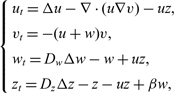 $$\left\{ \begin{array}{l} u_t = \Delta u - \nabla \cdot (u\nabla v) - uz, \\[1mm] v_t = - (u+w)v, \\[1mm] w_t = d_w \Delta w - w + uz, \\[1mm] z_t = d_z \Delta z - z - uz + \beta w, \end{array} \right.$$ $ D_w $, $ D_z $ and $\beta$. It is firstly shown that whenever $\beta \lt 1$, for any choice of $M \gt 0$, one can find initial data such that the solution of an associated no-flux initial-boundary value problem, well known to exist globally actually for any choice of $\beta \gt 0$, satisfies If
 $$u\ge M \qquad \mbox{in } \Omega\times (0,\infty).$$ $\beta \gt 1$, however, then for arbitrary initial data the corresponding is seen to have the property that This may be interpreted as indicating that
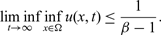 $$\liminf_{t\to\infty} \inf_{x\in\Omega} u(x,t)\le \frac{1}{\beta-1}.$$ $\beta$ plays the role of a critical virus replication rate with regard to efficiency of the considered virotherapy, with corresponding threshold value given by $\beta = 1$.


Restrictions on meromorphic solutions of Fermat type equations
- Part of
-
- Journal:
- Proceedings of the Edinburgh Mathematical Society / Volume 63 / Issue 3 / August 2020
- Published online by Cambridge University Press:
- 08 May 2020, pp. 654-665
-
- Article
- Export citation
-
The Fermat type functional equations $(*)\, f_1^n+f_2^n+\cdots +f_k^n=1$, where n and k are positive integers, are considered in the complex plane. Our focus is on equations of the form (*) where it is not known whether there exist non-constant solutions in one or more of the following four classes of functions: meromorphic functions, rational functions, entire functions, polynomials. For such equations, we obtain estimates on Nevanlinna functions that transcendental solutions of (*) would have to satisfy, as well as analogous estimates for non-constant rational solutions. As an application, it is shown that transcendental entire solutions of (*) when n = k(k − 1) with k ≥ 3, would have to satisfy a certain differential equation, which is a generalization of the known result when k = 3. Alternative proofs for the known non-existence theorems for entire and polynomial solutions of (*) are given. Moreover, some restrictions on degrees of polynomial solutions are discussed.
On topological approaches to the Jacobian conjecture in ℂn
- Part of
-
- Journal:
- Proceedings of the Edinburgh Mathematical Society / Volume 63 / Issue 3 / August 2020
- Published online by Cambridge University Press:
- 07 May 2020, pp. 666-675
-
- Article
- Export citation
-
We obtain a new theorem for the non-properness set $S_f$ of a non-singular polynomial mapping $f:\mathbb C^n \to \mathbb C^n$. In particular, our result shows that if f is a counterexample to the Jacobian conjecture, then $S_f\cap Z \neq \emptyset $, for every hypersurface Z dominated by $\mathbb C^{n-1}$ on which some non-singular polynomial $h: \mathbb C^{n}\to \mathbb C$ is constant. Also, we present topological approaches to the Jacobian conjecture in $\mathbb C^n$. As applications, we extend bidimensional results of Rabier, Lê and Weber to higher dimensions.


Entire solutions of a variation of the eikonal equation and related PDEs
- Part of
-
- Journal:
- Proceedings of the Edinburgh Mathematical Society / Volume 63 / Issue 3 / August 2020
- Published online by Cambridge University Press:
- 07 May 2020, pp. 697-708
-
- Article
- Export citation
-
The aim of this paper is twofold. The first aim is to describe the entire solutions of the partial differential equation (PDE) $u_{z_1}^2+2Bu_{z_1}u_{z_2}+u_{z_2}^2=e^g$, where B is a constant and g is a polynomial or an entire function in $\mathbb {C}^2$. The second aim is to consider the entire solutions of another PDE, which is a generalization of the well-known PDE of tubular surfaces.

NONBINARY DELSARTE–GOETHALS CODES AND FINITE SEMIFIELDS
- Part of
-
- Journal:
- Glasgow Mathematical Journal / Volume 62 / Issue S1 / December 2020
- Published online by Cambridge University Press:
- 07 May 2020, pp. S186-S205
-
- Article
-
- You have access
- Export citation
-
Symplectic finite semifields can be used to construct nonlinear binary codes of Kerdock type (i.e., with the same parameters of the Kerdock codes, a subclass of Delsarte–Goethals codes). In this paper, we introduce nonbinary Delsarte–Goethals codes of parameters $(q^{m+1}\ ,\ q^{m(r+2)+2}\ ,\ {\frac{q-1}{q}(q^{m+1}-q^{\frac{m+1}{2}+r})})$ over a Galois field of order $q=2^l$, for all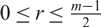 $0\le r\le\frac{m-1}{2}$, with m ≥ 3 odd, and show the connection of this construction to finite semifields.

SYMBOLIC ANALYTIC SPREAD: UPPER BOUNDS AND APPLICATIONS
- Part of
-
- Journal:
- Journal of the Institute of Mathematics of Jussieu / Volume 20 / Issue 6 / November 2021
- Published online by Cambridge University Press:
- 07 May 2020, pp. 1969-1981
- Print publication:
- November 2021
-
- Article
- Export citation
-
The symbolic analytic spread of an ideal $I$ is defined in terms of the rate of growth of the minimal number of generators of its symbolic powers. In this article, we find upper bounds for the symbolic analytic spread under certain conditions in terms of other invariants of $I$. Our methods also work for more general systems of ideals. As applications, we provide bounds for the (local) Kodaira dimension of divisors, the arithmetic rank, and the Frobenius complexity. We also show sufficient conditions for an ideal to be a set-theoretic complete intersection.


One-generator braces and indecomposable set-theoretic solutions to the Yang–Baxter equation
- Part of
-
- Journal:
- Proceedings of the Edinburgh Mathematical Society / Volume 63 / Issue 3 / August 2020
- Published online by Cambridge University Press:
- 06 May 2020, pp. 676-696
-
- Article
- Export citation
Concentration of positive solutions for a class of fractional p-Kirchhoff type equations
- Part of
-
- Journal:
- Proceedings of the Royal Society of Edinburgh. Section A: Mathematics / Volume 151 / Issue 2 / April 2021
- Published online by Cambridge University Press:
- 04 May 2020, pp. 601-651
- Print publication:
- April 2021
-
- Article
- Export citation
-
We study the existence and concentration of positive solutions for the following class of fractional p-Kirchhoff type problems:
where ɛ is a small positive parameter, a and b are positive constants, s ∈ (0, 1) and p ∈ (1, ∞) are such that $$ \left\{\begin{array}{@{}ll} \left(\varepsilon^{sp}a+\varepsilon^{2sp-3}b \,[u]_{s, p}^{p}\right)(-\Delta)_{p}^{s}u+V(x)u^{p-1}=f(u) & \text{in}\ \mathbb{R}^{3},\\ \noalign{ u\in W^{s, p}(\mathbb{R}^{3}), \quad u>0 & \text{in}\ \mathbb{R}^{3}, \end{array}\right.$$ $sp \in (\frac {3}{2}, 3)$, $(-\Delta )^{s}_{p}$ is the fractional p-Laplacian operator, f: ℝ → ℝ is a superlinear continuous function with subcritical growth and V: ℝ3 → ℝ is a continuous potential having a local minimum. We also prove a multiplicity result and relate the number of positive solutions with the topology of the set where the potential V attains its minimum values. Finally, we obtain an existence result when f(u) = uq−1 + γur−1, where γ > 0 is sufficiently small, and the powers q and r satisfy 2p < q < p*s ⩽ r. The main results are obtained by using some appropriate variational arguments.


Extended Stefan problem for the solidification of binary alloys in a sphere
- Part of
-
- Journal:
- European Journal of Applied Mathematics / Volume 32 / Issue 2 / April 2021
- Published online by Cambridge University Press:
- 04 May 2020, pp. 242-279
-
- Article
- Export citation
JMJ volume 19 Issue 3 Cover and Back matter
-
- Journal:
- Journal of the Institute of Mathematics of Jussieu / Volume 19 / Issue 3 / May 2020
- Published online by Cambridge University Press:
- 05 May 2020, pp. b1-b2
- Print publication:
- May 2020
-
- Article
-
- You have access
- Export citation
JMJ volume 19 Issue 3 Cover and Front matter
-
- Journal:
- Journal of the Institute of Mathematics of Jussieu / Volume 19 / Issue 3 / May 2020
- Published online by Cambridge University Press:
- 05 May 2020, pp. f1-f2
- Print publication:
- May 2020
-
- Article
-
- You have access
- Export citation
Edge corrections for parallel-plate capacitors
- Part of
-
- Journal:
- European Journal of Applied Mathematics / Volume 32 / Issue 2 / April 2021
- Published online by Cambridge University Press:
- 30 April 2020, pp. 226-241
-
- Article
-
- You have access
- Open access
- Export citation
Transition waves for lattice Fisher-KPP equations with time and space dependence
- Part of
-
- Journal:
- Proceedings of the Royal Society of Edinburgh. Section A: Mathematics / Volume 151 / Issue 2 / April 2021
- Published online by Cambridge University Press:
- 28 April 2020, pp. 573-600
- Print publication:
- April 2021
-
- Article
- Export citation
Existence and multiplicity of solutions for discontinuous elliptic problems in ℝN
- Part of
-
- Journal:
- Proceedings of the Royal Society of Edinburgh. Section A: Mathematics / Volume 151 / Issue 2 / April 2021
- Published online by Cambridge University Press:
- 28 April 2020, pp. 548-572
- Print publication:
- April 2021
-
- Article
- Export citation
HERMITIANS IN MATRIX ALGEBRAS WITH OPERATOR NORM
- Part of
-
- Journal:
- Glasgow Mathematical Journal / Volume 63 / Issue 2 / May 2021
- Published online by Cambridge University Press:
- 27 April 2020, pp. 280-290
-
- Article
-
- You have access
- Export citation
-
We investigate the real space H of Hermitian matrices in $M_n(\mathbb{C})$ with respect to norms on $\mathbb{C}^n$. For absolute norms, the general form of Hermitian matrices was essentially established by Schneider and Turner [Schneider and Turner, Linear and Multilinear Algebra (1973), 9–31]. Here, we offer a much shorter proof. For non-absolute norms, we begin an investigation of H by means of a series of examples, with particular reference to dimension and commutativity.


PRM volume 150 issue 3 Cover and Front matter
-
- Journal:
- Proceedings of the Royal Society of Edinburgh. Section A: Mathematics / Volume 150 / Issue 3 / June 2020
- Published online by Cambridge University Press:
- 22 April 2020, pp. f1-f2
- Print publication:
- June 2020
-
- Article
-
- You have access
- Export citation
PRM volume 150 issue 3 Cover and Back matter
-
- Journal:
- Proceedings of the Royal Society of Edinburgh. Section A: Mathematics / Volume 150 / Issue 3 / June 2020
- Published online by Cambridge University Press:
- 22 April 2020, pp. b1-b2
- Print publication:
- June 2020
-
- Article
-
- You have access
- Export citation
ON SOME QUESTIONS OF PARTITIO NUMERORUM: TRES CUBI
- Part of
-
- Journal:
- Glasgow Mathematical Journal / Volume 63 / Issue 1 / January 2021
- Published online by Cambridge University Press:
- 21 April 2020, pp. 223-244
-
- Article
-
- You have access
- Export citation
-
This paper is concerned with the function r3(n), the number of representations of n as the sum of at most three positive cubes,
, Our understanding of this function is surprisingly poor, and we examine various averages of it. In particular $$r_3(n) = {\mathrm{card}}\{\mathbf m\in\mathbb Z^3: m_1^3+m_2^3+m_3^3=n, m_j\ge1\}.$$and
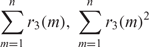 $${\sum_{m=1}^nr_3(m),\,\sum_{m=1}^nr_3(m)^2}$$
 $${\sum_{\substack{ n\le x\\ n\equiv a\,\mathrm{mod}\,q }} r_3(n).\}$$

BGG CATEGORY FOR THE QUANTUM SCHRÖDINGER ALGEBRA
- Part of
-
- Journal:
- Glasgow Mathematical Journal / Volume 63 / Issue 2 / May 2021
- Published online by Cambridge University Press:
- 20 April 2020, pp. 266-279
-
- Article
-
- You have access
- Export citation
-
In 1996, a q-deformation of the universal enveloping algebra of the Schrödinger Lie algebra was introduced in Dobrev et al. [J. Phys. A 29 (1996) 5909–5918.]. This algebra is called the quantum Schrödinger algebra. In this paper, we study the Bernstein-Gelfand-Gelfand (BGG) category $\mathcal{O}$ for the quantum Schrödinger algebra $U_q(\mathfrak{s})$, where q is a nonzero complex number which is not a root of unity. If the central charge $\dot z\neq 0$, using the module $B_{\dot z}$ over the quantum Weyl algebra $H_q$, we show that there is an equivalence between the full subcategory $\mathcal{O}[\dot Z]$ consisting of modules with the central charge $\dot z$ and the BGG category $\mathcal{O}^{(\mathfrak{sl}_2)}$ for the quantum group $U_q(\mathfrak{sl}_2)$. In the case that $\dot z = 0$, we study the subcategory $\mathcal{A}$ consisting of finite dimensional $U_q(\mathfrak{s})$-modules of type 1 with zero action of Z. We directly construct an equivalence functor from $\mathcal{A}$ to the category of finite dimensional representations of an infinite quiver with some quadratic relations. As a corollary, we show that the category of finite dimensional $U_q(\mathfrak{s})$-modules is wild.


On small-time similarity-solution behaviour in the solidification shrinkage of binary alloys
- Part of
-
- Journal:
- European Journal of Applied Mathematics / Volume 32 / Issue 2 / April 2021
- Published online by Cambridge University Press:
- 17 April 2020, pp. 199-225
-
- Article
- Export citation
