Refine search
Actions for selected content:
26063 results in Abstract analysis
ON NONLOCAL NONLINEAR ELLIPTIC PROBLEMS WITH THE FRACTIONAL LAPLACIAN
- Part of
-
- Journal:
- Glasgow Mathematical Journal / Volume 62 / Issue 1 / January 2020
- Published online by Cambridge University Press:
- 29 January 2019, pp. 75-84
-
- Article
-
- You have access
- Export citation
-
In this paper, we study the existence of positive solutions to a semilinear nonlocal elliptic problem with the fractional α-Laplacian on Rn, 0 < α < n. We show that the problem has infinitely many positive solutions in $ {C^\tau}({R^n})\bigcap H_{loc}^{\alpha /2}({R^n}) $. Moreover, each of these solutions tends to some positive constant limit at infinity. We can extend our previous result about sub-elliptic problem to the nonlocal problem on Rn. We also show for α ∊ (0, 2) that in some cases, by the use of Hardy’s inequality, there is a nontrivial non-negative $ H_{loc}^{\alpha /2}({R^n}) $ weak solution to the problemwhere K(x) = K(|x|) is a non-negative non-increasing continuous radial function in Rn and p > 1.
 $$ {( - \Delta )^{\alpha /2}}u(x) = K(x){u^p} \quad {\rm{ in}} \ {R^n}, $$

Determinantal inequalities for the partition function
- Part of
-
- Journal:
- Proceedings of the Royal Society of Edinburgh. Section A: Mathematics / Volume 150 / Issue 3 / June 2020
- Published online by Cambridge University Press:
- 29 January 2019, pp. 1451-1466
- Print publication:
- June 2020
-
- Article
- Export citation
-
Let p(n) denote the partition function. In this paper, we will prove that for $n\ges 222$,As a corollary, we deduce that p(n) satisfies the double Turán inequalities, that is, for
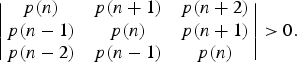 $$\left| {\matrix{ {p(n)} & {p(n + 1)} & {p(n + 2)} \cr {p(n-1)} & {p(n)} & {p(n + 1)} \cr {p(n-2)} & {p(n-1)} & {p(n)} \cr } } \right| > 0.{\rm }$$ $n\ges 222$,
 $$(p(n)^2-p(n-1)p(n+1))^2-(p(n-1)^2-p(n-2)p(n))(p(n+1)^2-p(n)p(n+2))>0.$$


On two cohomological Hall algebras
- Part of
-
- Journal:
- Proceedings of the Royal Society of Edinburgh. Section A: Mathematics / Volume 150 / Issue 3 / June 2020
- Published online by Cambridge University Press:
- 29 January 2019, pp. 1581-1607
- Print publication:
- June 2020
-
- Article
- Export citation
Existence and multiplicity of positive solutions for a fourth-order elliptic equation
- Part of
-
- Journal:
- Proceedings of the Royal Society of Edinburgh. Section A: Mathematics / Volume 150 / Issue 2 / April 2020
- Published online by Cambridge University Press:
- 28 January 2019, pp. 1053-1069
- Print publication:
- April 2020
-
- Article
- Export citation
-
We prove existence and multiplicity of solutions for the problem
where $$\left\{ {\matrix{ {\Delta ^2u + \lambda \Delta u = \vert u \vert ^{2*-2u},{\rm in }\Omega ,} \hfill \hfill \hfill \hfill \cr {u,-\Delta u > 0,\quad {\rm in}\;\Omega ,\quad u = \Delta u = 0,\quad {\rm on}\;\partial \Omega ,} \cr } } \right.$$ $\Omega \subset {\open R}^N$, $N \ges 5$, is a bounded regular domain, $\lambda >0$ and $2^*=2N/(N-4)$ is the critical Sobolev exponent for the embedding of $W^{2,2}(\Omega )$ into the Lebesgue spaces.


On a second numerical index for Banach spaces
- Part of
-
- Journal:
- Proceedings of the Royal Society of Edinburgh. Section A: Mathematics / Volume 150 / Issue 2 / April 2020
- Published online by Cambridge University Press:
- 28 January 2019, pp. 1003-1051
- Print publication:
- April 2020
-
- Article
- Export citation
Multi-clustered solutions for a singularly perturbed forced pendulum equation
- Part of
-
- Journal:
- Proceedings of the Royal Society of Edinburgh. Section A: Mathematics / Volume 150 / Issue 1 / February 2020
- Published online by Cambridge University Press:
- 26 January 2019, pp. 387-417
- Print publication:
- February 2020
-
- Article
- Export citation
-
In this paper, we are concerned with unbounded solutions of the singularly perturbed forced pendulum equation in the presence of friction, namely
Using a limiting energy function, we describe the behaviour of the solutions as the parameter ε approaches zero. We also prove the existence of a family of solutions having a prescribed asymptotic profile and exhibiting a highly rotatory behaviour alternated with a highly oscillatory behaviour in some open subsets of the domain. The proof relies on a combination of the Nehari finite dimensional reduction with the topological degree theory. $$\varepsilon ^2u_\varepsilon ^{{\prime}{\prime}} + \sin u_\varepsilon = \varepsilon ^2\alpha (t)u_\varepsilon + \varepsilon ^2\beta (t)u_\varepsilon ^{\prime} \quad {\rm in}\;(-L,L).{\rm }$$
Approximations, ghosts and derived equivalences
- Part of
-
- Journal:
- Proceedings of the Royal Society of Edinburgh. Section A: Mathematics / Volume 150 / Issue 2 / April 2020
- Published online by Cambridge University Press:
- 26 January 2019, pp. 813-840
- Print publication:
- April 2020
-
- Article
- Export citation
On triangle equivalences of stable categories
- Part of
-
- Journal:
- Proceedings of the Royal Society of Edinburgh. Section A: Mathematics / Volume 150 / Issue 2 / April 2020
- Published online by Cambridge University Press:
- 26 January 2019, pp. 955-974
- Print publication:
- April 2020
-
- Article
- Export citation
A stability index for travelling waves in activator-inhibitor systems
- Part of
-
- Journal:
- Proceedings of the Royal Society of Edinburgh. Section A: Mathematics / Volume 150 / Issue 1 / February 2020
- Published online by Cambridge University Press:
- 26 January 2019, pp. 517-548
- Print publication:
- February 2020
-
- Article
- Export citation
A note on a positive solution of a null mass nonlinear field equation in exterior domains
- Part of
-
- Journal:
- Proceedings of the Royal Society of Edinburgh. Section A: Mathematics / Volume 150 / Issue 2 / April 2020
- Published online by Cambridge University Press:
- 26 January 2019, pp. 841-870
- Print publication:
- April 2020
-
- Article
- Export citation
-
We consider the Null Mass nonlinear field equation(𝒫)
where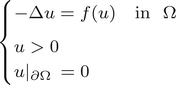 $$\left\{ {\matrix{ {-\Delta u = f(u){\rm in}\;\;\Omega } \hfill \hfill \hfill \hfill \cr {u > 0} \hfill \hfill \hfill \hfill \hfill \hfill \hfill \hfill \hfill \hfill \hfill \hfill \hfill \hfill \hfill \hfill \hfill \hfill \cr {u \vert_{\partial \Omega } = 0} \cr } } \right.$$ ${\open R}^N \setminus \Omega $ is a bounded regular domain. The existence of a bound state solution is established in situations where this problem does not have a ground state.

Spectral transitions for Aharonov-Bohm Laplacians on conical layers
- Part of
-
- Journal:
- Proceedings of the Royal Society of Edinburgh. Section A: Mathematics / Volume 149 / Issue 6 / December 2019
- Published online by Cambridge University Press:
- 26 January 2019, pp. 1663-1687
- Print publication:
- December 2019
-
- Article
- Export citation
A new test for asphericity and diagrammatic reducibility of group presentations
- Part of
-
- Journal:
- Proceedings of the Royal Society of Edinburgh. Section A: Mathematics / Volume 150 / Issue 2 / April 2020
- Published online by Cambridge University Press:
- 26 January 2019, pp. 871-895
- Print publication:
- April 2020
-
- Article
- Export citation
Frame and direction mappings for surfaces in ℝ3
- Part of
-
- Journal:
- Proceedings of the Royal Society of Edinburgh. Section A: Mathematics / Volume 149 / Issue 3 / June 2019
- Published online by Cambridge University Press:
- 26 January 2019, pp. 795-830
- Print publication:
- June 2019
-
- Article
- Export citation
Estimates for the order of Nevanlinna matrices and a Berezanskii-type theorem
- Part of
-
- Journal:
- Proceedings of the Royal Society of Edinburgh. Section A: Mathematics / Volume 149 / Issue 6 / December 2019
- Published online by Cambridge University Press:
- 26 January 2019, pp. 1637-1661
- Print publication:
- December 2019
-
- Article
- Export citation
On higher differentiability of solutions of parabolic systems with discontinuous coefficients and (p, q)-growth
- Part of
-
- Journal:
- Proceedings of the Royal Society of Edinburgh. Section A: Mathematics / Volume 150 / Issue 1 / February 2020
- Published online by Cambridge University Press:
- 26 January 2019, pp. 419-451
- Print publication:
- February 2020
-
- Article
- Export citation
-
We consider weak solutions $u:\Omega _T\to {\open R}^N$ to parabolic systems of the typewhere the function a(x, t, ξ) satisfies (p, q)-growth conditions. We give an a priori estimate for weak solutions in the case of possibly discontinuous coefficients. More precisely, the partial maps
 $$u_t-{\rm div}\;a(x,t,Du) = 0\quad {\rm in}\;\Omega _T = \Omega \times (0,T),$$ $x\mapsto a(x,t,\xi )$ under consideration may not be continuous, but may only possess a Sobolev-type regularity. In a certain sense, our assumption means that the weak derivatives $D_xa(\cdot ,\cdot ,\xi )$ are contained in the class $L^\alpha (0,T;L^\beta (\Omega ))$, where the integrability exponents $\alpha ,\beta $ are coupled byfor some κ ∈ (0,1). For the gap between the two growth exponents we assume
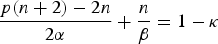 $$\displaystyle{{p(n + 2)-2n} \over {2\alpha }} + \displaystyle{n \over \beta } = 1-\kappa $$Under further assumptions on the integrability of the spatial gradient, we prove a result on higher differentiability in space as well as the existence of a weak time derivative
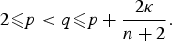 $$2 \les p < q \les p + \displaystyle{{2\kappa } \over {n + 2}}.$$ $u_t\in L^{p/(q-1)}_{{\rm loc}}(\Omega _T)$. We use the corresponding a priori estimate to deduce the existence of solutions of Cauchy–Dirichlet problems with the mentioned higher differentiability property.


Boardman–Vogt tensor products of absolutely free operads
- Part of
-
- Journal:
- Proceedings of the Royal Society of Edinburgh. Section A: Mathematics / Volume 150 / Issue 1 / February 2020
- Published online by Cambridge University Press:
- 26 January 2019, pp. 367-385
- Print publication:
- February 2020
-
- Article
- Export citation
Evolutes and focal surfaces of framed immersions in the Euclidean space
- Part of
-
- Journal:
- Proceedings of the Royal Society of Edinburgh. Section A: Mathematics / Volume 150 / Issue 1 / February 2020
- Published online by Cambridge University Press:
- 26 January 2019, pp. 497-516
- Print publication:
- February 2020
-
- Article
- Export citation
An application of the theorem on Sums to viscosity solutions of degenerate fully nonlinear equations
- Part of
-
- Journal:
- Proceedings of the Royal Society of Edinburgh. Section A: Mathematics / Volume 150 / Issue 2 / April 2020
- Published online by Cambridge University Press:
- 26 January 2019, pp. 975-992
- Print publication:
- April 2020
-
- Article
- Export citation
Nodal solutions for the fractional Yamabe problem on Heisenberg groups
- Part of
-
- Journal:
- Proceedings of the Royal Society of Edinburgh. Section A: Mathematics / Volume 150 / Issue 2 / April 2020
- Published online by Cambridge University Press:
- 26 January 2019, pp. 771-788
- Print publication:
- April 2020
-
- Article
- Export citation
-
We prove that the fractional Yamabe equation ${\rm {\cal L}}_\gamma u = \vert u \vert ^{((4\gamma )/(Q-2\gamma ))}u$ on the Heisenberg group ℍn has [n + 1/2] sequences of nodal (sign-changing) weak solutions whose elements have mutually different nodal properties, where ${\rm {\cal L}}_\gamma $ denotes the CR fractional sub-Laplacian operator on ℍn, Q = 2n + 2 is the homogeneous dimension of ℍn, and $\gamma \in \bigcup\nolimits_{k = 1}^n [k,((kQ)/Q-1)))$. Our argument is variational, based on a Ding-type conformal pulling-back transformation of the original problem into a problem on the CR sphere S2n + 1 combined with a suitable Hebey-Vaugon-type compactness result and group-theoretical constructions for special subgroups of the unitary group U(n + 1).

Characterization of fundamental networks
- Part of
-
- Journal:
- Proceedings of the Royal Society of Edinburgh. Section A: Mathematics / Volume 150 / Issue 1 / February 2020
- Published online by Cambridge University Press:
- 26 January 2019, pp. 453-474
- Print publication:
- February 2020
-
- Article
- Export citation
