Refine search
Actions for selected content:
26063 results in Abstract analysis
Quantitative estimates for bending energies and applications to non-local variational problems
- Part of
-
- Journal:
- Proceedings of the Royal Society of Edinburgh. Section A: Mathematics / Volume 150 / Issue 1 / February 2020
- Published online by Cambridge University Press:
- 23 January 2019, pp. 131-169
- Print publication:
- February 2020
-
- Article
- Export citation
Fatou components and singularities of meromorphic functions
- Part of
-
- Journal:
- Proceedings of the Royal Society of Edinburgh. Section A: Mathematics / Volume 150 / Issue 2 / April 2020
- Published online by Cambridge University Press:
- 23 January 2019, pp. 633-654
- Print publication:
- April 2020
-
- Article
- Export citation
-
We prove several results concerning the relative position of points in the postsingular set P(f) of a meromorphic map f and the boundary of a Baker domain or the successive iterates of a wandering component. For Baker domains we answer a question of Mihaljević-Brandt and Rempe-Gillen. For wandering domains we show that if the iterates Un of such a domain have uniformly bounded diameter, then there exists a sequence of postsingular values pn such that ${\rm dist} (p_n, U_n)\to 0$ as $n\to \infty $. We also prove that if $U_n \cap P(f)=\emptyset $ and the postsingular set of f lies at a positive distance from the Julia set (in ℂ), then the sequence of iterates of any wandering domain must contain arbitrarily large disks. This allows to exclude the existence of wandering domains for some meromorphic maps with infinitely many poles and unbounded set of singular values.

Multiplicity and concentration results for a fractional Schrödinger-Poisson type equation with magnetic field
- Part of
-
- Journal:
- Proceedings of the Royal Society of Edinburgh. Section A: Mathematics / Volume 150 / Issue 2 / April 2020
- Published online by Cambridge University Press:
- 23 January 2019, pp. 655-694
- Print publication:
- April 2020
-
- Article
- Export citation
-
This paper is devoted to the study of fractional Schrödinger-Poisson type equations with magnetic field of the type
where ε > 0 is a parameter, s, t ∈ (0, 1) are such that 2s+2t>3, A:ℝ3 → ℝ3 is a smooth magnetic potential, (−Δ)As is the fractional magnetic Laplacian, V:ℝ3 → ℝ is a continuous electric potential and f:ℝ → ℝ is a C1 subcritical nonlinear term. Using variational methods, we obtain the existence, multiplicity and concentration of nontrivial solutions for e > 0 small enough. $$\varepsilon^{2s}(-\Delta)_{A/\varepsilon}^{s}u + V(x)u + {\rm e}^{-2t}(\vert x \vert^{2t-3} \ast \vert u\vert ^{2})u = f(\vert u \vert^{2})u \quad \hbox{in} \ \open{R}^{3},$$
Twists and shear maps in nonlinear elasticity: explicit solutions and vanishing Jacobians
- Part of
-
- Journal:
- Proceedings of the Royal Society of Edinburgh. Section A: Mathematics / Volume 150 / Issue 1 / February 2020
- Published online by Cambridge University Press:
- 23 January 2019, pp. 41-71
- Print publication:
- February 2020
-
- Article
- Export citation
-
In this paper we study constrained variational problems that are principally motivated by nonlinear elasticity theory. We examine, in particular, the relationship between the positivity of the Jacobian det ∇u and the uniqueness and regularity of energy minimizers u that are either twist maps or shear maps. We exhibit explicit twist maps, defined on two-dimensional annuli, that are stationary points of an appropriate energy functional and whose Jacobian vanishes on a set of positive measure in the annulus. Within the class of shear maps we precisely characterize the unique global energy minimizer $u_{\sigma }: \Omega \to {\open R}^2$ in a model, two-dimensional case. We exploit the Jacobian constraint $\det \nabla u_{\sigma} \gt 0$ a.e. to obtain regularity results that apply ‘up to the boundary’ of domains with corners. It is shown that the unique shear map minimizer has the properties that (i) $\det \nabla u_{\sigma }$ is strictly positive on one part of the domain Ω, (ii) $\det \nabla u_{\sigma } = 0$ necessarily holds on the rest of Ω, and (iii) properties (i) and (ii) combine to ensure that $\nabla u_{\sigma }$ is not continuous on the whole domain.


Existence of bistable waves for a nonlocal and nonmonotone reaction-diffusion equation
- Part of
-
- Journal:
- Proceedings of the Royal Society of Edinburgh. Section A: Mathematics / Volume 150 / Issue 2 / April 2020
- Published online by Cambridge University Press:
- 23 January 2019, pp. 721-739
- Print publication:
- April 2020
-
- Article
- Export citation
Explicit asymptotics for certain single and double exponential sums
- Part of
-
- Journal:
- Proceedings of the Royal Society of Edinburgh. Section A: Mathematics / Volume 150 / Issue 2 / April 2020
- Published online by Cambridge University Press:
- 22 January 2019, pp. 607-632
- Print publication:
- April 2020
-
- Article
- Export citation
Classification of knotted tori
- Part of
-
- Journal:
- Proceedings of the Royal Society of Edinburgh. Section A: Mathematics / Volume 150 / Issue 2 / April 2020
- Published online by Cambridge University Press:
- 22 January 2019, pp. 549-567
- Print publication:
- April 2020
-
- Article
- Export citation
Long-time asymptotic expansions for Navier-Stokes equations with power-decaying forces
- Part of
-
- Journal:
- Proceedings of the Royal Society of Edinburgh. Section A: Mathematics / Volume 150 / Issue 2 / April 2020
- Published online by Cambridge University Press:
- 22 January 2019, pp. 569-606
- Print publication:
- April 2020
-
- Article
- Export citation
A CLASS OF CRITICAL KIRCHHOFF PROBLEM ON THE HYPERBOLIC SPACE $\mathbb{H}^{{\it n}}$
- Part of
-
- Journal:
- Glasgow Mathematical Journal / Volume 62 / Issue 1 / January 2020
- Published online by Cambridge University Press:
- 21 January 2019, pp. 109-122
-
- Article
-
- You have access
- Export citation
-
We investigate questions on the existence of nontrivial solution for a class of the critical Kirchhoff-type problems in Hyperbolic space. By the use of the stereographic projection the problem becomes a singular problem on the boundary of the open ball $B_1(0)\subset \mathbb{R}^n$ Combining a version of the Hardy inequality, due to Brezis–Marcus, with the mountain pass theorem due to Ambrosetti–Rabinowitz are used to obtain the nontrivial solution. One of the difficulties is to find a range where the Palais Smale converges, because our equation involves a nonlocal term coming from the Kirchhoff term.


Optimal growth of harmonic functions frequently hypercyclic for the partial differentiation operator
- Part of
-
- Journal:
- Proceedings of the Royal Society of Edinburgh. Section A: Mathematics / Volume 149 / Issue 6 / December 2019
- Published online by Cambridge University Press:
- 18 January 2019, pp. 1577-1594
- Print publication:
- December 2019
-
- Article
- Export citation
On critical exponents of a k-Hessian equation in the whole space
- Part of
-
- Journal:
- Proceedings of the Royal Society of Edinburgh. Section A: Mathematics / Volume 149 / Issue 6 / December 2019
- Published online by Cambridge University Press:
- 18 January 2019, pp. 1555-1575
- Print publication:
- December 2019
-
- Article
- Export citation
-
In this paper, we study negative classical solutions and stable solutions of the following k-Hessian equation
with radial structure, where n ⩾ 3, 1 < k < n/2 and p > 1. This equation is related to the extremal functions of the Hessian Sobolev inequality on the whole space. Several critical exponents including the Serrin type, the Sobolev type, and the Joseph-Lundgren type, play key roles in studying existence and decay rates. We believe that these critical exponents still come into play to research k-Hessian equations without radial structure. $$F_k(D^2V) = (-V)^p\quad {\rm in}\;\; R^n$$
LOCAL NEGATIVITY OF SURFACES WITH NON-NEGATIVE KODAIRA DIMENSION AND TRANSVERSAL CONFIGURATIONS OF CURVES
- Part of
-
- Journal:
- Glasgow Mathematical Journal / Volume 62 / Issue 1 / January 2020
- Published online by Cambridge University Press:
- 18 January 2019, pp. 123-135
-
- Article
-
- You have access
- Export citation
-
We give a bound on the H-constants of configurations of smooth curves having transversal intersection points only on an algebraic surface of non-negative Kodaira dimension. We also study in detail configurations of lines on smooth complete intersections $X \subset \mathbb{P}_{\mathbb{C}}^{n + 2}$ of multi-degree d = (d1, …, dn), and we provide a sharp and uniform bound on their H-constants, which only depends on d.

A note on rigidity theorem of λ-hypersurfaces
- Part of
-
- Journal:
- Proceedings of the Royal Society of Edinburgh. Section A: Mathematics / Volume 149 / Issue 6 / December 2019
- Published online by Cambridge University Press:
- 18 January 2019, pp. 1595-1601
- Print publication:
- December 2019
-
- Article
- Export citation
AN ALGORITHM TO CONSTRUCT THE LE DIAGRAM ASSOCIATED TO A GRASSMANN NECKLACE
- Part of
-
- Journal:
- Glasgow Mathematical Journal / Volume 62 / Issue 1 / January 2020
- Published online by Cambridge University Press:
- 18 January 2019, pp. 85-91
-
- Article
-
- You have access
- Export citation
Asymptotic behaviour as p → ∞ of least energy solutions of a (p, q(p))-Laplacian problem
- Part of
-
- Journal:
- Proceedings of the Royal Society of Edinburgh. Section A: Mathematics / Volume 149 / Issue 6 / December 2019
- Published online by Cambridge University Press:
- 17 January 2019, pp. 1493-1522
- Print publication:
- December 2019
-
- Article
- Export citation
-
We study the asymptotic behaviour, as p → ∞, of the least energy solutions of the problem
where xu is the (unique) maximum point of |u|, $$\left\{ {\matrix{ {-(\Delta _p + \Delta _{q(p)})u = \lambda _p \vert u(x_u) \vert ^{p-2}u(x_u)\delta _{x_u}} & {{\rm in}} & \Omega \cr {u = 0} \hfill \hfill \hfill & {{\rm on}} & {\partial \Omega ,} \cr } } \right.$$ $\delta _{x_{u}}$ is the Dirac delta distribution supported at xu,and λp > 0 is such that
 $$\mathop {\lim }\limits_{p\to \infty } \displaystyle{{q(p)} \over p} = Q\in \left\{ {\matrix{ {(0,1)} & {{\rm if}} & {N < q(p) < p} \cr {(1,\infty )} & {{\rm if}} & {N < p < q(p)} \cr } } \right.$$
 $$\min \left\{ {\displaystyle{{{\rm \Vert }\nabla u{\rm \Vert }_\infty } \over {{\rm \Vert }u{\rm \Vert }_\infty }}:0 \ne u\in W^{1,\infty }(\Omega )\cap C_0(\bar{\Omega })} \right\} \les \mathop {\lim }\limits_{p\to \infty } (\lambda _p)^{1/p} < \infty .$$

Codimension two spacelike submanifolds of the Lorentz-Minkowski spacetime into the light cone
- Part of
-
- Journal:
- Proceedings of the Royal Society of Edinburgh. Section A: Mathematics / Volume 149 / Issue 6 / December 2019
- Published online by Cambridge University Press:
- 17 January 2019, pp. 1523-1553
- Print publication:
- December 2019
-
- Article
- Export citation
Complete quenching phenomenon and instantaneous shrinking of support of solutions of degenerate parabolic equations with nonlinear singular absorption
- Part of
-
- Journal:
- Proceedings of the Royal Society of Edinburgh. Section A: Mathematics / Volume 149 / Issue 5 / October 2019
- Published online by Cambridge University Press:
- 17 January 2019, pp. 1323-1346
- Print publication:
- October 2019
-
- Article
- Export citation
Asymptotics for some polynomial patterns in the primes
- Part of
-
- Journal:
- Proceedings of the Royal Society of Edinburgh. Section A: Mathematics / Volume 149 / Issue 5 / October 2019
- Published online by Cambridge University Press:
- 17 January 2019, pp. 1241-1290
- Print publication:
- October 2019
-
- Article
- Export citation
-
We prove asymptotic formulae for sums of the form
where K is a convex body, each Fi is either the von Mangoldt function or the representation function of a quadratic form, and Ψ = (ψ1, …, ψt) is a system of linear forms of finite complexity. When all the functions Fi are equal to the von Mangoldt function, we recover a result of Green and Tao, while when they are all representation functions of quadratic forms, we recover a result of Matthiesen. Our formulae imply asymptotics for some polynomial patterns in the primes. For instance, they describe the asymptotic behaviour of the number of k-term arithmetic progressions of primes whose common difference is a sum of two squares.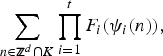 $$\sum\limits_{n\in {\open z}^d\cap K} {\prod\limits_{i = 1}^t {F_i} } (\psi _i(n)),$$
The paper combines ingredients from the work of Green and Tao on linear equations in primes and that of Matthiesen on linear correlations amongst integers represented by a quadratic form. To make the von Mangoldt function compatible with the representation function of a quadratic form, we provide a new pseudorandom majorant for both – an average of the known majorants for each of the functions – and prove that it has the required pseudorandomness properties.
Infinite multiplicity of stable entire solutions for a semilinear elliptic equation with exponential nonlinearity
- Part of
-
- Journal:
- Proceedings of the Royal Society of Edinburgh. Section A: Mathematics / Volume 149 / Issue 5 / October 2019
- Published online by Cambridge University Press:
- 17 January 2019, pp. 1371-1404
- Print publication:
- October 2019
-
- Article
- Export citation
On the classification of standing wave solutions to a coupled Schrödinger system
- Part of
-
- Journal:
- Proceedings of the Royal Society of Edinburgh. Section A: Mathematics / Volume 149 / Issue 5 / October 2019
- Published online by Cambridge University Press:
- 17 January 2019, pp. 1347-1370
- Print publication:
- October 2019
-
- Article
- Export citation
