Refine listing
Actions for selected content:
34 results in MCA Journal Article Collection
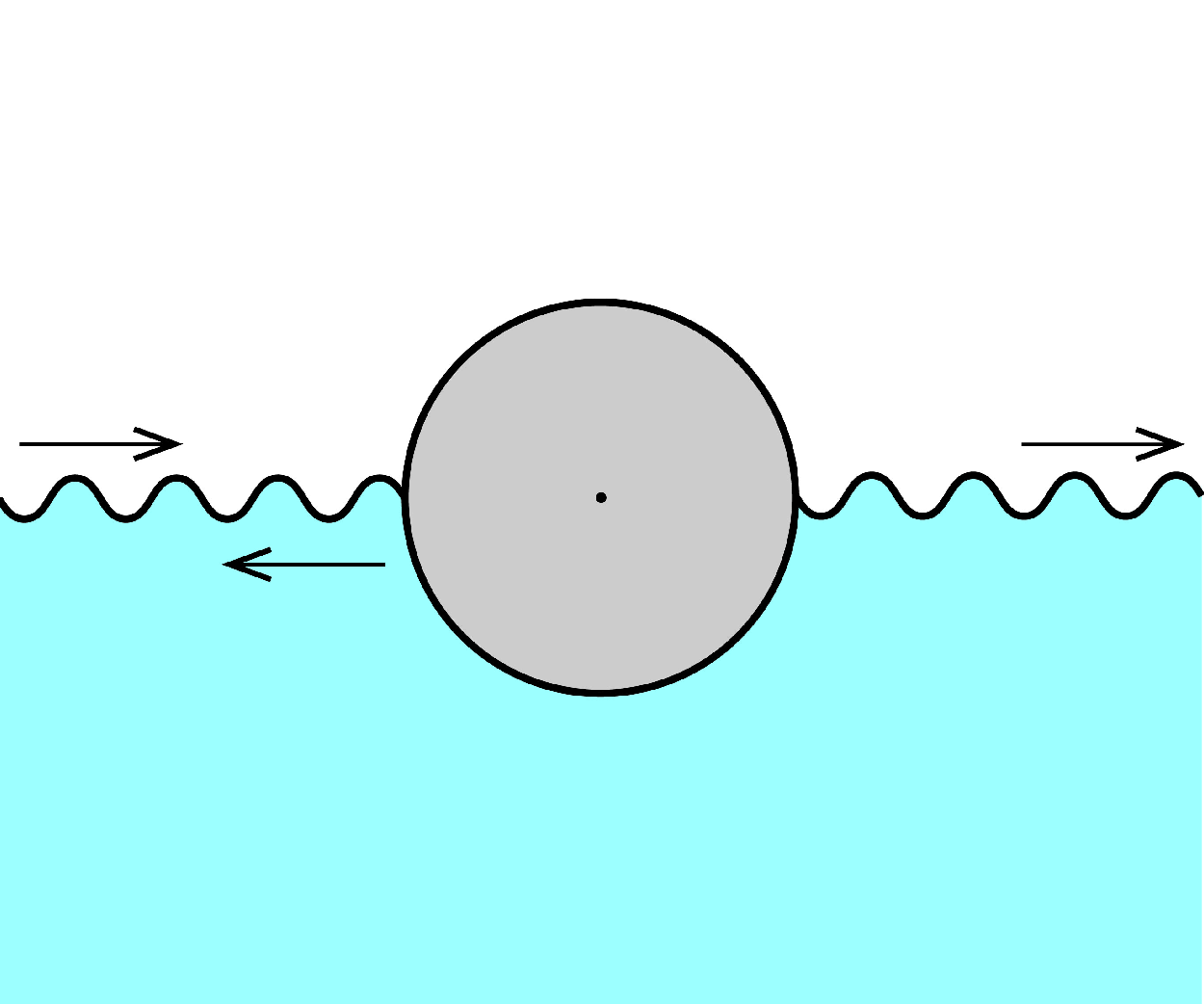
Theory of capillary-gravity wave scattering by a fixed, semi-immersed cylindrical barrier with contact line dissipation
-
- Journal:
- Journal of Fluid Mechanics / Volume 1013 / 25 June 2025
- Published online by Cambridge University Press:
- 19 June 2025, A27
-
- Article
-
- You have access
- Open access
- HTML
- Export citation
-
The scattering of surface waves by structures intersecting liquid surfaces is fundamental in fluid mechanics, with prior studies exploring gravity, capillary and capillary–gravity wave interactions. This paper develops a semi-analytical framework for capillary–gravity wave scattering by a fixed, horizontally placed, semi-immersed cylindrical barrier. Assuming linearised potential flow, the problem is formulated with differential equations, conformal mapping and Fourier transforms, resulting in a compound integral equation framework solved numerically via the Nyström method. An effective-slip dynamic contact line model accounting for viscous dissipation links contact line velocity to deviations from equilibrium contact angles, with fixed and free contact lines of no dissipation as limiting cases. The framework computes transmission and reflection coefficients as functions of the Bond number, slip coefficient and barrier radius, validating energy conservation and confirming a $90^\circ$ phase difference between transmission and reflection in specific limits. A closed-form solution for scattering by an infinitesimal barrier, derived using Fourier transforms, reveals spatial symmetry in the diffracted field, reduced transmission transitioning from gravity to capillary waves and peak contact line dissipation when the slip coefficient matches the capillary wave phase speed. This dissipation, linked to impedance matching at the contact lines, persists across a range of barrier sizes. These results advance theoretical insights into surface-tension-dominated fluid mechanics, offering a robust theoretical framework for analysing wave scattering and comparison with future experimental and numerical studies.

A study on the expansion wave diffraction over bodies – ERRATUM
-
- Journal:
- Journal of Fluid Mechanics / Volume 1013 / 25 June 2025
- Published online by Cambridge University Press:
- 19 June 2025, E2
-
- Article
-
- You have access
- HTML
- Export citation
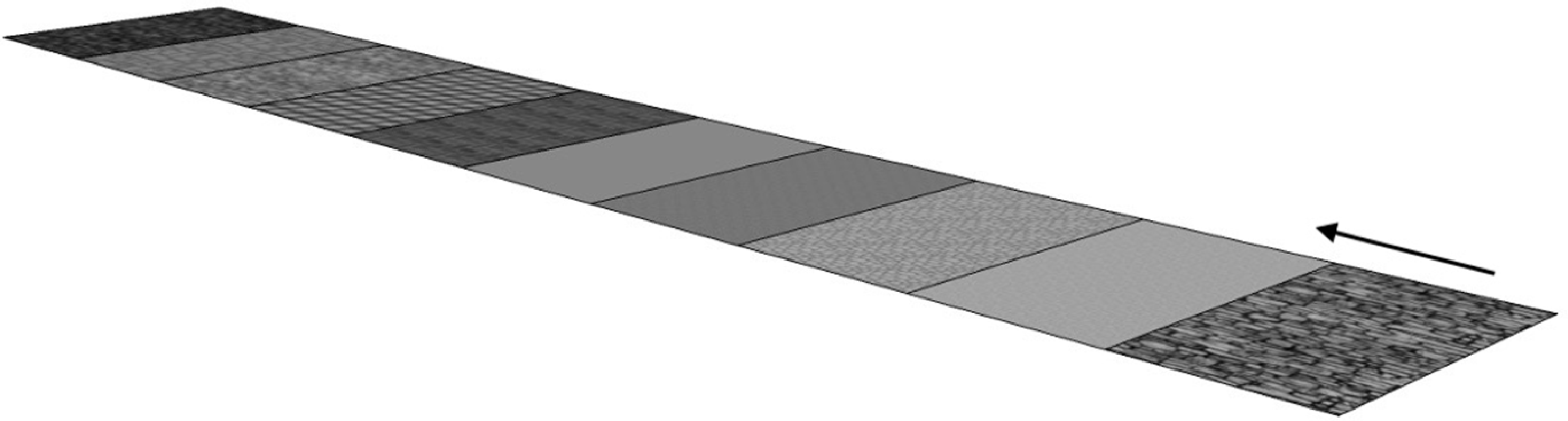
Evaluating the power mean method to determine an equivalent sandgrain roughness parameter over streamwise-heterogeneous roughness
-
- Journal:
- Flow: Applications of Fluid Mechanics / Volume 5 / 2025
- Published online by Cambridge University Press:
- 17 June 2025, E23
-
- Article
-
- You have access
- Open access
- HTML
- Export citation
-
Weighted and unweighted power mean methods are compared against the accuracy of the simple arithmetic average to estimate an equivalent sandgrain roughness parameter ( $k_{s}$) for streamwise-heterogeneous rough surfaces. Specifically, these methods are conceptually and iteratively tested on roughness plates with surface characteristics following beta ( $\beta$), uniform or Gaussian distributions. The sandgrain roughness computed using these averaging methods, $k_{s_{eq}}$, is then compared with true parameters, $k_{s_{eff}}$, estimated from the fully rough asymptote model and a modified momentum integral method that accounts for the streamwise variation of skin friction over the heterogeneous surface. The weighted power mean offers significant advantages, particularly for roughness in $\beta$ distribution, which is attributed to the distribution bias towards smaller magnitudes of $k_s$. While the advantage of using the weighted power mean over the unweighted power mean is less significant for the other surface distributions, the weighted method consistently yields the lowest discrepancy in effective drag estimates, independent of roughness configuration, and is therefore the recommended method for estimating the effective sandgrain roughness across heterogeneous surfaces.


Moduli spaces of framed logarithmic and parabolic connections on a Riemann surface
- Part of
-
- Article
-
- You have access
- Open access
- HTML
- Export citation
Reflective centers of module categories and quantum K-matrices
- Part of
-
- Journal:
- Forum of Mathematics, Sigma / Volume 13 / 2025
- Published online by Cambridge University Press:
- 16 June 2025, e95
-
- Article
-
- You have access
- Open access
- HTML
- Export citation
-
Our work is motivated by obtaining solutions to the quantum reflection equation (qRE) by categorical methods. To start, given a braided monoidal category ${\mathcal {C}}$ and ${\mathcal {C}}$-module category ${\mathcal {M}}$, we introduce a version of the Drinfeld center ${\mathcal {Z}}({\mathcal {C}})$ of ${\mathcal {C}}$ adapted for ${\mathcal {M}}$; we refer to this category as the reflective center ${\mathcal {E}}_{\mathcal {C}}({\mathcal {M}})$ of ${\mathcal {M}}$. Just like ${\mathcal {Z}}({\mathcal {C}})$ is a canonical braided monoidal category attached to ${\mathcal {C}}$, we show that ${\mathcal {E}}_{\mathcal {C}}({\mathcal {M}})$ is a canonical braided module category attached to ${\mathcal {M}}$; its properties are investigated in detail.
Our second goal pertains to when ${\mathcal {C}}$ is the category of modules over a quasitriangular Hopf algebra H, and ${\mathcal {M}}$ is the category of modules over an H-comodule algebra A. We show that the reflective center ${\mathcal {E}}_{\mathcal {C}}({\mathcal {M}})$ here is equivalent to a category of modules over an explicit algebra, denoted by $R_H(A)$, which we call the reflective algebra of A. This result is akin to ${\mathcal {Z}}({\mathcal {C}})$ being represented by the Drinfeld double ${\operatorname {Drin}}(H)$ of H. We also study the properties of reflective algebras.
Our third set of results is also in the Hopf setting above. We show that reflective algebras are quasitriangular H-comodule algebras, and we examine their corresponding quantum K-matrices; this yields solutions to the qRE. We also establish that the reflective algebra $R_H(\mathbb {k})$ is an initial object in the category of quasitriangular H-comodule algebras, where $\mathbb {k}$ is the ground field. The case when H is the Drinfeld double of a finite group is illustrated.


Rotation groups virtually embed into right-angled rotation groups
- Part of
-
- Journal:
- Canadian Journal of Mathematics , First View
- Published online by Cambridge University Press:
- 16 June 2025, pp. 1-25
-
- Article
- Export citation
A WALK ON THE WILD SIDE: NOTIONS OF MAXIMALITY IN FIRST-ORDER THEORIES
- Part of
-
- Journal:
- The Journal of Symbolic Logic , First View
- Published online by Cambridge University Press:
- 13 June 2025, pp. 1-31
-
- Article
- Export citation
-
In the classification of complete first-order theories, many dividing lines have been defined in order to understand the complexity and the behavior of some classes of theories. In this paper, using the concept of patterns of consistency and inconsistency, we describe a general framework to study dividing lines and introduce a notion of maximal complexity by requesting the presence of all the exhibitable patterns of definable sets. Weakening this notion, we define new properties (Positive Maximality and the $\mathrm {PM}^{(k)}$ hierarchy) and prove some results about them. In particular, we show that $\mathrm {PM}^{(k+1)}$ theories are not k-dependent. Moreover, we provide an example of a $\mathrm {PM}$ but $\mathrm {NSOP}_4$ theory (showing that $\mathrm {SOP}$ and the $\mathrm {SOP}_n$ hierarchy, for $n \geq 4$, cannot be described by positive patterns) and, for each $1<k<\omega $, an example of a $\mathrm {PM}^{(k)}$ but $\mathrm {NPM}^{(k+1)}$ theory (showing that the newly defined hierarchy does not collapse).


A model of the Axiom of Determinacy in which every set of reals is universally Baire
- Part of
-
- Journal:
- Forum of Mathematics, Sigma / Volume 13 / 2025
- Published online by Cambridge University Press:
- 11 June 2025, e94
-
- Article
-
- You have access
- Open access
- HTML
- Export citation
-
The consistency of the theory $\mathsf {ZF} + \mathsf {AD}_{\mathbb {R}} + {}$‘every set of reals is universally Baire’ is proved relative to $\mathsf {ZFC} + {}$‘there is a cardinal that is a limit of Woodin cardinals and of strong cardinals’. The proof is based on the derived model construction, which was used by Woodin to show that the theory $\mathsf {ZF} + \mathsf {AD}_{\mathbb {R}} + {}$‘every set of reals is Suslin’ is consistent relative to $\mathsf {ZFC} + {}$‘there is a cardinal $\lambda $ that is a limit of Woodin cardinals and of $\mathord {<}\lambda $-strong cardinals’. The $\Sigma ^2_1$ reflection property of our model is proved using genericity iterations as in Neeman [18] and Steel [22].


Critical scaling profile for trees and connected subgraphs on the complete graph
- Part of
-
- Journal:
- Canadian Mathematical Bulletin , First View
- Published online by Cambridge University Press:
- 11 June 2025, pp. 1-16
-
- Article
-
- You have access
- Open access
- HTML
- Export citation
-
We analyze generating functions for trees and for connected subgraphs on the complete graph, and identify a single scaling profile which applies for both generating functions in a critical window. Our motivation comes from the analysis of the finite-size scaling of lattice trees and lattice animals on a high-dimensional discrete torus, for which we conjecture that the identical profile applies in dimensions $d \ge 8$.

On Dirichlet non-improvable numbers and shrinking target problems
- Part of
-
- Journal:
- Ergodic Theory and Dynamical Systems / Volume 45 / Issue 11 / November 2025
- Published online by Cambridge University Press:
- 11 June 2025, pp. 3540-3568
- Print publication:
- November 2025
-
- Article
- Export citation
-
In one-dimensional Diophantine approximation, the Diophantine properties of a real number are characterized by its partial quotients, especially the growth of its large partial quotients. Notably, Kleinbock and Wadleigh [Proc. Amer. Math. Soc. 146(5) (2018), 1833–1844] made a seminal contribution by linking the improvability of Dirichlet’s theorem to the growth of the product of consecutive partial quotients. In this paper, we extend the concept of Dirichlet non-improvable sets within the framework of shrinking target problems. Specifically, consider the dynamical system $([0,1), T)$ of continued fractions. Let $\{z_n\}_{n \ge 1}$ be a sequence of real numbers in $[0,1]$ and let $B> 1$. We determine the Hausdorff dimension of the following set: $ \{x\in [0,1):|T^nx-z_n||T^{n+1}x-Tz_n|<B^{-n}\text { infinitely often}\}. $


 $B_h$-sets of real and complex numbers
- Part of
-
- Journal:
- Canadian Mathematical Bulletin / Volume 69 / Issue 1 / March 2026
- Published online by Cambridge University Press:
- 11 June 2025, pp. 137-141
- Print publication:
- March 2026
-
- Article
- Export citation
-
Let $K = \mathbf {R}$ or $\mathbf {C}$. An n-element subset A of K is a $B_h$-set if every element of K has at most one representation as the sum of h not necessarily distinct elements of A. Associated with the $B_h$-set $A = \{a_1,\ldots , a_n\}$ are the $B_h$-vectors $\mathbf {a} = (a_1,\ldots , a_n)$ in $K^n$. This article proves that “almost all” n-element subsets of K are $B_h$-sets in the sense that the set of all $B_h$-vectors is a dense open subset of $K^n$.


ON PRODUCTS OF ULTRAFILTERS
- Part of
-
- Journal:
- The Journal of Symbolic Logic , First View
- Published online by Cambridge University Press:
- 09 June 2025, pp. 1-17
-
- Article
- Export citation
-
Assuming the Generalized Continuum hypothesis, this paper answers the question: when is the tensor product of two ultrafilters equal to their Cartesian product? It is necessary and sufficient that their Cartesian product is an ultrafilter; that the two ultrafilters commute in the tensor product; that for all cardinals $\lambda $, one of the ultrafilters is both $\lambda $-indecomposable and $\lambda ^+$-indecomposable; that the ultrapower embedding associated with each ultrafilter restricts to a definable embedding of the ultrapower of the universe associated with the other.


DOUGLAS–RACHFORD ALGORITHM FOR OPTIMAL CONTROL PROBLEMS
- Part of
-
- Journal:
- Bulletin of the Australian Mathematical Society / Volume 112 / Issue 2 / October 2025
- Published online by Cambridge University Press:
- 09 June 2025, pp. 392-393
- Print publication:
- October 2025
-
- Article
-
- You have access
- HTML
- Export citation
Isometric rigidity of the Wasserstein space over the plane with the maximum metric
- Part of
-
- Journal:
- Canadian Journal of Mathematics , First View
- Published online by Cambridge University Press:
- 09 June 2025, pp. 1-30
-
- Article
-
- You have access
- Open access
- HTML
- Export citation
-
We study p-Wasserstein spaces over the branching spaces $\mathbb {R}^2$ and $[-1,1]^2$ equipped with the maximum norm metric. We show that these spaces are isometrically rigid for all $p\geq 1,$ meaning that all isometries of these spaces are induced by isometries of the underlying space via the push-forward operation. This is in contrast to the case of the Euclidean metric since with that distance the $2$-Wasserstein space over $\mathbb {R}^2$ is not rigid. Also, we highlight that the $1$-Wasserstein space is not rigid over the closed interval $[-1,1]$, while according to our result, its two-dimensional analog, the closed unit ball $[-1,1]^2$ with the more complicated geodesic structure is rigid.


Assessment of mixing efficiency of thermally driven microfluidic swirlers
- Part of
-
- Journal:
- Flow: Applications of Fluid Mechanics / Volume 5 / 2025
- Published online by Cambridge University Press:
- 09 June 2025, E21
-
- Article
-
- You have access
- Open access
- HTML
- Export citation
-
In this study, we examine the mixing performance of thermally induced microfluidic swirlers, which are recently developed micromixers based on mixed thermal convection. In this configuration, a swirling flow motion is induced by the combination of natural convection and a pressure-driven Poiseuille flow. An experimental investigation was carried out on a microfluidic swirler composed of a glass capillary with a square cross-section of 800 $\times$ 800 $\unicode {x03BC}$m $^2$, measuring the three-dimensional flow fields in different operating conditions using the general defocusing particle tracking technique. Furthermore, a thorough numerical analysis was performed to characterise the mixing performance for different Reynolds numbers and microchannel dimensions. Our results show that thermally induced microfluidic swirlers have an optimal range of operation for microchannel with hydraulic diameters between 400 and 1600 $\unicode {x03BC}$m and Reynolds numbers around 1, where they show an increase of mixing efficiency up to 60 % with respect to the case of pure diffusion. The swirl is activated already at moderate temperature differences of 20–30 K, making this approach compatible with most chemical and biomedical applications.


On quasiconformal non-equivalence of gasket Julia sets and limit sets
- Part of
-
- Journal:
- Ergodic Theory and Dynamical Systems / Volume 45 / Issue 11 / November 2025
- Published online by Cambridge University Press:
- 09 June 2025, pp. 3465-3489
- Print publication:
- November 2025
-
- Article
- Export citation
REDUCING TYPE 1 CHILDHOOD DIABETES IN SAUDI ARABIA BY IDENTIFYING AND MODELLING ITS KEY PERFORMANCE INDICATORS
- Part of
-
- Journal:
- Bulletin of the Australian Mathematical Society / Volume 112 / Issue 3 / December 2025
- Published online by Cambridge University Press:
- 09 June 2025, pp. 574-576
- Print publication:
- December 2025
-
- Article
-
- You have access
- HTML
- Export citation
IMPROVED LOWER BOUNDS FOR STRONG n-CONJECTURES
- Part of
-
- Journal:
- Journal of the Australian Mathematical Society / Volume 119 / Issue 1 / August 2025
- Published online by Cambridge University Press:
- 02 June 2025, pp. 61-81
-
- Article
-
- You have access
- Open access
- HTML
- Export citation
-
The well-known $abc$-conjecture concerns triples $(a,b,c)$ of nonzero integers that are coprime and satisfy ${a+b+c=0}$. The strong n-conjecture is a generalisation to n summands where integer solutions of the equation ${a_1 + \cdots + a_n = 0}$ are considered such that the $a_i$ are pairwise coprime and satisfy a certain subsum condition. Ramaekers studied a variant of this conjecture with a slightly different set of conditions. He conjectured that in this setting the limit superior of the so-called qualities of the admissible solutions equals $1$ for any n. In this paper, we follow results of Konyagin and Browkin. We restrict to a smaller, and thus more demanding, set of solutions, and improve the known lower bounds on the limit superior: for ${n \geq 6}$ we achieve a lower bound of $\frac 54$; for odd $n \geq 5$ we even achieve $\frac 53$. In particular, Ramaekers’ conjecture is false for every ${n \ge 5}$.


INFLUENCE OF NOISE-INDUCED MODULATIONS ON THE TIMING STABILITY OF PASSIVELY MODE-LOCKED SEMICONDUCTOR LASER SUBJECT TO OPTICAL FEEDBACK
- Part of
-
- Journal:
- The ANZIAM Journal / Volume 67 / 2025
- Published online by Cambridge University Press:
- 29 May 2025, e22
-
- Article
- Export citation
ALPHA–DELTA TRANSITIONS IN CORTICAL RHYTHMS AS GRAZING BIFURCATIONS
- Part of
-
- Journal:
- The ANZIAM Journal / Volume 67 / 2025
- Published online by Cambridge University Press:
- 21 May 2025, e21
-
- Article
-
- You have access
- Open access
- HTML
- Export citation
