Refine listing
Actions for selected content:
387 results in 37Axx
Exponential mixing of frame flows for convex cocompact hyperbolic manifolds
- Part of
-
- Journal:
- Compositio Mathematica / Volume 157 / Issue 12 / December 2021
- Published online by Cambridge University Press:
- 08 November 2021, pp. 2585-2634
- Print publication:
- December 2021
-
- Article
- Export citation
Equidistribution of horospheres in non-positive curvature
- Part of
-
- Journal:
- Ergodic Theory and Dynamical Systems / Volume 43 / Issue 2 / February 2023
- Published online by Cambridge University Press:
- 28 October 2021, pp. 460-479
- Print publication:
- February 2023
-
- Article
-
- You have access
- Open access
- HTML
- Export citation
Host–Kra theory for $\bigoplus _{p\in P}{\mathbb {F}}_p$-systems and multiple recurrence
- Part of
-
- Journal:
- Ergodic Theory and Dynamical Systems / Volume 43 / Issue 1 / January 2023
- Published online by Cambridge University Press:
- 25 October 2021, pp. 299-360
- Print publication:
- January 2023
-
- Article
- Export citation
-
Let $\mathcal {P}$ be an (unbounded) countable multiset of primes (that is, every prime may appear multiple times) and let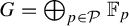 $G=\bigoplus _{p\in \mathcal {P}}\mathbb {F}_p$. We develop a Host–Kra structure theory for the universal characteristic factors of an ergodic G-system. More specifically, we generalize the main results of Bergelson, Tao and Ziegler [An inverse theorem for the uniformity seminorms associated with the action of $\mathbb {F}_p^\infty $. Geom. Funct. Anal. 19(6) (2010), 1539–1596], who studied these factors in the special case $\mathcal {P}=\{p,p,p,\ldots \}$ for some fixed prime p. As an application we deduce a Khintchine-type recurrence theorem in the flavor of Bergelson, Tao and Ziegler [Multiple recurrence and convergence results associated to $F_p^\omega $-actions. J. Anal. Math. 127 (2015), 329–378] and Bergelson, Host and Kra [Multiple recurrence and nilsequences. Invent. Math. 160(2) (2005), 261–303, with an appendix by I. Ruzsa].


Effective equidistribution for generalized higher-step nilflows
- Part of
-
- Journal:
- Ergodic Theory and Dynamical Systems / Volume 42 / Issue 12 / December 2022
- Published online by Cambridge University Press:
- 25 October 2021, pp. 3656-3715
- Print publication:
- December 2022
-
- Article
- Export citation
Twisted cohomological equations for translation flows
- Part of
-
- Journal:
- Ergodic Theory and Dynamical Systems / Volume 42 / Issue 3 / March 2022
- Published online by Cambridge University Press:
- 22 October 2021, pp. 881-916
- Print publication:
- March 2022
-
- Article
- Export citation
-
We prove by methods of harmonic analysis a result on the existence of solutions for twisted cohomological equations on translation surfaces with loss of derivatives at most $3+$ in Sobolev spaces. As a consequence we prove that product translation flows on (three-dimensional) translation manifolds which are products of a (higher-genus) translation surface with a (flat) circle are stable in the sense of A. Katok. In turn, our result on product flows implies a stability result of time- $\tau $ maps of translation flows on translation surfaces.


Non-uniform ergodic properties of Hamiltonian flows with impacts
- Part of
-
- Journal:
- Ergodic Theory and Dynamical Systems / Volume 43 / Issue 1 / January 2023
- Published online by Cambridge University Press:
- 20 October 2021, pp. 190-252
- Print publication:
- January 2023
-
- Article
- Export citation
-
The ergodic properties of two uncoupled oscillators, one horizontal and one vertical, residing in a class of non-rectangular star-shaped polygons with only vertical and horizontal boundaries and impacting elastically from its boundaries are studied. We prove that the iso-energy level sets topology changes non-trivially; the flow on level sets is always conjugated to a translation flow on a translation surface, yet, for some segments of partial energies the genus of the surface is strictly greater than $1$. When at least one of the oscillators is unharmonic, or when both are harmonic and non-resonant, we prove that for almost all partial energies, including the impacting ones, the flow on level sets is uniquely ergodic. When both oscillators are harmonic and resonant, we prove that there exist intervals of partial energies on which periodic ribbons and additional ergodic components coexist. We prove that for almost all partial energies in such segments the motion is uniquely ergodic on the part of the level set that is not occupied by the periodic ribbons. This implies that ergodic averages project to piecewise smooth weighted averages in the configuration space.

Packing topological entropy for amenable group actions
- Part of
-
- Journal:
- Ergodic Theory and Dynamical Systems / Volume 43 / Issue 2 / February 2023
- Published online by Cambridge University Press:
- 20 October 2021, pp. 480-514
- Print publication:
- February 2023
-
- Article
- Export citation
-
Packing topological entropy is a dynamical analogy of the packing dimension, which can be viewed as a counterpart of Bowen topological entropy. In the present paper we give a systematic study of the packing topological entropy for a continuous G-action dynamical system $(X,G)$, where X is a compact metric space and G is a countable infinite discrete amenable group. We first prove a variational principle for amenable packing topological entropy: for any Borel subset Z of X, the packing topological entropy of Z equals the supremum of upper local entropy over all Borel probability measures for which the subset Z has full measure. Then we obtain an entropy inequality concerning amenable packing entropy. Finally, we show that the packing topological entropy of the set of generic points for any invariant Borel probability measure $\mu $ coincides with the metric entropy if either $\mu $ is ergodic or the system satisfies a kind of specification property.


Cocycles on groupoids arising from $\mathbb {N}^k$-actions
- Part of
-
- Journal:
- Ergodic Theory and Dynamical Systems / Volume 42 / Issue 11 / November 2022
- Published online by Cambridge University Press:
- 18 October 2021, pp. 3325-3356
- Print publication:
- November 2022
-
- Article
-
- You have access
- Open access
- HTML
- Export citation
-
We consider groupoids constructed from a finite number of commuting local homeomorphisms acting on a compact metric space and study generalized Ruelle operators and $ C^{\ast } $-algebras associated to these groupoids. We provide a new characterization of $ 1 $-cocycles on these groupoids taking values in a locally compact abelian group, given in terms of $ k $-tuples of continuous functions on the unit space satisfying certain canonical identities. Using this, we develop an extended Ruelle–Perron–Frobenius theory for dynamical systems of several commuting operators ( $ k $-Ruelle triples and commuting Ruelle operators). Results on KMS states on $ C^{\ast } $-algebras constructed from these groupoids are derived. When the groupoids being studied come from higher-rank graphs, our results recover existence and uniqueness results for KMS states associated to the graphs.


Loosely Bernoulli odometer-based systems whose corresponding circular systems are not loosely Bernoulli
- Part of
-
- Journal:
- Ergodic Theory and Dynamical Systems / Volume 42 / Issue 3 / March 2022
- Published online by Cambridge University Press:
- 01 October 2021, pp. 917-973
- Print publication:
- March 2022
-
- Article
- Export citation
-
Foreman and Weiss [Measure preserving diffeomorphisms of the torus are unclassifiable. Preprint, 2020, arXiv:1705.04414] obtained an anti-classification result for smooth ergodic diffeomorphisms, up to measure isomorphism, by using a functor $\mathcal {F}$ (see [Foreman and Weiss, From odometers to circular systems: a global structure theorem. J. Mod. Dyn. 15 (2019), 345–423]) mapping odometer-based systems, $\mathcal {OB}$, to circular systems, $\mathcal {CB}$. This functor transfers the classification problem from $\mathcal {OB}$ to $\mathcal {CB}$, and it preserves weakly mixing extensions, compact extensions, factor maps, the rank-one property, and certain types of isomorphisms. Thus it is natural to ask whether $\mathcal {F}$ preserves other dynamical properties. We show that $\mathcal {F}$ does not preserve the loosely Bernoulli property by providing positive and zero-entropy examples of loosely Bernoulli odometer-based systems whose corresponding circular systems are not loosely Bernoulli. We also construct a loosely Bernoulli circular system whose corresponding odometer-based system has zero entropy and is not loosely Bernoulli.


Rigidity properties for commuting automorphisms on tori and solenoids
- Part of
-
- Journal:
- Ergodic Theory and Dynamical Systems / Volume 42 / Issue 2 / February 2022
- Published online by Cambridge University Press:
- 08 September 2021, pp. 691-736
- Print publication:
- February 2022
-
- Article
-
- You have access
- Open access
- HTML
- Export citation
Subgeometric ergodicity and β-mixing
- Part of
-
- Journal:
- Journal of Applied Probability / Volume 58 / Issue 3 / September 2021
- Published online by Cambridge University Press:
- 16 September 2021, pp. 594-608
- Print publication:
- September 2021
-
- Article
- Export citation
-
It is well known that stationary geometrically ergodic Markov chains are $\beta$-mixing (absolutely regular) with geometrically decaying mixing coefficients. Furthermore, for initial distributions other than the stationary one, geometric ergodicity implies $\beta$-mixing under suitable moment assumptions. In this note we show that similar results hold also for subgeometrically ergodic Markov chains. In particular, for both stationary and other initial distributions, subgeometric ergodicity implies $\beta$-mixing with subgeometrically decaying mixing coefficients. Although this result is simple, it should prove very useful in obtaining rates of mixing in situations where geometric ergodicity cannot be established. To illustrate our results we derive new subgeometric ergodicity and $\beta$-mixing results for the self-exciting threshold autoregressive model.


Harmonic models and Bernoullicity
- Part of
-
- Journal:
- Compositio Mathematica / Volume 157 / Issue 10 / October 2021
- Published online by Cambridge University Press:
- 19 August 2021, pp. 2160-2198
- Print publication:
- October 2021
-
- Article
- Export citation
The scenery flow of self-similar measures with weak separation condition
- Part of
-
- Journal:
- Ergodic Theory and Dynamical Systems / Volume 42 / Issue 10 / October 2022
- Published online by Cambridge University Press:
- 06 August 2021, pp. 3167-3190
- Print publication:
- October 2022
-
- Article
- Export citation
-
We show that self-similar measures on $\mathbb R^d$ satisfying the weak separation condition are uniformly scaling. Our approach combines elementary ergodic theory with geometric analysis of the structure given by the weak separation condition.

Gaps of saddle connection directions for some branched covers of tori
- Part of
-
- Journal:
- Ergodic Theory and Dynamical Systems / Volume 42 / Issue 10 / October 2022
- Published online by Cambridge University Press:
- 03 August 2021, pp. 3191-3245
- Print publication:
- October 2022
-
- Article
-
- You have access
- Open access
- HTML
- Export citation
-
We compute the gap distribution of directions of saddle connections for two classes of translation surfaces. One class will be the translation surfaces arising from gluing two identical tori along a slit. These yield the first explicit computations of gap distributions for non-lattice translation surfaces. We show that this distribution has support at zero and quadratic tail decay. We also construct examples of translation surfaces in any genus $d>1$ that have the same gap distribution as the gap distribution of two identical tori glued along a slit. The second class we consider are twice-marked tori and saddle connections between distinct marked points with a specific orientation. These results can be interpreted as the gap distribution of slopes of affine lattices. We obtain our results by translating the question of gap distributions to a dynamical question of return times to a transversal under the horocycle flow on an appropriate moduli space.

Classification of backward filtrations and factor filtrations: examples from cellular automata
- Part of
-
- Journal:
- Ergodic Theory and Dynamical Systems / Volume 42 / Issue 9 / September 2022
- Published online by Cambridge University Press:
- 21 July 2021, pp. 2890-2922
- Print publication:
- September 2022
-
- Article
- Export citation
Markovian random iterations of homeomorphisms of the circle
- Part of
-
- Journal:
- Ergodic Theory and Dynamical Systems / Volume 42 / Issue 9 / September 2022
- Published online by Cambridge University Press:
- 21 July 2021, pp. 2935-2956
- Print publication:
- September 2022
-
- Article
- Export citation
-
In this paper we prove a local exponential synchronization for Markovian random iterations of homeomorphisms of the circle $S^{1}$, providing a new result on stochastic circle dynamics even for $C^1$-diffeomorphisms. This result is obtained by combining an invariance principle for stationary random iterations of homeomorphisms of the circle with a Krylov–Bogolyubov-type result for homogeneous Markov chains.


Mixing rates for potentials of non-summable variations
- Part of
-
- Journal:
- Ergodic Theory and Dynamical Systems / Volume 42 / Issue 9 / September 2022
- Published online by Cambridge University Press:
- 16 July 2021, pp. 2823-2840
- Print publication:
- September 2022
-
- Article
- Export citation
GEOMETRICAL AND MEASURE-THEORETIC STRUCTURES OF MAPS WITH A MOSTLY EXPANDING CENTER
- Part of
-
- Journal:
- Journal of the Institute of Mathematics of Jussieu / Volume 22 / Issue 2 / March 2023
- Published online by Cambridge University Press:
- 12 July 2021, pp. 919-959
- Print publication:
- March 2023
-
- Article
- Export citation
-
In this article we study physical measures for $\operatorname {C}^{1+\alpha }$ partially hyperbolic diffeomorphisms with a mostly expanding center. We show that every diffeomorphism with a mostly expanding center direction exhibits a geometrical-combinatorial structure, which we call skeleton, that determines the number, basins and supports of the physical measures. Furthermore, the skeleton allows us to describe how physical measures bifurcate as the diffeomorphism changes under $C^1$ topology.
Moreover, for each diffeomorphism with a mostly expanding center, there exists a $C^1$ neighbourhood, such that diffeomorphism among a $C^1$ residual subset of this neighbourhood admits finitely many physical measures, whose basins have full volume.
We also show that the physical measures for diffeomorphisms with a mostly expanding center satisfy exponential decay of correlation for any Hölder observes. In particular, we prove that every $C^2$, partially hyperbolic, accessible diffeomorphism with 1-dimensional center and nonvanishing center exponent has exponential decay of correlations for Hölder functions.


Anosov diffeomorphisms, anisotropic BV spaces and regularity of foliations
- Part of
-
- Journal:
- Ergodic Theory and Dynamical Systems / Volume 42 / Issue 8 / August 2022
- Published online by Cambridge University Press:
- 04 June 2021, pp. 2431-2467
- Print publication:
- August 2022
-
- Article
-
- You have access
- Open access
- Export citation
Smooth, mixing transformations with loosely Bernoulli Cartesian square
- Part of
-
- Journal:
- Ergodic Theory and Dynamical Systems / Volume 42 / Issue 3 / March 2022
- Published online by Cambridge University Press:
- 04 June 2021, pp. 1252-1283
- Print publication:
- March 2022
-
- Article
- Export citation
