Refine listing
Actions for selected content:
387 results in 37Axx
Explicit coupling argument for non-uniformly hyperbolic transformations
- Part of
-
- Journal:
- Proceedings of the Royal Society of Edinburgh. Section A: Mathematics / Volume 149 / Issue 1 / February 2019
- Published online by Cambridge University Press:
- 06 July 2018, pp. 101-130
- Print publication:
- February 2019
-
- Article
- Export citation
Pair correlation for quadratic polynomials mod 1
- Part of
-
- Journal:
- Compositio Mathematica / Volume 154 / Issue 5 / May 2018
- Published online by Cambridge University Press:
- 20 March 2018, pp. 960-983
- Print publication:
- May 2018
-
- Article
- Export citation
BRANCHING SYSTEMS FOR HIGHER-RANK GRAPH C*-ALGEBRAS
- Part of
-
- Journal:
- Glasgow Mathematical Journal / Volume 60 / Issue 3 / September 2018
- Published online by Cambridge University Press:
- 12 March 2018, pp. 731-751
- Print publication:
- September 2018
-
- Article
-
- You have access
- Export citation
A large sample test for the length of memory of stationary symmetric stable random fields via nonsingular ℤd-actions
- Part of
-
- Journal:
- Journal of Applied Probability / Volume 55 / Issue 1 / March 2018
- Published online by Cambridge University Press:
- 28 March 2018, pp. 179-195
- Print publication:
- March 2018
-
- Article
- Export citation
Uniform convergence of conditional distributions for absorbed one-dimensional diffusions
- Part of
-
- Journal:
- Advances in Applied Probability / Volume 50 / Issue 1 / March 2018
- Published online by Cambridge University Press:
- 20 March 2018, pp. 178-203
- Print publication:
- March 2018
-
- Article
- Export citation
Exponential ergodicity of an affine two-factor model based on the α-root process
- Part of
-
- Journal:
- Advances in Applied Probability / Volume 49 / Issue 4 / December 2017
- Published online by Cambridge University Press:
- 17 November 2017, pp. 1144-1169
- Print publication:
- December 2017
-
- Article
- Export citation
ITERATED LOGARITHM SPEED OF RETURN TIMES
- Part of
-
- Journal:
- Bulletin of the Australian Mathematical Society / Volume 96 / Issue 3 / December 2017
- Published online by Cambridge University Press:
- 04 October 2017, pp. 468-478
- Print publication:
- December 2017
-
- Article
-
- You have access
- Export citation
-
In a general setting of an ergodic dynamical system, we give a more accurate calculation of the speed of the recurrence of a point to itself (or to a fixed point). Precisely, we show that for a certain $\unicode[STIX]{x1D709}$ depending on the dimension of the space, $\liminf _{n\rightarrow +\infty }(n\log \log n)^{\unicode[STIX]{x1D709}}d(T^{n}x,x)=0$ almost everywhere and $\liminf _{n\rightarrow +\infty }(n\log \log n)^{\unicode[STIX]{x1D709}}d(T^{n}x,y)=0$ for almost all $x$ and $y$ . This is done by assuming the exponential decay of correlations and making a weak assumption on the invariant measure.


Ergodic measures on spaces of infinite matrices over non-Archimedean locally compact fields
- Part of
-
- Journal:
- Compositio Mathematica / Volume 153 / Issue 12 / December 2017
- Published online by Cambridge University Press:
- 11 September 2017, pp. 2482-2533
- Print publication:
- December 2017
-
- Article
-
- You have access
- HTML
- Export citation
-
Let $F$ be a non-discrete non-Archimedean locally compact field and ${\mathcal{O}}_{F}$ the ring of integers in $F$ . The main results of this paper are the classification of ergodic probability measures on the space $\text{Mat}(\mathbb{N},F)$ of infinite matrices with entries in $F$ with respect to the natural action of the group $\text{GL}(\infty ,{\mathcal{O}}_{F})\times \text{GL}(\infty ,{\mathcal{O}}_{F})$ and the classification, for non-dyadic $F$ , of ergodic probability measures on the space $\text{Sym}(\mathbb{N},F)$ of infinite symmetric matrices with respect to the natural action of the group $\text{GL}(\infty ,{\mathcal{O}}_{F})$ .


Computing absorbing times via fluid approximations
- Part of
-
- Journal:
- Advances in Applied Probability / Volume 49 / Issue 3 / September 2017
- Published online by Cambridge University Press:
- 08 September 2017, pp. 768-790
- Print publication:
- September 2017
-
- Article
- Export citation
RANDOM MULTIPLICATIVE WALKS ON THE RESIDUES MODULO $n$
$n$
- Part of
-
- Journal:
- Mathematika / Volume 63 / Issue 2 / 2017
- Published online by Cambridge University Press:
- 12 May 2017, pp. 602-621
- Print publication:
- 2017
-
- Article
- Export citation
-
We introduce a new arithmetic function $a(n)$ defined to be the number of random multiplications by residues modulo $n$ before the running product is congruent to zero modulo $n$ . We give several formulas for computing the values of this function and analyze its asymptotic behavior. We find that it is closely related to $P_{1}(n)$ , the largest prime divisor of $n$ . In particular, $a(n)$ and $P_{1}(n)$ have the same average order asymptotically. Furthermore, the difference between the functions $a(n)$ and $P_{1}(n)$ is $o(1)$ as $n$ tends to infinity on a set with density approximately $0.623$ . On the other hand, however, we see that (except on a set of density zero) the difference between $a(n)$ and $P_{1}(n)$ tends to infinity on the integers outside this set. Finally, we consider the asymptotic behavior of the difference between these two functions and find that $\sum _{n\leqslant x}(a(n)-P_{1}(n))\sim (1-\unicode[STIX]{x1D70B}/4)\sum _{n\leqslant x}P_{2}(n)$ , where $P_{2}(n)$ is the second largest divisor of $n$ .
$n$ .


DYNAMICS ON SUPERSINGULAR K3 SURFACES AND AUTOMORPHISMS OF SALEM DEGREE 22
- Part of
-
- Journal:
- Nagoya Mathematical Journal / Volume 227 / September 2017
- Published online by Cambridge University Press:
- 13 October 2016, pp. 1-15
- Print publication:
- September 2017
-
- Article
-
- You have access
- HTML
- Export citation
-
In this paper, we exhibit explicit automorphisms of maximal Salem degree 22 on the supersingular K3 surface of Artin invariant one for all primes $p\equiv 3~\text{mod}\,4$ in a systematic way. Automorphisms of Salem degree 22 do not lift to any characteristic zero model.

KŐNIG’S LINE COLORING AND VIZING’S THEOREMS FOR GRAPHINGS
- Part of
-
- Journal:
- Forum of Mathematics, Sigma / Volume 4 / 2016
- Published online by Cambridge University Press:
- 19 September 2016, e27
-
- Article
-
- You have access
- Open access
- Export citation
-
The classical theorem of Vizing states that every graph of maximum degree $d$ admits an edge coloring with at most $d+1$ colors. Furthermore, as it was earlier shown by Kőnig, $d$ colors suffice if the graph is bipartite. We investigate the existence of measurable edge colorings for graphings (or measure-preserving graphs). A graphing is an analytic generalization of a bounded-degree graph that appears in various areas, such as sparse graph limits, orbit equivalence and measurable group theory. We show that every graphing of maximum degree $d$ admits a measurable edge coloring with $d+O(\sqrt{d})$ colors; furthermore, if the graphing has no odd cycles, then $d+1$ colors suffice. In fact, if a certain conjecture about finite graphs that strengthens Vizing’s theorem is true, then our method will show that $d+1$ colors are always enough.


ADDITIVITY PROPERTIES OF SOFIC ENTROPY AND MEASURES ON MODEL SPACES
- Part of
-
- Journal:
- Forum of Mathematics, Sigma / Volume 4 / 2016
- Published online by Cambridge University Press:
- 31 August 2016, e25
-
- Article
-
- You have access
- Open access
- Export citation
CENTRAL LIMIT THEOREM FOR THE MODULUS OF CONTINUITY OF AVERAGES OF OBSERVABLES ON TRANSVERSAL FAMILIES OF PIECEWISE EXPANDING UNIMODAL MAPS
- Part of
-
- Journal:
- Journal of the Institute of Mathematics of Jussieu / Volume 17 / Issue 3 / June 2018
- Published online by Cambridge University Press:
- 13 July 2016, pp. 673-733
- Print publication:
- June 2018
-
- Article
- Export citation
-
Consider a $C^{2}$ family of mixing $C^{4}$ piecewise expanding unimodal maps $t\in [a,b]\mapsto f_{t}$ , with a critical point $c$ , that is transversal to the topological classes of such maps. Given a Lipchitz observable $\unicode[STIX]{x1D719}$ consider the function where
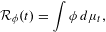 $$\begin{eqnarray}{\mathcal{R}}_{\unicode[STIX]{x1D719}}(t)=\int \unicode[STIX]{x1D719}\,d\unicode[STIX]{x1D707}_{t},\end{eqnarray}$$ $\unicode[STIX]{x1D707}_{t}$ is the unique absolutely continuous invariant probability of $f_{t}$ . Suppose that $\unicode[STIX]{x1D70E}_{t}>0$ for every $t\in [a,b]$ , where
  $$\begin{eqnarray}\unicode[STIX]{x1D70E}_{t}^{2}=\unicode[STIX]{x1D70E}_{t}^{2}(\unicode[STIX]{x1D719})=\lim _{n\rightarrow \infty }\int \left(\frac{\mathop{\sum }_{j=0}^{n-1}\left(\unicode[STIX]{x1D719}\circ f_{t}^{j}-\int \unicode[STIX]{x1D719}\,d\unicode[STIX]{x1D707}_{t}\right)}{\sqrt{n}}\right)^{2}\,d\unicode[STIX]{x1D707}_{t}.\end{eqnarray}$$
We show that
converges to $$\begin{eqnarray}m\left\{t\in [a,b]:t+h\in [a,b]\text{ and }\frac{1}{\unicode[STIX]{x1D6F9}(t)\sqrt{-\log |h|}}\left(\frac{{\mathcal{R}}_{\unicode[STIX]{x1D719}}(t+h)-{\mathcal{R}}_{\unicode[STIX]{x1D719}}(t)}{h}\right)\leqslant y\right\}\end{eqnarray}$$where
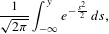 $$\begin{eqnarray}\frac{1}{\sqrt{2\unicode[STIX]{x1D70B}}}\int _{-\infty }^{y}e^{-\frac{s^{2}}{2}}\,ds,\end{eqnarray}$$ $\unicode[STIX]{x1D6F9}(t)$ is a dynamically defined function and $m$ is the Lebesgue measure on $[a,b]$ , normalized in such way that $m([a,b])=1$ . As a consequence, we show that ${\mathcal{R}}_{\unicode[STIX]{x1D719}}$ is not a Lipchitz function on any subset of $[a,b]$ with positive Lebesgue measure.


BROOKS’ THEOREM FOR MEASURABLE COLORINGS
- Part of
-
- Journal:
- Forum of Mathematics, Sigma / Volume 4 / 2016
- Published online by Cambridge University Press:
- 24 June 2016, e16
-
- Article
-
- You have access
- Open access
- Export citation
-
We generalize Brooks’ theorem to show that if $G$ is a Borel graph on a standard Borel space $X$ of degree bounded by $d\geqslant 3$ which contains no $(d+1)$ -cliques, then $G$ admits a ${\it\mu}$ -measurable $d$ -coloring with respect to any Borel probability measure ${\it\mu}$ on $X$ , and a Baire measurable $d$ -coloring with respect to any compatible Polish topology on $X$ . The proof of this theorem uses a new technique for constructing one-ended spanning subforests of Borel graphs, as well as ideas from the study of list colorings. We apply the theorem to graphs arising from group actions to obtain factor of IID $d$ -colorings of Cayley graphs of degree $d$ , except in two exceptional cases.


A NEW EXAMPLE OF A DETERMINISTIC CHAOS GAME
- Part of
-
- Journal:
- Bulletin of the Australian Mathematical Society / Volume 94 / Issue 3 / December 2016
- Published online by Cambridge University Press:
- 02 June 2016, pp. 464-470
- Print publication:
- December 2016
-
- Article
-
- You have access
- Export citation
EXPECTATIONS OVER DETERMINISTIC FRACTAL SETS
- Part of
-
- Journal:
- Bulletin of the Australian Mathematical Society / Volume 94 / Issue 1 / August 2016
- Published online by Cambridge University Press:
- 25 April 2016, pp. 171-172
- Print publication:
- August 2016
-
- Article
-
- You have access
- Export citation
POLISH MODELS AND SOFIC ENTROPY
- Part of
-
- Journal:
- Journal of the Institute of Mathematics of Jussieu / Volume 17 / Issue 2 / April 2018
- Published online by Cambridge University Press:
- 18 January 2016, pp. 241-275
- Print publication:
- April 2018
-
- Article
- Export citation
-
We deduce properties of the Koopman representation of a positive entropy probability measure-preserving action of a countable, discrete, sofic group. Our main result may be regarded as a‘representation-theoretic’ version of Sinaǐ’s factor theorem. We show that probability measure-preserving actions with completely positive entropy of an infinite sofic group must be mixing and, if the group is nonamenable, have spectral gap. This implies that if $\unicode[STIX]{x1D6E4}$ is a nonamenable group and $\unicode[STIX]{x1D6E4}\curvearrowright (X,\unicode[STIX]{x1D707})$ is a probability measure-preserving action which is not strongly ergodic, then no action orbit equivalent to $\unicode[STIX]{x1D6E4}\curvearrowright (X,\unicode[STIX]{x1D707})$ has completely positive entropy. Crucial to these results is a formula for entropy in the presence of a Polish, but a priori noncompact, model.


ON SMALL BASES FOR WHICH 1 HAS COUNTABLY MANY EXPANSIONS
- Part of
-
- Journal:
- Mathematika / Volume 62 / Issue 2 / 2016
- Published online by Cambridge University Press:
- 22 January 2016, pp. 362-377
- Print publication:
- 2016
-
- Article
- Export citation
-
Let $q\in (1,2)$ . A $q$ -expansion of a number $x$ in $[0,1/(q-1)]$ is a sequence $({\it\delta}_{i})_{i=1}^{\infty }\in \{0,1\}^{\mathbb{N}}$ satisfying Let
 $$\begin{eqnarray}x=\mathop{\sum }_{i=1}^{\infty }\frac{{\it\delta}_{i}}{q^{i}}.\end{eqnarray}$$ ${\mathcal{B}}_{\aleph _{0}}$ denote the set of $q$ for which there exists $x$ with a countable number of $q$ -expansions, and let ${\mathcal{B}}_{1,\aleph _{0}}$ denote the set of $q$ for which $1$ has a countable number of $q$ -expansions. In Erdős et al [On the uniqueness of the expansions $1=\sum _{i=1}^{\infty }q^{-n_{i}}$ . Acta Math. Hungar.58 (1991), 333–342] it was shown that $\min {\mathcal{B}}_{\aleph _{0}}=\min {\mathcal{B}}_{1,\aleph _{0}}=(1+\sqrt{5})/2$ , and in S. Baker [On small bases which admit countably many expansions. J. Number Theory147 (2015), 515–532] it was shown that ${\mathcal{B}}_{\aleph _{0}}\cap ((1+\sqrt{5})/2,q_{1}]=\{q_{1}\}$ , where $q_{1}\,({\approx}1.64541)$ is the positive root of $x^{6}-x^{4}-x^{3}-2x^{2}-x-1=0$ . In this paper we show that the second smallest point of ${\mathcal{B}}_{1,\aleph _{0}}$ is $q_{3}\,({\approx}1.68042)$ , the positive root of $x^{5}-x^{4}-x^{3}-x+1=0$ . En route to proving this result, we show that ${\mathcal{B}}_{\aleph _{0}}\cap (q_{1},q_{3}]=\{q_{2},q_{3}\}$ , where $q_{2}\,({\approx}1.65462)$ is the positive root of $x^{6}-2x^{4}-x^{3}-1=0$ .


FAILURE OF THE $L^{1}$ POINTWISE AND MAXIMAL ERGODIC THEOREMS FOR THE FREE GROUP
- Part of
-
- Journal:
- Forum of Mathematics, Sigma / Volume 3 / 2015
- Published online by Cambridge University Press:
- 01 December 2015, e27
-
- Article
-
- You have access
- Open access
- Export citation
-
Let $F_{2}$ denote the free group on two generators $a$ and $b$. For any measure-preserving system $(X,{\mathcal{X}},{\it\mu},(T_{g})_{g\in F_{2}})$ on a finite measure space $X=(X,{\mathcal{X}},{\it\mu})$, any $f\in L^{1}(X)$, and any $n\geqslant 1$, define the averaging operators where
 $$\begin{eqnarray}\displaystyle {\mathcal{A}}_{n}f(x):=\frac{1}{4\times 3^{n-1}}\mathop{\sum }_{g\in F_{2}:|g|=n}f(T_{g}^{-1}x), & & \displaystyle \nonumber\end{eqnarray}$$ $|g|$ denotes the word length of $g$. We give an example of a measure-preserving system $X$ and an $f\in L^{1}(X)$ such that the sequence ${\mathcal{A}}_{n}f(x)$ is unbounded in $n$ for almost every $x$, thus showing that the pointwise and maximal ergodic theorems do not hold in $L^{1}$ for actions of $F_{2}$. This is despite the results of Nevo–Stein and Bufetov, who establish pointwise and maximal ergodic theorems in $L^{p}$ for $p>1$ and for $L\log L$ respectively, as well as an estimate of Naor and the author establishing a weak-type $(1,1)$ maximal inequality for the action on $\ell ^{1}(F_{2})$. Our construction is a variant of a counterexample of Ornstein concerning iterates of a Markov operator.


