Refine listing
Actions for selected content:
387 results in 37Axx
Rank-one non-singular actions of countable groups and their odometer factors
- Part of
-
- Journal:
- Ergodic Theory and Dynamical Systems / Volume 45 / Issue 4 / April 2025
- Published online by Cambridge University Press:
- 30 September 2024, pp. 1078-1128
- Print publication:
- April 2025
-
- Article
- Export citation
-
For an arbitrary countable discrete infinite group G, non-singular rank-one actions are introduced. It is shown that the class of non-singular rank-one actions coincides with the class of non-singular $(C,F)$-actions. Given a decreasing sequence
  of cofinite subgroups in G with $\bigcap _{n=1}^\infty \bigcap _{g\in G}g\Gamma _ng^{-1}=\{1_G\}$, the projective limit of the homogeneous G-spaces $G/\Gamma _n$ as $n\to \infty $ is a G-space. Endowing this G-space with an ergodic non-singular non-atomic measure, we obtain a dynamical system which is called a non-singular odometer. Necessary and sufficient conditions are found for a rank-one non-singular G-action to have a finite factor and a non-singular odometer factor in terms of the underlying $(C,F)$-parameters. Similar conditions are also found for a rank-one non-singular G-action to be isomorphic to an odometer. Minimal Radon uniquely ergodic locally compact Cantor models are constructed for the non-singular rank-one extensions of odometers. Several concrete examples are constructed and several facts are proved that illustrate a sharp difference of the non-singular non-commutative case from the classical finite measure preserving one: odometer actions which are not of rank-one and factors of rank-one systems which are not of rank one; however, each probability preserving odometer is a factor of an infinite measure preserving rank-one system, etc.

 of cofinite subgroups in


A parameter ASIP for the quadratic family
- Part of
-
- Journal:
- Ergodic Theory and Dynamical Systems / Volume 45 / Issue 3 / March 2025
- Published online by Cambridge University Press:
- 24 September 2024, pp. 663-703
- Print publication:
- March 2025
-
- Article
- Export citation
-
Consider the quadratic family $T_a(x) = a x (1 - x)$ for $x \in [0, 1]$ and mixing Collet–Eckmann (CE) parameters $a \in (2,4)$. For bounded $\varphi $, set $\tilde \varphi _{a} := \varphi - \int \varphi \, d\mu _a$, with $\mu _a$ the unique acim of $T_a$, and put $(\sigma _a (\varphi ))^2 := \int \tilde \varphi _{a}^2 \, d\mu _a + 2 \sum _{i>0} \int \tilde \varphi _{a} (\tilde \varphi _{a} \circ T^i_{a}) \, d\mu _a$. For any mixing Misiurewicz parameter $a_{*}$, we find a positive measure set $\Omega _{*}$ of mixing CE parameters, containing $a_{*}$ as a Lebesgue density point, such that for any Hölder $\varphi $ with $\sigma _{a_{*}}(\varphi )\ne 0$, there exists $\epsilon _\varphi>0$ such that, for normalized Lebesgue measure on $\Omega _{*}\cap [a_{*}-\epsilon _\varphi , a_{*}+\epsilon _\varphi ]$, the functions $\xi _i(a)=\tilde \varphi _a(T_a^{i+1}(1/2))/\sigma _a (\varphi )$ satisfy an almost sure invariance principle (ASIP) for any error exponent $\gamma>2/5$. (In particular, the Birkhoff sums satisfy this ASIP.) Our argument goes along the lines of Schnellmann’s proof for piecewise expanding maps. We need to introduce a variant of Benedicks–Carleson parameter exclusion and to exploit fractional response and uniform exponential decay of correlations from Baladi et al [Whitney–Hölder continuity of the SRB measure for transversal families of smooth unimodal maps. Invent. Math. 201 (2015), 773–844].


A recurrence-type strong Borel–Cantelli lemma for Axiom A diffeomorphisms
- Part of
-
- Journal:
- Ergodic Theory and Dynamical Systems / Volume 45 / Issue 3 / March 2025
- Published online by Cambridge University Press:
- 18 September 2024, pp. 936-955
- Print publication:
- March 2025
-
- Article
-
- You have access
- Open access
- HTML
- Export citation
-
Let $(X,\mu ,T,d)$ be a metric measure-preserving dynamical system such that three-fold correlations decay exponentially for Lipschitz continuous observables. Given a sequence $(M_k)$ that converges to $0$ slowly enough, we obtain a strong dynamical Borel–Cantelli result for recurrence, that is, for $\mu $-almost every $x\in X$, where
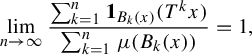 $$ \begin{align*} \lim_{n \to \infty}\frac{\sum_{k=1}^{n} \mathbf{1}_{B_k(x)}(T^{k}x)} {\sum_{k=1}^{n} \mu(B_k(x))} = 1, \end{align*} $$ $\mu (B_k(x)) = M_k$. In particular, we show that this result holds for Axiom A diffeomorphisms and equilibrium states under certain assumptions.


On transversal Hölder regularity for flat Wieler solenoids
- Part of
-
- Journal:
- Ergodic Theory and Dynamical Systems / Volume 45 / Issue 1 / January 2025
- Published online by Cambridge University Press:
- 10 September 2024, pp. 294-320
- Print publication:
- January 2025
-
- Article
-
- You have access
- Open access
- HTML
- Export citation
-
This paper studies various aspects of inverse limits of locally expanding affine linear maps on flat branched manifolds, which I call flat Wieler solenoids. Among the aspects studied are different types of cohomologies, the rates of mixing given by the Ruelle spectrum of the hyperbolic map acting on this space, and solutions of the cohomological equation in primitive substitution subshifts for Hölder functions. The overarching theme is that considerations of $\alpha $-Hölder regularity on Cantor sets go a long way.

Minimal and proximal examples of $\bar {d}$-stable and $\bar {d}$-approachable shift spaces
- Part of
-
- Journal:
- Ergodic Theory and Dynamical Systems / Volume 45 / Issue 2 / February 2025
- Published online by Cambridge University Press:
- 10 September 2024, pp. 396-426
- Print publication:
- February 2025
-
- Article
-
- You have access
- Open access
- HTML
- Export citation
-
We study shift spaces over a finite alphabet that can be approximated by mixing shifts of finite type in the sense of (pseudo)metrics connected to Ornstein’s $\bar {d}$ metric ( $\bar {d}$-approachable shift spaces). The class of $\bar {d}$-approachable shifts can be considered as a topological analog of measure-theoretical Bernoulli systems. The notion of $\bar {d}$-approachability, together with a closely connected notion of $\bar {d}$-shadowing, was introduced by Konieczny, Kupsa, and Kwietniak [Ergod. Th. & Dynam. Sys. 43(3) (2023), 943–970]. These notions were developed with the aim of significantly generalizing specification properties. Indeed, many popular variants of the specification property, including the classic one and the almost/weak specification property, ensure $\bar {d}$-approachability and $\bar {d}$-shadowing. Here, we study further properties and connections between $\bar {d}$-shadowing and $\bar {d}$-approachability. We prove that $\bar {d}$-shadowing implies $\bar {d}$-stability (a notion recently introduced by Tim Austin). We show that for surjective shift spaces with the $\bar {d}$-shadowing property the Hausdorff pseudodistance ${\bar d}^{\mathrm {H}}$ between shift spaces induced by $\bar {d}$ is the same as the Hausdorff distance between their simplices of invariant measures with respect to the Hausdorff distance induced by Ornstein’s metric $\bar {d}$ between measures. We prove that without $\bar {d}$-shadowing this need not to be true (it is known that the former distance always bounds the latter). We provide examples illustrating these results, including minimal examples and proximal examples of shift spaces with the $\bar {d}$-shadowing property. The existence of such shift spaces was announced in the earlier paper mentioned above. It shows that $\bar {d}$-shadowing indeed generalizes the specification property.


Uniform syndeticity in multiple recurrence
- Part of
-
- Journal:
- Ergodic Theory and Dynamical Systems / Volume 45 / Issue 2 / February 2025
- Published online by Cambridge University Press:
- 28 May 2024, pp. 504-525
- Print publication:
- February 2025
-
- Article
-
- You have access
- Open access
- HTML
- Export citation
-
The main theorem of this paper establishes a uniform syndeticity result concerning the multiple recurrence of measure-preserving actions on probability spaces. More precisely, for any integers $d,l\geq 1$ and any $\varepsilon> 0$, we prove the existence of $\delta>0$ and $K\geq 1$ (dependent only on d, l, and $\varepsilon $) such that the following holds: Consider a solvable group $\Gamma $ of derived length l, a probability space $(X, \mu )$, and d pairwise commuting measure-preserving $\Gamma $-actions $T_1, \ldots , T_d$ on $(X, \mu )$. Let E be a measurable set in X with $\mu (E) \geq \varepsilon $. Then, K many (left) translates of cover
 $$ \begin{align*} \big\{\gamma\in\Gamma\colon \mu(T_1^{\gamma^{-1}}(E)\cap T_2^{\gamma^{-1}} \circ T^{\gamma^{-1}}_1(E)\cap \cdots \cap T^{\gamma^{-1}}_d\circ T^{\gamma^{-1}}_{d-1}\circ \cdots \circ T^{\gamma^{-1}}_1(E))\geq \delta \big\} \end{align*} $$ $\Gamma $. This result extends and refines uniformity results by Furstenberg and Katznelson. As a combinatorial application, we obtain the following uniformity result. For any integers $d,l\geq 1$ and any $\varepsilon> 0$, there are $\delta>0$ and $K\geq 1$ (dependent only on d, l, and $\varepsilon $) such that for all finite solvable groups G of derived length l and any subset $E\subset G^d$ with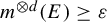 $m^{\otimes d}(E)\geq \varepsilon $ (where m is the uniform measure on G), we have that K-many (left) translates of cover G. The proof of our main result is a consequence of an ultralimit version of Austin’s amenable ergodic Szeméredi theorem.
 $$ \begin{align*} \{g\in G\colon &m^{\otimes d}(\{(a_1,\ldots,a_n)\in G^d\colon \\ & (a_1,\ldots,a_n),(ga_1,a_2,\ldots,a_n),\ldots,(ga_1,ga_2,\ldots, ga_n)\in E\})\geq \delta \} \end{align*} $$


A variational principle of amenable random metric mean dimensions
- Part of
-
- Journal:
- Proceedings of the Edinburgh Mathematical Society / Volume 67 / Issue 3 / August 2024
- Published online by Cambridge University Press:
- 16 May 2024, pp. 852-875
-
- Article
- Export citation
Co-spectral radius for countable equivalence relations
- Part of
-
- Journal:
- Ergodic Theory and Dynamical Systems / Volume 44 / Issue 12 / December 2024
- Published online by Cambridge University Press:
- 10 May 2024, pp. 3385-3427
- Print publication:
- December 2024
-
- Article
-
- You have access
- Open access
- HTML
- Export citation
-
We define the co-spectral radius of inclusions ${\mathcal S}\leq {\mathcal R}$ of discrete, probability- measure-preserving equivalence relations as the sampling exponent of a generating random walk on the ambient relation. The co-spectral radius is analogous to the spectral radius for random walks on $G/H$ for inclusion $H\leq G$ of groups. For the proof, we develop a more general version of the 2–3 method we used in another work on the growth of unimodular random rooted trees. We use this method to show that the walk growth exists for an arbitrary unimodular random rooted graph of bounded degree. We also investigate how the co-spectral radius behaves for hyperfinite relations, and discuss new critical exponents for percolation that can be defined using the co-spectral radius.


Weighted topological pressure revisited
- Part of
-
- Journal:
- Ergodic Theory and Dynamical Systems / Volume 45 / Issue 1 / January 2025
- Published online by Cambridge University Press:
- 08 May 2024, pp. 34-70
- Print publication:
- January 2025
-
- Article
- Export citation
Poissonian pair correlation for directions in multi-dimensional affine lattices and escape of mass estimates for embedded horospheres
- Part of
-
- Journal:
- Ergodic Theory and Dynamical Systems / Volume 45 / Issue 1 / January 2025
- Published online by Cambridge University Press:
- 26 April 2024, pp. 218-246
- Print publication:
- January 2025
-
- Article
-
- You have access
- Open access
- HTML
- Export citation
-
We prove the convergence of moments of the number of directions of affine lattice vectors that fall into a small disc, under natural Diophantine conditions on the shift. Furthermore, we show that the pair correlation function is Poissonian for any irrational shift in dimension 3 and higher, including well-approximable vectors. Convergence in distribution was already proved in the work of Strömbergsson and the second author [The distribution of free path lengths in the periodic Lorentz gas and related lattice point problems. Ann. of Math. (2) 172 (2010), 1949–2033], and the principal step in the extension to convergence of moments is an escape of mass estimate for averages over embedded $\operatorname {SL}(d,\mathbb {R})$-horospheres in the space of affine lattices.

Khintchine-type double recurrence in abelian groups
- Part of
-
- Journal:
- Ergodic Theory and Dynamical Systems / Volume 45 / Issue 1 / January 2025
- Published online by Cambridge University Press:
- 24 April 2024, pp. 1-33
- Print publication:
- January 2025
-
- Article
- Export citation
-
We prove a Khintchine-type recurrence theorem for pairs of endomorphisms of a countable discrete abelian group. As a special case of the main result, if $\Gamma $ is a countable discrete abelian group, $\varphi , \psi \in \mathrm {End}(\Gamma )$, and $\psi - \varphi $ is an injective endomorphism with finite index image, then for any ergodic measure-preserving $\Gamma $-system $( X, {\mathcal {X}}, \mu , (T_g)_{g \in \Gamma } )$, any measurable set $A \in {\mathcal {X}}$, and any ${\varepsilon }> 0$, there is a syndetic set of $g \in \Gamma$ such that $\mu ( A \cap T_{\varphi(g)}^{-1} A \cap T_{\psi(g)}^{-1} A ) > \mu(A)^3 - \varepsilon$. This generalizes the main results of Ackelsberg et al [Khintchine-type recurrence for 3-point configurations. Forum Math. Sigma 10 (2022), Paper no. e107] and essentially answers a question left open in that paper [Question 1.12; Khintchine-type recurrence for 3-point configurations. Forum Math. Sigma 10 (2022), Paper no. e107]. For the group $\Gamma = {\mathbb {Z}}^d$, the result applies to pairs of endomorphisms given by matrices whose difference is non-singular. The key ingredients in the proof are: (1) a recent result obtained jointly with Bergelson and Shalom [Khintchine-type recurrence for 3-point configurations. Forum Math. Sigma 10 (2022), Paper no. e107] that says that the relevant ergodic averages are controlled by a characteristic factor closely related to the quasi-affine (or Conze–Lesigne) factor; (2) an extension trick to reduce to systems with well-behaved (with respect to $\varphi $ and $\psi $) discrete spectrum; and (3) a description of Mackey groups associated to quasi-affine cocycles over rotational systems with well-behaved discrete spectrum.


Schmidt games and Cantor winning sets
- Part of
-
- Journal:
- Ergodic Theory and Dynamical Systems / Volume 45 / Issue 1 / January 2025
- Published online by Cambridge University Press:
- 19 April 2024, pp. 71-110
- Print publication:
- January 2025
-
- Article
- Export citation
-
Schmidt games and the Cantor winning property give alternative notions of largeness, similar to the more standard notions of measure and category. Being intuitive, flexible, and applicable to recent research made them an active object of study. We survey the definitions of the most common variants and connections between them. A new game called the Cantor game is invented and helps with presenting a unifying framework. We prove surprising new results such as the coincidence of absolute winning and $1$ Cantor winning in metric spaces, and the fact that $1/2$ winning implies absolute winning for subsets of $\mathbb {R}$. We also suggest a prototypical example of a Cantor winning set to show the ubiquity of such sets in metric number theory and ergodic theory.


Non-existence of a universal zero-entropy system via generic actions of almost complete growth
- Part of
-
- Journal:
- Ergodic Theory and Dynamical Systems / Volume 44 / Issue 12 / December 2024
- Published online by Cambridge University Press:
- 12 April 2024, pp. 3630-3644
- Print publication:
- December 2024
-
- Article
- Export citation
Entropy, virtual Abelianness and Shannon orbit equivalence
- Part of
-
- Journal:
- Ergodic Theory and Dynamical Systems / Volume 44 / Issue 12 / December 2024
- Published online by Cambridge University Press:
- 02 April 2024, pp. 3481-3500
- Print publication:
- December 2024
-
- Article
-
- You have access
- Open access
- HTML
- Export citation
-
We prove that if two free probability-measure-preserving (p.m.p.) ${\mathbb Z}$-actions are Shannon orbit equivalent, then they have the same entropy. The argument also applies more generally to yield the same conclusion for free p.m.p. actions of finitely generated virtually Abelian groups. Together with the isomorphism theorems of Ornstein and Ornstein–Weiss and the entropy invariance results of Austin and Kerr–Li in the non-virtually-cyclic setting, this shows that two Bernoulli actions of any non-locally-finite countably infinite amenable group are Shannon orbit equivalent if and only if they are measure conjugate. We also show, at the opposite end of the stochastic spectrum, that every ${\mathbb Z}$-odometer is Shannon orbit equivalent to the universal ${\mathbb Z}$-odometer.


Rigidity of pressures of Hölder potentials and the fitting of analytic functions through them
- Part of
-
- Journal:
- Ergodic Theory and Dynamical Systems / Volume 44 / Issue 12 / December 2024
- Published online by Cambridge University Press:
- 18 March 2024, pp. 3530-3564
- Print publication:
- December 2024
-
- Article
-
- You have access
- Open access
- HTML
- Export citation
Approximate homomorphisms and sofic approximations of orbit equivalence relations
- Part of
-
- Journal:
- Ergodic Theory and Dynamical Systems / Volume 44 / Issue 12 / December 2024
- Published online by Cambridge University Press:
- 15 March 2024, pp. 3455-3480
- Print publication:
- December 2024
-
- Article
-
- You have access
- Open access
- HTML
- Export citation
THERMODYNAMIC FORMALISM FOR AMENABLE GROUPS AND COUNTABLE STATE SPACES
- Part of
-
- Journal:
- Journal of the Institute of Mathematics of Jussieu / Volume 23 / Issue 6 / November 2024
- Published online by Cambridge University Press:
- 15 March 2024, pp. 2647-2711
- Print publication:
- November 2024
-
- Article
-
- You have access
- Open access
- HTML
- Export citation
Discrepancy of rational points in simple algebraic groups
- Part of
-
- Journal:
- Compositio Mathematica / Volume 160 / Issue 4 / April 2024
- Published online by Cambridge University Press:
- 13 March 2024, pp. 836-877
- Print publication:
- April 2024
-
- Article
- Export citation
Measure transfer and S-adic developments for subshifts
- Part of
-
- Journal:
- Ergodic Theory and Dynamical Systems / Volume 44 / Issue 11 / November 2024
- Published online by Cambridge University Press:
- 11 March 2024, pp. 3120-3154
- Print publication:
- November 2024
-
- Article
- Export citation
-
Based on previous work of the authors, to any S-adic development of a subshift X a ‘directive sequence’ of commutative diagrams is associated, which consists at every level $n \geq 0$ of the measure cone and the letter frequency cone of the level subshift $X_n$ associated canonically to the given S-adic development. The issuing rich picture enables one to deduce results about X with unexpected directness. For instance, we exhibit a large class of minimal subshifts with entropy zero that all have infinitely many ergodic probability measures. As a side result, we also exhibit, for any integer $d \geq 2$, an S-adic development of a minimal, aperiodic, uniquely ergodic subshift X, where all level alphabets $\mathcal A_n$ have cardinality $d,$ while none of the $d-2$ bottom level morphisms is recognizable in its level subshift $X_n \subseteq \mathcal A_n^{\mathbb {Z}}$.


Hyperfiniteness of boundary actions of acylindrically hyperbolic groups
- Part of
-
- Journal:
- Forum of Mathematics, Sigma / Volume 12 / 2024
- Published online by Cambridge University Press:
- 11 March 2024, e32
-
- Article
-
- You have access
- Open access
- HTML
- Export citation
-
We prove that, for any countable acylindrically hyperbolic group G, there exists a generating set S of G such that the corresponding Cayley graph $\Gamma (G,S)$ is hyperbolic, $|\partial \Gamma (G,S)|>2$, the natural action of G on $\Gamma (G,S)$ is acylindrical and the natural action of G on the Gromov boundary $\partial \Gamma (G,S)$ is hyperfinite. This result broadens the class of groups that admit a non-elementary acylindrical action on a hyperbolic space with a hyperfinite boundary action.


