Refine search
Actions for selected content:
238502 results in Physics and Astronomy
On the $\mathfrak{M}_H(G)$-property
- Part of
-
- Journal:
- Mathematical Proceedings of the Cambridge Philosophical Society / Volume 179 / Issue 2 / September 2025
- Published online by Cambridge University Press:
- 24 June 2025, pp. 449-501
- Print publication:
- September 2025
-
- Article
- Export citation
-
Let E be an elliptic curve defined over ${{\mathbb{Q}}}$ which has good ordinary reduction at the prime p. Let K be a number field with at least one complex prime which we assume to be totally imaginary if $p=2$. We prove several equivalent criteria for the validity of the $\mathfrak{M}_H(G)$-property for ${{\mathbb{Z}}}_p$-extensions other than the cyclotomic extension inside a fixed ${{\mathbb{Z}}}_p^2$-extension $K_\infty/K$. The equivalent conditions involve the growth of $\mu$-invariants of the Selmer groups over intermediate shifted ${{\mathbb{Z}}}_p$-extensions in $K_\infty$, and the boundedness of $\lambda$-invariants as one runs over ${{\mathbb{Z}}}_p$-extensions of K inside of $K_\infty$.
Using these criteria we also derive several applications. For example, we can bound the number of ${{\mathbb{Z}}}_p$-extensions of K inside $K_\infty$ over which the Mordell–Weil rank of E is not bounded, thereby proving special cases of a conjecture of Mazur. Moreover, we show that the validity of the $\mathfrak{M}_H(G)$-property sometimes can be shifted to a larger base field K′.


How vortices enhance heat transfer from an oscillating plate
-
- Journal:
- Journal of Fluid Mechanics / Volume 1013 / 25 June 2025
- Published online by Cambridge University Press:
- 24 June 2025, A47
-
- Article
-
- You have access
- Open access
- HTML
- Export citation
Lift force on a spherical droplet in a viscous linear shear flow – CORRIGENDUM
-
- Journal:
- Journal of Fluid Mechanics / Volume 1013 / 25 June 2025
- Published online by Cambridge University Press:
- 24 June 2025, E1
-
- Article
-
- You have access
- Open access
- HTML
- Export citation
Self-consistent model for active control of wind turbine wakes
-
- Journal:
- Journal of Fluid Mechanics / Volume 1013 / 25 June 2025
- Published online by Cambridge University Press:
- 23 June 2025, A36
-
- Article
- Export citation
Deformation and breakup of a ferrofluid compound droplet migrating in a microchannel under a magnetic field: a phase-field-based multiple-relaxation time lattice Boltzmann study
-
- Journal:
- Journal of Fluid Mechanics / Volume 1013 / 25 June 2025
- Published online by Cambridge University Press:
- 23 June 2025, A37
-
- Article
- Export citation
-
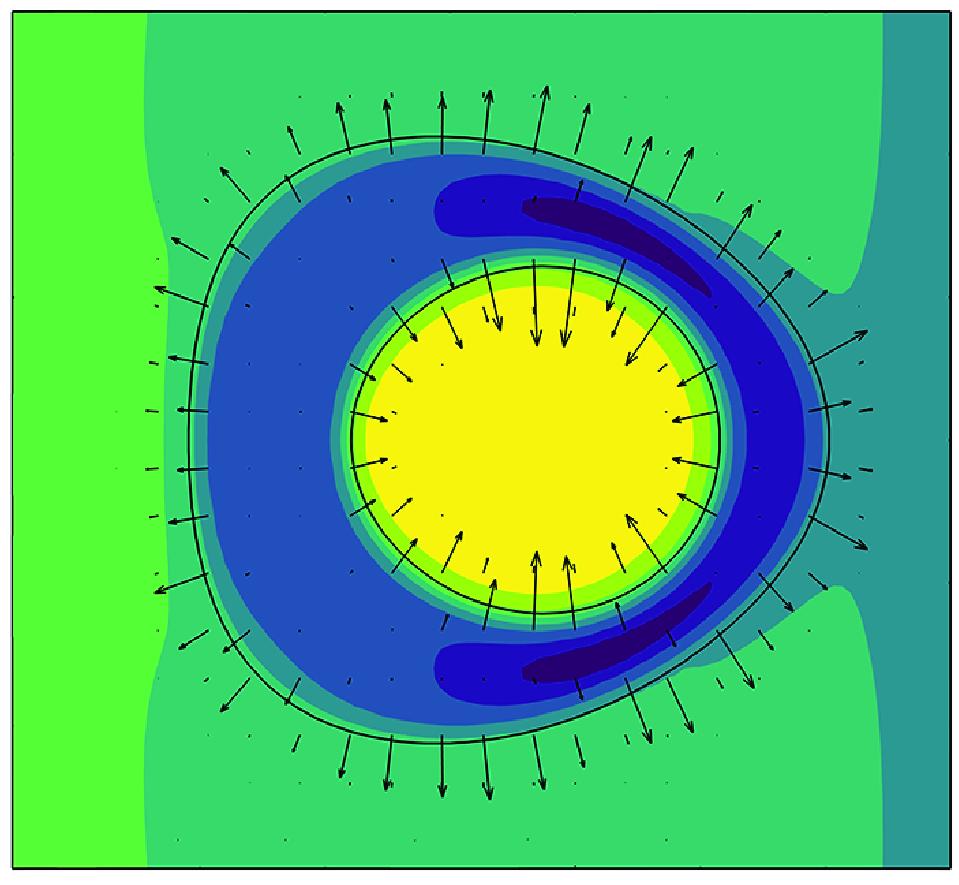
Though ubiquitous in many engineering applications, including drug delivery, the compound droplet hydrodynamics in confined geometries have been barely surveyed. For the first time, this study thoroughly investigates the hydrodynamics of a ferrofluid compound droplet (FCD) during its migration in a microchannel under the presence of a pressure-driven flow and a uniform external magnetic field (UEMF) to manipulate its morphology and retard its breakup. Finite difference and phase-field multiple-relaxation time lattice Boltzmann approaches are coupled to determine the magnetic field and ternary flow system, respectively. First, the influence of the magnetic Bond number ( ${Bo}_m$) on the FCD morphology is explored depending on whether the core or shell is ferrofluid when the UEMF is applied along $\alpha =0^\circ$ and $\alpha =90^\circ$ relative to the fluid flow. It is ascertained that imposing the UEMF at $\alpha =0^\circ$ when the shell is ferrofluid can postpone the breakup. Intriguingly, when the core is ferrofluid, strengthening the UEMF enlarges the shell deformation. Afterwards, the effects of the capillary number ( ${Ca}$), density ratio, viscosity ratio, radius ratio and surface tension coefficients are scrutinised on the FCD deformation and breakup. The results indicate that augmenting the core-to-shell viscosity and density ratios accelerates the breakup process. Additionally, surface tension between the core and shell suppresses the core deformation. Moreover, increasing the ${Ca}$ intensifies the viscous drag force exerted on the shell, flattening its rear side, which causes a triangular-like configuration. Ultimately, by varying ${Bo}_m$ and ${Ca}$, five distinct regimes are observed, whose regime map is established.


Low-order flow reconstruction and uncertainty quantification in disturbed aerodynamics using sparse pressure measurements
-
- Journal:
- Journal of Fluid Mechanics / Volume 1013 / 25 June 2025
- Published online by Cambridge University Press:
- 23 June 2025, A41
-
- Article
-
- You have access
- Open access
- HTML
- Export citation
A comparison of the intensity scaling for nonlinear Compton scattering and bremsstrahlung X-ray emission
-
- Journal:
- High Power Laser Science and Engineering / Volume 13 / 2025
- Published online by Cambridge University Press:
- 23 June 2025, e66
-
- Article
-
- You have access
- Open access
- HTML
- Export citation
-
Ultraintense laser–plasma experiments generate a variety of high-energy radiations, including nonlinear inverse Compton scattered (NCS) X-rays, which are expected to be a key experimental observable as we transition into the quantum electrodynamic plasma regime. However, there is also a high bremsstrahlung X-ray background that reduces our ability to observe NCS X-rays. Previous numerical studies comparing NCS and bremsstrahlung emissions fail to capture the full temporal emission of both processes. We present for the first time two-dimensional particle-in-cell (PIC) and three-dimensional hybrid-PIC EPOCH simulations that capture up to 150 ps of the laser–plasma interaction and directly compare the NCS and bremsstrahlung emissions for a plastic target for intensities of ${10}^{20}{-}{10}^{23}$ W/cm2. We present angular distribution plots where the NCS emission is seen to dominate at intensities greater than 5 $\times {10}^{21}$ W/cm2 and the target design is seen to successfully divert the bremsstrahlung signal away from the NCS lobe regions, making the experimental observation of nonlinear inverse Compton scattering at lower intensities more likely.


On the dominant motions in Taylor–Couette systems with square enclosures
-
- Journal:
- Journal of Fluid Mechanics / Volume 1013 / 25 June 2025
- Published online by Cambridge University Press:
- 23 June 2025, A38
-
- Article
-
- You have access
- Open access
- HTML
- Export citation
-
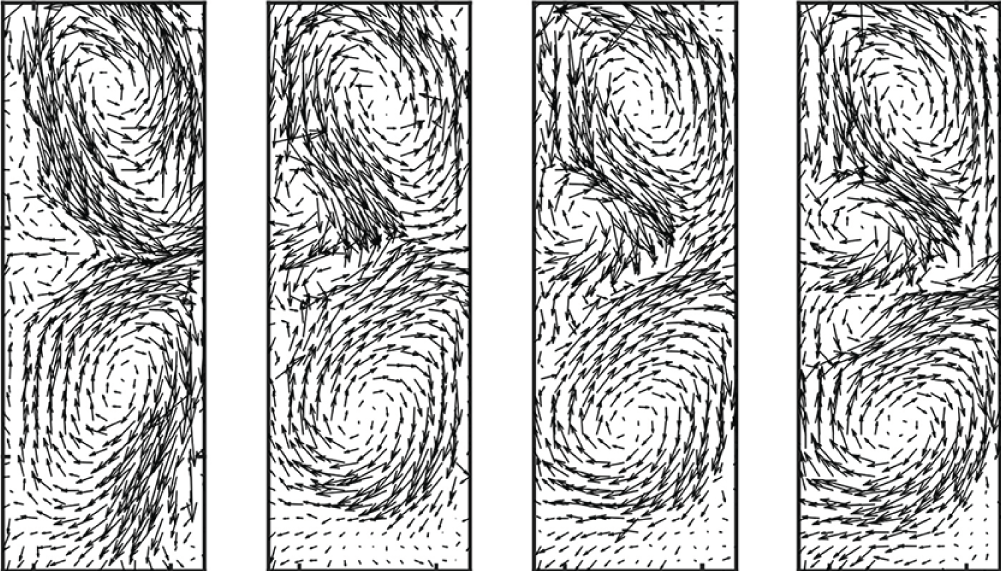
We explored the dynamics of Taylor–Couette flows within square enclosures, focusing primarily on the turbulence regime and vortex behaviour at varying Reynolds numbers. Laboratory experiments were conducted using particle image velocimetry for Reynolds numbers $Re_{\varDelta }\in [0.23, 4.6]\times 10^3$ based on the minimum gap $\varDelta /d = 1/16$, $1/8$ and $1/4$, where $d$ is the cylinder diameter, or $Re\in [1.8, 9.8]\times 10^3$ based on $d/2$. At lower $Re$, the flow was dominated by well-defined Taylor and Görtler vortices, while higher $Re$ led to a turbulent state with distinct motions. Space–time radial velocity analysis revealed persistent Taylor vortices at lower $Re$, with larger gaps but increased turbulence, and irregular motions at higher $Re$, with smaller gaps. Velocity spectra reveal that the energy distribution is maintained at frequencies lower than the integral-type frequency $f_I$ across varying $\varDelta$ due to the dominance of large vortices. However, there is a monotonic increase in energy at higher frequencies beyond $f_I$. The reduced characteristic frequency $f_I\varDelta /\omega _ir_i \sim 1/10$ indicates that these motions scale linearly with angular velocity, and inversely with the gap. Proper orthogonal decomposition (POD) and spectral POD were used to distinguish between Taylor and Görtler vortices, showing the effects of gap size and the associated energy cascade. Linear stability analysis included as complementary support revealed primary instability of the Taylor vortex, which is similar to the circular enclosure, along with multiple corner modes that are unique to the geometry.


Scale-dependent contributions from turbulent motions to the wall-shear stress in rough-wall open channel flows
-
- Journal:
- Journal of Fluid Mechanics / Volume 1013 / 25 June 2025
- Published online by Cambridge University Press:
- 23 June 2025, A34
-
- Article
- Export citation
-
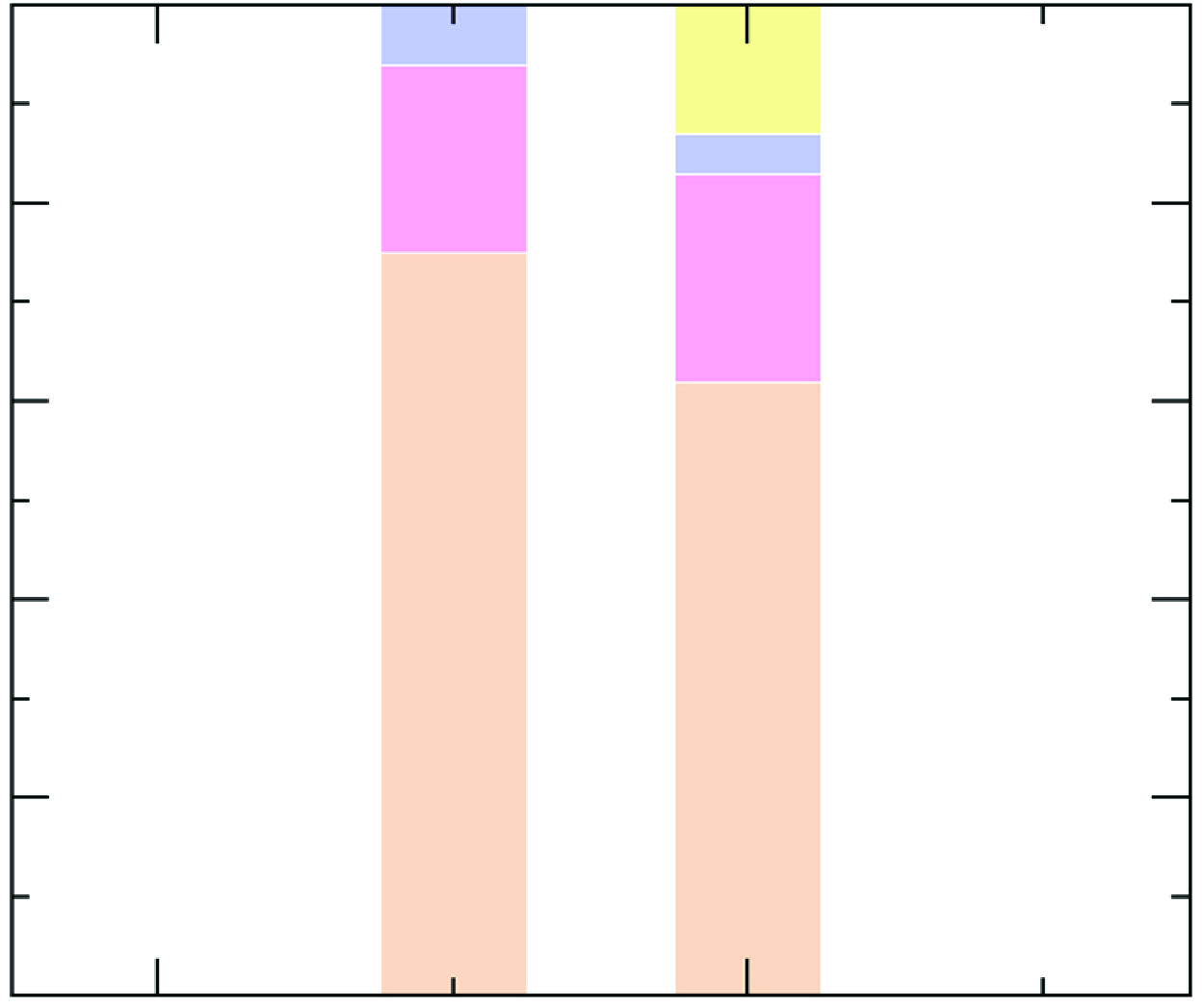
Long-duration and time-resolved particle image velocimetry measurements were conducted in rough-wall open channel flows (OCFs), with the friction Reynolds number ranging from 642 to 2034. The primary objective is to investigate the impacts of various turbulent motions at different scales on the mean wall-shear stress ( $\langle \tau _w \rangle$). To achieve this aim, a physical decomposition of $\langle \tau _w \rangle$ was initially performed utilizing the double-averaged methodology proposed by Nikora et al. (2019 J. Fluid Mech. 872, 626–664). This method enabled the breakdown of $\langle \tau _w \rangle$ into three distinct constituents: viscous, turbulent and dispersive stress segments. The findings underscore the substantial roles that turbulent and dispersive stresses play, accounting for over 75 % and 9 % of $\langle \tau _w \rangle$, respectively. Subsequently, a scale decomposition was further applied to analyse the contributions of coherent motions at different scales to $\langle \tau _w \rangle$. Adopting typical cutoff streamwise wavelengths ( $\lambda _x = 3h$ and $10h$), the contribution of large-scale motions (LSMs) and very large-scale motions (VLSMs) to the overall wall-shear stress was quantified. It was revealed that turbulent motions with $\lambda _x \gt 3h$ and $\lambda _x \gt 10h$ contribute more than 40 % and 18 % of $\langle \tau _w \rangle$, respectively. The scale decomposition of the wall-shear stress and the contribution from LSMs and VLSMs exhibit evident dependencies on the Reynolds number. The contribution of LSMs and VLSMs to $\langle \tau _w \rangle$ is lower in rough OCFs compared with those of smooth counterparts. Secondary currents induced by the rough wall are hypothesised to be responsible for the reduced strength of LSMs and VLSMs and decreases in their contribution to $\langle \tau _w \rangle$.


The third Konus-Wind catalogue of short gamma-ray bursts
-
- Journal:
- Publications of the Astronomical Society of Australia / Volume 42 / 2025
- Published online by Cambridge University Press:
- 23 June 2025, e063
-
- Article
-
- You have access
- Open access
- HTML
- Export citation
Pattern formation on an ice surface
-
- Journal:
- Journal of Fluid Mechanics / Volume 1013 / 25 June 2025
- Published online by Cambridge University Press:
- 23 June 2025, A35
-
- Article
- Export citation
Nonlinear modulation of arbitrary intense electromagnetic waves in magnetized electron–positron plasmas with temperature
-
- Journal:
- Journal of Plasma Physics / Volume 91 / Issue 3 / June 2025
- Published online by Cambridge University Press:
- 23 June 2025, E89
-
- Article
-
- You have access
- Open access
- HTML
- Export citation
Dynamic behaviour of a thermal spheroid particle in shear flows
-
- Journal:
- Journal of Fluid Mechanics / Volume 1013 / 25 June 2025
- Published online by Cambridge University Press:
- 23 June 2025, A40
-
- Article
-
- You have access
- Open access
- HTML
- Export citation
-
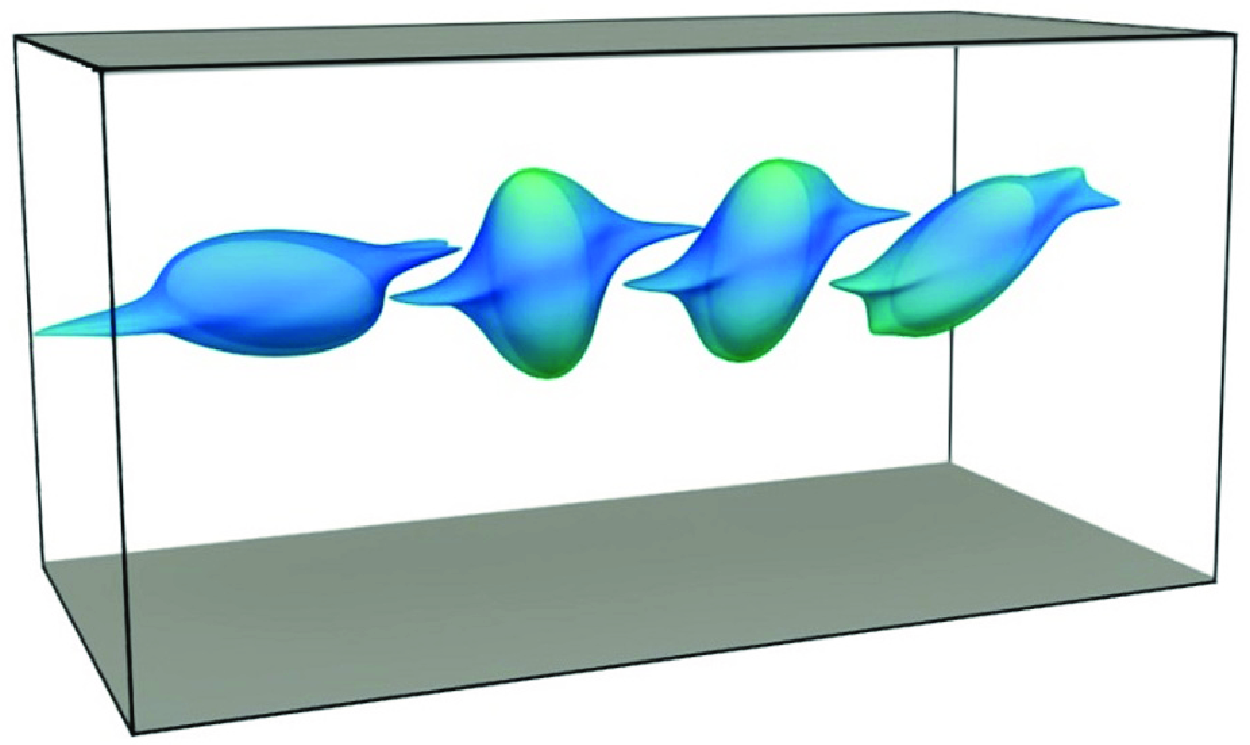
In this work, a systematic study is carried out concerning the dynamic behaviour of finite-size spheroidal particles in non-isothermal shear flows between parallel plates. The simulations rely on a hybrid method combining the lattice Boltzmann method with a finite-difference solver. Fluid–particle and heat–particle interactions are accounted for by using the immersed boundary method. The effect of particle Reynolds number ( $\textit{Re}_p=1{-}90$), Grashof number ( ${Gr}=0{-}200$), initial position and initial orientation of the particle are thoroughly examined. For the isothermal prolate particle, we observed that above a certain Reynolds number, the particle undergoes a pitchfork bifurcation; at an even higher Reynolds number, it returns to the centre position. In contrast, the hot particle behaves differently, with no pitchfork bifurcation. Instead, the Reynolds and Grashof numbers can induce oscillatory tumbling or log-rolling motions in either the lower or upper half of the channel. Heat transfer also plays an important role: at low Grashof numbers, the particle settles near the lower wall, while increasing the Grashof number shifts it towards the upper side. Moreover, the presence of thermal convection increases the rotational speed of the particle. Surprisingly, beyond the first critical Reynolds number, the equilibrium position of the thermal particle shifts closer to the centreline compared with that of a neutrally buoyant isothermal particle. Moreover, higher Grashof numbers can cause the particle to transition from tumbling to log-rolling or even a no-rotation mode. The initial orientation has a stronger influence at low Grashof numbers, while the initial position shows no strong effect in non-isothermal cases.


On rotor noise interference
-
- Journal:
- Journal of Fluid Mechanics / Volume 1013 / 25 June 2025
- Published online by Cambridge University Press:
- 23 June 2025, A43
-
- Article
- Export citation
Viscotaxis of chiral microswimmer in viscosity gradients
-
- Journal:
- Journal of Fluid Mechanics / Volume 1013 / 25 June 2025
- Published online by Cambridge University Press:
- 23 June 2025, A42
-
- Article
- Export citation
Optical tuning of vertical-cavity surface-emitting laser side-pumped neodymium-doped yttrium aluminum garnet laser cavity
-
- Journal:
- High Power Laser Science and Engineering / Volume 13 / 2025
- Published online by Cambridge University Press:
- 20 June 2025, e61
-
- Article
-
- You have access
- Open access
- HTML
- Export citation
The central spectra of massive star-forming galaxies
-
- Journal:
- Publications of the Astronomical Society of Australia / Volume 42 / 2025
- Published online by Cambridge University Press:
- 20 June 2025, e096
-
- Article
-
- You have access
- Open access
- HTML
- Export citation
-
We have examined the nuclear spectra of very massive star-forming galaxies at $z \sim 0$ to understand how they differ from other galaxies with comparable masses, which are typically passive. We selected a sample of 126 nearby massive star-forming galaxies ( $\lt100\,\textrm{Mpc}$, $10^{11.3}\,\mathrm{M_\odot} \leq M_\textrm{stellar} \leq 10^{11.7}\,\mathrm{M_\odot}$, $1 \,\mathrm{M_\odot\,yr^{-1}}\lt \textrm{SFR} \lt13 \,\mathrm{M_\odot\,yr^{-1}}$) from the 2MRS-Bright WXSC catalogue. LEDA morphologies indicate at least 63% of our galaxies are spirals, while visual inspection of Dark Energy Survey images reveals 75% of our galaxies to be spirals with the remainder being lenticular. Of our sample 59 have archival nuclear spectra, which we have modelled and subsequently measured emission lines ([NII] ${\lambda 6583}$, H $\alpha{\lambda 6563}$, [OIII] ${\lambda 5008}$, and H $\beta{\lambda 4863}$), classifying galaxies as star-forming, LINERs or AGNs. Using a BPT diagram we find $83 \pm 6$% of our galaxies, with sufficient signal-to-noise to measure all 4 emission lines, to be LINERs. Using the [NII] ${\lambda 6583}$/H $\alpha{\lambda 6563}$ emission line ratio alone we find that $79 \pm 6$% of the galaxies (46 galaxies) with archival spectra are LINERs, whereas just $\sim 30\%$ of the overall massive galaxy population are LINERs (Belfiore et al. 2016, MNRAS, 461, 3111). Our sample can be considered a local analogue of the Ogle et al. (2019, VizieR Online Data Catalog, p. J/ApJS/243/14; 2016, ApJ, 817, 109) sample of $z \sim 0.22$ massive star-forming galaxies in terms of selection criteria, and we find 64% of their galaxies are LINERs using SDSS spectra. The high frequency of LINER emission in these massive star-forming galaxies indicates that LINER emission in massive galaxies may be linked to the presence of gas that fuels star formation.


Lectures on statistical mechanics
- Part of
-
- Journal:
- Journal of Plasma Physics / Volume 91 / Issue 3 / June 2025
- Published online by Cambridge University Press:
- 20 June 2025, E87
-
- Article
-
- You have access
- Open access
- HTML
- Export citation
Nonlinear evolution of radiating modes in the presence of sound waves impinging on a supersonic boundary layer: subharmonic resonance
-
- Journal:
- Journal of Fluid Mechanics / Volume 1013 / 25 June 2025
- Published online by Cambridge University Press:
- 20 June 2025, A29
-
- Article
-
- You have access
- Open access
- HTML
- Export citation
Passive scalar statistics in a turbulent round jet: symmetry theory and direct numerical simulation
-
- Journal:
- Journal of Fluid Mechanics / Volume 1013 / 25 June 2025
- Published online by Cambridge University Press:
- 20 June 2025, A33
-
- Article
-
- You have access
- Open access
- HTML
- Export citation
-
We analyse moment and probability density function (PDF) statistics of a passive scalar $\Theta$ at a Prandtl number of $Pr=0.71$ in a turbulent jet. For this, we conducted a direct numerical simulation at a Reynolds number of $Re=3500$ and, further, employed Lie symmetries applied to the multi-point moment equations, generalising recent work (Nguyen & Oberlack 2024b under review with Flow Turbul. Combust.) that focused on pure hydrodynamics. It is shown that the symmetry theory also provides highly precise results for free shear flows for all the quantities mentioned and statistical symmetries again play a key role. The scalar statistics are partly similar to the $U_z$ velocity statistics, and in particular, as in the above-mentioned work, a significant generalisation of the classical scalings has been derived so that a variation of the scaling laws solely controlled by the inflow is possible. An exponential behaviour of the scaling prefactors with the moment orders $m$ and $n$ for scalar and velocity is also discovered for any mixed moments. Instantaneous $\Theta$-moments and mixed $U_z$- $\Theta$-moments exhibit a Gaussian distribution with variation of the scaled radius $\eta =r/(z-z_0)$. Therein, the coefficient in the Gauss exponent is nonlinear with varying moment orders $m$ and $n$. The scalar PDF statistics are clearly different from the velocity statistics, i.e. already deviate from the Gaussian distribution on the jet axis, as is observed for the $U_z$ statistics, and become clearly skewed and heavy tailed for increasing $\eta$.


