JFM Rapids
JFM Rapids provides a highly visible venue for short, yet still self-contained and complete, high-quality articles addressing timely research challenges of broad interest. They present exciting results that are likely to have a high impact on some aspect of currently active fluid mechanical research.
The average time from submission to first decision is under 30 days, and from submission to publication within a volume is under 100 days.
The latest Rapids are displayed below, and are available to view in order of publication date, title, or article number.
Contents
JFM Rapids

Inferring activity from the flow field around active colloidal particles using deep learning
-
- Journal:
- Journal of Fluid Mechanics / Volume 1018 / 2025
- Published online by Cambridge University Press:
- 27 August 2025, R1
-
- Article
- Export citation
-
Active colloidal particles create flow around them due to non-equilibrium processes on their surfaces. In this paper, we infer the activity of such colloidal particles from the flow field created by them via deep learning. We first explain our method for one active particle, inferring the $2s$ mode (or the stresslet) and the $3t$ mode (or the source dipole) from the flow field data, along with the position and orientation of the particle. We then apply the method to a system of many active particles. We find excellent agreements between the predictions and the true values of activity. Our method presents a principled way to predict arbitrary activity from the flow field created by active particles.


Coupling and synchronisation effects on local lock-in of two thermoacoustic oscillators in a stochastic environment
-
- Journal:
- Journal of Fluid Mechanics / Volume 1017 / 2025
- Published online by Cambridge University Press:
- 22 August 2025, R2
-
- Article
- Export citation

Jamming of elastoviscoplastic fluids in elastic turbulence
-
- Journal:
- Journal of Fluid Mechanics / Volume 1017 / 2025
- Published online by Cambridge University Press:
- 13 August 2025, R1
-
- Article
-
- You have access
- Open access
- HTML
- Export citation
-
Elastoviscoplastic (EVP) fluid flows are driven by a non-trivial interplay between the elastic, viscous and plastic properties, which under certain conditions can transition the otherwise laminar flow into complex flow instabilities with rich space–time-dependent dynamics. We discover that under elastic turbulence regimes, EVP fluids undergo dynamic jamming triggered by localised polymer stress deformations that facilitate the formation of solid regions trapped in local low-stress energy wells. The solid volume fraction $\phi$, below the jamming transition $\phi\lt\phi_J$, scales with $\sqrt {\textit{Bi}}$, where $\textit{Bi}$ is the Bingham number characterising the ratio of yield to viscous stresses, in direct agreement with theoretical approximations based on the laminar solution. The onset of this new dynamic jamming transition $\phi \geqslant \phi _J$ is marked by a clear deviation from the scaling $\phi \sim \sqrt {\textit{Bi}}$, scaling as $\phi \sim \exp {\textit{Bi}}$. We show that this instability-induced jamming transition – analogous to that in dense suspensions – leads to slow, minimally diffusive and rigid-like flows with finite deformability, highlighting a novel phase change in elastic turbulence regimes of complex fluids.


How much Navier–Stokes dynamics is needed to capture turbulent mixing?
-
- Journal:
- Journal of Fluid Mechanics / Volume 1016 / 2025
- Published online by Cambridge University Press:
- 11 August 2025, R7
-
- Article
-
- You have access
- Open access
- HTML
- Export citation
-
We study the mixing of passive scalars in a velocity field generated by selected-eddy simulations (SES), an approach where only a randomly selected subset of spectrally distributed modes obey Navier–Stokes dynamics. The Taylor Reynolds number varies from 140 to 400 and the Schmidt number ( $Sc$) varies from 0.25 to 1. By comparing the results with direct numerical simulations (DNS), we show that most statistics are captured with as low as $0.5\,\%$ of Navier–Stokes modes in the velocity field. This includes scalar gradients, spectra, structure functions and their departures from classical scaling due to intermittency. The results suggest that all modes need not be resolved to accurately capture turbulent mixing for $Sc\leqslant 1$ scalars.


A correlation model of energy and impulse losses for vortex ring–porous wall interactions
-
- Journal:
- Journal of Fluid Mechanics / Volume 1016 / 2025
- Published online by Cambridge University Press:
- 08 August 2025, R8
-
- Article
- Export citation
-
An experimental study was conducted to investigate the impingement of a vortex ring onto a porous wall by laser-induced fluorescence and particle image velocimetry. The effects of different Reynolds numbers ( ${{Re}}_{\it\Gamma } = 700$ and $1800$) and hole diameters ( $d_{h}^{*} = 0.067$, $0.10$, $0.133$ and $0.20$) on the flow characteristics were examined at a constant porosity ( $\phi = 0.75$). To characterise fluid transport through a porous wall, we recall the model proposed by Naaktgeboren, Krueger & Lage (2012, J. Fluid Mech., vol. 707, 260–286), which shows rough agreement with the experimental results due to the absence of vortex ring characteristics. This highlights the need for a more accurate model to correlate the losses in kinetic energy ( $\Delta E^{*}$) and impulse ( $\Delta I^{*}$) resulting from the vortex ring–porous wall interaction. Starting from Lamb’s vortex ring model and considering the flow transition from the upstream laminar state to the downstream turbulent state caused by the porous wall disturbance, a new model is derived theoretically: $\Delta E^{*} = 1 - k(1 - \Delta I^{*})^2$, where $k$ is a parameter dependent on the dimensionless core radius $\varepsilon$, with $k = 1$ when no flow state change occurs. This new model effectively correlates $\Delta E^{*}$ and $\Delta I^{*}$ across more than 70 cases from current and previous experiments, capturing the dominant flow physics of the vortex ring–porous wall interaction.


Choking the flow in soft Hele-Shaw cells: the role of elastomer geometry
-
- Journal:
- Journal of Fluid Mechanics / Volume 1016 / 2025
- Published online by Cambridge University Press:
- 07 August 2025, R6
-
- Article
-
- You have access
- Open access
- HTML
- Export citation

Predicting internal boundary layer growth following a roughness change in thermally neutral and stable boundary layers
-
- Journal:
- Journal of Fluid Mechanics / Volume 1016 / 2025
- Published online by Cambridge University Press:
- 30 July 2025, R4
-
- Article
-
- You have access
- Open access
- HTML
- Export citation
-
This study uses the diffusion analogy (Miyake, Sci. Rep., 5R-6, 1965, Univ. of Washington, Seattle, USA) to predict the full growth behaviour of internal boundary layers (IBLs) induced by a roughness change for neutrally – and especially stably – stratified boundary layers with finite thickness. The physics of the diffusion analogy shows that the streamwise variation of the IBL thickness is dictated by $\sigma _w/U$ at the interface, where $\sigma _w$ and $U$ represent wall-normal Reynolds stress and mean streamwise velocity, respectively. The existing variants of the model, summarised by Savelyev & Taylor (2005, Boundary-Layer Meteorol., vol. 115, pp. 1–25), are tailored to IBLs confined within the constant shear stress layer. To extend the applicability of the model to the outer region, we investigate the relation between $\sigma _w/U$ and $U/U_\infty$ in the outer region across varying stratification, where $U_\infty$ is the free-stream velocity. Our analysis reveals that wind tunnel data from a number of facilities collapse onto a master curve when $\sigma _w/U$ is premultiplied by a height-independent parameter, which is a function of the ratio of Monin–Obukhov length to the boundary layer thickness. The scaled $\sigma _w/U$ decreases inversely with $U/U_\infty$ in the surface layer, transitioning to a linear decrease as $U/U_\infty$ increases. The new model, which integrates these findings, along with the effects of streamline displacement and acceleration, captures the complete characteristics of IBLs as they develop within turbulent boundary layers of finite thickness.


Scale invariance of intermittency in LES turbulence
-
- Journal:
- Journal of Fluid Mechanics / Volume 1016 / 2025
- Published online by Cambridge University Press:
- 30 July 2025, R5
-
- Article
- Export citation

Double-diffusive viscous fingering induced by an active dye
-
- Journal:
- Journal of Fluid Mechanics / Volume 1016 / 2025
- Published online by Cambridge University Press:
- 29 July 2025, R3
-
- Article
- Export citation

Experimental investigation of cylindrically divergent Rayleigh–Taylor instability on a water–air interface
-
- Journal:
- Journal of Fluid Mechanics / Volume 1016 / 2025
- Published online by Cambridge University Press:
- 28 July 2025, R2
-
- Article
- Export citation

Data-enabled discovery of specific and generalisable turbulence closures
-
- Journal:
- Journal of Fluid Mechanics / Volume 1016 / 2025
- Published online by Cambridge University Press:
- 25 July 2025, R1
-
- Article
- Export citation
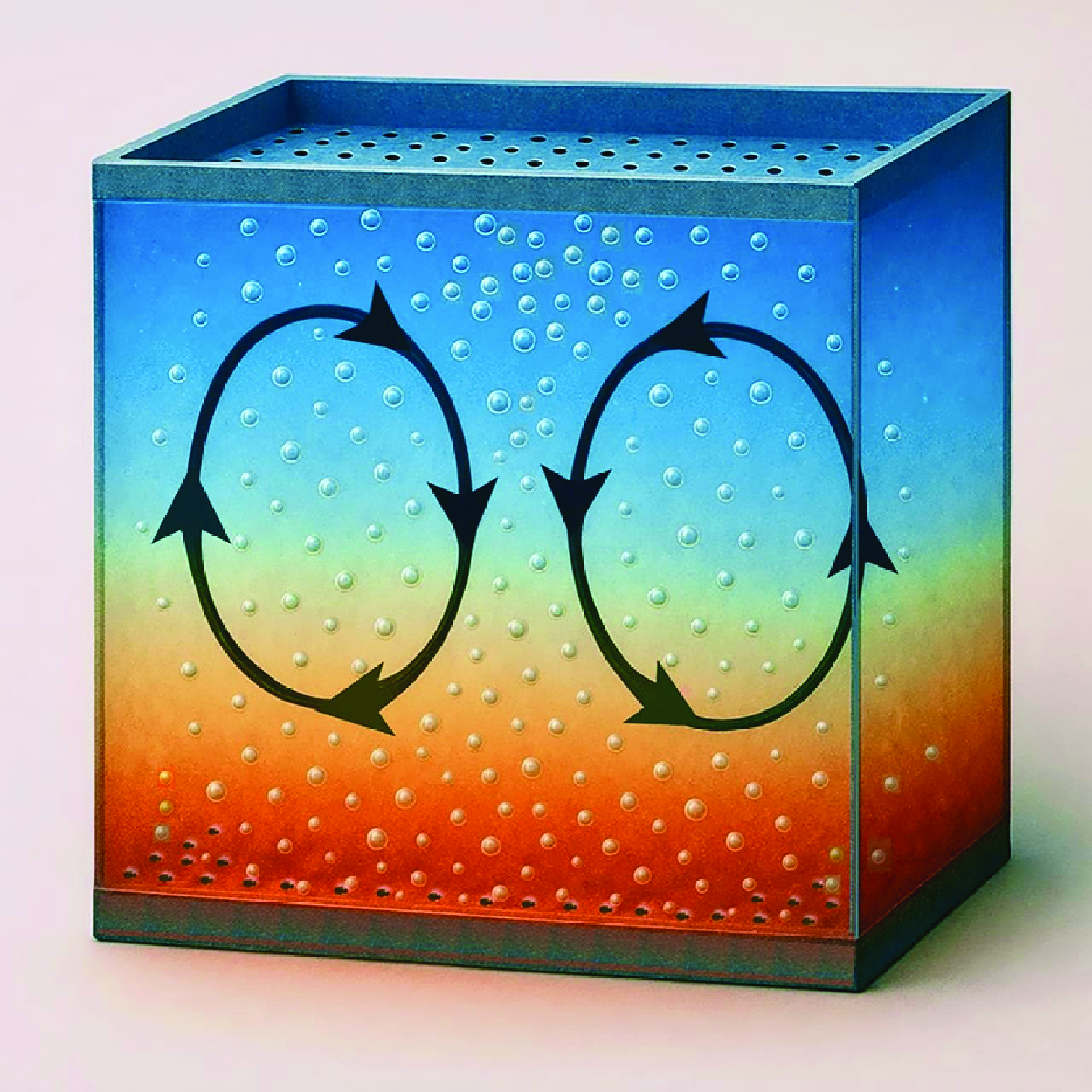
Impact of particle injection velocity on the stability of the particulate Rayleigh–Bénard system
-
- Journal:
- Journal of Fluid Mechanics / Volume 1015 / 2025
- Published online by Cambridge University Press:
- 21 July 2025, R2
-
- Article
- Export citation
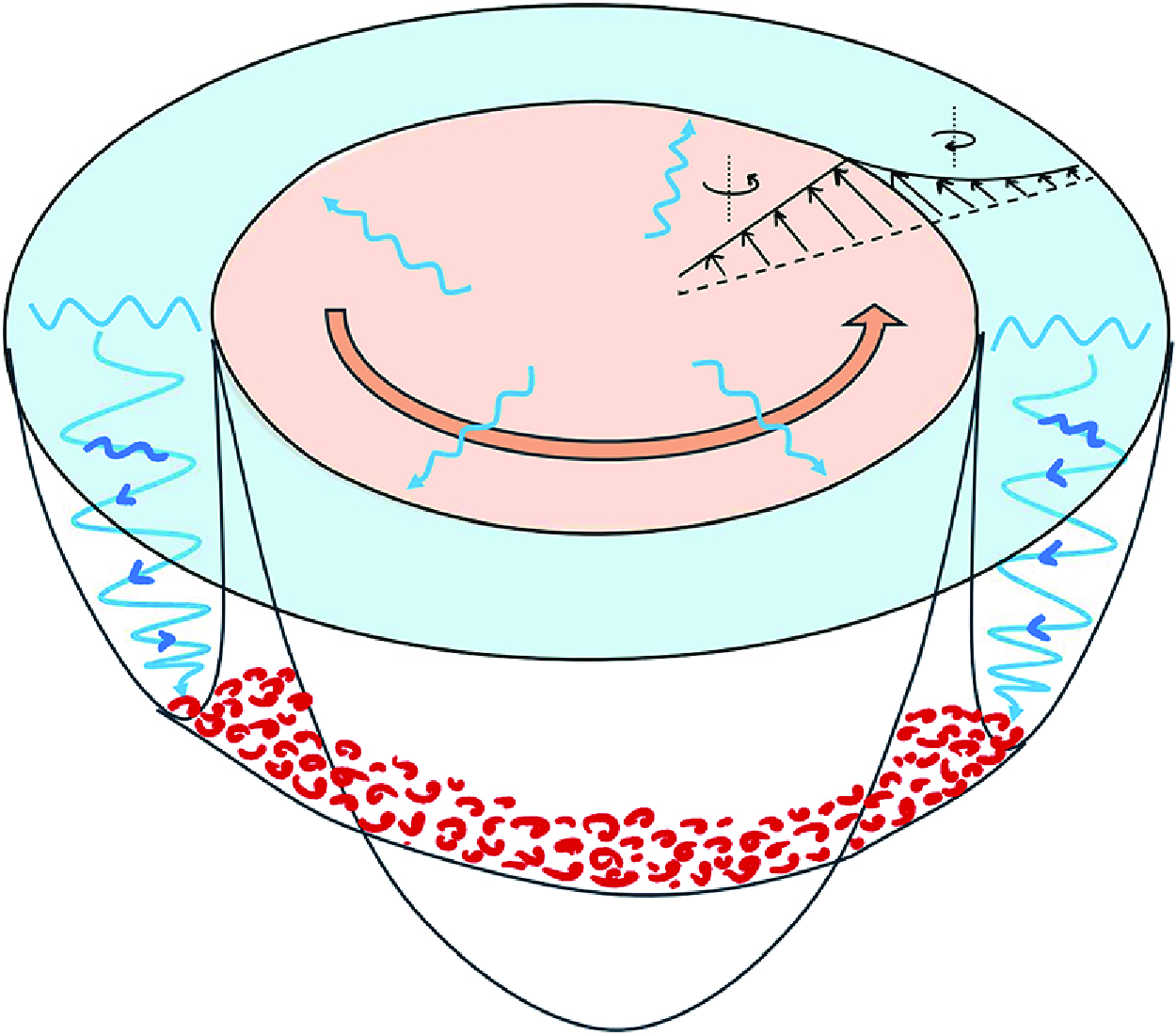
Near-inertial wave propagation in a curved front
-
- Journal:
- Journal of Fluid Mechanics / Volume 1015 / 2025
- Published online by Cambridge University Press:
- 17 July 2025, R1
-
- Article
- Export citation

Major role and longitudinal nature of stochastic resonance in promoting chaotic states in viscoelastic channel flow with low inlet perturbations
-
- Journal:
- Journal of Fluid Mechanics / Volume 1014 / 2025
- Published online by Cambridge University Press:
- 08 July 2025, R4
-
- Article
- Export citation
-
Stochastic resonance (SR) is universal phenomenon, where noise amplifies a weak periodic signal in bistable nonlinear systems, with wide applications in biology, climate science, engineering etc., although in fluid dynamics it remains underexplored. Recently, we unexpectedly found SR above non-modal elastic instability onset in an inertialess viscoelastic channel flow, where it emerges on the top of a chaotic streamwise velocity power spectrum $E_u$ due to its interaction with white-noise spanwise velocity power spectrum $E_w$ and weak elastic waves. These three conditions necessary for SR emergence differ from those required for the classical SR emergence mentioned above. Here, we consider SR in an inertialess viscoelastic channel flow with a smoothed inlet causing order of magnitude lower noise intensity than in our former studies. Our observations reveal that SR appears at the same conditions mentioned above, where SR is found just upon the instability onset in a lower subrange of a transition regime, in contrast, here, SR persists across all flow regimes – transition, elastic turbulence and drag reduction. Furthermore, we provide experimental evidence that SR, presented by a sharp peak in $E_u$, manifests as either a standing or propagating wave in the $x$-direction, with a rather uniform amplitude of streamwise velocity fluctuations and zero propagation velocity in the $z$-direction. These findings reveal a new mechanism underpinning the transition to a chaotic channel flow of viscoelastic fluids and establish SR as a robust framework for understanding complex flow dynamics. This work opens new avenues for exploring SR in other nonlinear systems and practical applications such as mixing enhancement and flow control in industrial and biological contexts.


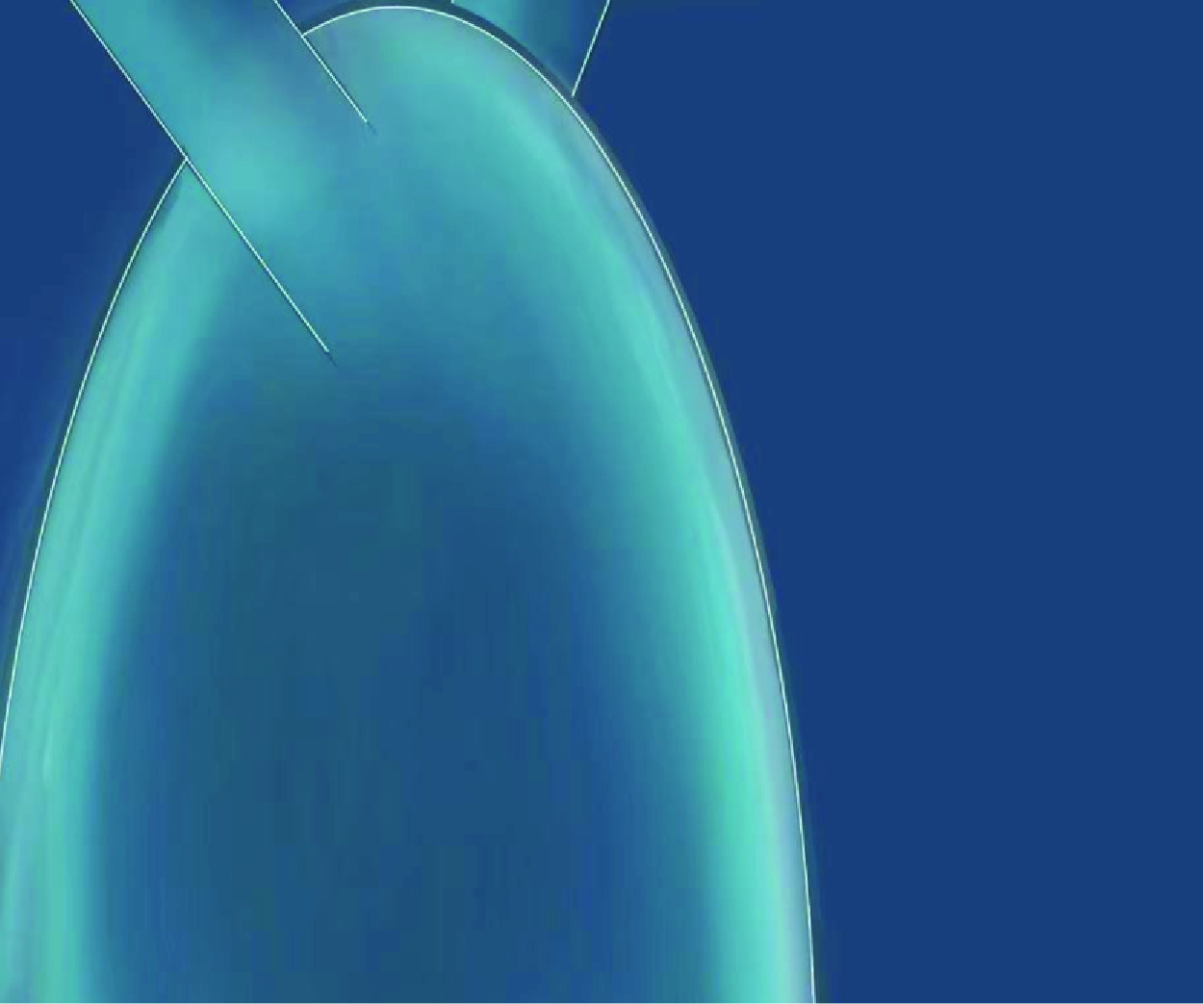
Thickness model for viscous impinging liquid sheets
-
- Journal:
- Journal of Fluid Mechanics / Volume 1014 / 2025
- Published online by Cambridge University Press:
- 30 June 2025, R3
-
- Article
- Export citation
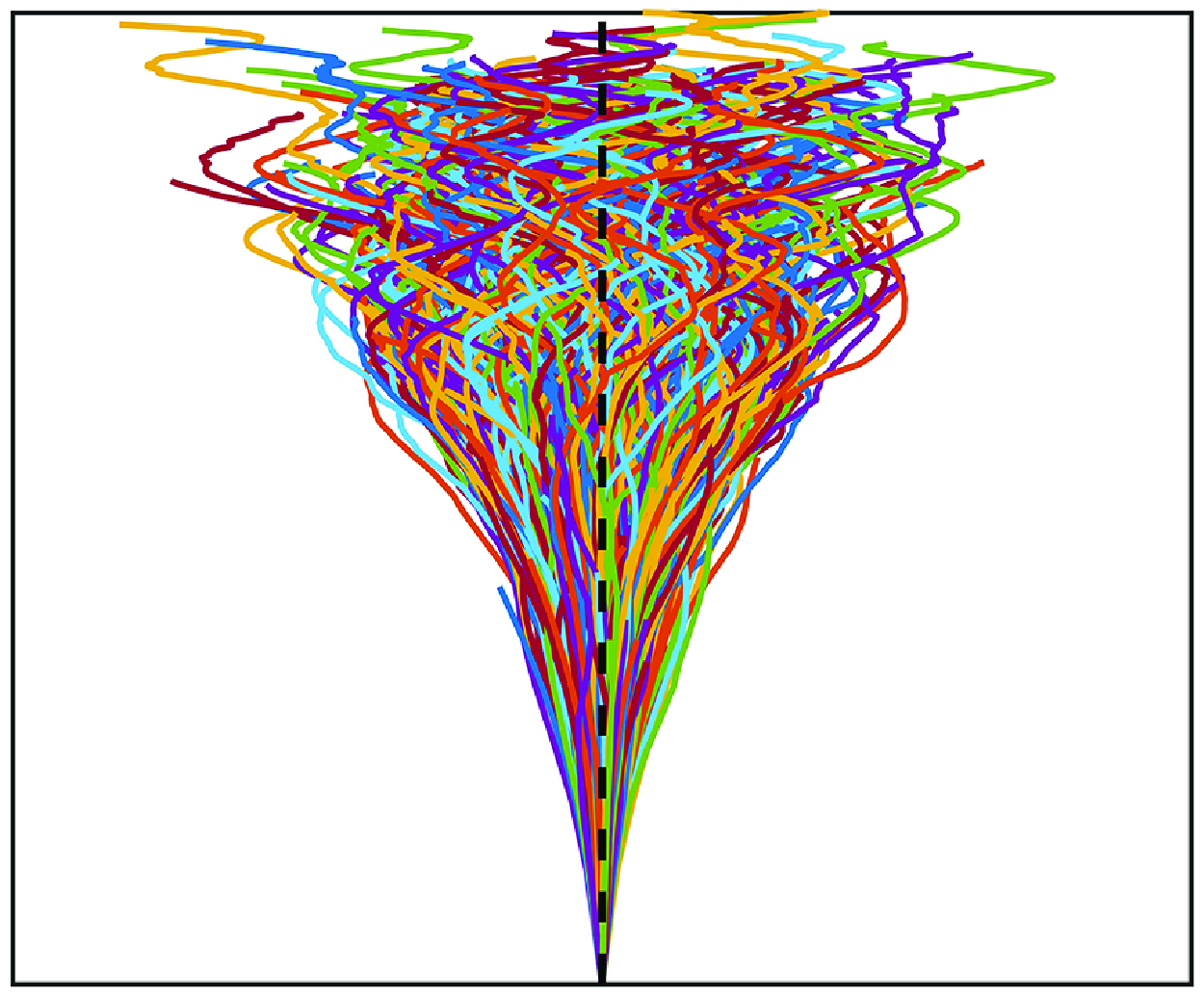
Taylor dispersion of bubble swarms rising in quiescent liquid
-
- Journal:
- Journal of Fluid Mechanics / Volume 1014 / 2025
- Published online by Cambridge University Press:
- 26 June 2025, R1
-
- Article
-
- You have access
- Open access
- HTML
- Export citation
-
We study the dispersion of bubble swarms rising in initially quiescent water using three-dimensional Lagrangian tracking of deformable bubbles and tracer particles in an octagonal bubble column. Two different bubble sizes (3.5 mm and 4.4 mm) and moderate gas volume fractions ( $0.52\,\%{-}1.20\,\%$) are considered. First, we compare the dispersion inside bubble swarms with that for single-bubble cases, and find that the horizontal mean squared displacement (MSD) in the swarm cases exhibits oscillations around the asymptotic scaling predicted for a diffusive regime. This occurs due to wake-induced bubble motion; however, the oscillatory behaviour is heavily damped compared to the single-bubble cases due to the presence of bubble-induced turbulence (BIT) and bubble–bubble interactions in the swarm. The vertical MSD in bubble swarms is nearly an order of magnitude faster than in the single-bubble cases, due to the much higher vertical fluctuating bubble velocities in the swarms. We also investigate tracer dispersion in BIT, and find that concerning the time to transition away from the ballistic regime, larger bubbles with a higher gas void fraction transition earlier than tracers, consistent with Mathai et al. (2018, Phys. Rev. Lett., vol. 121, 054501). However, for bubble swarms with smaller bubbles and a lower gas void fraction, they transition at the same time. This differing behaviour is due to the turbulence being more well-mixed for the larger bubble case, whereas for the smaller bubble case, the tracer dispersion is highly dependent on the wake fluctuations generated by the oscillating motion of nearby bubbles.
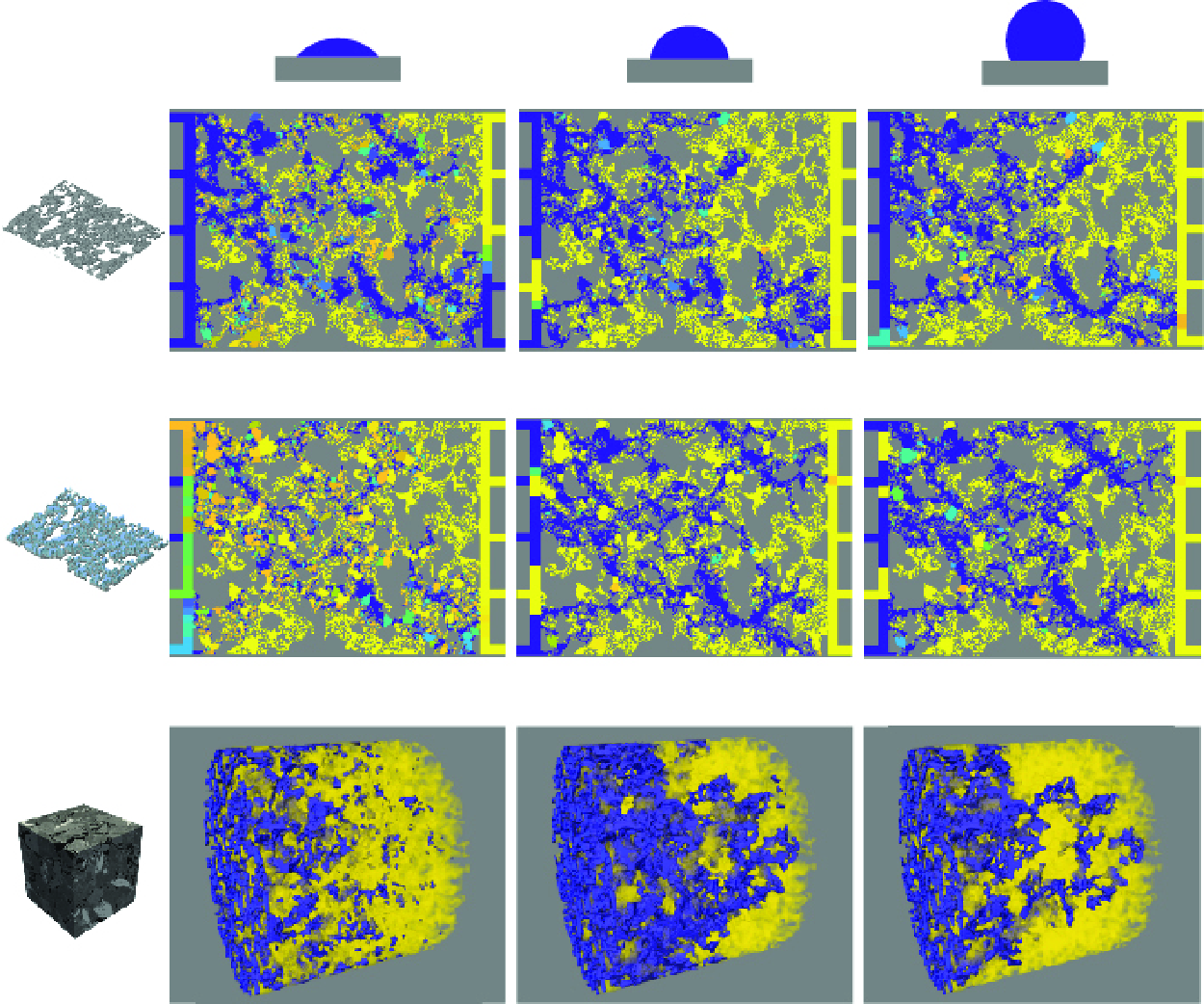
3-D-geometry-triggered transition from monotonic to non-monotonic effects of wettability on multiphase displacements in homogeneous porous media
-
- Journal:
- Journal of Fluid Mechanics / Volume 1014 / 2025
- Published online by Cambridge University Press:
- 25 June 2025, R2
-
- Article
- Export citation
-
Previous studies claimed that the non-monotonic effects of wettability came mainly from the heterogeneity of geometries or flow conditions on multiphase displacements in porous media. For macroscopic homogeneous porous media, without permeability contrast or obvious preferential flow pathways, most pore-scale evidence showed a monotonic trend of the wettability effect. However, this work reports transitions from monotonic to non-monotonic wettability effects when the dimension of the model system rises from two-dimensional (2-D) to three-dimensional (3-D), validated by both the network modelling and the microfluidic experiments. The mechanisms linking the pore-scale events to macroscopic displacement patterns have been analysed through direct simulations. For 2-D porous media, the monotonic effect of wettability comes from the consistent transition pattern for the full range of capillary numbers $Ca$, where the capillary fingering mode transitions to the compact displacement mode as the contact angle $\theta$ decreases. Yet, it is indicated that the 3-D porous geometries, even though homogeneous without permeability contrast or obvious preferential flow pathways, introduce a different $Ca$–
$Ca$– $\theta$ phase diagram with new pore-scale events, such as the coupling of capillary fingering with snap-off during strong drainage, and frequent snap-off events during strong imbibition. These events depend strongly on geometric confinements and capillary numbers, leading to the non-monotonicity of wettability effects. Our findings provide new insights into the multiphase displacement dependent on wettability in various natural porous media and offer design principles for engineering artificial porous media to achieve desired immiscible displacement behaviours.


Dynamics of rotating helices in a viscous fluid
-
- Journal:
- Journal of Fluid Mechanics / Volume 1013 / 2025
- Published online by Cambridge University Press:
- 13 June 2025, R1
-
- Article
-
- You have access
- Open access
- HTML
- Export citation
The effect of shear-thinning on the scalings and small-scale structures of turbulence
-
- Journal:
- Journal of Fluid Mechanics / Volume 1012 / 2025
- Published online by Cambridge University Press:
- 09 June 2025, R5
-
- Article
-
- You have access
- Open access
- HTML
- Export citation
-
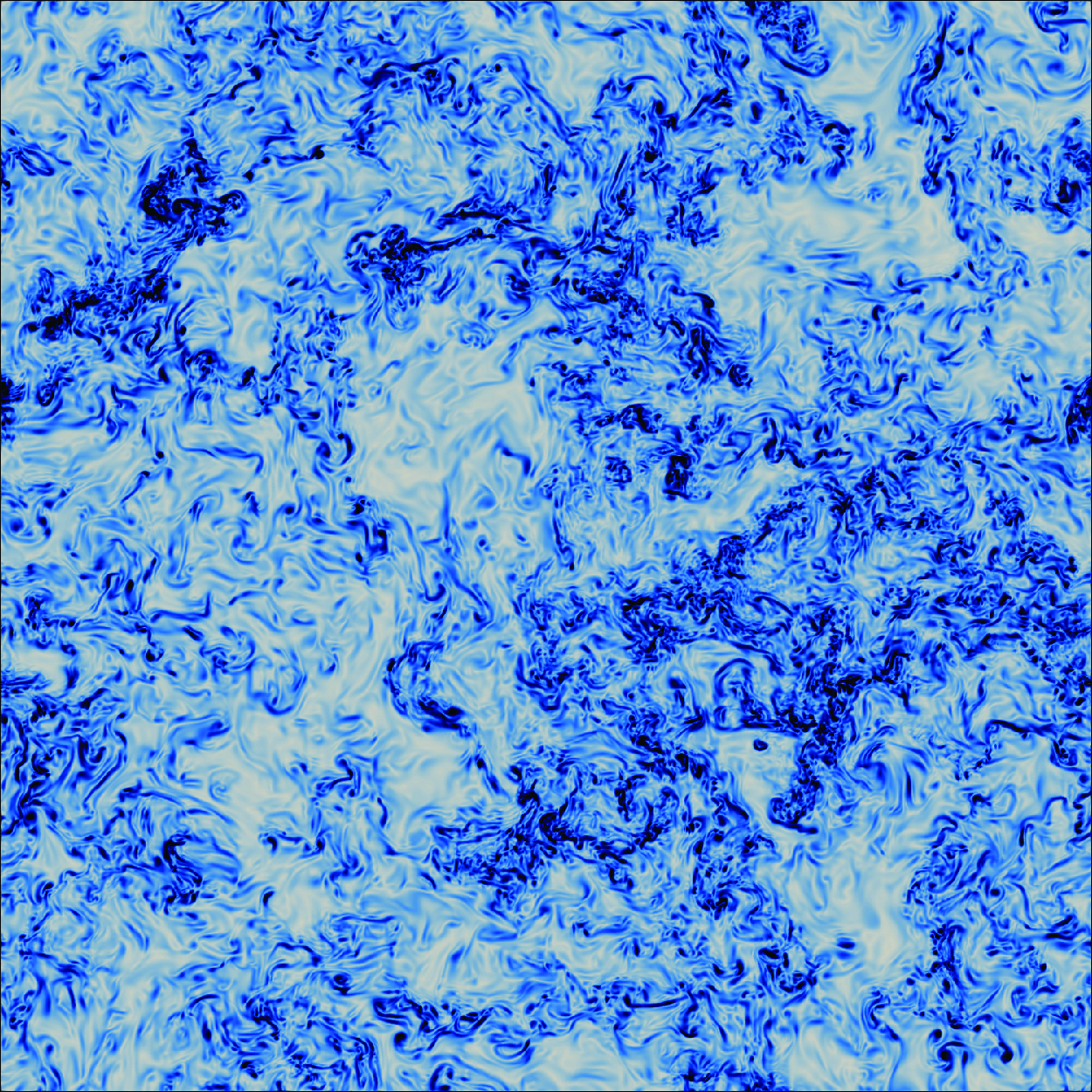
We study the homogeneous isotropic turbulence of a shear-thinning fluid modelled by the Carreau model, and show how the variable viscosity affects the multiscale behaviour of the turbulent flow. We show that Kolmogorov theory can be extended to such non-Newtonian fluids, provided that the correct choice of average is taken when defining the mean Kolmogorov scale and dissipation rate, to properly capture the effect of the variable viscosity. Thus the classical phenomenology à la Kolmogorov can be observed in the inertial range of scale, with the energy spectra decaying as $k^{-5/3}$, with $k$ being the wavenumber, and the third-order structure function obeying the $4/5$ law. The changing viscosity instead strongly alters the small scale of turbulence, leading to an enhanced intermittent behaviour of the velocity field.


Measurements of turbulent decay in a von Kármán flow at high Reynolds numbers
-
- Journal:
- Journal of Fluid Mechanics / Volume 1012 / 2025
- Published online by Cambridge University Press:
- 29 May 2025, R4
-
- Article
-
- You have access
- Open access
- HTML
- Export citation
-
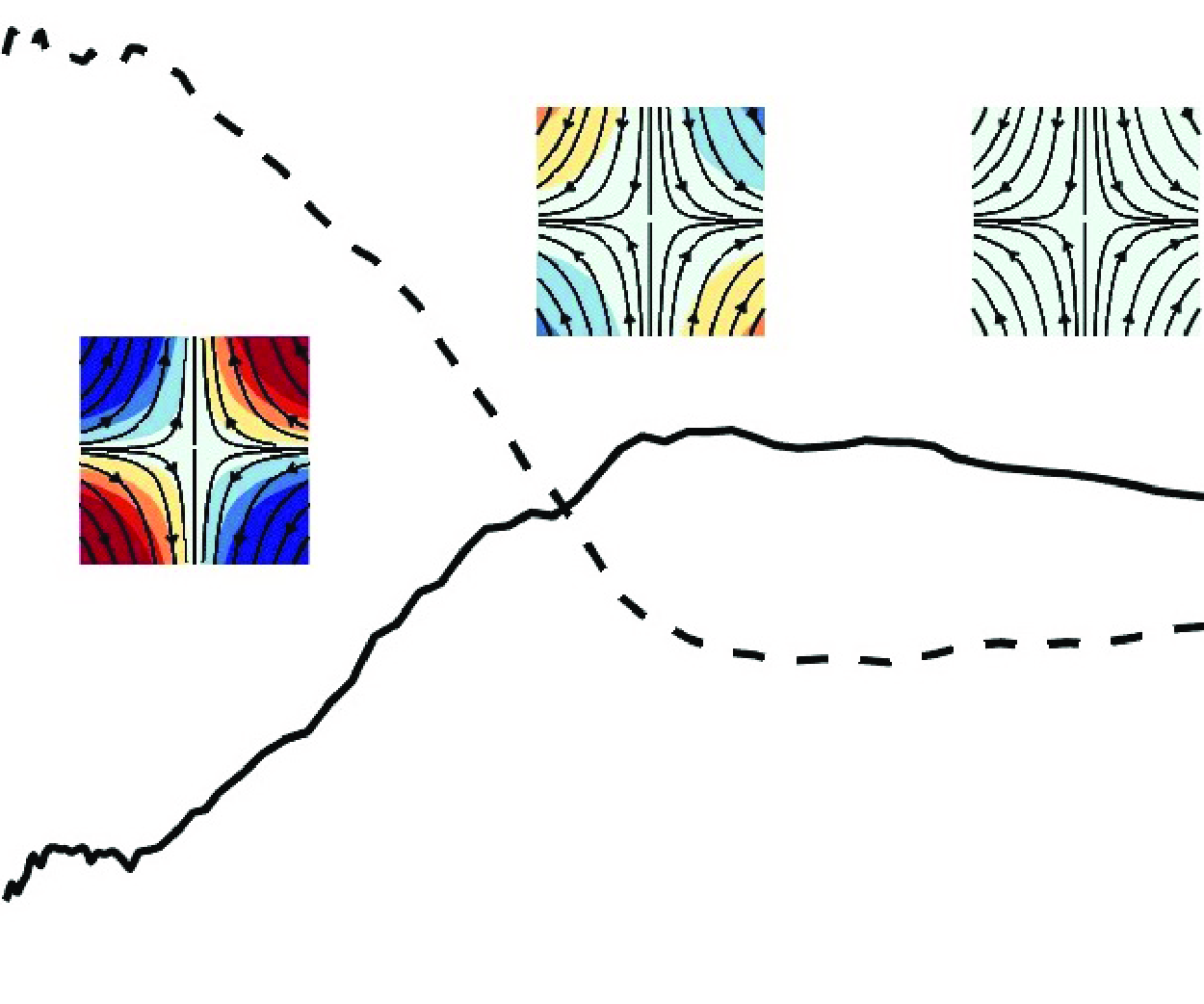
We present the measurements of the decay of stationary turbulence at Reynolds numbers based on the Taylor microscale $Re_{\lambda }=493, 599, 689$ produced in a large-scale von Kármán flow using stereoscopic particle image velocimetry. First, steady-state conditions were established, after which the impellers were simultaneously and abruptly stopped, and the turbulent decay was measured over 10–20 impeller rotation periods. A total of 258 decay experiments were performed. The temporal evolution of the ensemble-averaged turbulent kinetic energy (TKE) showed excellent agreement over all $Re_{\lambda }$ and exhibited two distinct phases: a short, initial transition phase where the TKE remained almost constant due to the inertia of the flow and lasted approximately $0.4$ impeller rotations, followed by a classical power-law decay. To extract the decay exponent $n$, a curve-fitting function based on a one-dimensional energy spectrum was used, and successfully captured the entire measured decay process. A value $n=1.62$ was obtained based on ensemble-averaged TKE. However, different decay exponents were found for individual velocity components: $n=1.38$ for the axial component consistent with various reports in the literature and Loitsiansky’s prediction ( $n=1.43$), and $n=1.99$ for the radial and circumferential components indicating saturation/confinement effects. Similarly, the longitudinal integral length scale in the axial direction grew as $L\propto t^{2/7}$, whereas it remained nearly constant in the radial direction. Finally, the evolution of the ensemble-averaged velocity gradients showed that after the impellers were stopped, the mean flow pattern persisted for a short time before undergoing a large-scale reversal before the onset of the turbulent decay.


