Contents
Research Article
The Distribution of Sequences and Summability
-
- Published online by Cambridge University Press:
- 20 November 2018, pp. 1-10
-
- Article
-
- You have access
- Export citation
-
We suppose that 0 < sn ≤ 1 for every n, and denote by n(α, β) the number of S 0, S1, S 2, . . . , Sn which fall in the interval 0 ≤ α < x ≤ β ≤ 1. If there exists a function g(t), 0 ≤ t ≤ 1, such that

for every interval (α, β] with 0 ≤ β — α ≤ 1, the sequence (Sn ) is said to have a distribution function g(t), 0 ≤ t ≤ 1, in the interval [0, 1], (see 9, p. 87).
An Algorithm for a Minimum Cover of an Abstract Complex
-
- Published online by Cambridge University Press:
- 20 November 2018, pp. 11-24
-
- Article
-
- You have access
- Export citation
-
Let X = {x 1, x 2,...,x m} be a finite set of m points and
 = {A 1, A 2, . . . , An ] be a class of n subsets of X. Such a system of points and sets is called a complex (X, ). If every set of the class contains two points, the complex is a graph with m points x 1x 2, . . . , xm and n edges A 1, A 2, . . . , An . A complex (X, ) in which every set has the same number of points is called regular.
 = {A
= {A A New Proof of Certain Metrization Theorems
-
- Published online by Cambridge University Press:
- 20 November 2018, pp. 25-32
-
- Article
-
- You have access
- Export citation
Triangles in an Ordinary Graph
-
- Published online by Cambridge University Press:
- 20 November 2018, pp. 33-41
-
- Article
-
- You have access
- Export citation
Relations Among Generalized Hadamard Matrices, Relative Difference Sets, and Maximal Length Linear Recurring Sequences
-
- Published online by Cambridge University Press:
- 20 November 2018, pp. 42-48
-
- Article
-
- You have access
- Export citation
The Embedding Theorems of Malcev and Lambek
-
- Published online by Cambridge University Press:
- 20 November 2018, pp. 49-58
-
- Article
-
- You have access
- Export citation
-
A given semigroup
 is said to be embeddable in a group if there exists a group which contains a subsemigroup isomorphic to .
It can easily be proved that cancellation is a necessary condition for embeddability. It can also be shown that we can adjoin an identity to a semigroup without identity in such a way that the new semigroup is embeddable if and only if the original was embeddable. Therefore, we can, without loss of generality, restrict our attention to cancellation semigroups with identity, whenever this is convenient.
 is said to be embeddable in a group if there exists a group
 On Commutative Squares
-
- Published online by Cambridge University Press:
- 20 November 2018, pp. 59-79
-
- Article
-
- You have access
- Export citation
Subnormal Subgroups of Division Rings
-
- Published online by Cambridge University Press:
- 20 November 2018, pp. 80-83
-
- Article
-
- You have access
- Export citation
Sur la Cohomologie Non Abelienne, II
-
- Published online by Cambridge University Press:
- 20 November 2018, pp. 84-93
-
- Article
-
- You have access
- Export citation
The Divided Central Differences of Zero
-
- Published online by Cambridge University Press:
- 20 November 2018, pp. 94-100
-
- Article
-
- You have access
- Export citation
-
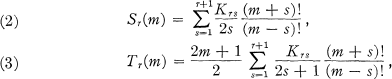
Put

In a recent paper (4), Lohne showed that
Union Curves in a Subspace Vn of a Riemannian Vm
-
- Published online by Cambridge University Press:
- 20 November 2018, pp. 101-105
-
- Article
-
- You have access
- Export citation
On the Number of Disjoint Edges in a Graph
-
- Published online by Cambridge University Press:
- 20 November 2018, pp. 106-111
-
- Article
-
- You have access
- Export citation
-
In what follows we prove that a finite graph of n nodes in which each node has degree ≥ 1 but ≤
 possesses a set of at least n/(1 + ) pairwise disjoint edges. Our principal theorem states an analogue of this result for the case when each node has degree ≥2: we show that in this case the graph possesses a set of at least 2n/(2 + max(4, )) mutually disjoint edges.
 possesses a set of at least n/(1 +
 Cluster Sets of Functions on an N-Ball
-
- Published online by Cambridge University Press:
- 20 November 2018, pp. 112-120
-
- Article
-
- You have access
- Export citation
-
Let Dn be the open unit ball in En , and let Sn be the n-sphere. The cluster set C(f, p) of a function f : Dn —> Sn at a point p on the boundary of Dn is the set of points y in Sn such that there exists a sequence of points xm —> p, xm in Dn , with f(xm ) —> y. Given an arc γ in
 , meeting the boundary bdy(Dn ) only in p, the arc cluster set C(f, γ) is the set of points y in Sn such that there exists a sequence xm —> p, xm in γ, with f(xm ) —> y.
 , meeting the boundary bdy(D
Multipliers of Difference Sets
-
- Published online by Cambridge University Press:
- 20 November 2018, pp. 121-124
-
- Article
-
- You have access
- Export citation
-
Let λ, K, v be integers such that 0 < λ < k < v. Then the set of integers

is a difference set with parameters v, k, λ if each non-zero residue modulo v occurs precisely λ times and zero occurs precisely ktimes among the k2 numbers

On the "Edge of the Wedge" Theorem
-
- Published online by Cambridge University Press:
- 20 November 2018, pp. 125-131
-
- Article
-
- You have access
- Export citation
Torsion-Free and Divisible Modules Over Non-Integral-Domains
-
- Published online by Cambridge University Press:
- 20 November 2018, pp. 132-151
-
- Article
-
- You have access
- Export citation
Unions of Two Convex Sets
-
- Published online by Cambridge University Press:
- 20 November 2018, pp. 152-156
-
- Article
-
- You have access
- Export citation
Properties of Harmonic Functions of Three Real Variables Given by Bergman-Whittaker Operators
-
- Published online by Cambridge University Press:
- 20 November 2018, pp. 157-168
-
- Article
-
- You have access
- Export citation
-
Let
 be a closed rectifiable curve, not going through the origin, which bounds a domain Ω in the complex ζ-plane. Let X = (x, y, z) be a point in three-dimensional euclidean space E3 and set
The Bergman-Whittaker operator defined by

 be a closed rectifiable curve, not going through the origin, which bounds a domain Ω in the complex ζ-plane. Let X = (x, y, z) be a point in three-dimensional euclidean space E
Characters With Preassigned Values
-
- Published online by Cambridge University Press:
- 20 November 2018, pp. 169-171
-
- Article
-
- You have access
- Export citation
-
Let k and t be positive integers; let q 1, q 2, . . . , q t be distinct prime numbers; and let ζ1, ζ 2, ... , ζ t be kth roots of unity, not necessarily primitive. Recent investigations on consecutive kth power residues have led to the following question: Under what conditions do there exist primes p that have a kth power character X such that

Pairs of Consecutive Power Residues
-
- Published online by Cambridge University Press:
- 20 November 2018, pp. 172-177
-
- Article
-
- You have access
- Export citation