To save content items to your account,
please confirm that you agree to abide by our usage policies.
If this is the first time you use this feature, you will be asked to authorise Cambridge Core to connect with your account.
Find out more about saving content to .
To save content items to your Kindle, first ensure no-reply@cambridge.org
is added to your Approved Personal Document E-mail List under your Personal Document Settings
on the Manage Your Content and Devices page of your Amazon account. Then enter the ‘name’ part
of your Kindle email address below.
Find out more about saving to your Kindle.
Note you can select to save to either the @free.kindle.com or @kindle.com variations.
‘@free.kindle.com’ emails are free but can only be saved to your device when it is connected to wi-fi.
‘@kindle.com’ emails can be delivered even when you are not connected to wi-fi, but note that service fees apply.
The works of prominent contemporary Iranian composers Hossein Alīzādeh and Parvīz Meshkātīān demonstrate a novel approach to the text-music relationship, characterized by a new understanding of the interaction between music's internal syntax and structure and the external world. This innovative approach, which can be described as “musical realism,” strives to represent textual meanings through musical gestures, particularly within the tasnīf genre, a metrical, pre-composed song with a pre-determined way of accompaniment, which developed over the past century.1 This approach, emerging primarily in contemporary compositions, is exemplified by the above two composers, who illustrate textual meaning through the intricate utilization of innovative treatments of modes, rhythm, melody, and texture relying on the potentials of the core of Persian musical tradition, the radīf – a collection of traditional Iranian melodic figures passed down orally through generations and serving as the foundational framework for improvisation and composition.2 By examining select instances from these composers’ works, I highlight the growing emphasis on a realist music-text relationship and its interplay with both the inner structures of Persian classical music and the broader context of Iran's modern position in the world.
Single-molecule methods offer powerful insights into DNA-protein interactions at the individual DNA molecule level. We developed an automated, high-throughput nanofluidic imaging platform to characterize DNA-protein complexes in solution. The platform uses a nanofluidic chip with 10 sets of nanochannels where thousands of DNA molecules can be simultaneously analyzed in different conditions. Using this approach, we investigate Rok, a multifunctional Bacillus subtilis protein involved in genome organization and transcription regulation. Our findings confirm the DNA-condensing activity of Rok, likely attributed to its ability to bridge distant DNA segments. Additionally, Rok promotes the hybridization of 12 base complementary single-stranded DNA overhangs, suggesting a potential role in homology search during recombination. Rok also displays sequence-selective binding, preferentially associating with adenine and thymine-rich (AT-rich) DNA regions. To explore the structural features of Rok underlying these activities and test our nanofluidic system further, we compare wild-type Rok with two variants: ∆Rok, lacking the neutral part of the internal linker, and sRok, a naturally occurring variant without the linker. This comparison highlights the role of the linker in hybridization, i.e., interaction with single-stranded DNA. Together, these findings enhance our understanding of Rok-mediated DNA dynamics and establish single-molecule nanofluidics as a powerful tool for high-throughput studies of DNA–protein interactions.
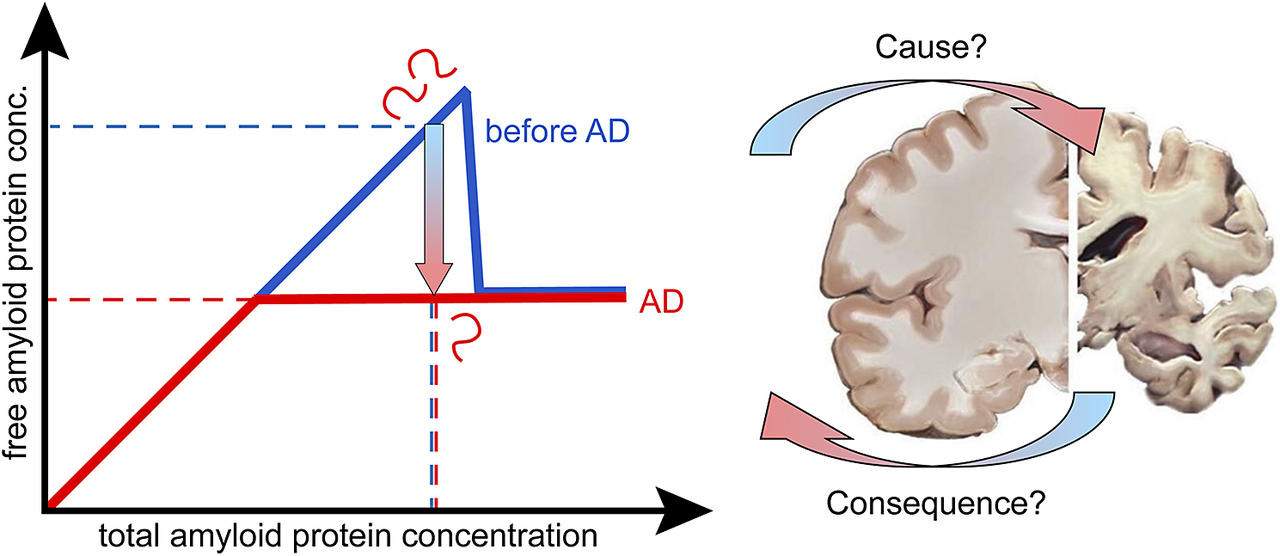
In this perspective, we ask the question whether the apparently lower solubility of specific proteins in amyloid disease is a cause or consequence of the protein deposition seen in such diseases. We focus on Alzheimer’s disease and start by reviewing the experimental evidence of disease-associated reduction in the measured concentration of amyloid β peptide, Aβ42, in cerebrospinal fluid. We propose a series of possible physicochemical explanations for these observations. These include a reduced solubility, a reduced apparent solubility, as well as a long-lived metastable state manifested in healthy individuals as a free concentration of Aβ42 in the solution phase above the solubility limit. For each scenario, we discuss whether it is most likely a cause or a consequence of the observed protein deposition in the disease.
Prayer is one of the basic elements of religious life and is widespread in most religions. It is the human act, verbal and non-verbal, of communicating with a transcendent being (in the broadest sense). In comparison to its communicative function, the written form of prayer is secondary. This study differentiates between prayer as act, prayer as text and prayer as subject, understood as any reference to or statement made about prayer. In First Thessalonians, as in contemporary letters, prayer as subject can be found in a variety of ways. An especially remarkable feature is the prayer texts and acts of prayer (although these are not numerous and mostly short), which imply a change of addressee within the communicative situation of the letter. Against the background of ancient letters and epistolary conventions of the time, this article examines the characteristics and the specific function of prayer (as text, act and subject) in First Thessalonians. It argues that the Christian message shapes and multiplies the references to prayer, also integrating short texts and acts of prayer which transcend the epistolary communication, deepening not only the relationship between Paul, Silvanus, and Timothy and the Thessalonians but also their relationship to God and in God.
Australia appears to be following the trend in mainly Western countries of recognising animal sentience in the law. This article sets out a typology of animal sentience recognition provisions that have been enacted, or have been proposed, in Australian jurisdictions to date. These include provisions or proposed provisions located in statutory objects, statutory principles, statutory definitions and a treaty. Depending on legislative context, these provisions, and proposed provisions (if enacted), may have different legal consequences. The trend towards legally recognising animal sentience may also signal further positive legal reforms for animals in the future.
Given a self-morphism $\phi$ on a projective variety defined over a number field k, we prove two results which bound the largest iterate of $\phi$ whose evaluation at P is quasi-integral with respect to a divisor D, uniformly across P defined over a field of bounded degree over k. The first result applies when the pullback of D by some iterate of $\phi$ breaks up into enough irreducible components which are numerical multiples of each other. The proof uses Le’s algebraic-point version of a result of Ji–Yan–Yu, which is based on Schmidt subspace theorem. The second result applies more generally but relies on a deep conjecture by Vojta for algebraic points. The second result is an extension of a recent result of Matsuzawa, based on the theory of asymptotic multiplicity. Both results are generalisations of Hsia–Silverman, which treated the case of morphisms on ${\mathbb{P}}^1$.
The past few years were marked by increased online offensive strategies perpetrated by state and non-state actors to promote their political agenda, sow discord, and question the legitimacy of democratic institutions in the US and Western Europe. In 2016, the US congress identified a list of Russian state-sponsored Twitter accounts that were used to try to divide voters on a wide range of issues. Previous research used latent Dirichlet allocation (LDA) to estimate latent topics in data extracted from these accounts. However, LDA has characteristics that may limit the effectiveness of its use on data from social media: The number of latent topics must be specified by the user, interpretability of the topics can be difficult to achieve, and it does not model short-term temporal dynamics. In the current paper, we propose a new method to estimate latent topics in texts from social media termed Dynamic Exploratory Graph Analysis (DynEGA). In a Monte Carlo simulation, we compared the ability of DynEGA and LDA to estimate the number of simulated latent topics. The results show that DynEGA is substantially more accurate than several different LDA algorithms when estimating the number of simulated topics. In an applied example, we performed DynEGA on a large dataset with Twitter posts from state-sponsored right- and left-wing trolls during the 2016 US presidential election. DynEGA revealed topics that were pertinent to several consequential events in the election cycle, demonstrating the coordinated effort of trolls capitalizing on current events in the USA. This example demonstrates the potential power of our approach for revealing temporally relevant information from qualitative text data.
Lyu et al. (Psychometrika, 2023) demonstrated that item-specific factors can cause spurious effects on the structural parameters of IRTree models for multiple nested response processes per item. Here, we discuss some boundary conditions and argue that person selection effects on item parameters are not unique to item-specific factors and that the effects presented by Lyu et al. (Psychometrika, 2023) may not generalize to the family of IRTree models as a whole. We conclude with the recommendation that IRTree model specification should be guided by theoretical considerations, rather than driven by data, in order to avoid misinterpretations of parameter differences.
Numerous recent scandals have surfaced relating to the Australian government allegedly engaging in ‘pork barrelling’, that is, the partisan channelling of grants funding to government electorates, instead of merit-based allocation. Yet the probity of the use of public money is crucial towards preserving public trust in Australian democratic institutions. This article will critically analyse the legal accountability mechanisms for grants funding through public finance legislation, ‘soft law’ such as grants, guidelines and ministerial standards, and the availability of legal redress. It will also examine political accountability mechanisms, including the operation of parliamentary committees, the Auditor-General and the Ombudsman. The author argues that although political regulation provides transparency in the government’s use of public funds, it remains ineffective to combat the government’s deeply entrenched incentives to allocate grants in a partisan manner. As such, it is contended that stronger legal accountability in terms of enforceable rules and regulations is required to reform grants regulation towards improving the probity and accountability of the use of public funding.
This article examines how the war in Ukraine has had an impact upon the enlargement of the European Union (EU) and transnational cooperation in Europe. It explains how, in response to Russia's aggression against Ukraine, the EU has relaunched its enlargement process (notably, by opening accession negotiations with Ukraine), promoted the establishment of a new European Political Community and deepened its ties with other regional organisations, like the Council of Europe and the North Atlantic Treaty Organization, and the United Kingdom. It is argued that the return of large-scale warfare to the European continent for the first time since the end of World War II has contributed to reaffirming the role of the EU as a beacon of liberty, peace, security and prosperity, and highlighted the dynamism of the European integration project. Nevertheless, a number of challenges lie ahead, especially regarding enlargement, including both the candidates’ preparation and the EU's own readiness. The article therefore proceeds to map the debate about EU reform, the ongoing stalemate and the open questions concerning the future of Europe in order to illustrate fully the impact of the war in Ukraine on the enlargement project.
Populism’s effects on democracy after populists gain control of government (hereafter, populist incumbents) are some of the best theorized and documented consequences. The argument that populist incumbents threaten institutions of democratic contestation—and, less frequently, that they correct some aspects of political participation and representation—has been made from multiple approaches.1 Scholars and commentators often cite specific cases of populists harming democracy and, since 2016, several large-N studies have confirmed their negative impact. Specifically, studies repeatedly show the harmful effects of populist incumbents on civil liberties, including media freedom, horizontal accountability, and electoral integrity in both electoral and liberal democracies. Research has been less consistent in showing the positive consequences of populist incumbents, especially for democratic representation and political participation.
This article revisits Rayford Logan’s thesis in The Negro in American Life and Thought: The Nadir, 1877‒1901 to chart how African Americans experienced joy during a racial low point—“the Nadir” of race relations. Using Logan’s claims as a conceptual framework, the article examines W. E. B. Du Bois’s position on amusement and everyday Black people’s joyful acts during the post-Reconstruction period to understand “a paradox of pleasure”—feeling jovial during dark times. With the Nadir as a case study, this essay argues that historians may develop Black joy as a historical analytic by asking research questions about Black affect, employing the tools of historical imagination, and concentrating on the small delights of daily life. This essay seeks to inspire curiosity about how exploring Black life from the angle of elation, not sorrow, can produce complex histories of Black subjectivity and feeling. It proposes Black joy as an inchoate analytic in hopes of it becoming a formal mode of historical inquiry.
The Inclusion of Other in the Self (IOS) scale is a popular tool to measure interpersonal closeness that is increasingly being used in economics. We develop and validate a continuous version of the IOS scale. This Continuous IOS scale gives a finer measure and addresses the reluctance of subjects to report low scores on the standard IOS scale. We also propose a version of the standard IOS scale that meets its original design features. Our IOS scales are easy-to-use, well-documented, standardised, and available at https://github.com/geoffreycastillo/ios-js.
The analysis of variance, and mixed models in general, are popular tools for analyzing experimental data in psychology. Bayesian inference for these models is gaining popularity as it allows to easily handle complex experimental designs and data dependence structures. When working on the log of the response variable, the use of standard priors for the variance parameters can create inferential problems and namely the non-existence of posterior moments of parameters and predictive distributions in the original scale of the data. The use of the generalized inverse Gaussian distributions with a careful choice of the hyper-parameters is proposed as a general purpose option for priors on variance parameters. Theoretical and simulations results motivate the proposal. A software package that implements the analysis is also discussed. As the log-transformation of the response variable is often applied when modelling response times, an empirical data analysis in this field is reported.
This article reconsiders the sixteenth-century Idealist Neo-Confucian philosophy of Wang Yangming (1472–1529) in light of the development of twentieth-century Latin American liberation theology. After defining liberation theology, this study identifies the crucial contributions made to it by Emmanuel Levinas’s assertion of the primacy of ethics over ontology and critique of the egocentric nature of Western philosophy. It then delineates the epistemological and deontological criticisms made of Roman Catholic orthodoxy—and institutionalized Christianity in general—by Latin American liberation theologians, particularly Enrique Dussel and José Porfirio Miranda. These are compared with Wang’s critique of the Rationalist Neo-Confucianism that had been official orthodoxy and the legitimating philosophy for imperial China for three centuries. The study finds that Wang’s Idealist philosophy incorporates epistemological, spiritual, and ethical perspectives with powerful democratic and liberationist elements that prefigure the development of late-twentieth-century Latin American liberation theology. Thus, contrary to the conventional view of Confucianism as a conservative philosophy, these elements in Wang’s Neo-Confucianism render it a theology (or philosophy) of liberation.
Complex interactive test items are becoming more widely used in assessments. Being computer-administered, assessments using interactive items allow logging time-stamped action sequences. These sequences pose a rich source of information that may facilitate investigating how examinees approach an item and arrive at their given response. There is a rich body of research leveraging action sequence data for investigating examinees’ behavior. However, the associated timing data have been considered mainly on the item-level, if at all. Considering timing data on the action-level in addition to action sequences, however, has vast potential to support a more fine-grained assessment of examinees’ behavior. We provide an approach that jointly considers action sequences and action-level times for identifying common response processes. In doing so, we integrate tools from clickstream analyses and graph-modeled data clustering with psychometrics. In our approach, we (a) provide similarity measures that are based on both actions and the associated action-level timing data and (b) subsequently employ cluster edge deletion for identifying homogeneous, interpretable, well-separated groups of action patterns, each describing a common response process. Guidelines on how to apply the approach are provided. The approach and its utility are illustrated on a complex problem-solving item from PIAAC 2012.
The goodness-of-fit of the unidimensional monotone latent variable model can be assessed using the empirical conditions of nonnegative correlations (Mokken in A theory and procedure of scale-analysis, Mouton, The Hague, 1971), manifest monotonicity (Junker in Ann Stat 21:1359–1378, 1993), multivariate total positivity of order 2 (Bartolucci and Forcina in Ann Stat 28:1206–1218, 2000), and nonnegative partial correlations (Ellis in Psychometrika 79:303–316, 2014). We show that multidimensional monotone factor models with independent factors also imply these empirical conditions; therefore, the conditions are insensitive to multidimensionality. Conditional association (Rosenbaum in Psychometrika 49(3):425–435, 1984) can detect multidimensionality, but tests of it (De Gooijer and Yuan in Comput Stat Data Anal 55:34–44, 2011) are usually not feasible for realistic numbers of items. The only existing feasible test procedures that can reveal multidimensionality are Rosenbaum’s (Psychometrika 49(3):425–435, 1984) Case 2 and Case 5, which test the covariance of two items or two subtests conditionally on the unweighted sum of the other items. We improve this procedure by conditioning on a weighted sum of the other items. The weights are estimated in a training sample from a linear regression analysis. Simulations show that the Type I error rate is under control and that, for large samples, the power is higher if one dimension is more important than the other or if there is a third dimension. In small samples and with two equally important dimensions, using the unweighted sum yields greater power.
The GESAH Graphic Arts Ontology (GESAH GAO) was developed to describe works of art on paper such as prints and drawings. The design was guided by the content-related, specialized needs of the domain experts, as well as the requirement to record the data in a structured manner in order to enable subsequent use and to ensure technical connectivity to current and future developments. The ontology models cultural objects by means of activities related to them (creation, production, inscription, preservation, exhibition etc.), people/organizations and their roles, subjects depicted and other relevant concepts. It incorporates concepts from upper ontologies such as the Basic Formal Ontology (BFO) and reuses classes and properties from ontologies such as Friend of a Friend (FOAF), VIVO, and Simple Knowledge Organization System (SKOS). With TIB SAH digital, we show the reference implementation of the GESAH GAO. It was constructed using the open-source knowledge graph suite Vitro, which provides custom entry forms for cataloguing and public access to the digitized collection.