Refine search
Actions for selected content:
179478 results in Earth and Environmental Sciences
George Sheldrick 1942–2025
-
- Journal:
- Mineralogical Magazine / Volume 89 / Issue 2 / April 2025
- Published online by Cambridge University Press:
- 30 June 2025, pp. 304-305
-
- Article
-
- You have access
- HTML
- Export citation
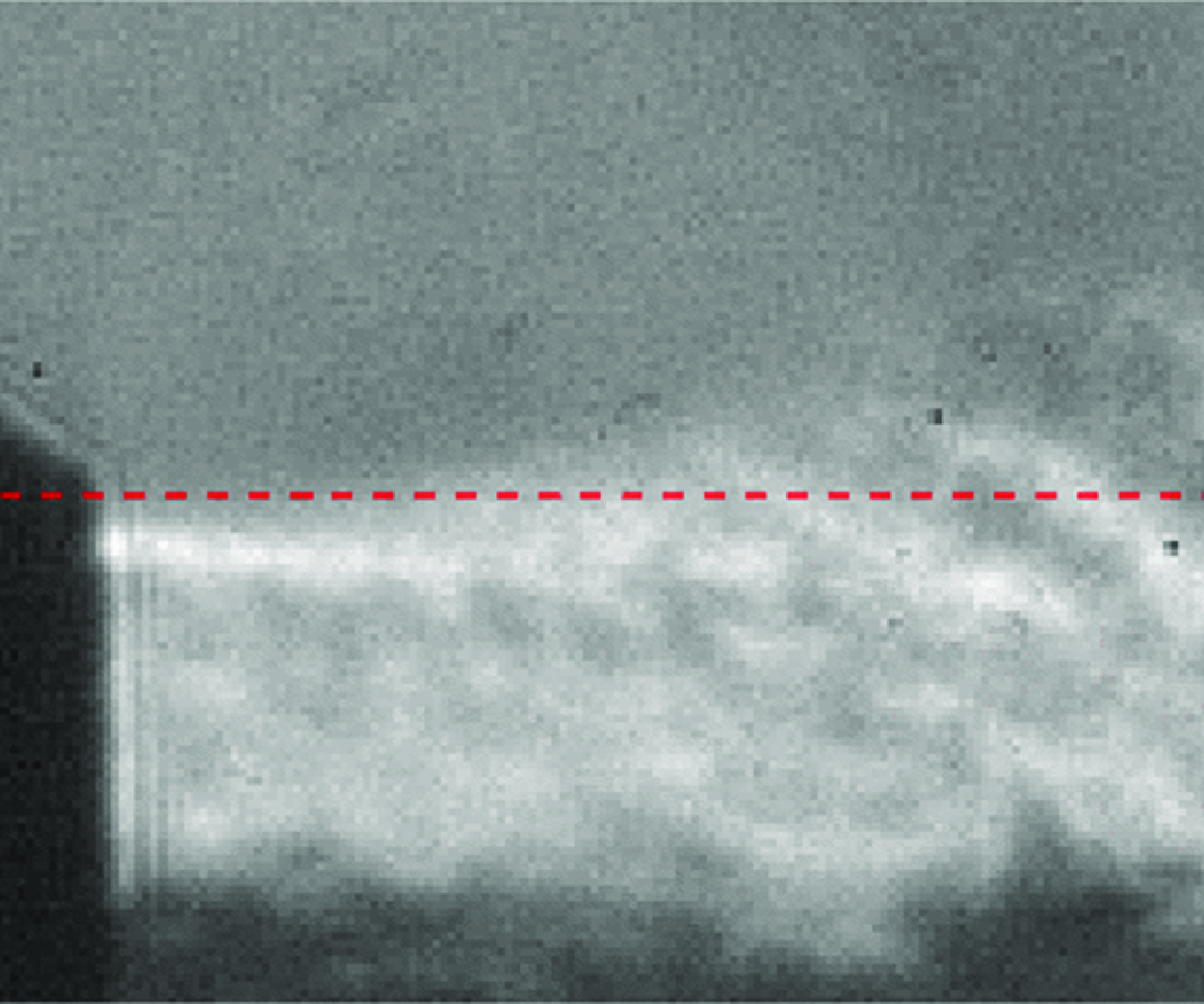
Howling of a model-scale nozzle due to shock-induced boundary-layer separation at its exit
-
- Journal:
- Journal of Fluid Mechanics / Volume 1014 / 10 July 2025
- Published online by Cambridge University Press:
- 30 June 2025, A8
-
- Article
-
- You have access
- Open access
- HTML
- Export citation
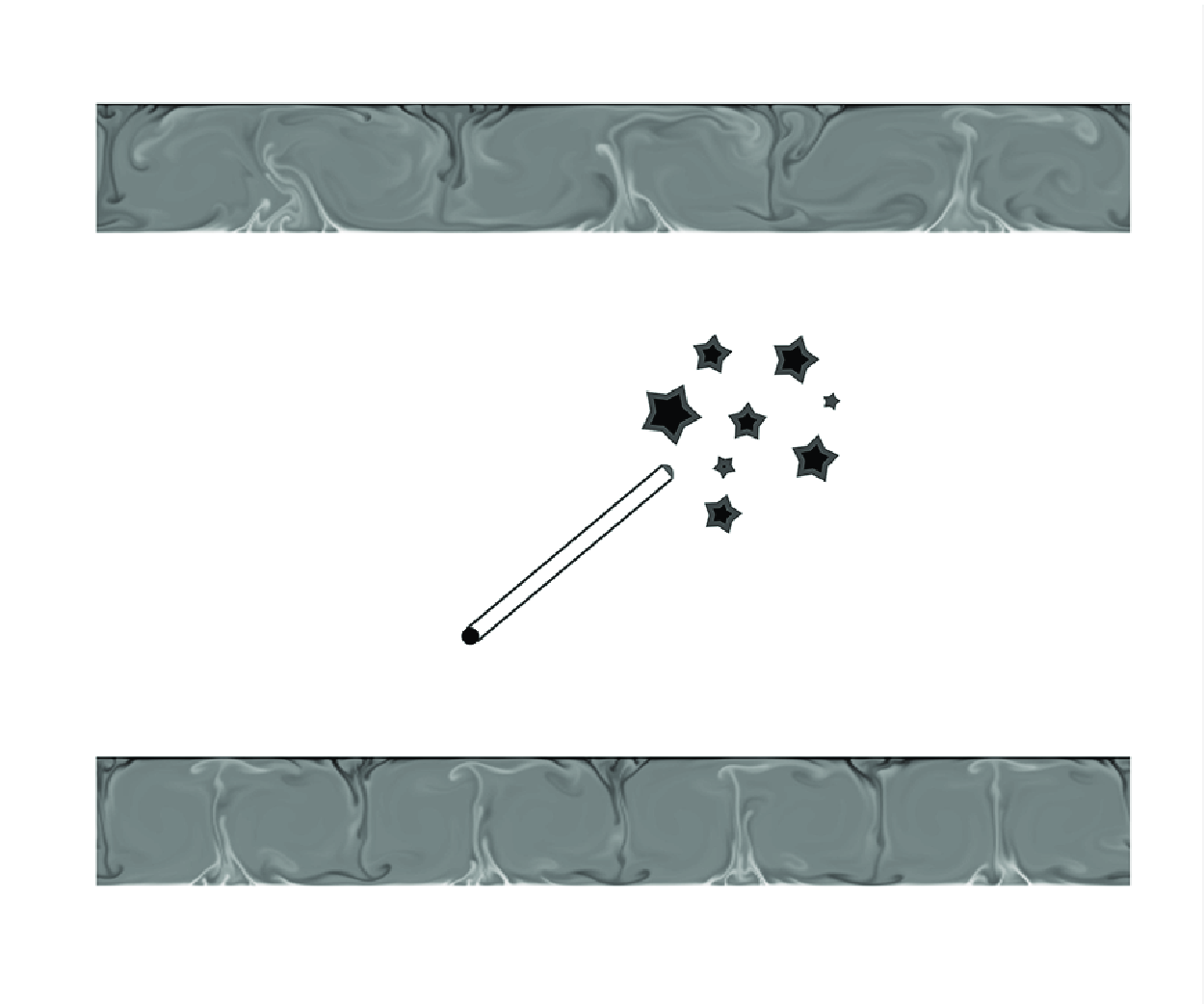
A framework for suppressing triad interaction in nonlinear dynamical systems: application to multiple states in two-dimensional Rayleigh–Bénard convection
-
- Journal:
- Journal of Fluid Mechanics / Volume 1014 / 10 July 2025
- Published online by Cambridge University Press:
- 30 June 2025, A7
-
- Article
-
- You have access
- Open access
- HTML
- Export citation
Intra- and interspecific variation of otolith morphometric asymmetry in Ethmalosa fimbriata, Galeoides decadactylus, and Cynoglossus monodi living at different depth levels in the Komo Estuary, Gabon
-
- Journal:
- Journal of the Marine Biological Association of the United Kingdom / Volume 105 / 2025
- Published online by Cambridge University Press:
- 30 June 2025, e70
-
- Article
- Export citation
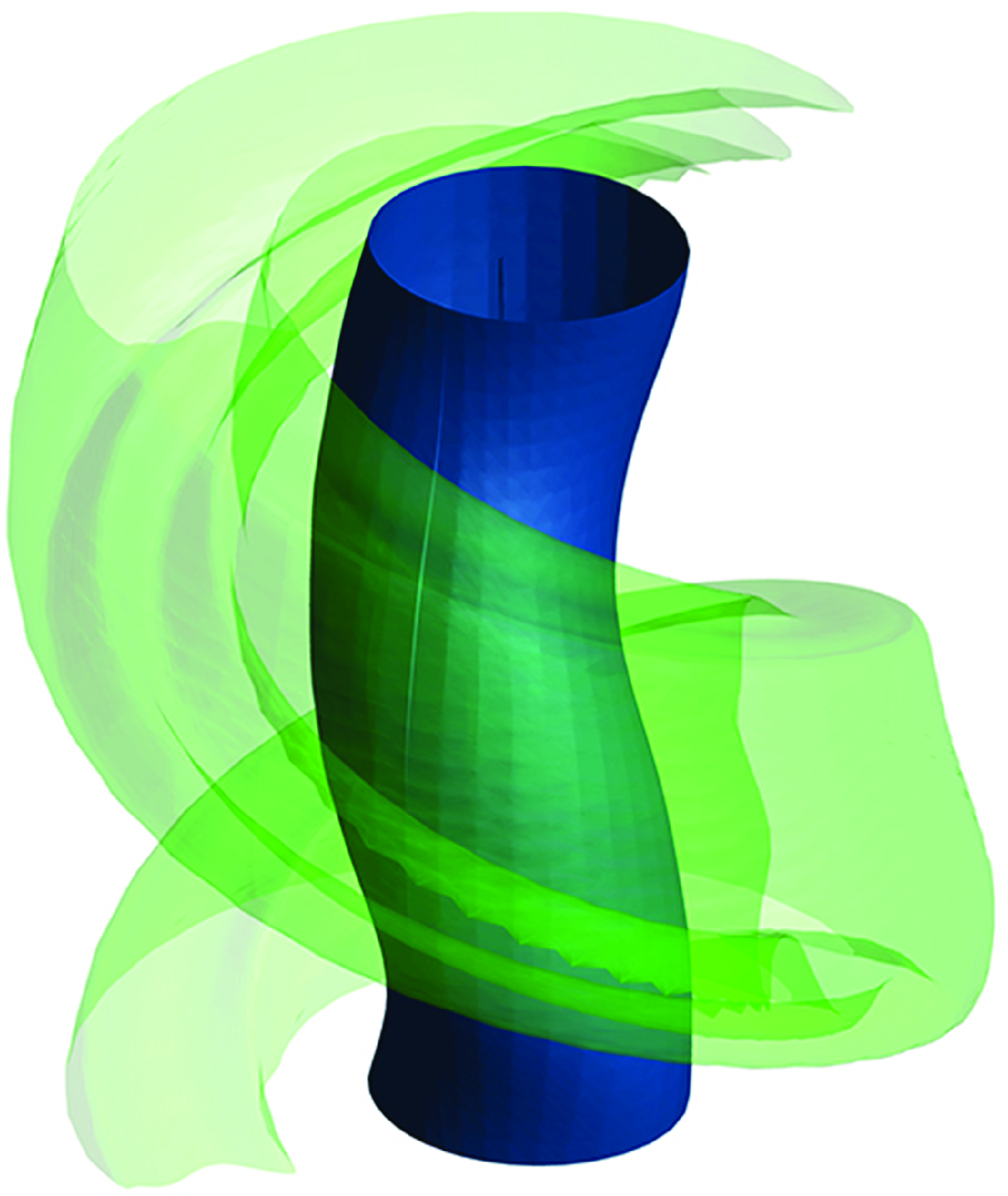
Transient growth of a wake vortex and its initiation via inertial particles
-
- Journal:
- Journal of Fluid Mechanics / Volume 1014 / 10 July 2025
- Published online by Cambridge University Press:
- 30 June 2025, A16
-
- Article
-
- You have access
- Open access
- HTML
- Export citation
-
The transient dynamics of a wake vortex, modelled as a strong swirling $q$-vortex, is investigated with a focus on optimal transient growth driven by continuous eigenmodes associated with continuous spectra. The pivotal contribution of viscous critical-layer eigenmodes (Lee and Marcus, J. Fluid Mech. vol. 967, 2023, p. A2) amongst the entire eigenmode families to optimal perturbations is numerically confirmed, using a spectral collocation method for a radially unbounded domain that ensures correct analyticity and far-field behaviour. The consistency of the numerical method across different sensitivity tests supports the reliability of the results and provides flexibility for tuning. Both axisymmetric and helical perturbations with axial wavenumbers of order unity or less are examined through linearised theory and nonlinear simulations, yielding results that align with existing literature on energy growth curves and optimal perturbation structures. The initiation process of transient growth is also explored, highlighting its practical relevance. Inspired by ice crystals in contrails, the backward influence of inertial particles on the vortex flow, particularly through particle drag, is emphasised. In the pursuit of optimal transient growth, particles are initially distributed at the periphery of the vortex core to disturb the flow. Two-way coupled vortex–particle simulations reveal clear evidence of optimal transient growth during ongoing vortex–particle interactions, reinforcing the robustness and significance of transient growth in the original nonlinear vortex system over finite time periods.

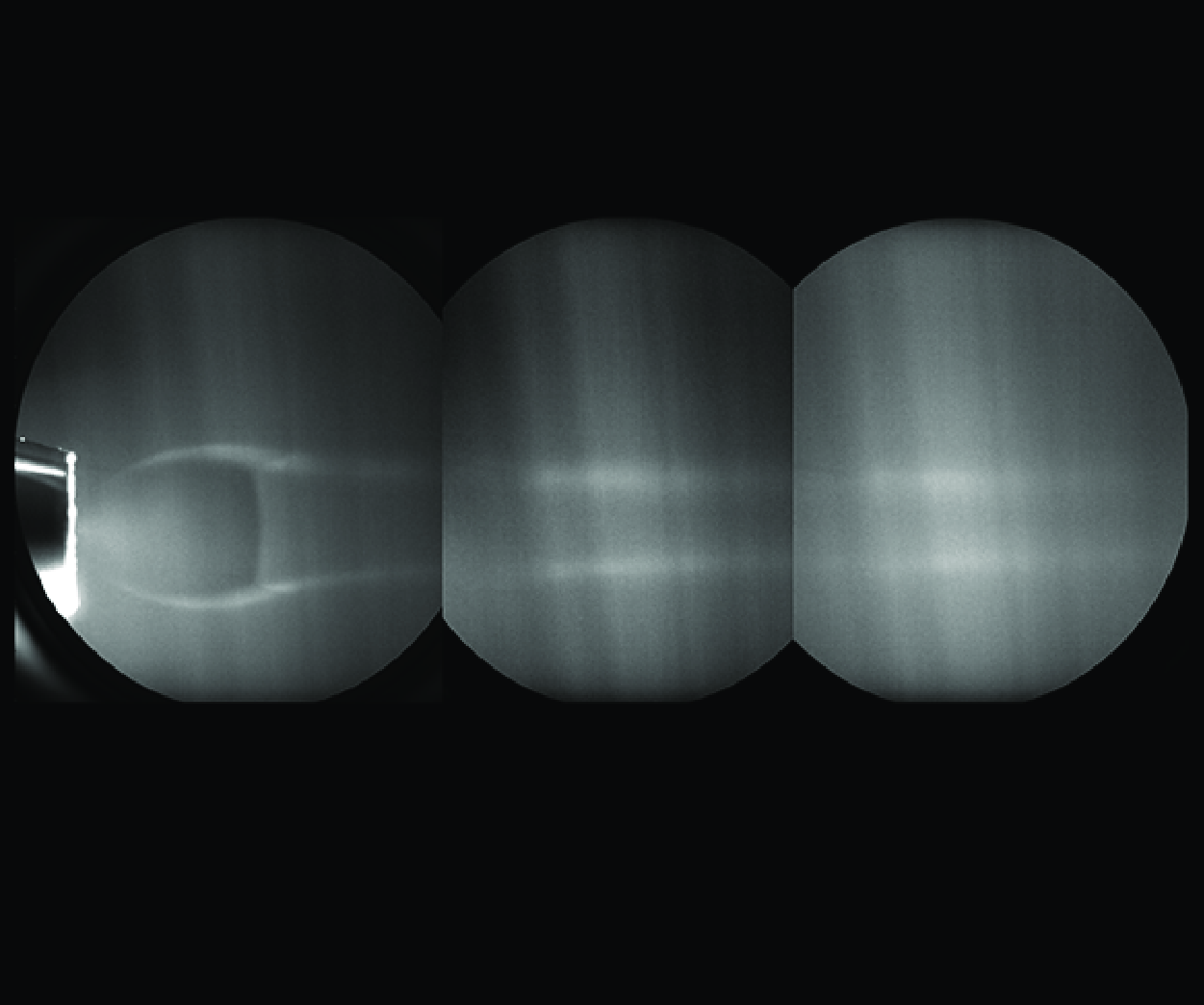
Experimental investigation of turbulent and laminar flow regimes in a supersonic free jet under near-vacuum conditions
-
- Journal:
- Journal of Fluid Mechanics / Volume 1014 / 10 July 2025
- Published online by Cambridge University Press:
- 30 June 2025, A12
-
- Article
-
- You have access
- Open access
- HTML
- Export citation
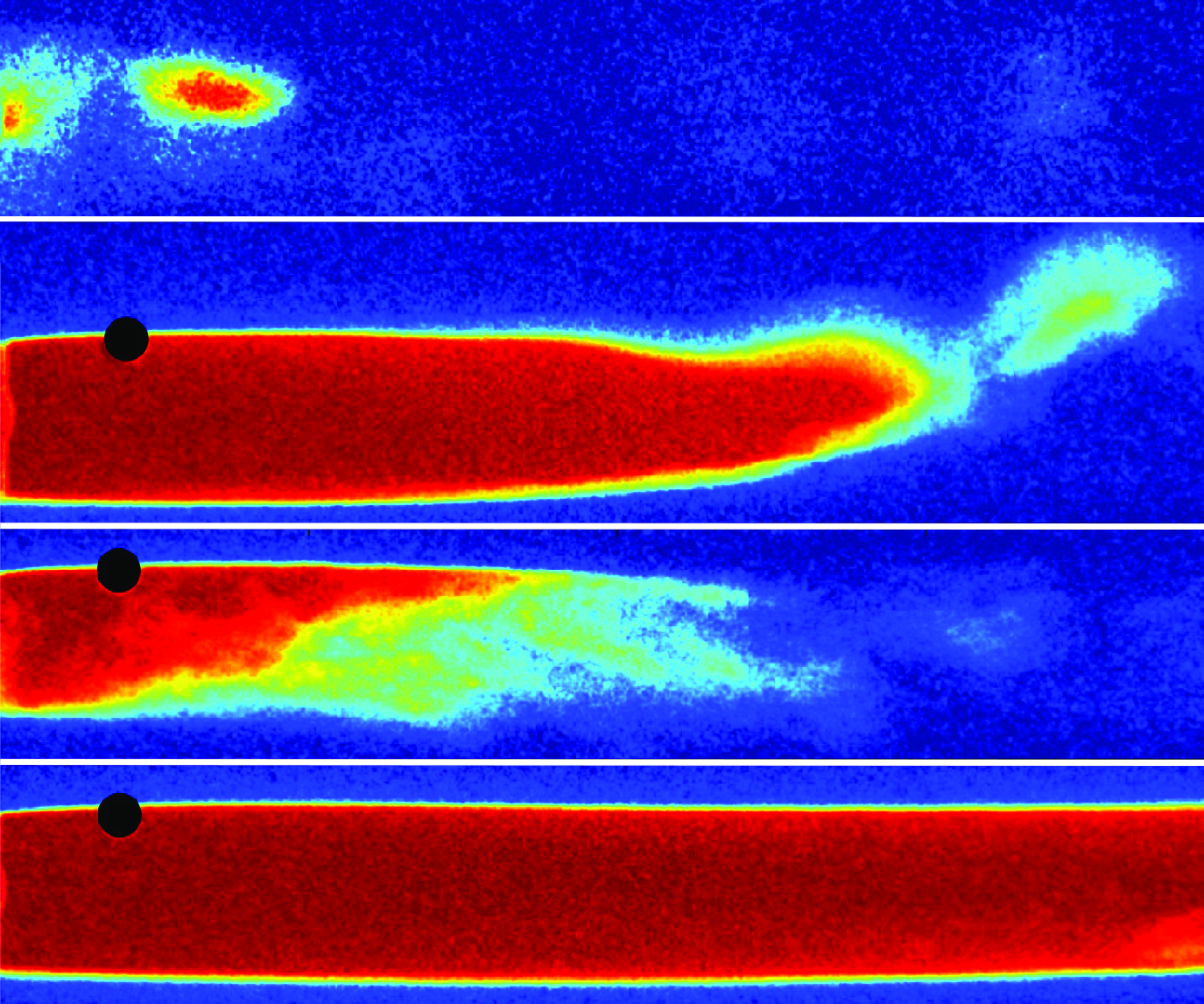
Examination of ventilated cavities in the wake of a two-dimensional bluff body using X-ray densitometry
-
- Journal:
- Journal of Fluid Mechanics / Volume 1014 / 10 July 2025
- Published online by Cambridge University Press:
- 30 June 2025, A14
-
- Article
-
- You have access
- Open access
- HTML
- Export citation
-
Ventilated cavities in the wake of a two-dimensional bluff body are studied experimentally via time-resolved X-ray densitometry. With a systematic variation of flow velocity and gas injection rate, expressed as Froude number ( $\textit{Fr}$) and ventilation coefficient ( $C_{qs}$), four cavities with different closure types are identified. A regime map governed by $\textit{Fr}$ and $C_{qs}$ is constructed to estimate flow conditions associated with each cavity closure type. Each closure exhibits a different gas ejection mechanism, which in turn dictates the cavity geometry and the pressure in the cavity. Three-dimensional cavity closure is seen to exist for the supercavities at low $\textit{Fr}$. However, closure is nominally two-dimensional for supercavities at higher $\textit{Fr}$. At low $C_{qs}$, cavity closure is seen to be wake-dominated, while supercavities are seen to have interfacial perturbation near the closure at higher $C_{qs}$, irrespective of $\textit{Fr}$. With the measured gas fraction, a gas balance analysis is performed to quantify the gas ejection rate at the transitional cavity closure during its formation. For a range of $\textit{Fr}$, the transitional cavity closure is seen to be characterised by re-entrant flow, whose intensity depends on the flow inertia, dictating the gas ejection rates. Two different ventilation strategies were employed to systematically investigate the formation and maintenance gas fluxes. The interaction of wake and gas injection is suspected to dominate the cavity formation process and not the maintenance, resulting in ventilation hysteresis. Consequently, the ventilation gas flux required to maintain the supercavity is significantly less than the gas flux required to form the supercavity.


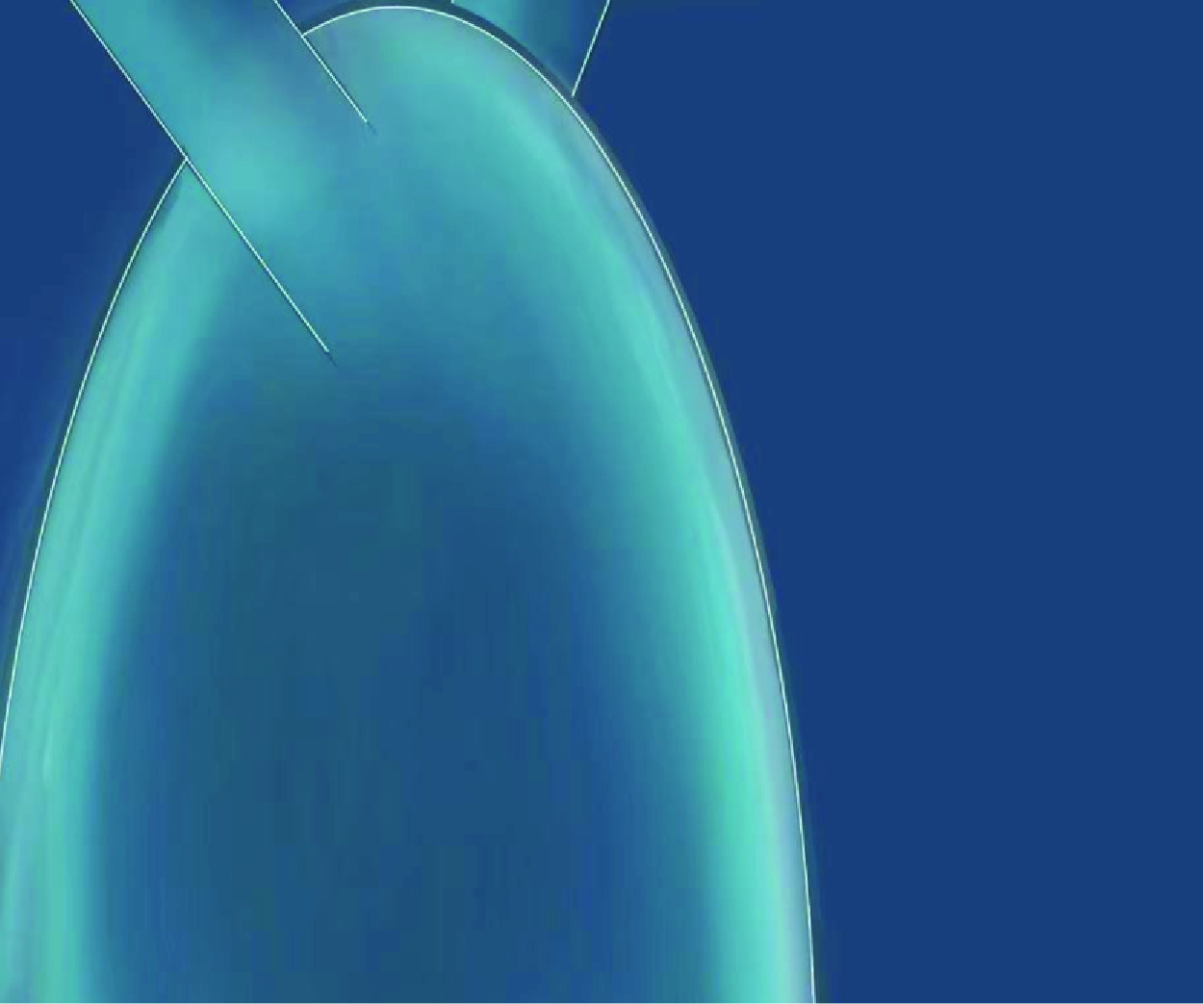
Thickness model for viscous impinging liquid sheets
-
- Journal:
- Journal of Fluid Mechanics / Volume 1014 / 10 July 2025
- Published online by Cambridge University Press:
- 30 June 2025, R3
-
- Article
- Export citation
Investigation on the cavitation bubble dynamics and pressure characteristics near a wall with a viscous oil layer
-
- Journal:
- Journal of Fluid Mechanics / Volume 1014 / 10 July 2025
- Published online by Cambridge University Press:
- 30 June 2025, A9
-
- Article
-
- You have access
- Open access
- HTML
- Export citation
-
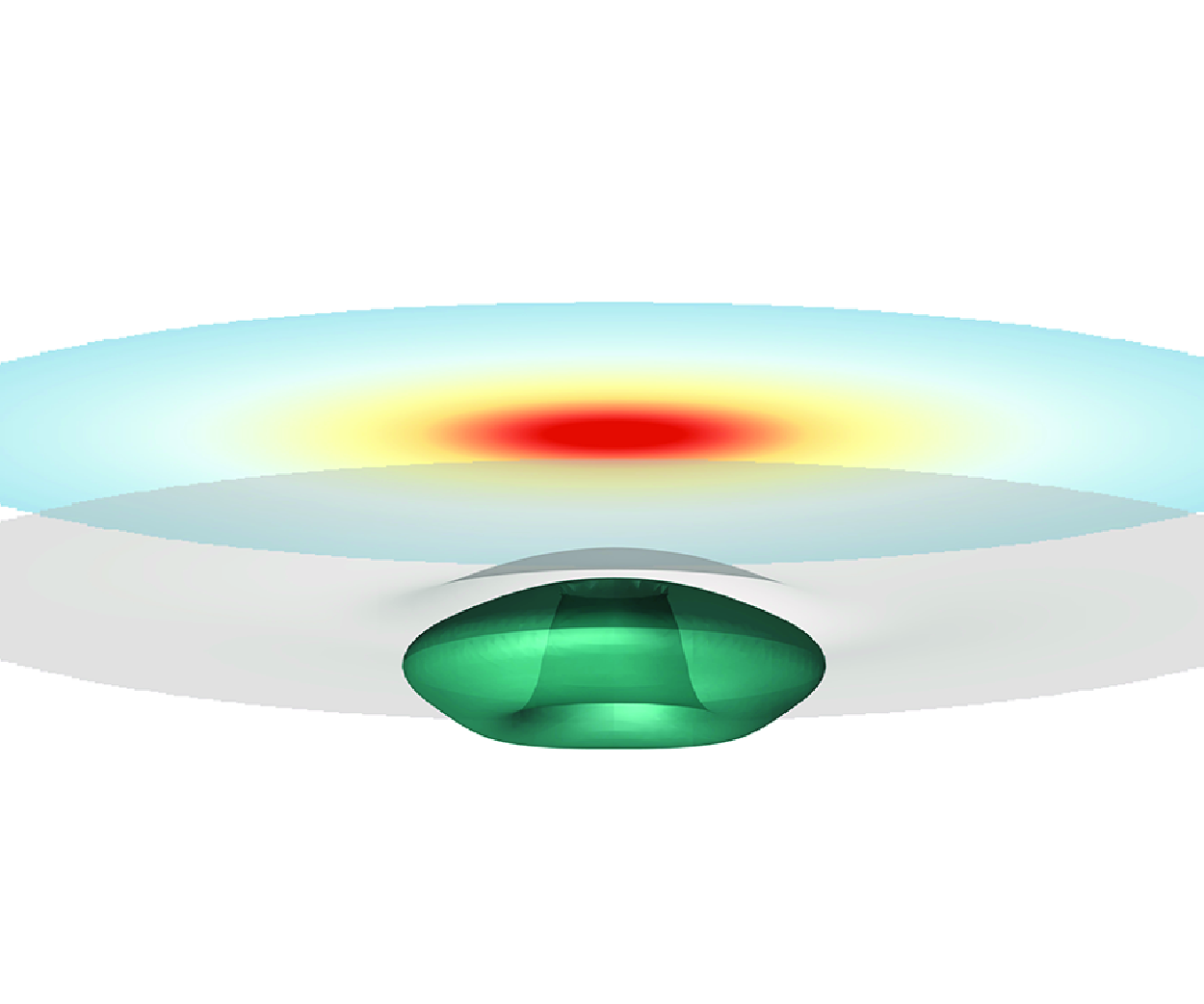
Cavitation bubble pulsation and liquid jet loads are the main causes of hydraulic machinery erosion. Methods to weaken the load influences have always been hot topics of related research. In this work, a method of attaching a viscous layer to a rigid wall is investigated in order to reduce cavitation pulsations and liquid jet loads, using both numerical simulations and experiments. A multiphase flow model incorporating viscous effects has been developed using the Eulerian finite element method (EFEM), and experimental methods of a laser-induced bubble near the viscous layer attached on a rigid wall have been carefully designed. The effects of the initial bubble–wall distance, the thickness of the viscous layer, and the viscosity on bubble pulsation, migration and wall pressure load are investigated. The results show that the bubble migration distance, the normalised thickness of the oil layer and the wall load generally decrease with the initial bubble–wall distance or the oil-layer parameters. Quantitative analysis reveals that when the initial bubble–wall distance remains unchanged, there exists a demarcation line for the comparison of the bubble period and the reference period (the bubble period without viscous layer under the same initial bubble–wall distance), and a logarithmic relationship is observed that $\delta \propto \log_{10} \mu ^*$, where $\delta =h/R_{max}$ is the thickness of the viscous layer h normalised by the maximum bubble radius $R_{max}$, $\mu ^* = \mu /({R_{max }}\sqrt {{\rho }{{\mathop {P}\nolimits } _{{atm}}}})$ is the dynamic viscosity $\mu$ normalised by water density $ \rho $ and atmospheric pressure $P_{atm}$. The results of this paper can provide technical support for related studies of hydraulic cavitation erosion.


Addressing microplastics in drinking water in the global plastics treaty – Gaps, challenges and opportunities
- Part of
-
- Journal:
- Cambridge Prisms: Plastics / Volume 3 / 2025
- Published online by Cambridge University Press:
- 30 June 2025, e20
-
- Article
-
- You have access
- Open access
- HTML
- Export citation
How can Li be incorporated into the structure of Al-rich tourmaline?
- Part of
-
- Journal:
- Mineralogical Magazine / Volume 89 / Issue 6 / December 2025
- Published online by Cambridge University Press:
- 27 June 2025, pp. 791-803
-
- Article
- Export citation
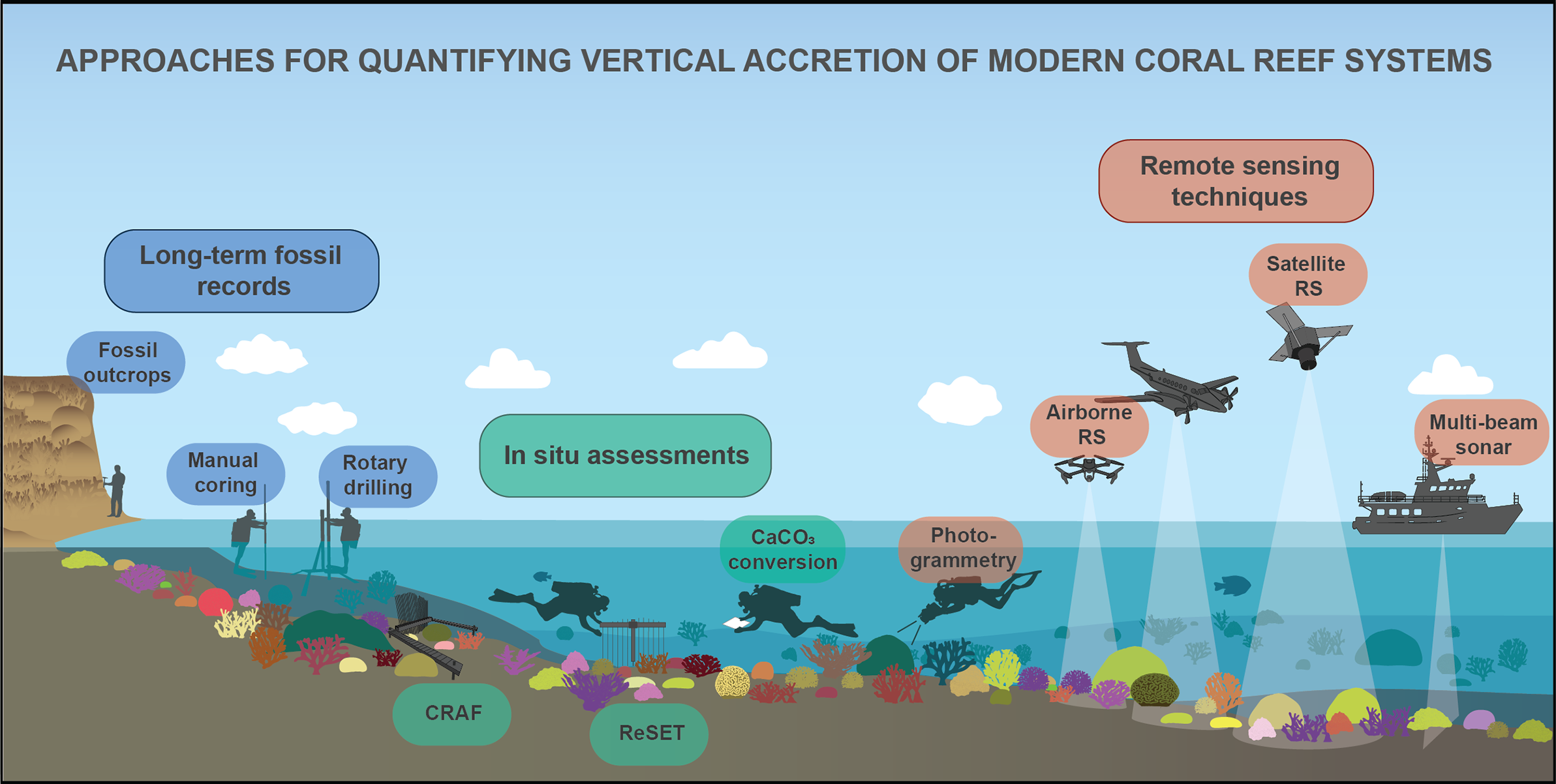
Quantifying coral reef accretion in a changing world: approaches, challenges and emerging opportunities
-
- Journal:
- Cambridge Prisms: Coastal Futures / Volume 3 / 2025
- Published online by Cambridge University Press:
- 27 June 2025, e15
-
- Article
-
- You have access
- Open access
- HTML
- Export citation
5 - IFIs as Lawmakers I
-
- Book:
- International Financial Institutions and Sustainable Development
- Published online:
- 09 June 2025
- Print publication:
- 26 June 2025, pp 141-169
-
- Chapter
- Export citation
2 - Detour to Bretton Woods
-
- Book:
- International Financial Institutions and Sustainable Development
- Published online:
- 09 June 2025
- Print publication:
- 26 June 2025, pp 58-93
-
- Chapter
- Export citation
1 - Sustainability’s Journey
-
- Book:
- International Financial Institutions and Sustainable Development
- Published online:
- 09 June 2025
- Print publication:
- 26 June 2025, pp 36-57
-
- Chapter
- Export citation
Contents
-
- Book:
- International Financial Institutions and Sustainable Development
- Published online:
- 09 June 2025
- Print publication:
- 26 June 2025, pp xi-xiv
-
- Chapter
- Export citation
Energy balance analysis of a tropical glacier in the Andes and identification of key meteorological variables for empirical melt estimates
- Part of
-
- Journal:
- Annals of Glaciology / Volume 66 / 2025
- Published online by Cambridge University Press:
- 26 June 2025, e16
-
- Article
-
- You have access
- Open access
- HTML
- Export citation
L-band radiometric measurement of liquid water in Greenland’s firn: Comparative analysis with in situ measurements and modeling
- Part of
-
- Journal:
- Annals of Glaciology / Volume 66 / 2025
- Published online by Cambridge University Press:
- 26 June 2025, e15
-
- Article
-
- You have access
- Open access
- HTML
- Export citation
Taylor dispersion of bubble swarms rising in quiescent liquid
-
- Journal:
- Journal of Fluid Mechanics / Volume 1014 / 10 July 2025
- Published online by Cambridge University Press:
- 26 June 2025, R1
-
- Article
-
- You have access
- Open access
- HTML
- Export citation
-
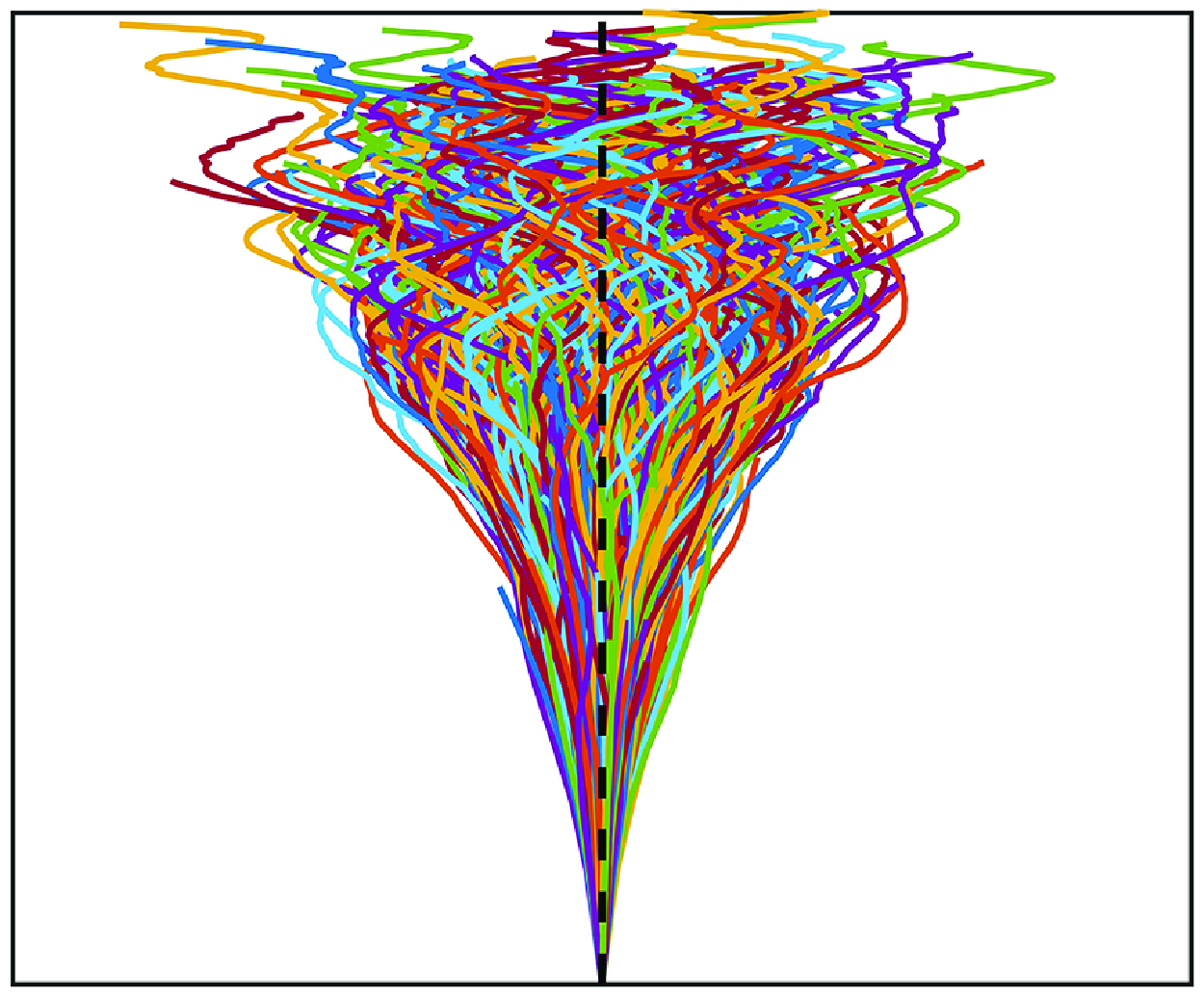
We study the dispersion of bubble swarms rising in initially quiescent water using three-dimensional Lagrangian tracking of deformable bubbles and tracer particles in an octagonal bubble column. Two different bubble sizes (3.5 mm and 4.4 mm) and moderate gas volume fractions ( $0.52\,\%{-}1.20\,\%$) are considered. First, we compare the dispersion inside bubble swarms with that for single-bubble cases, and find that the horizontal mean squared displacement (MSD) in the swarm cases exhibits oscillations around the asymptotic scaling predicted for a diffusive regime. This occurs due to wake-induced bubble motion; however, the oscillatory behaviour is heavily damped compared to the single-bubble cases due to the presence of bubble-induced turbulence (BIT) and bubble–bubble interactions in the swarm. The vertical MSD in bubble swarms is nearly an order of magnitude faster than in the single-bubble cases, due to the much higher vertical fluctuating bubble velocities in the swarms. We also investigate tracer dispersion in BIT, and find that concerning the time to transition away from the ballistic regime, larger bubbles with a higher gas void fraction transition earlier than tracers, consistent with Mathai et al. (2018, Phys. Rev. Lett., vol. 121, 054501). However, for bubble swarms with smaller bubbles and a lower gas void fraction, they transition at the same time. This differing behaviour is due to the turbulence being more well-mixed for the larger bubble case, whereas for the smaller bubble case, the tracer dispersion is highly dependent on the wake fluctuations generated by the oscillating motion of nearby bubbles.
Reactive and resilient: the contrasting behaviour of monazite and titanite during deformation (the Forno-Rosarolo shear zone; Ivrea-Verbano Zone)
-
- Journal:
- Geological Magazine / Volume 162 / 2025
- Published online by Cambridge University Press:
- 26 June 2025, e18
-
- Article
-
- You have access
- Open access
- HTML
- Export citation
