To save content items to your account,
please confirm that you agree to abide by our usage policies.
If this is the first time you use this feature, you will be asked to authorise Cambridge Core to connect with your account.
Find out more about saving content to .
To save content items to your Kindle, first ensure no-reply@cambridge.org
is added to your Approved Personal Document E-mail List under your Personal Document Settings
on the Manage Your Content and Devices page of your Amazon account. Then enter the ‘name’ part
of your Kindle email address below.
Find out more about saving to your Kindle.
Note you can select to save to either the @free.kindle.com or @kindle.com variations.
‘@free.kindle.com’ emails are free but can only be saved to your device when it is connected to wi-fi.
‘@kindle.com’ emails can be delivered even when you are not connected to wi-fi, but note that service fees apply.
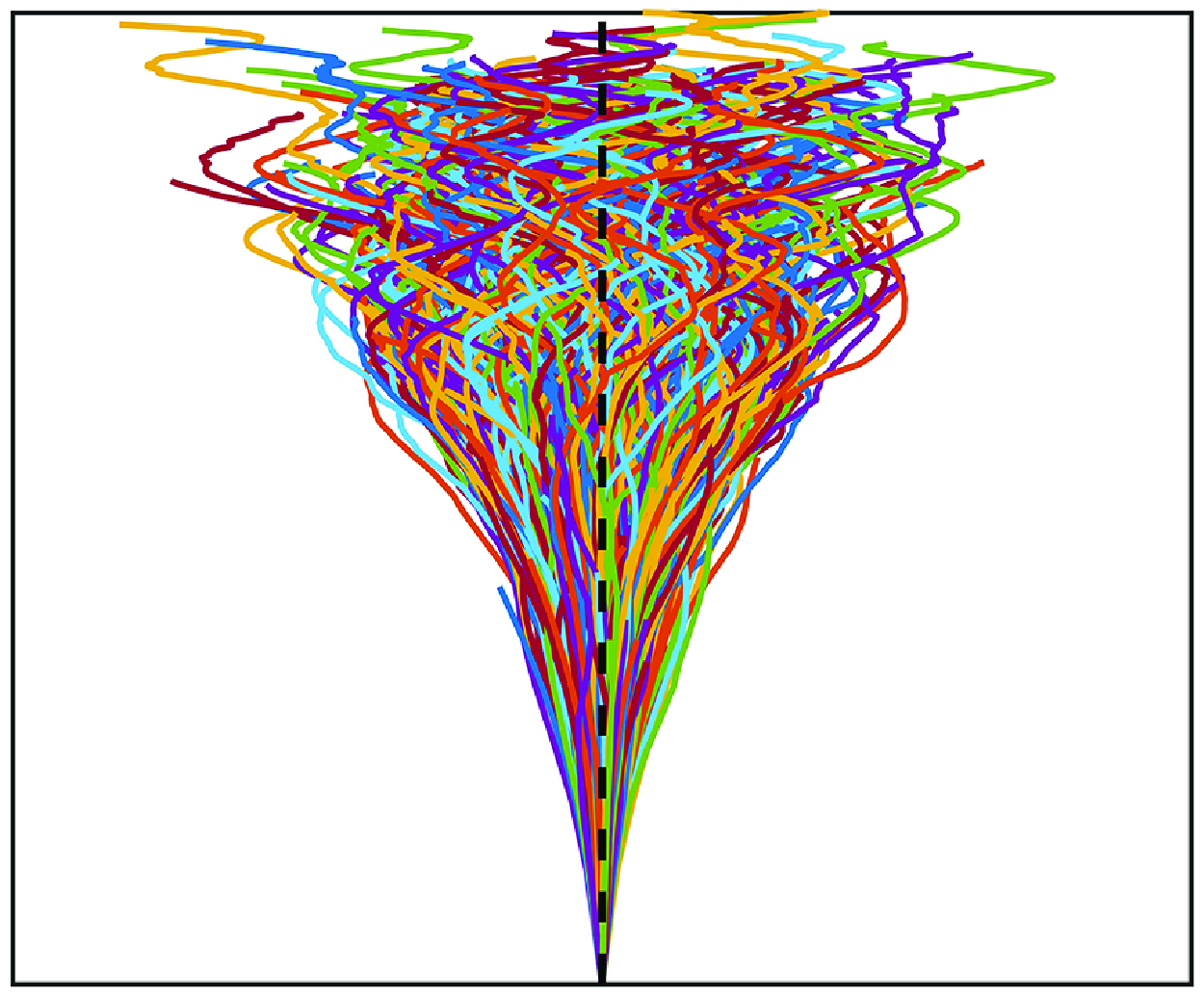
A collection of secondary instability calculations in streaky boundary layers is presented. The data are retrieved from well-resolved numerical simulations of boundary layers forced by free-stream turbulence (FST), considering different geometries and FST conditions. The stability calculations are performed before streak breakdown, taking place at various $Rey_x$ the Reynolds number based on the streamwise coordinate. Despite the rich streak population of various sizes, it is found that breaking streaks have similar aspect ratios, independently of the streamwise position where they appear. This suggests that wider streaks will break down further downstream than thinner ones, making the appearance of secondary instabilities somewhat independent of the streak’s wavelength. Moreover, the large difference in the integral length scale among the simulations suggests that this aspect ratio is also independent of the FST scales. An explanation for this behaviour is provided by showing that these breaking streaks are in the range of perturbations that can experience maximum transient growth according to optimal disturbance theory. This could explain why, at a given streamwise position, there is a narrow spanwise wavelength range where streak breakdown is more likely to occur.
Wave propagation in channels with area changes is a topic of significant practical interest that involves a rich set of coupled physics. While the acoustic wave problem has been studied extensively, the shock propagation problem has received less attention. In addition to its practical significance, this problem also introduces deep fundamental issues associated with how energy in propagating large-amplitude disturbances is redistributed upon interaction with inhomogeneities. This paper presents a study of shock scattering and entropy and vorticity coupling for shock wave propagation through discrete area changes. It compares results from computational fluid dynamics to those of one-dimensional quasi-steady calculations. The solution space is naturally divided into five ‘regimes’ based upon the incident shock strength and area ratio. This paper also presents perturbation methods to quantify the dimensionless scaling of physical effects associated with wave reflection/transmission and energy transfer to other disturbances. Finally, it presents an analysis of the ‘energetics’ of the interaction, quantifying how energy that initially resides in dilatational disturbances and propagates at the shock speed is redistributed into finite-amplitude reflected and transmitted waves as well as convecting vortical and entropy disturbances.
The formation process of a vortex pair generated by a two-dimensional starting jet has been investigated numerically over a range of Reynolds numbers from 500 to 2000. The effects of stroke ratio and nozzle configuration are examined. Only a single vortex pair can be observed in the vorticity field generated by small stroke ratios less than 10 while the leading vortex pair formed by larger stroke ratios eventually disconnects from the trailing jet. The formation numbers (13.6 and 9.3) for a straight nozzle and an orifice nozzle have been identified by the circulation criterion and they are further analysed by four other criteria. Using the contraction coefficient, formation numbers can be transformed into a universal value at about 16.5 for both nozzles. The effect of Reynolds number on the formation number is found to be within 12 % for parallel flow cases but it will increase up to 27 % for non-parallel flow cases due to shear-layer instability. A modified contraction-based slug model is proposed, and it can accurately predict the total invariants (e.g. circulation, hydrodynamic impulse and kinetic energy) shedding from the nozzle edge. Analytical estimation of the formation number is further conducted by matching the predicted total invariants to the Pierrehumbert model of steady vortex pairs. By assuming that pinch-off starts when the vortex pair achieves the steady state, two analytical models are proposed in terms of vortex impulse and translational velocity. The latter appears to be more appropriate to predict the formation number for two-dimensional flows.
Turbulent transonic buffet is an aerodynamic instability causing periodic (albeit, often irregular) oscillations of lift/drag in aerospace applications. Involving complex coupling between inviscid and viscous effects, buffet is characterised by shock wave oscillations and flow separation/reattachment. Previous studies have identified both two-dimensional (2-D) chordwise shock-oscillation and three-dimensional (3-D) buffet-/stall-cell modes. While the 2-D instability has been studied extensively, investigations of 3-D buffet have been limited to only low-fidelity simulations or experiments. Due to computational cost, almost all high-fidelity studies to date have been limited to narrow span-widths around 5 % of aerofoil chord length (aspect ratio, ), which is insufficiently wide to observe large-scale three-dimensionality. In this work, high-fidelity simulations are performed up to , on an infinite unswept NASA Common Research Model (CRM) wing profile at $Re=5\times 10^{5}$. At , intermittent 3-D separation bubbles are observed at buffet conditions. While previous Reynolds-averaged Navier–Stokes (RANS)/stability-based studies predict quasi-simultaneous onset of 2-D- and 3-D-buffet, a case that remains essentially 2-D is identified here. Strongest three-dimensionality was observed near low-lift phases of the buffet cycle at maximum flow separation, reverting to essentially 2-D behaviour during high-lift phases. Buffet was found to become 3-D when extensive mean flow separation was present. At , multiple 3-D separation bubbles form in a spanwise wavelength range $\lambda =1c$ to $1.5c$. Spectral proper orthogonal decomposition (SPOD) was applied to analyse the spatio/temporal structure of 3-D buffet-cells. In addition to the 2-D chordwise shock-oscillation mode (Strouhal number $St \approx 0.07-0.1$), 3-D modal structures were observed at the shock wave/boundary layer interaction at $St \approx 0.002-0.004$.
The brachyuran crab fauna (Crustacea: Decapoda: Brachyura) collections in the extensive exploratory fishery survey cruises from the northeast coast of India was studied from June 2018 to March 2020. During the study period, 81 species of brachyuran crabs belonging to 19 families and 46 genera were recorded. Among these, 21 species were newly recorded from the northeast coast of India, and 1 species, Naxioides taurus (Pocock, 1890) represents a new record for the mainland coasts of India. This study serves as a baseline for understanding the diversity and distribution of brachyuran crabs in the region. It provides valuable insights for future research and conservation efforts.
Experiments are presented to explore the non-axisymmetric instabilities of spreading films of aqueous suspensions of Carbopol and Xanthan gum floating on a bath of perfluoropolyether oil. The experimental observations are compared against theoretical predictions exploiting a shallow-film model in which the viscoplastic rheology is captured by the Herschel–Bulkley constitutive law. With this model, we construct axisymmetric base states that evolve from the moment that the film floats onto the bath, out towards long times at which spreading becomes self-similar, and then test their linear stability towards non-axisymmetric perturbations. In the geometry of a thinning expanding film, we find that shear thinning does not drive a loss of axisymmetry at early times (when the degree of expansion is small), but when the film has expanded in radius by a factor of two or so, shear-thinning hoop stresses drive non-axisymmetric instabilities. Unstable modes possess relatively low angular wavenumber, and the loss of symmetry is not particularly dramatic. When the oil in the bath is replaced by salty water, the experiments are completely different, with dramatic non-axisymmetric patterns emerging from interfacial effects.
We report the first measurement of turbulent mixing developing from the convergent Richtmyer–Meshkov (RM) instability using time-resolved planar laser-induced fluorescence in a semi-annular convergent shock tube. A membraneless yet sharp interface with random short-wavelength perturbations, but controllable long-wavelength perturbations, is created by an automatically retractable plate, enhancing the reproducibility and reliability of RM turbulence experiments. The cylindrical air/SF$_6$ interface formed is first subjected to a convergent shock, then to its reflected shock and subsequently transits to turbulent mixing. It is found that the mixing width after reshock has a linear growth rate more than twice the rate in planar geometry. Also, the mixing width does not present power-law growth at late stages as in a planar geometry. However, the scalar spectrum and transition criterion obtained are similar to their planar counterparts. These findings indicate that the geometric constraint greatly affects the large scales of the flow, while having a weaker effect on the small scales. It is also found that the reflected shock significantly increases both scale separation and Reynolds number, explaining the rapid transition to turbulence following reshock.
The transport of particles in elastoviscoplastic (EVP) fluids is of significant interest across various industrial and scientific domains. However, the physical mechanisms underlying the various particle distribution patterns observed in experimental studies remain inadequately understood in the current literature. To bridge this gap, we perform interface-resolved direct numerical simulations to study the collective dynamics of spherical particles suspended in a pressure-driven EVP duct flow. In particular, we investigate the effects of solid volume fraction, yield stress, inertia, elasticity, shear-thinning viscosity, and secondary flows on particle migration and formation of plug regions in the suspending fluid. Various cross-streamline migration patterns are observed depending on the rheological parameters of the carrier fluid. In EVP fluids with constant plastic viscosity, particles aggregate into a large cluster at the duct centre. Conversely, EVP fluids with shear-thinning plastic viscosity induce particle migration towards the duct walls, leading to formation of particle trains at the corners. Notably, we observe significant secondary flows ($O(10^{-2})$ compared to the mean velocity) in shear-thinning EVP suspensions, arising from the interplay of elasticity, shear-thinning viscosity and particle presence, which further enhances corner-ward particle migration. We elucidate the physical mechanism by which yield stress augments the first normal stress difference, thereby significantly amplifying elastic effects. Furthermore, through a comprehensive analysis of various EVP suspensions, we identify critical thresholds for elasticity and yield stress necessary to achieve particle focusing at the duct corners.
In binary mixtures, the lifetimes of surface bubbles can be five orders of magnitude longer than those in pure liquids because of slightly different compositions of the bulk and the surfaces, leading to a thickness-dependent surface tension of thin films. Taking advantage of the resulting simple surface rheology, we derive the equations describing the thickness, flow velocity and surface tension of a single liquid film, using thermodynamics of ideal solutions and thin film mechanics. Numerical resolution shows that, after a first step of tension equilibration, the Laplace-pressure-driven flow is associated with a flow at the interface driven by an induced Marangoni stress. The resulting parabolic flow with mobile interfaces in the film further leads to its pinching, eventually causing its rupture. Our model paves the way for a better understanding of the rupture dynamics of liquid films of binary mixtures.
Linear and nonlinear mechanisms governing the growth of second-mode waves are analysed using a newly derived disturbance energy conservation equation that highlights the physical processes responsible for fluctuation energy production, flux-based transport and destruction. Axisymmetric direct numerical simulations (DNS) data from a Mach 6 hypersonic boundary layer, simulated over a $3^\circ$ half-angle sharp cone at zero angle of attack, is used as a reference. A Legendre polynomial-based forcing methodology is used to trigger transition in the DNS over a range of various amplitude levels and different forcing frequency content. Closure of the disturbance energy budgets is demonstrated numerically using the DNS data. The terms responsible for the amplification of the disturbance are identified, and nonlinear attenuation effects are discussed. We show that the interaction between the entropy/velocity fluctuations and the base temperature gradient governs the second-mode growth in the linear regime. Energy production occurs in the critical layer due to non-isentropic processes and accumulates in acoustic form below the relative sonic line through downward transport. At higher forcing amplitudes, nonlinear spectral broadening is observed, with simultaneous thermoviscous diffusion attenuating the disturbance energy growth. This effect is responsible for the non-monotonic streamwise variation of the wall-pressure spectrum. Phase speed and growth rate analyses, informed by linear stability theory (LST), reveal wave steepening effects preceding this nonlinear attenuation effect. The disturbance energy is observed to match the LST predictions at lower forcing amplitudes, deviating, as expected, at higher amplitudes.
Selenium is a widespread contaminant released by industrial activities such as coal combustion. In selenium-contaminated groundwater, native microbial communities commonly have the capability of reducing the toxic oxyanions selenate and selenite to insoluble elemental selenium. The impact of local hydrogeography on microbial selenium reduction was tested by constructing laboratory microcosms using biofilm and groundwater collected from four monitoring wells screened in three distinct stratigraphic units near fly ash disposal ponds in southeastern Montana. Glycerol, methanol and molasses were tested as carbon amendments. Nitrate and selenium concentrations were monitored, and microbial communities were sequenced to examine differences among sites and carbon amendments. All site and carbon combinations resulted in nitrate removal, though molasses had the highest removal rate. Selenium removal was significantly impacted by stratigraphic unit, with microcosms from alluvial wells removing more total selenium than those from coal and interburden wells. Microbial community composition was correlated with site, carbon amendment, and nitrate and selenium removal. Furthermore, two genera from the order Clostridiales, Desulfosporosinus and Gracilibacter, emerged as potential indicator organisms for selenium reduction in this environment. The site, carbon amendment, and microbial community were all found to potentially impact remediation efficacy.
Skin-friction drag reduction (DR) in a turbulent boundary layer (TBL) using plasma-generated streamwise vortices (PGSVs) is governed by plasma-induced spanwise wall-jet velocity $W$, the distance $L$ between the positive electrodes of two adjacent plasma actuators (PAs) and the friction Reynolds number $Re_\tau$. It is found experimentally that DR increases logarithmically with the growing maximum spanwise mean velocity $\overline {W}_{max}^+$ but decreases with rising $L^+$ and $Re_\tau$, where superscript ‘+’ denotes normalization by the inner scales. It is further found from theoretical and empirical scaling analyses that the dimensionless drag variation $\Delta F = g_1 (\overline {W}_{max}^+, L^+, {Re_\tau })$ may be reduced to $\Delta F = g_2 (\xi )$, where $g_1$ and $g_2$ are different functions and the scaling factor $\xi = [k_{2} \log _{10} (k_{1} \overline {W}_{max }^{+} ) ] / (L^{+} Re_{\tau } )$ ($k_{2}$ and $k_{1}$ are constants) is physically the circulation of the PGSVs. Discussion is conducted based on $\Delta F = g_2 (\xi )$, which provides important insight into the physics of TBL control based on PAs.
Earthworm biospheroids are a useful alternative to radiocarbon (14C) soil dating. In this study, we undertook a series of measurements to test the 14C dating potential/performance of recent earthworm biospheroid granules. A novel sample preparation protocol for 14C in biospheroids was developed and elaborated at Atomki (Institute for Nuclear Research) and tested on IAEA reference materials. 24 natural biospheroid samples were extracted from five different location/environment-eight topsoils (A-horizon soils). Bomb-peak-based, high-resolution 14C dating show very uniform 14C results at 105.6 ± 2.6 pMC (1σ) and none of the biospheroids are older than 30 yr. It also shows that no biospheroid with a 14C bomb-peak as high as that observed in the 1960s and 1990s were observed. The results confirmed that earthworms do indeed consume almost exclusively recent biogenic carbon, not other organic compounds or inorganic carbonates previously bound in the soil. The calendar age of their biospheroids were extremely close to the real (zero) age of the surface. Thus, no “reservoir effect” is seen for these macrofossils. We conclude that a biospheroid-based 14C age determination method may be suitable to measure the burial time as long as earthworm biospheroids can be found in the soil.
Three-dimensional eddy-resolving simulations are used to study the structure of turbulent boundary layers developing in an open channel where an array of sparse roughness elements in the form of partially burrowed mussels is placed on the smooth, flat channel bed starting at a certain streamwise location. The identical mussels are oriented with their major axis parallel to the mean flow. Their positions are randomised while making sure that the mussels are close to uniformly distributed inside the array. The turbulent flow approaching the leading edge of the array is fully developed. The protruding parts of the mussels play the role of sparse roughness elements and generate a rough-bed, internal boundary that is characterised by zero net flow exchange but non-zero local flow exchange due to active filtering. A double-averaging technique is used to obtain an equivalent, width- and time-averaged, boundary layer over a ‘flat’ rough surface containing no mussels. The paper discusses the effects of varying the mussel array density, protruding height of the mussels and filtering discharge on the spatial growth of the two-dimensional boundary layer. With proper scaling, the profiles of the (double-averaged) streamwise velocity are close to self-similar inside the inertial layer (e.g. for h$\lt$z$\lt$$\delta$, where h is the height of the protruding part of the mussels and $\delta$ is the boundary layer thickness) starting some distance from the leading edge of the array. The scaled turbulent kinetic energy and concentration profiles associated with the scalar advected through the excurrent syphons are also found to be self-similar above the vertical location where the maximum value is reached. An analytical model containing three subzones is proposed for the streamwise velocity in between the bed (z$=$ 0) and z$=$$\delta$. The velocity profile inside the inertial region contains a law-of-the-wall component supplemented by a law-of-the-wake component. The scaling coefficient of the law-of-the-wake component is found to be larger than typical values used to describe velocity variation in turbulent boundary layers developing in a surrounding flow with close-to-uniform free stream velocity. The equivalent roughness height for this particular type of boundary layers developing over sparse roughness elements increases monotonically with h and the mussel array density, $\rho$N. The paper also discusses the effect of the mussel bed density on the average refiltration fraction and the phytoplankton removal efficiency of the mussel bed.
Continent formation and its stabilization are key factors for understanding tectonic processes and histories across geologic time. Sri Lanka consists of a Central Highland (HC) granulite/UHT terrane bounded by tectonic sutures and medium-to-high-grade magmatic arc terranes likely formed via Neoproterozoic double-sided subduction and collision associated with assembly of Gondwana. EMP Chemical Th-U-Pb dating of monazite within the eastern suture is dominated by 595–635 Ma dates, consistent with juxtaposition ca. 600 Ma as arc magmatism ended. Chemical analysis of metamorphic monazite dates from the eastern HC indicates prograde HT metamorphism (M1) at ca. 570 Ma during garnet growth (lower Y monazite) and retrograde HT metamorphism (M2) at ca. 560–550 Ma (higher Y monazite). These ages reflect orogenic thickening associated with arc collisions (M1) and retrograde metamorphism (M2) during deep-crustal exhumation of HC rocks. Regional long duration (>50–100 Ma) HT metamorphism, which continued until 520 Ma, and possibly to ca. 480 Ma, was followed shortly by rapid early Ordovician (480–490 Ma) lower to mid-crustal cooling based on near concordant 40Ar-39Ar hornblende and biotite ages. Rapid cooling occurred concurrently with metasomatism (He et al.2016), and region-wide exhumation during orogenic collapse documented in adjacent portions of Gondwana. The cessation of long-duration HT metamorphism linked to the onset of rapid Ordovician intermediate-temperature (>500–<300 °C) cooling and exhumation via orogenic collapse resulted in young stabilized continental crust. The Neoproterozoic-Early Palaeozoic metamorphic/thermal evolution of Sri Lanka (and correlated regions) within Gondwana attests to the timing and process of rapid stabilization of central Gondwanaland.
This paper presents a numerical investigation of the turbulence transition phenomenon in the wake of wall-mounted prisms. Large-eddy simulations are performed at $Re = 1\times 10^3 {-}5\times 10^3$ for prisms with a range of aspect ratio (height to width) from $0.25$ to $1.5$, and depth ratios (length to width) between $1$ and $4$. The results show that the wake irregularity is enhanced with increasing depth ratio, evidenced by higher turbulent kinetic energy (${\approx}90\,\%$) near the leading edge, and the onset of irregular, unsteady vortex shedding. This is attributed to interactions between Kelvin–Helmholtz instability (KHI) of the shear layer and large-scale vortex shedding, and it is induced by an unsteady shear layer, resembling flapping-like motion. These interactions elevate the flow momentum due to increased turbulence intensity and mixing, contributing to the wake transition phenomenon. To this end, this study defines the role of depth ratio in the transition phenomenon by showing that increasing depth ratio (e.g. from $1$ to $4$) leads to earlier onset of KHIs in the shear layer. These instabilities intensify with depth ratio, resulting in stronger interactions between shear layer and large-scale vortex shedding. Specifically, KHI-induced vortices interact more frequently with large-scale wake structures for higher depth ratio prisms, exciting larger flow fluctuations and irregular wake patterns. This interaction alters the frequency and coherence of vortex shedding, revealing a complex coupling mechanism that drives the transition to turbulence.
This article explores how a submerged elastic plate, clamped at one edge, interacts with water waves. Submerged elastic plates have been considered as potentially effective design elements in the development of wave energy harvesters but their behaviour in a wave field remains largely unexplored, especially experimentally. Positioned at a fixed depth in a wave tank, the flexible plate demonstrates significant wave reflection capabilities, a characteristic absent in rigid plates of identical dimensions. The experiments thus reveal that plate motion is crucial for wave reflection. Sufficiently steep waves are shown to induce a change in the mean position of the plate, with the trailing edge reaching the free surface in some cases. This configuration change is found to be particularly efficient to break water waves. These findings contribute to understanding the potential of elastic plates for wave energy harvesting and wave attenuation scenarios.
This work focuses on the intensity variation mechanisms in the mean inner and outer shear layers of a premixed swirling flame. In order to close the gap between the Lagrangian vorticity transport and the Eulerian shear layer intensity ($\gamma$), we propose a combined Reynolds-vorticity transport approach to obtain the streamwise variation of $\gamma$ as the integrals of vorticity generation terms, including tilting, baroclinic torque, diffusion and dilatation. However, different from the classical vorticity (transport) equation, the vortex stretching vanishes, and the original dilatation is replaced by a shear-layer dilatation in the new model. It enables the quantitative evaluation of how the different vorticity transport terms affect the shear layer intensity; in particular, we have identified vortex tilting and baroclinic torque as the main cause of the inner shear layer enhancement in the swirling flame’s near field. Although this model is initially developed to study the flame-attached shear layers, the broader significance lies in its applicability to general axisymmetric shear flows.
The influence of irregular three-dimensional rough surfaces on the displacement of the logarithmic velocity profile relative to that of a smooth wall in turbulent flow, known as the roughness function, is studied using direct numerical simulations. Five different surface power spectral density (PSD) shapes were considered, and for each, several rough Gaussian surfaces were generated by varying the root mean square ($k_{rms}$) of the surface heights. It is shown that the roughness function ($\Delta U^{+}$) depends on both the PSD and $k_{rms}$. For a given $k_{rms}$, $\Delta U^{+}$ increases as the wavenumbers of the PSD expand to large values, but at a rate that decreases with the magnitude of the wavenumbers. Although $\Delta U^{+}$ generally does not scale with either $k_{rms}$ or the effective slope $ES$ when these variables are considered singularly, for PSDs with low wavenumbers, $\Delta U^{+}$ tends to scale with $ES$, whereas as wavenumbers increase, $\Delta U^{+}$ tends to scale with $k_{rms}$. An equivalent Nikuradse sand roughness of about eight times $k_{rms}$ is found, which is similar to that observed in previous studies for a regular three-dimensional roughness. Finally, it is shown that $k_{rms}$ and the effective slope are sufficient to describe the roughness function in the transitional rough regime.