Refine search
Actions for selected content:
179500 results in Earth and Environmental Sciences
The petrochemical historical bloc: Exposing the extent and depth of opposition to a high-ambition plastics treaty
- Part of
-
- Journal:
- Cambridge Prisms: Plastics / Volume 3 / 2025
- Published online by Cambridge University Press:
- 24 June 2025, e16
-
- Article
-
- You have access
- Open access
- HTML
- Export citation
Postglacial fire and vegetation histories of a mid-elevation mixed-conifer forest in the Gallatin Range, MT, USA
-
- Journal:
- Quaternary Research / Volume 127 / September 2025
- Published online by Cambridge University Press:
- 24 June 2025, pp. 107-121
-
- Article
-
- You have access
- Open access
- HTML
- Export citation
Lift force on a spherical droplet in a viscous linear shear flow – CORRIGENDUM
-
- Journal:
- Journal of Fluid Mechanics / Volume 1013 / 25 June 2025
- Published online by Cambridge University Press:
- 24 June 2025, E1
-
- Article
-
- You have access
- Open access
- HTML
- Export citation
Introducing Cambridge Prisms: Carbon Technologies
-
- Journal:
- Cambridge Prisms: Carbon Technologies / Volume 1 / 2025
- Published online by Cambridge University Press:
- 24 June 2025, e2
-
- Article
-
- You have access
- Open access
- HTML
- Export citation
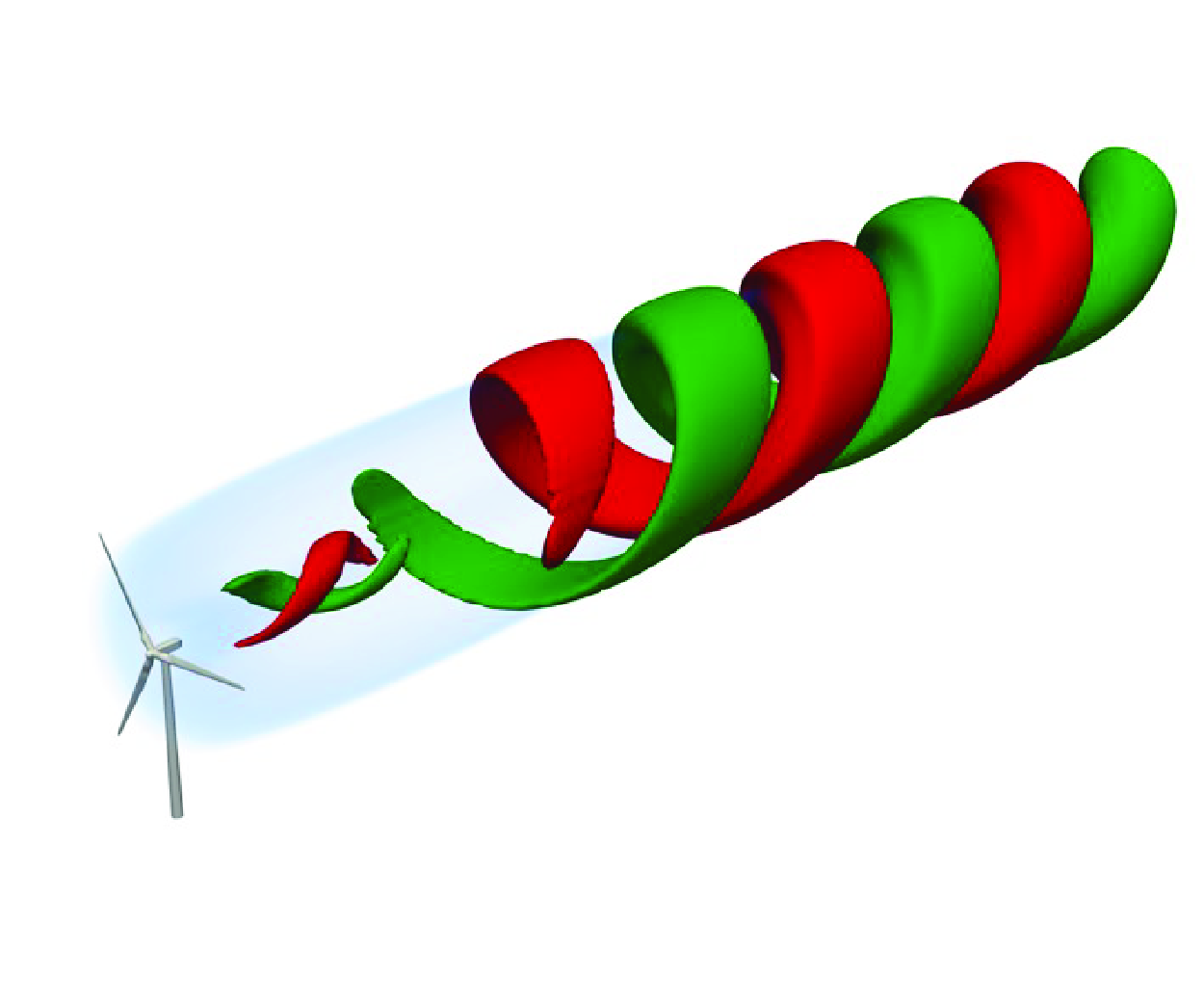
Self-consistent model for active control of wind turbine wakes
-
- Journal:
- Journal of Fluid Mechanics / Volume 1013 / 25 June 2025
- Published online by Cambridge University Press:
- 23 June 2025, A36
-
- Article
- Export citation
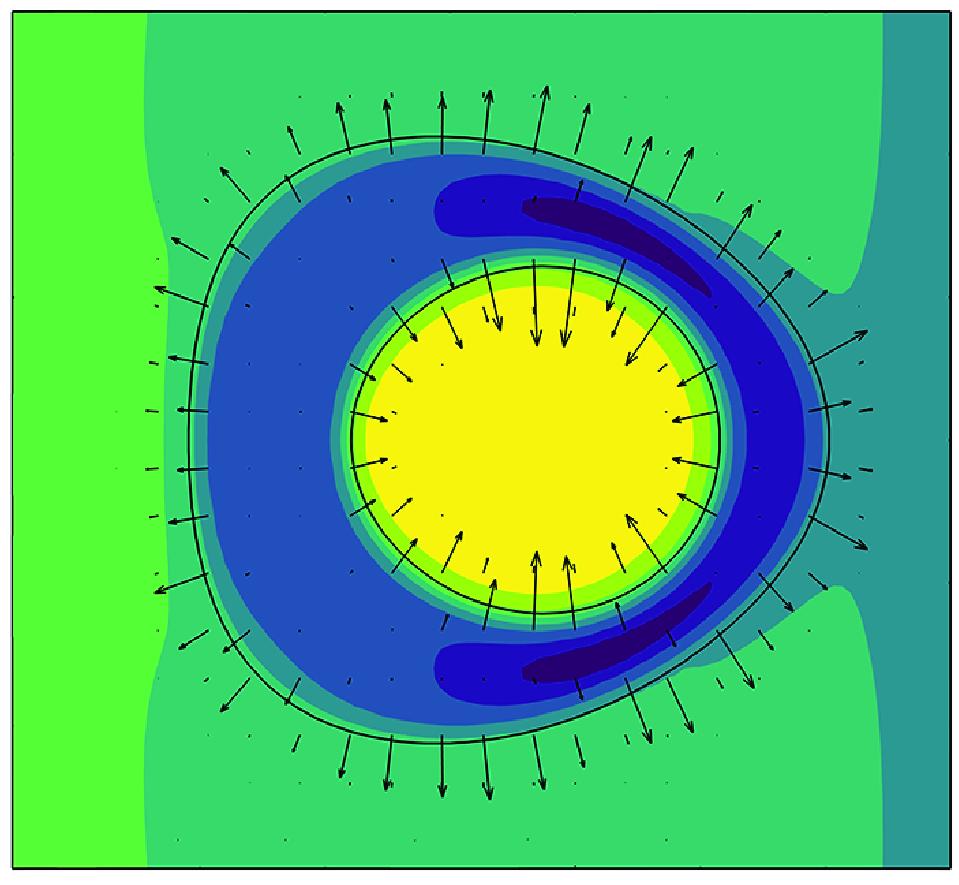
Deformation and breakup of a ferrofluid compound droplet migrating in a microchannel under a magnetic field: a phase-field-based multiple-relaxation time lattice Boltzmann study
-
- Journal:
- Journal of Fluid Mechanics / Volume 1013 / 25 June 2025
- Published online by Cambridge University Press:
- 23 June 2025, A37
-
- Article
- Export citation
-
Though ubiquitous in many engineering applications, including drug delivery, the compound droplet hydrodynamics in confined geometries have been barely surveyed. For the first time, this study thoroughly investigates the hydrodynamics of a ferrofluid compound droplet (FCD) during its migration in a microchannel under the presence of a pressure-driven flow and a uniform external magnetic field (UEMF) to manipulate its morphology and retard its breakup. Finite difference and phase-field multiple-relaxation time lattice Boltzmann approaches are coupled to determine the magnetic field and ternary flow system, respectively. First, the influence of the magnetic Bond number ( ${Bo}_m$) on the FCD morphology is explored depending on whether the core or shell is ferrofluid when the UEMF is applied along $\alpha =0^\circ$ and $\alpha =90^\circ$ relative to the fluid flow. It is ascertained that imposing the UEMF at $\alpha =0^\circ$ when the shell is ferrofluid can postpone the breakup. Intriguingly, when the core is ferrofluid, strengthening the UEMF enlarges the shell deformation. Afterwards, the effects of the capillary number ( ${Ca}$), density ratio, viscosity ratio, radius ratio and surface tension coefficients are scrutinised on the FCD deformation and breakup. The results indicate that augmenting the core-to-shell viscosity and density ratios accelerates the breakup process. Additionally, surface tension between the core and shell suppresses the core deformation. Moreover, increasing the ${Ca}$ intensifies the viscous drag force exerted on the shell, flattening its rear side, which causes a triangular-like configuration. Ultimately, by varying ${Bo}_m$ and ${Ca}$, five distinct regimes are observed, whose regime map is established.


Navigating the microbial seas: a global analysis of gut microbiota in marine mammals
-
- Journal:
- Journal of the Marine Biological Association of the United Kingdom / Volume 105 / 2025
- Published online by Cambridge University Press:
- 23 June 2025, e66
-
- Article
- Export citation
Systemic contributions to global catastrophic risk
- Part of
-
- Journal:
- Global Sustainability / Volume 8 / 2025
- Published online by Cambridge University Press:
- 23 June 2025, e19
-
- Article
-
- You have access
- Open access
- HTML
- Export citation
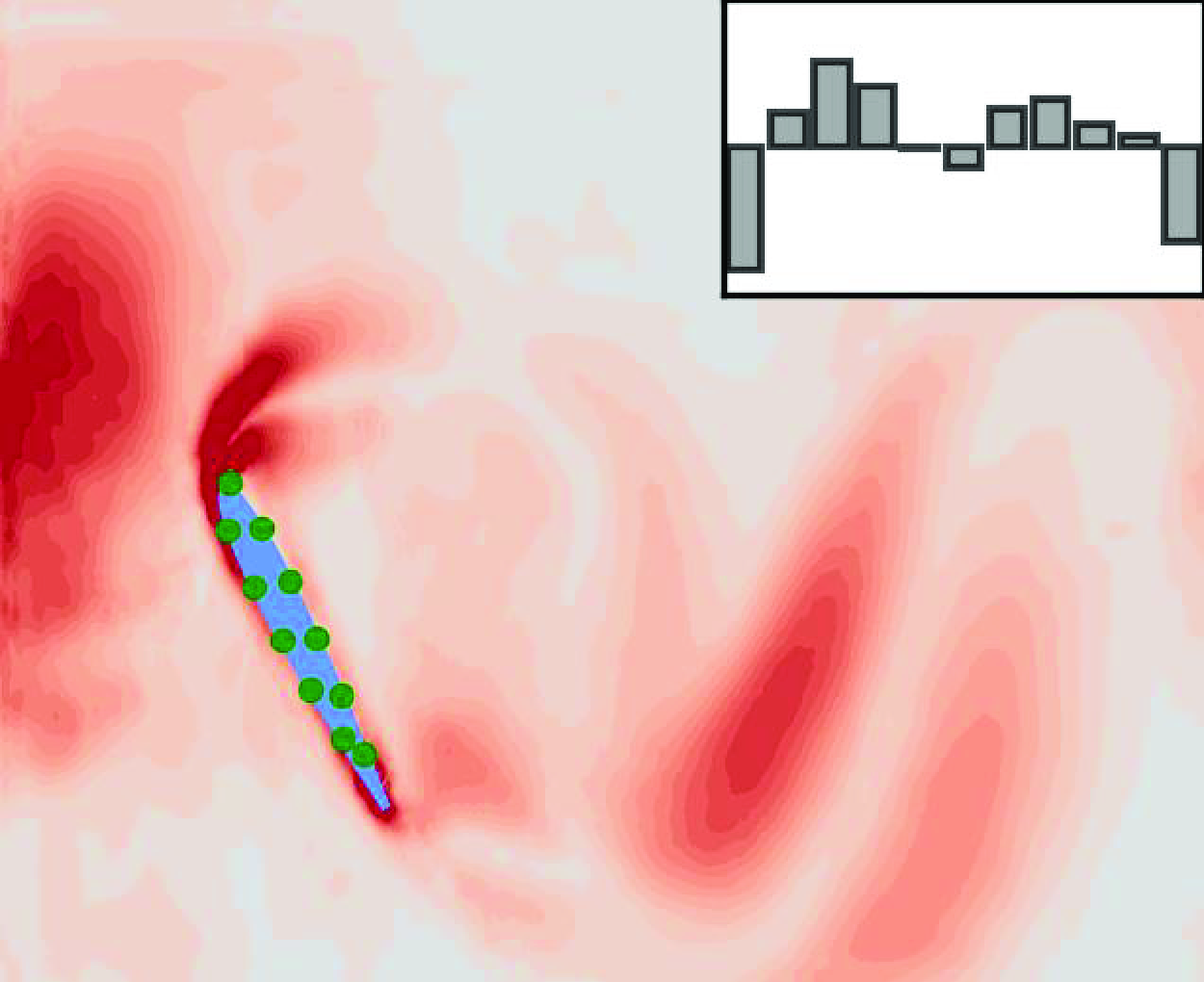
Low-order flow reconstruction and uncertainty quantification in disturbed aerodynamics using sparse pressure measurements
-
- Journal:
- Journal of Fluid Mechanics / Volume 1013 / 25 June 2025
- Published online by Cambridge University Press:
- 23 June 2025, A41
-
- Article
-
- You have access
- Open access
- HTML
- Export citation
Professor John Albert Raven, FRS
-
- Journal:
- Journal of the Marine Biological Association of the United Kingdom / Volume 105 / 2025
- Published online by Cambridge University Press:
- 23 June 2025, e67
-
- Article
-
- You have access
- HTML
- Export citation
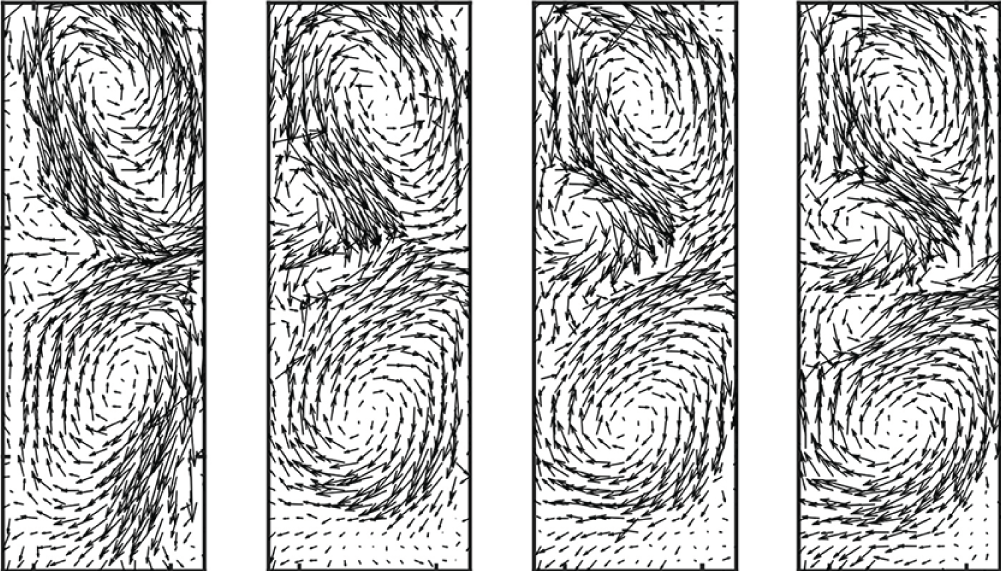
On the dominant motions in Taylor–Couette systems with square enclosures
-
- Journal:
- Journal of Fluid Mechanics / Volume 1013 / 25 June 2025
- Published online by Cambridge University Press:
- 23 June 2025, A38
-
- Article
-
- You have access
- Open access
- HTML
- Export citation
-
We explored the dynamics of Taylor–Couette flows within square enclosures, focusing primarily on the turbulence regime and vortex behaviour at varying Reynolds numbers. Laboratory experiments were conducted using particle image velocimetry for Reynolds numbers $Re_{\varDelta }\in [0.23, 4.6]\times 10^3$ based on the minimum gap $\varDelta /d = 1/16$, $1/8$ and $1/4$, where $d$ is the cylinder diameter, or $Re\in [1.8, 9.8]\times 10^3$ based on $d/2$. At lower $Re$, the flow was dominated by well-defined Taylor and Görtler vortices, while higher $Re$ led to a turbulent state with distinct motions. Space–time radial velocity analysis revealed persistent Taylor vortices at lower $Re$, with larger gaps but increased turbulence, and irregular motions at higher $Re$, with smaller gaps. Velocity spectra reveal that the energy distribution is maintained at frequencies lower than the integral-type frequency $f_I$ across varying $\varDelta$ due to the dominance of large vortices. However, there is a monotonic increase in energy at higher frequencies beyond $f_I$. The reduced characteristic frequency $f_I\varDelta /\omega _ir_i \sim 1/10$ indicates that these motions scale linearly with angular velocity, and inversely with the gap. Proper orthogonal decomposition (POD) and spectral POD were used to distinguish between Taylor and Görtler vortices, showing the effects of gap size and the associated energy cascade. Linear stability analysis included as complementary support revealed primary instability of the Taylor vortex, which is similar to the circular enclosure, along with multiple corner modes that are unique to the geometry.


Scale-dependent contributions from turbulent motions to the wall-shear stress in rough-wall open channel flows
-
- Journal:
- Journal of Fluid Mechanics / Volume 1013 / 25 June 2025
- Published online by Cambridge University Press:
- 23 June 2025, A34
-
- Article
- Export citation
-
Long-duration and time-resolved particle image velocimetry measurements were conducted in rough-wall open channel flows (OCFs), with the friction Reynolds number ranging from 642 to 2034. The primary objective is to investigate the impacts of various turbulent motions at different scales on the mean wall-shear stress ( $\langle \tau _w \rangle$). To achieve this aim, a physical decomposition of $\langle \tau _w \rangle$ was initially performed utilizing the double-averaged methodology proposed by Nikora et al. (2019 J. Fluid Mech. 872, 626–664). This method enabled the breakdown of $\langle \tau _w \rangle$ into three distinct constituents: viscous, turbulent and dispersive stress segments. The findings underscore the substantial roles that turbulent and dispersive stresses play, accounting for over 75 % and 9 % of $\langle \tau _w \rangle$, respectively. Subsequently, a scale decomposition was further applied to analyse the contributions of coherent motions at different scales to $\langle \tau _w \rangle$. Adopting typical cutoff streamwise wavelengths ( $\lambda _x = 3h$ and $10h$), the contribution of large-scale motions (LSMs) and very large-scale motions (VLSMs) to the overall wall-shear stress was quantified. It was revealed that turbulent motions with $\lambda _x \gt 3h$ and $\lambda _x \gt 10h$ contribute more than 40 % and 18 % of $\langle \tau _w \rangle$, respectively. The scale decomposition of the wall-shear stress and the contribution from LSMs and VLSMs exhibit evident dependencies on the Reynolds number. The contribution of LSMs and VLSMs to $\langle \tau _w \rangle$ is lower in rough OCFs compared with those of smooth counterparts. Secondary currents induced by the rough wall are hypothesised to be responsible for the reduced strength of LSMs and VLSMs and decreases in their contribution to $\langle \tau _w \rangle$.


Frontal variations and surface area changes of Swedish glaciers during 2017–2023
-
- Journal:
- Journal of Glaciology / Volume 71 / 2025
- Published online by Cambridge University Press:
- 23 June 2025, e78
-
- Article
-
- You have access
- Open access
- HTML
- Export citation
Pattern formation on an ice surface
-
- Journal:
- Journal of Fluid Mechanics / Volume 1013 / 25 June 2025
- Published online by Cambridge University Press:
- 23 June 2025, A35
-
- Article
- Export citation
Binding the flows: Why trade is central for a global plastics treaty
- Part of
-
- Journal:
- Cambridge Prisms: Plastics / Volume 3 / 2025
- Published online by Cambridge University Press:
- 23 June 2025, e17
-
- Article
-
- You have access
- Open access
- HTML
- Export citation
The entangled fates of plastics and climate change
- Part of
-
- Journal:
- Cambridge Prisms: Plastics / Volume 3 / 2025
- Published online by Cambridge University Press:
- 23 June 2025, e13
-
- Article
-
- You have access
- Open access
- HTML
- Export citation
Dynamic behaviour of a thermal spheroid particle in shear flows
-
- Journal:
- Journal of Fluid Mechanics / Volume 1013 / 25 June 2025
- Published online by Cambridge University Press:
- 23 June 2025, A40
-
- Article
-
- You have access
- Open access
- HTML
- Export citation
-
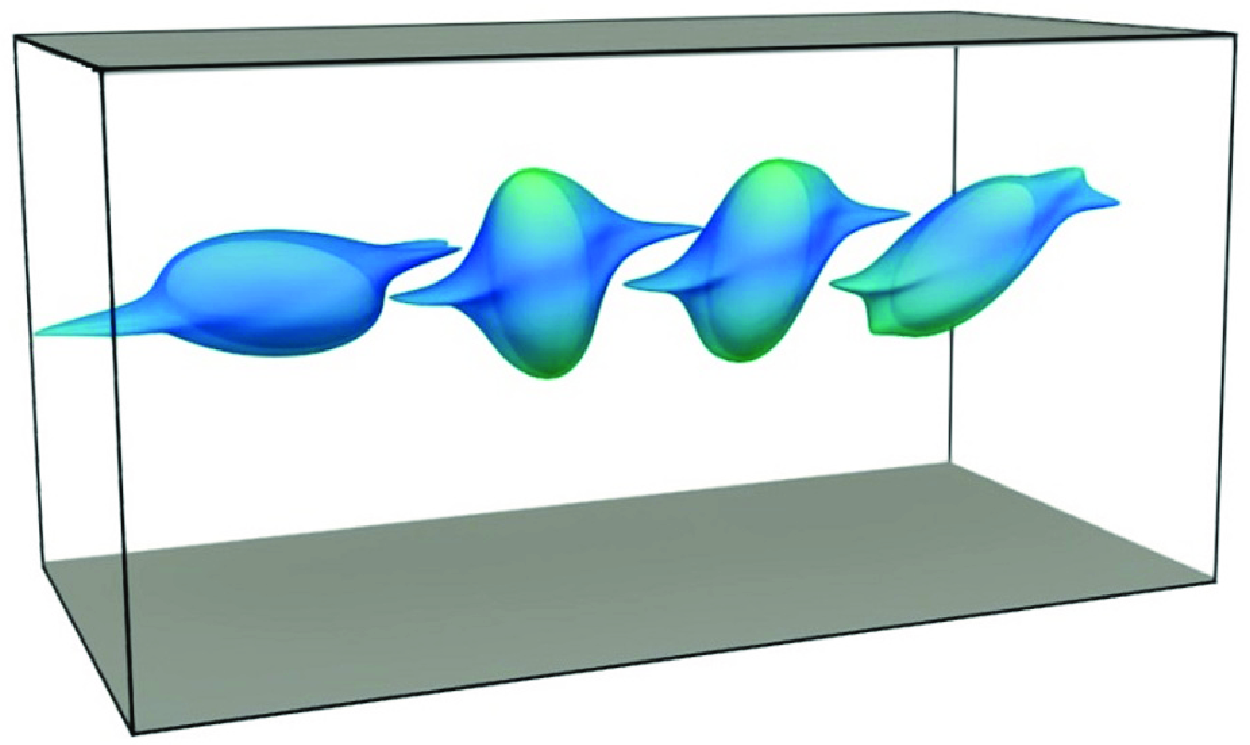
In this work, a systematic study is carried out concerning the dynamic behaviour of finite-size spheroidal particles in non-isothermal shear flows between parallel plates. The simulations rely on a hybrid method combining the lattice Boltzmann method with a finite-difference solver. Fluid–particle and heat–particle interactions are accounted for by using the immersed boundary method. The effect of particle Reynolds number ( $\textit{Re}_p=1{-}90$), Grashof number ( ${Gr}=0{-}200$), initial position and initial orientation of the particle are thoroughly examined. For the isothermal prolate particle, we observed that above a certain Reynolds number, the particle undergoes a pitchfork bifurcation; at an even higher Reynolds number, it returns to the centre position. In contrast, the hot particle behaves differently, with no pitchfork bifurcation. Instead, the Reynolds and Grashof numbers can induce oscillatory tumbling or log-rolling motions in either the lower or upper half of the channel. Heat transfer also plays an important role: at low Grashof numbers, the particle settles near the lower wall, while increasing the Grashof number shifts it towards the upper side. Moreover, the presence of thermal convection increases the rotational speed of the particle. Surprisingly, beyond the first critical Reynolds number, the equilibrium position of the thermal particle shifts closer to the centreline compared with that of a neutrally buoyant isothermal particle. Moreover, higher Grashof numbers can cause the particle to transition from tumbling to log-rolling or even a no-rotation mode. The initial orientation has a stronger influence at low Grashof numbers, while the initial position shows no strong effect in non-isothermal cases.


On rotor noise interference
-
- Journal:
- Journal of Fluid Mechanics / Volume 1013 / 25 June 2025
- Published online by Cambridge University Press:
- 23 June 2025, A43
-
- Article
- Export citation
Calving rate linearly dependent on sub-aerial terminus cliff height at tidewater glaciers around the Antarctic Peninsula
- Part of
-
- Journal:
- Annals of Glaciology / Volume 66 / 2025
- Published online by Cambridge University Press:
- 23 June 2025, e13
-
- Article
-
- You have access
- Open access
- HTML
- Export citation
Coastal roots: the history of seagrass in Northern Ireland
-
- Journal:
- Journal of the Marine Biological Association of the United Kingdom / Volume 105 / 2025
- Published online by Cambridge University Press:
- 23 June 2025, e63
-
- Article
-
- You have access
- Open access
- HTML
- Export citation
