Refine search
Actions for selected content:
179500 results in Earth and Environmental Sciences
Kantorite, K2NaMg(SO4)2F, a new fumarolic mineral from the tolbachik volcano, Kamchatka, Russia
-
- Journal:
- Mineralogical Magazine / Volume 89 / Issue 5 / October 2025
- Published online by Cambridge University Press:
- 21 May 2025, pp. 575-581
-
- Article
- Export citation
Polycrisis patterns: applying system archetypes to crisis interactions
- Part of
-
- Journal:
- Global Sustainability / Volume 8 / 2025
- Published online by Cambridge University Press:
- 20 May 2025, e17
-
- Article
-
- You have access
- Open access
- HTML
- Export citation
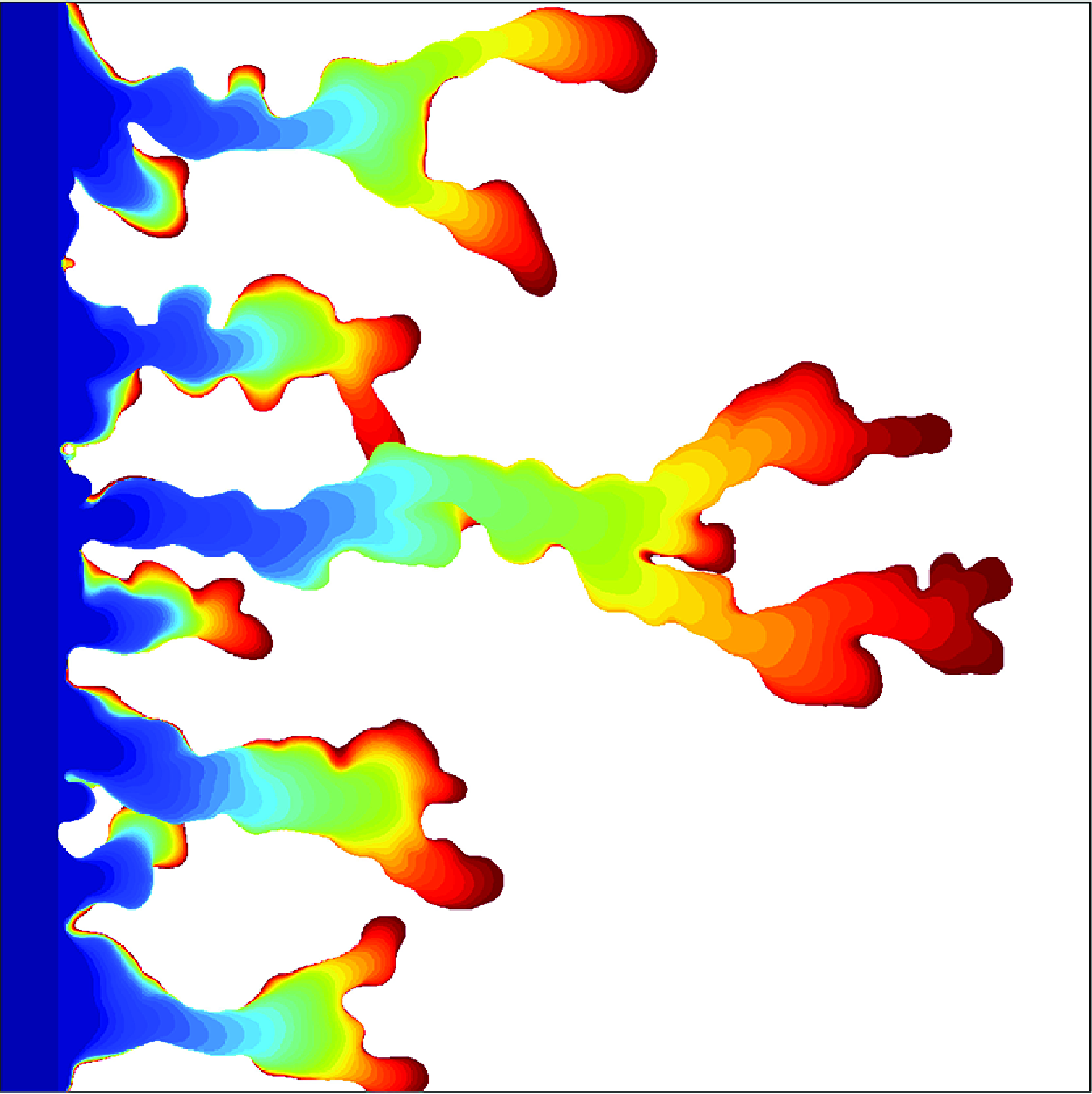
A two-dimensional depth-integrated model for immiscible two-phase flow in open rough fractures
-
- Journal:
- Journal of Fluid Mechanics / Volume 1011 / 25 May 2025
- Published online by Cambridge University Press:
- 20 May 2025, A43
-
- Article
-
- You have access
- Open access
- HTML
- Export citation
-
Immiscible two-phase flows in geological fractures are relevant to various industrial applications, including subsurface fluid storage and hydrocarbon exploitation. Direct numerical simulations (DNS) of first-principle equations, which resolve three-dimensional (3-D) fluid–fluid interfaces, can address all types of flow regimes but are computationally intensive. To retain most of their advantages while reducing the computational cost, we propose a novel two-dimensional (2-D) model based on integrating the 3-D first-principle equations over the local fracture aperture, assuming the lubrication approximation and a parabolic out-of-plane velocity profile, and relying on the volume-of-fluid method for fluid–fluid interface capturing. Such existing models have, so far, been restricted to single-phase permanent flow in rough fractures and two-phase flow in 2-D porous media. Wall friction and out-of-plane capillary pressure are incorporated as additional terms in the 2-D momentum equation. The model then relies on a geometric description reduced to the fracture’s aperture field and mean topography field. Implemented in OpenFOAM, it is validated against 3-D DNS results for viscous fingering in a Hele-Shaw cell, and applied to a realistic synthetic rough fracture geometry over a wide range of capillary numbers ( $Ca$). We then analyse to which extent, under which conditions and why this depth-integrated 2-D model, with a tenfold reduction in computational cost, provides convincing results compared with 3-D DNS predictions. We find that it performs surprisingly well over nearly the entire range of $Ca$ for which 3-D DNS models are relevant, in particular because it properly accounts for the out-of-plane capillary forces and wall friction.


Discovering effective policies for land-use planning with neuroevolution
- Part of
-
- Journal:
- Environmental Data Science / Volume 4 / 2025
- Published online by Cambridge University Press:
- 19 May 2025, e30
-
- Article
-
- You have access
- Open access
- HTML
- Export citation

The influence of free-stream turbulence on the fluctuating loads experienced by a cylinder exposed to a turbulent cross-flow
-
- Journal:
- Journal of Fluid Mechanics / Volume 1011 / 25 May 2025
- Published online by Cambridge University Press:
- 19 May 2025, A47
-
- Article
-
- You have access
- Open access
- HTML
- Export citation
-
The impact of several ‘flavours’ of free-stream turbulence (FST) on the structural response of a cantilever cylinder, subjected to a turbulent cross-flow is investigated. At high enough Reynolds numbers, the cylinder generates a spectrally rich turbulent wake that contributes significantly to the experienced loads. The presence of FST introduces additional complexity through two primary mechanisms: directly, by imposing a fluctuating velocity field on the cylinder’s surface, and indirectly, by altering the vortex shedding dynamics, modifying the experienced loads. We employ concurrent temporally resolved particle image velocimetry and distributed strain measurements using Rayleigh backscattering fibre optic sensors to instrument the surrounding velocity field and the structural strain respectively. By using various turbulence-generating grids, and manipulating their distance to the cylinder, we assess a broad FST parameter space allowing us to explore individually the influence of the transverse integral length scale ( $\mathcal{L}_{13}/D$) and turbulence intensity of the FST on the developing load dynamics. The FST enhances the magnitude of the loads acting on the cylinder. This results from a decreased vortex formation length, increased coherence of regular vortex shedding, and energy associated with this flow structure in the near wake. The cylinder’s structural response is driven mainly by the vortex shedding dynamics, and its modification induced by the presence of FST, i.e. the indirect effect outweighs the direct effect. From the explored FST parameter space, turbulence intensity was seen to be the main driver of enhanced loading conditions, presenting a positive correlation with the fluctuating loads magnitude at the root.


Confinement-induced spreading and fingering of suspensions
-
- Journal:
- Journal of Fluid Mechanics / Volume 1011 / 25 May 2025
- Published online by Cambridge University Press:
- 19 May 2025, A48
-
- Article
-
- You have access
- Open access
- HTML
- Export citation
Public engagement with Antarctic research: a global survey to understand sector capacity
-
- Journal:
- Antarctic Science / Volume 37 / Issue 4 / August 2025
- Published online by Cambridge University Press:
- 19 May 2025, pp. 320-331
-
- Article
-
- You have access
- Open access
- HTML
- Export citation

Turbulent/non-turbulent interface in polymer-laden jets
-
- Journal:
- Journal of Fluid Mechanics / Volume 1010 / 10 May 2025
- Published online by Cambridge University Press:
- 19 May 2025, A25
-
- Article
- Export citation
-
We present an experimental study on the effects of polymer additives on the turbulent/non-turbulent interface (TNTI) in a fully developed round water jet. The Reynolds number based on the jet diameter is fixed at $Re=7075$. The Weissenberg number $Wi$ ranges from 24 to 86. We employ time-resolved simultaneous particle image velocimetry and laser-induced fluorescence measurements to investigate the local entrainment and engulfment process along the TNTI in two regimes: entrainment transition and enhancement regimes. In polymer-laden jets, the TNTI fluctuates more intermittently in the radial direction and more ambient fluid can be engulfed into the turbulent region due to the augmented large scale motion. Though the contribution of engulfment to the total flux increases with $Wi$, engulfment is still not the major contribution to the entrainment in polymer-laden jets. We further show that the local entrainment velocity is increased in both regimes compared with the pure water jet, due to two contributions: polymer elastic stress and the more intermittent character of the TNTI. In the entrainment transition regime, we observe smaller fractal dimension and shorter length of TNTI compared with the Newtonian case, consistent with previous numerical simulations (Abreu et al. J. Fluid Mech. vol. 934, 2022, A36); whereas those in the enhancement regime remain largely unchanged. The difference between the two regimes results from the fact that the jet flow decays in the streamwise direction. In the entrainment transition regime, turbulence intensity is strong enough to significantly stretch the polymers, resulting in a smoother TNTI in the inertial range. However, in the entrainment enhancement regime, the polymer’s feedback is not strong enough to alter the fractal dimension due to the low elasticity. The above mentioned differences of entrainment velocity and TNTI in the entrainment reduction/transition and enhancement regimes also explain the reduced and enhanced spreading rate of the viscoelastic jet observed in previous numerical simulations and experiments (Guimarães et al. J. Fluid Mech. 2020,vol. 899, A11; Peng et al. Phys. Fluids, 2023, vol. 35, 045110).


Discrepancies between radiocarbon dates and dated finds among Phoenician tombs in Sicily
-
- Journal:
- Radiocarbon / Volume 67 / Issue 3 / June 2025
- Published online by Cambridge University Press:
- 19 May 2025, pp. 630-645
- Print publication:
- June 2025
-
- Article
-
- You have access
- Open access
- HTML
- Export citation
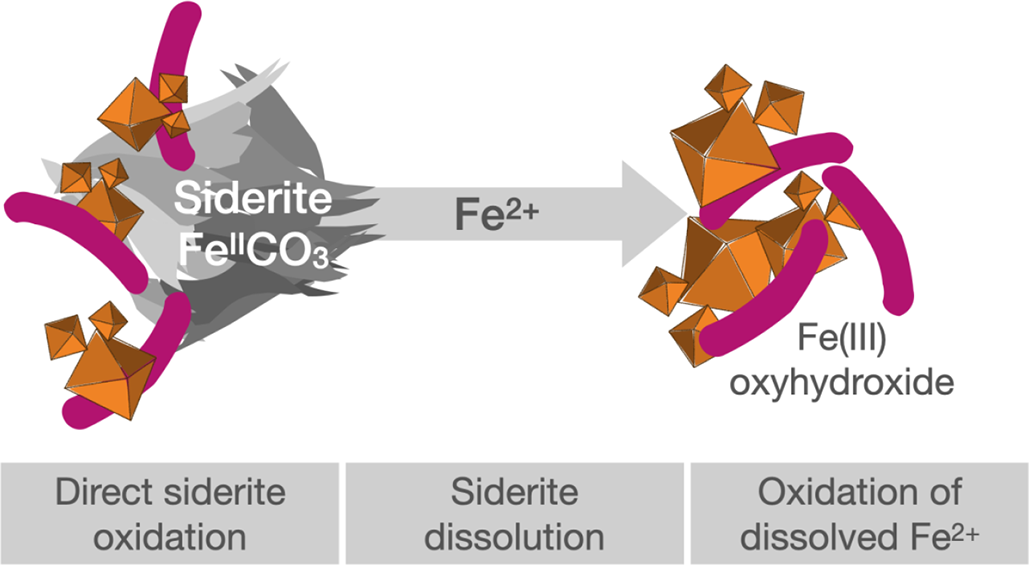
Oxidation of Fe(II) carbonate (siderite) by anoxygenic phototrophic Fe(II)-oxidising bacteria
-
- Journal:
- Geo-Bio Interfaces / Volume 2 / 2025
- Published online by Cambridge University Press:
- 19 May 2025, e9
-
- Article
-
- You have access
- Open access
- HTML
- Export citation
Reservoir Effects from Shells of Tell Abraq, Sharjah Emirate, UAE
-
- Journal:
- Radiocarbon / Volume 67 / Issue 3 / June 2025
- Published online by Cambridge University Press:
- 19 May 2025, pp. 600-612
- Print publication:
- June 2025
-
- Article
- Export citation
Fracturation pattern and morphostructure of the Deception Island volcano, South Shetland Islands, Antarctica
- Part of
-
- Journal:
- Antarctic Science / Volume 37 / Issue 3 / June 2025
- Published online by Cambridge University Press:
- 19 May 2025, pp. 176-200
-
- Article
-
- You have access
- Open access
- HTML
- Export citation
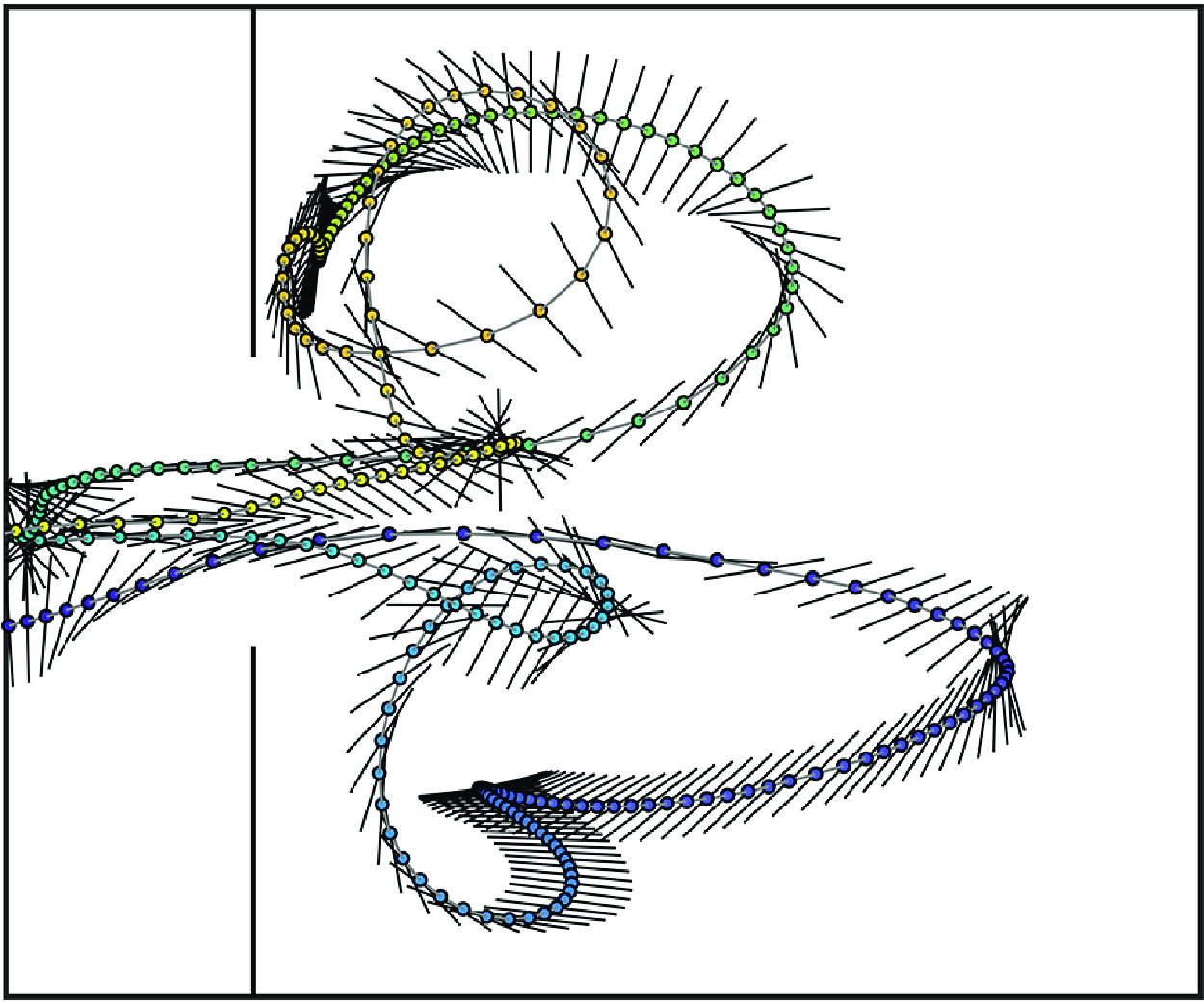
Rigid fibre transport in a periodic non-homogeneous geophysical turbulent flow
-
- Journal:
- Journal of Fluid Mechanics / Volume 1011 / 25 May 2025
- Published online by Cambridge University Press:
- 16 May 2025, A5
-
- Article
-
- You have access
- Open access
- HTML
- Export citation
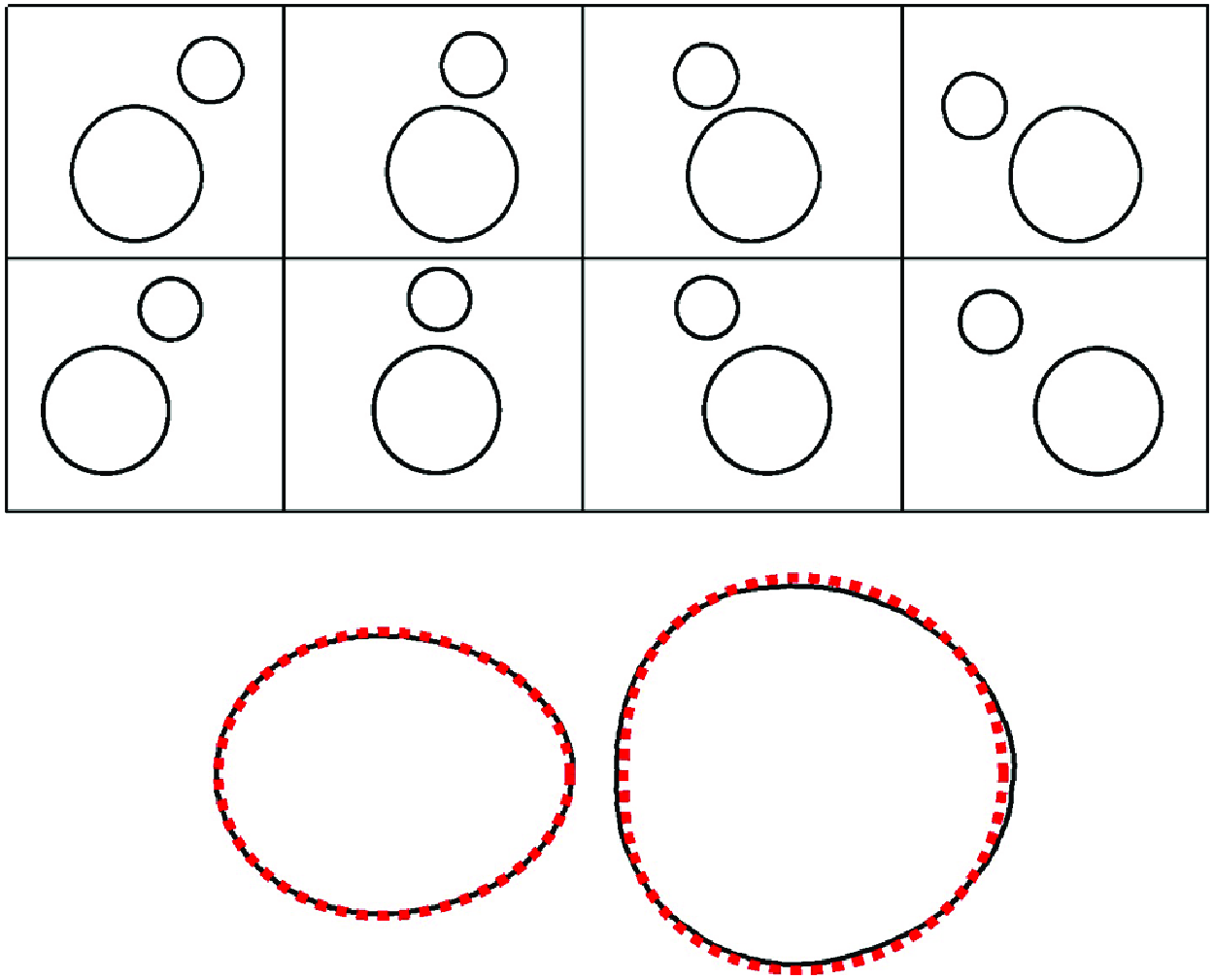
Bubble racing in a Hele-Shaw cell
-
- Journal:
- Journal of Fluid Mechanics / Volume 1010 / 10 May 2025
- Published online by Cambridge University Press:
- 16 May 2025, A19
-
- Article
-
- You have access
- Open access
- HTML
- Export citation

Large eddy simulations of wall-bounded turbulence based on interscale energy transfer among resolved scales
-
- Journal:
- Journal of Fluid Mechanics / Volume 1010 / 10 May 2025
- Published online by Cambridge University Press:
- 16 May 2025, A22
-
- Article
- Export citation

Turbulent pipe flow of thixotropic fluids
-
- Journal:
- Journal of Fluid Mechanics / Volume 1011 / 25 May 2025
- Published online by Cambridge University Press:
- 16 May 2025, A45
-
- Article
-
- You have access
- Open access
- HTML
- Export citation
-
Complex materials with internal microstructure such as suspensions and emulsions exhibit time-dependent rheology characterised by viscoelasticity and thixotropy. In many large-scale applications such as turbulent pipe flow, the elastic response occurs on a much shorter time scale than the thixotropy, hence these flows are purely thixotropic. The fundamental dynamics of thixotropic turbulence is poorly understood, particularly the interplay between microstructural state, rheology and turbulence structure. To address this gap, we conduct direct numerical simulations (DNS) of fully developed turbulent pipe flow of a model thixotropic (Moore) fluid as a function of the thixoviscous number $\Lambda$, which characterises the thixotropic kinetic rate relative to turbulence eddy turnover time, ranging from slow ( $\Lambda \ll 1$) to fast ( $\Lambda \gg 1$) kinetics. Analysis of DNS results in the Lagrangian frame shows that, as expected, in the limits of slow and fast kinetics, these time-dependent flows behave as time-independent purely viscous (generalised Newtonian) analogues. For intermediate kinetics ( $\Lambda \sim 1$), the rheology is governed by a path integral of the thixotropic fading memory kernel over the distribution of Lagrangian shear history, the latter of which is modelled via a simple stochastic model for the radially non-stationary pipe flow. The DNS computations based on this effective viscosity closure exhibit excellent agreement with the fully thixotropic model for $\Lambda =1$, indicating that the purely viscous (generalised Newtonian) analogue persists for arbitrary values of $\Lambda \in (0,\infty ^+)$ and across nonlinear rheology models. These results significantly simplify our understanding of turbulent thixotropic flow, and provide insights into the structure of these complex time-dependent flows.


Electrohydrodynamic deformation of liquid film underneath a topographical template
-
- Journal:
- Journal of Fluid Mechanics / Volume 1011 / 25 May 2025
- Published online by Cambridge University Press:
- 16 May 2025, A46
-
- Article
- Export citation
The molecular basis of punctuated equilibria: the roles of developmental genes in stasis and speciation
-
- Journal:
- Paleobiology / Volume 51 / Issue 4 / November 2025
- Published online by Cambridge University Press:
- 15 May 2025, pp. 753-764
-
- Article
-
- You have access
- Open access
- HTML
- Export citation
FLM volume 1009 Cover and Front matter
-
- Journal:
- Journal of Fluid Mechanics / Volume 1009 / 10 May 2025
- Published online by Cambridge University Press:
- 15 May 2025, p. f1
-
- Article
-
- You have access
- Export citation

Constructing turbulence models using the kinetic Fokker–Planck equation
-
- Journal:
- Journal of Fluid Mechanics / Volume 1011 / 25 May 2025
- Published online by Cambridge University Press:
- 15 May 2025, A44
-
- Article
- Export citation
