Refine search
Actions for selected content:
179500 results in Earth and Environmental Sciences

How a self-propelled fin gains hydrodynamic advantages behind a circular cylinder with vortex-induced vibrations
-
- Journal:
- Journal of Fluid Mechanics / Volume 1011 / 25 May 2025
- Published online by Cambridge University Press:
- 15 May 2025, A26
-
- Article
- Export citation
-
The interaction of a swimmer with unsteady vortices in complex flows remains a topic of interest and open discussion. The present study, employing the immersed boundary method with a flexible fin model, explores swimming behaviours behind a circular cylinder with vortex-induced vibration (VIV). Five distinct swimming modes are identified on the $U_r$– $G_0$ plane, where $U_r$ denotes the reduced velocity, and $G_0$ represents the fin’s initial position. These modes include drifting upstream I/II (DU-I/II), Karman gait I/II (KG-I/II), and large oscillation (LO), with the DU-II, KG-II and LO modes being newly reported. The fin can either move around or cross through the vortex cores in the KG-I and KG-II modes, respectively, for energy saving and maintaining a stable position. When the upstream cylinder vibrates with its maximum amplitude, a double-row vortex shedding forms in the wake, allowing the DU-II mode to occur with the fin to achieve high-speed locomotion. This is attributed to a significant reduction in the streamwise velocity caused by vortex-induced velocity. Furthermore, a symmetry breaking is observed in the fin’s wake in the DU-II mode, potentially also contributing to high-speed locomotion. Overall, compared to the case without an upstream cylinder, we demonstrate that a self-propelled fin gains hydrodynamic advantages with various swimming modes in different VIV wakes. Interestingly, increased power transferred from flows by the oscillating cylinder leads to a more favourable environment for the downstream fin’s propulsion, indicating that a fin in VIV wakes obtains more advantages compared to the vortex street generated by a stationary cylinder.


Experimental tests of feeding behaviour, dietary breadth and cooperative feeding in a predatory carabid invading sub-Antarctic regions
-
- Journal:
- Antarctic Science / Volume 37 / Issue 3 / June 2025
- Published online by Cambridge University Press:
- 15 May 2025, pp. 167-175
-
- Article
-
- You have access
- Open access
- HTML
- Export citation

Pressure and vorticity scaling in anguilliform and carangiform swimming
-
- Journal:
- Journal of Fluid Mechanics / Volume 1010 / 10 May 2025
- Published online by Cambridge University Press:
- 15 May 2025, A28
-
- Article
-
- You have access
- Open access
- HTML
- Export citation
-
The scaling of pressure and vorticity in aquatic swimming can provide insights into the mechanisms of propulsion. This is investigated through self-propelled, wall-resolved, large-eddy simulations of a lamprey (an anguilliform swimmer) and a mackerel (a carangiform swimmer) using the curvilinear immersed boundary method. It is observed that the pressure around the swimmers scales with theoretical fluid acceleration, which includes both local body and the convective acceleration, for anguilliform swimmers, whereas it scales with both acceleration and the angle of attack (AoA) for carangiform swimmers. This indicates that the main mechanism for propulsion in anguilliform swimmers is added mass (unsteady), whereas both lift-based (steady) and added mass (unsteady) are at play for carangiform swimmers. Furthermore, it is observed that the vorticity in the boundary layer of the swimmer initially follows the body rotation at low speeds but not at high speeds during the quasisteady swimming. This is explained by identifying the scaling of vorticity components: one due to body rotation and the other due to shear, which scale with Strouhal number ( $St$) and Reynolds number ( $\sqrt {Re}$), respectively. Here $St$ (body rotation) dominates at low speeds, but $\sqrt {Re}$ (shear) dominates at high speeds. Finally, it is observed that the pressure decreases as the swimming speed increases. This counterintuitive observation is explained by showing that both fluid acceleration and AoA decrease as swimming speed increases. This suggests that for efficient swimming, the pressure difference across the body should be minimised, but high enough to overcome the viscous drag.


Modelling the evolution of Richtmyer–Meshkov mixing width during shock compression phases
-
- Journal:
- Journal of Fluid Mechanics / Volume 1011 / 25 May 2025
- Published online by Cambridge University Press:
- 15 May 2025, A39
-
- Article
- Export citation

Forced convection in two-phase core-annular flows
-
- Journal:
- Journal of Fluid Mechanics / Volume 1011 / 25 May 2025
- Published online by Cambridge University Press:
- 15 May 2025, A41
-
- Article
-
- You have access
- Open access
- HTML
- Export citation
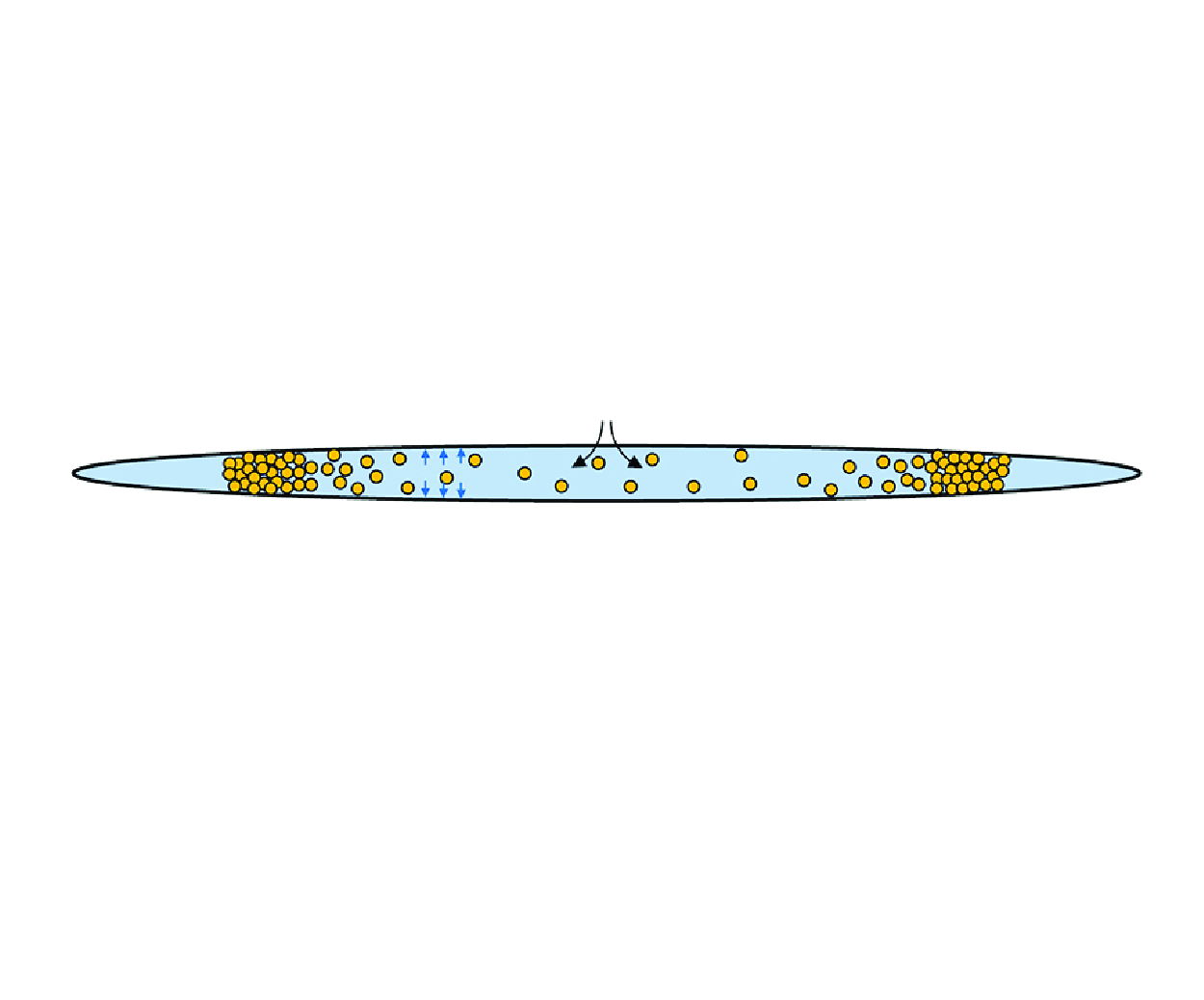
Dynamic plugging of a plane-strain hydraulic fracture driven by slurry flow
-
- Journal:
- Journal of Fluid Mechanics / Volume 1010 / 10 May 2025
- Published online by Cambridge University Press:
- 15 May 2025, A23
-
- Article
-
- You have access
- Open access
- HTML
- Export citation

Statistical analysis of vertical velocity and buoyancy in convective boundary layers
-
- Journal:
- Journal of Fluid Mechanics / Volume 1011 / 25 May 2025
- Published online by Cambridge University Press:
- 15 May 2025, A40
-
- Article
-
- You have access
- Open access
- HTML
- Export citation
Environmental degradation and loss of polyester marker flags are major sources of localized plastic pollution in the Antarctic
-
- Journal:
- Antarctic Science / Volume 37 / Issue 4 / August 2025
- Published online by Cambridge University Press:
- 15 May 2025, pp. 218-226
-
- Article
-
- You have access
- Open access
- HTML
- Export citation
-
Reducing plastic pollution of the Antarctic environment is a priority for the Antarctic Treaty Consultative Meeting (ATCM) and Council of Managers of National Antarctic Programs (COMNAP). Polyester flags mounted on bamboo poles are commonly used by governmental and tourism operators as markers of safe travel routes, scientific equipment and depots in snow-covered areas. Polar environmental conditions can rapidly degrade polyester flags, resulting in plastic release into the environment. This study aimed to quantify the degree of polyester flag degradation and investigate alternative, less polluting flag types. Pre-weighed flags of four types - standard polyester, hemmed polyester, organic cotton canvas and Ventile ${}^\circledR $ (a tight-weave cotton fabric) - were deployed close to Rothera Research Station, Antarctic Peninsula, from February 2023 to January 2024, after which any changes in weight were recorded. On average, each standard polyester flag lost 25.5% (± standard error (SE) 0.8) of its weight, equating to the release of 8.3 g of plastic into the environment; however, hemming the flag reduced this loss to 13.3% (± SE 3.7). Ventile ${}^\circledR $ was almost as durable as unhemmed polyester (loss of 26.9% (± SE 3.8)), whereas cotton canvas was the least durable (loss of 44.1% (± SE 4.3)). Switching from standard polyester to Ventile ${}^\circledR $ flags would prevent the annual release of > 8.3 kg of plastic into the environment around Rothera Research Station, and potentially ~300 kg across all Antarctic operator activities. This is a conservative estimate compared to a potential additional 800 kg of plastic that could be lost to the environment due a high proportion of deployed flags not being recovered. Further investigations to identify cost-effective sustainable flag materials are recommended to comply with ATCM and COMNAP recommendations concerning plastic management in Antarctica.


Self-excited instability and transition to turbulence in laminar separation bubbles induced by surface waviness
-
- Journal:
- Journal of Fluid Mechanics / Volume 1011 / 25 May 2025
- Published online by Cambridge University Press:
- 15 May 2025, A27
-
- Article
-
- You have access
- Open access
- HTML
- Export citation
Centrifugal convection with oscillating rotating velocity
-
- Journal:
- Journal of Fluid Mechanics / Volume 1010 / 10 May 2025
- Published online by Cambridge University Press:
- 15 May 2025, A17
-
- Article
- Export citation
-
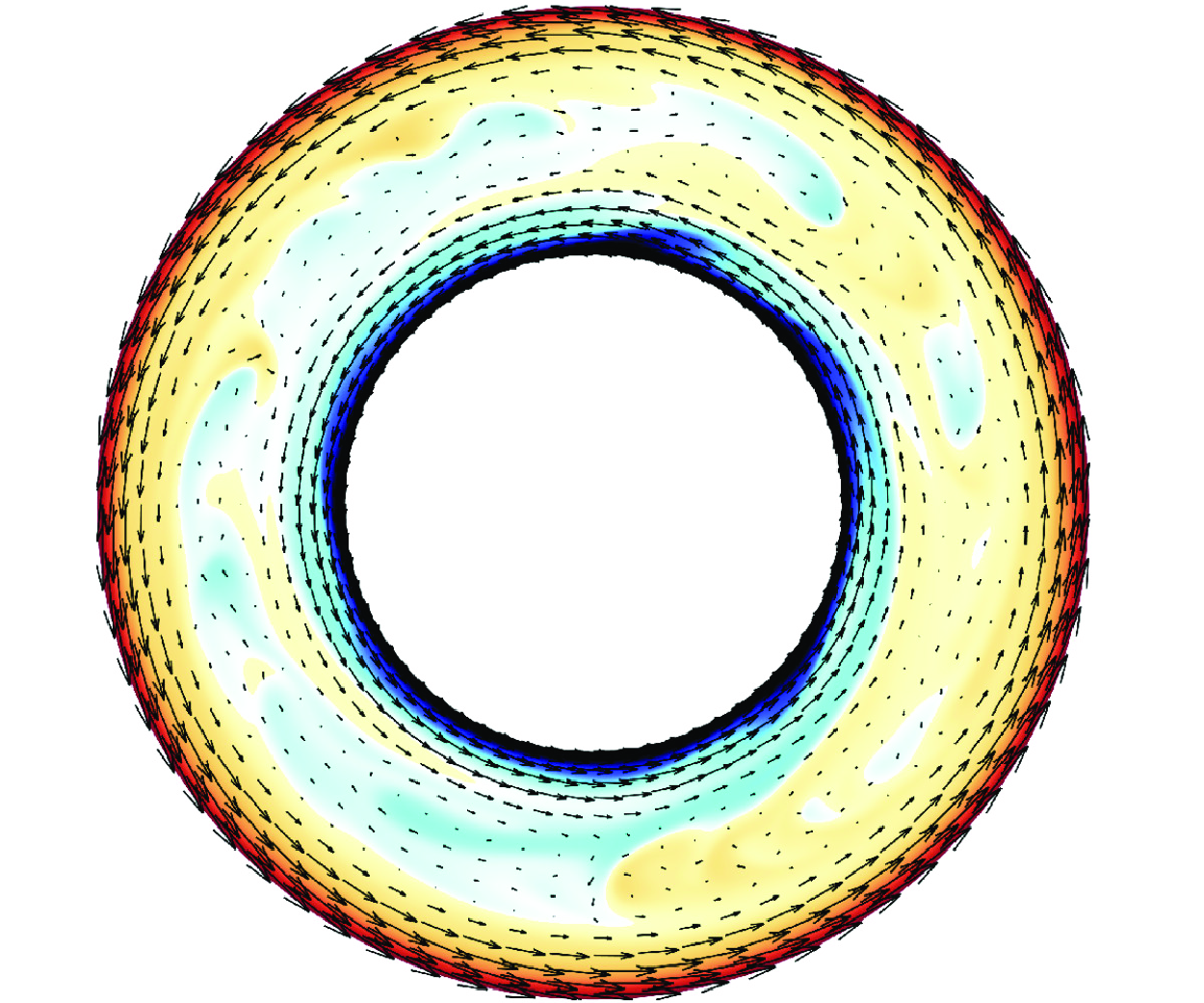
We perform direct numerical simulations of centrifugal convection with an oscillating rotational velocity of small amplitude to study the effects of oscillatory boundary motion. The oscillation period is the main control parameter, with its range corresponding to a Womersley number in the range $1\lt Wo\lt 300$. Oscillating boundaries generate a circumferential shear flow, which significantly inhibits heat transfer, with maximum suppression $87\,\%$ observed in the present parameter space. Through analysis of the background flow, we find that as the oscillation period increases, the increasing penetration depth of the oscillation and weakening local shear strength result in non-monotonic changes in heat transfer. Under high-frequency oscillation, the characteristic length scale of the viscous layer induced by the oscillation is smaller than the convective length scale, and shear manifests primarily as a continuous suppression of the boundary layer. In contrast, under low-frequency oscillation, the shear flow covers the entire region but with weak strength. The suppression effect of such shear flow exhibits periodicity, leading to alternating phases of convection inhibition and convection generation. The present findings explore the physical mechanisms behind the suppression of convective heat transfer by oscillation, and offer a new strategy for controlling convection systems, with potential implications for both fundamental research and industrial applications.

Microbial mat activity and soil biogeochemistry across variable phosphorus availability in Taylor Valley, Antarctica
-
- Journal:
- Antarctic Science / Volume 37 / Issue 4 / August 2025
- Published online by Cambridge University Press:
- 15 May 2025, pp. 205-217
-
- Article
-
- You have access
- Open access
- HTML
- Export citation

A generalised multiparameter linear stability and sensitivity analysis method
-
- Journal:
- Journal of Fluid Mechanics / Volume 1011 / 25 May 2025
- Published online by Cambridge University Press:
- 15 May 2025, A12
-
- Article
- Export citation
-
A generalised multiparameter model for linear modal stability and sensitivity analysis is developed. The stability and sensitivity equations are derived from a generalised vector-form governing equation comprised of multiple dimensionless parameters that represent different physical forces affecting the system’s stability. By introducing adjoint variables and constructing the Lagrangian identity, a differential relationship between the eigenvalue of the perturbation mode and dimensionless parameters is determined and defined as the global sensitivity gradient. It provides the constraint that must be satisfied for changes in different dimensionless parameters along the isoeigenvalue curve, which aids in the fast computation of the neutral curve. Moreover, the global sensitivity gradient can directly and intuitively evaluate the competitive relationship among the influences of various parameters on system instability. Based on the global sensitivity gradient, an optimal stability control strategy for transitioning from an unstable state to a stable state is discussed. Additionally, the relative sensitivity function is also introduced to investigate the influence of relative parameter variations on instability. To demonstrate the effectiveness of this method, three applications are presented: two-dimensional flow around a circular cylinder with a single dimensionless parameter Re; three-dimensional axisymmetric magnetohydrodynamic (MHD) flow around a sphere with two parameters Re and $N$; and two-dimensional MHD mixed convection with three parameters Re, ${\textit{Gr}}$ and $\textit{Ha}$.


Optimising branched fluidic networks: a unifying approach including laminar and turbulent flows, rough walls and non-Newtonian fluids
-
- Journal:
- Journal of Fluid Mechanics / Volume 1011 / 25 May 2025
- Published online by Cambridge University Press:
- 15 May 2025, A42
-
- Article
-
- You have access
- Open access
- HTML
- Export citation
-
Power minimisation in branched fluidic networks has gained significant attention in biology and engineering. The optimal network is defined by channel radii that minimise the sum of viscous dissipation and the volumetric energetic cost of the fluid. For limit cases including laminar flows, high-Reynolds-number turbulence or smooth-channel approximations, optimal solutions are known. However, current methods do not allow optimisation for a large intermediate part of the parameter space which is typically encountered in realistic fluidic networks that exhibit turbulent flow. Here, we present a unifying optimisation approach based on the Darcy friction factor, which has been determined for a wide range of flow regimes and fluid models and is applicable to the entire parameter space: (i) laminar and turbulent flows, including networks that exhibit both flow types, (ii) non-Newtonian fluids (powerlaw, Bingham and Herschel–Bulkley) and (iii) networks with arbitrary wall roughness, including non-uniform relative roughness. The optimal channel radii are presented analytically and graphically. All existing limit cases are recovered, and a concise framework is presented for systematic optimisation of fluidic networks. Finally, the parameter $x$ in the optimisation relationship $Q\propto R^{x}$, with $Q$ the flow rate and $R$ the channel radius, was approximated as a function of the Reynolds number, revealing in which case the entire network can be optimised based on one optimal channel radius, and in which case all radii must be optimised individually. Our approach can be extended to a wide range of fluidic networks for which the friction factor is known, such as different channel curvatures, bubbly flows or specific wall slip conditions.


Complementary in situ garnet Lu-Hf geochronology and monazite U(-Th)-Pb petrochronology: an example from the Archean Slave craton, Northwest Territories, Canada
-
- Journal:
- Geological Magazine / Volume 162 / 2025
- Published online by Cambridge University Press:
- 14 May 2025, e14
-
- Article
-
- You have access
- Open access
- HTML
- Export citation
Turbulent boundary layers under spatially and temporally varying pressure gradients
-
- Journal:
- Journal of Fluid Mechanics / Volume 1010 / 10 May 2025
- Published online by Cambridge University Press:
- 14 May 2025, A61
-
- Article
-
- You have access
- Open access
- HTML
- Export citation
-
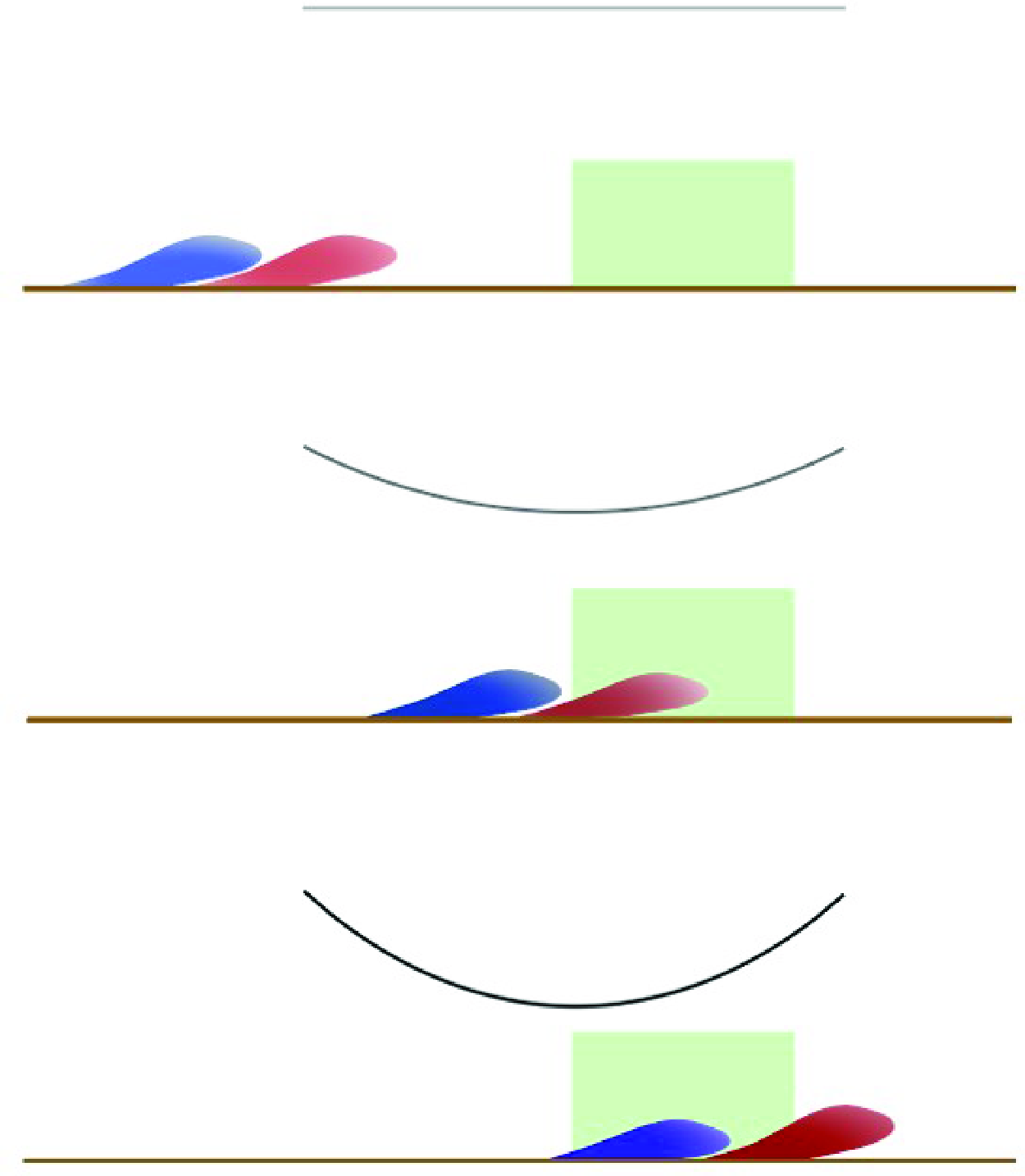
The spatiotemporal dynamics of a turbulent boundary layer subjected to an unsteady pressure gradient are studied. A dynamic sequence of favourable to adverse pressure gradients (FAPGs) is imposed by deforming a section of the wind tunnel ceiling, transitioning the pressure gradient from zero to a strong FAPG within 0.07 s. At the end of the transient, the acceleration parameter is $K$ =
$K$ =  $6 \times 10^{-6}$ in the favourable pressure gradient (FPG) region and $K$ =
$K$ =  $-4.8 \times 10^{-6}$ in the adverse pressure gradient (APG) region. The resulting unsteady response of the boundary layer is compared with equivalent steady pressure gradient cases in terms of turbulent statistics and coherent structures. While the steady FAPG effects, as shown by Parthasarathy & Saxton-Fox (2023), caused upstream stabilisation in the FPG, a milder APG response downstream, and the formation of an internal layer, the unsteady case presented in this paper shows a reduced stabilisation in the FPG region, a stronger APG response and a weaker internal layer. This altered response is hypothesised to stem from the different spatiotemporal pressure gradient histories experienced by turbulent structures when the pressure gradient changes at a time scale comparable to their convection.


Obliquely interacting solitary waves and wave wakes in free-surface flows
-
- Journal:
- Journal of Fluid Mechanics / Volume 1011 / 25 May 2025
- Published online by Cambridge University Press:
- 14 May 2025, A8
-
- Article
- Export citation
On Ophioderma (Echinodermata: Ophiuroidea) coming of age: morphological variations in three eastern Pacific species
-
- Journal:
- Journal of the Marine Biological Association of the United Kingdom / Volume 105 / 2025
- Published online by Cambridge University Press:
- 14 May 2025, e49
-
- Article
- Export citation

Refinements in the nonlinear term of a turbulence predictive model based on atmospheric surface layer observations
-
- Journal:
- Journal of Fluid Mechanics / Volume 1011 / 25 May 2025
- Published online by Cambridge University Press:
- 14 May 2025, A25
-
- Article
- Export citation

A multi-horizon peridynamics for coupled fluid flow and heat transfer
-
- Journal:
- Journal of Fluid Mechanics / Volume 1010 / 10 May 2025
- Published online by Cambridge University Press:
- 14 May 2025, A66
-
- Article
-
- You have access
- Open access
- HTML
- Export citation
Multi-scale dynamics of scalar transfer in Rayleigh–Taylor turbulent mixing
-
- Journal:
- Journal of Fluid Mechanics / Volume 1011 / 25 May 2025
- Published online by Cambridge University Press:
- 14 May 2025, A4
-
- Article
-
- You have access
- Open access
- HTML
- Export citation
-
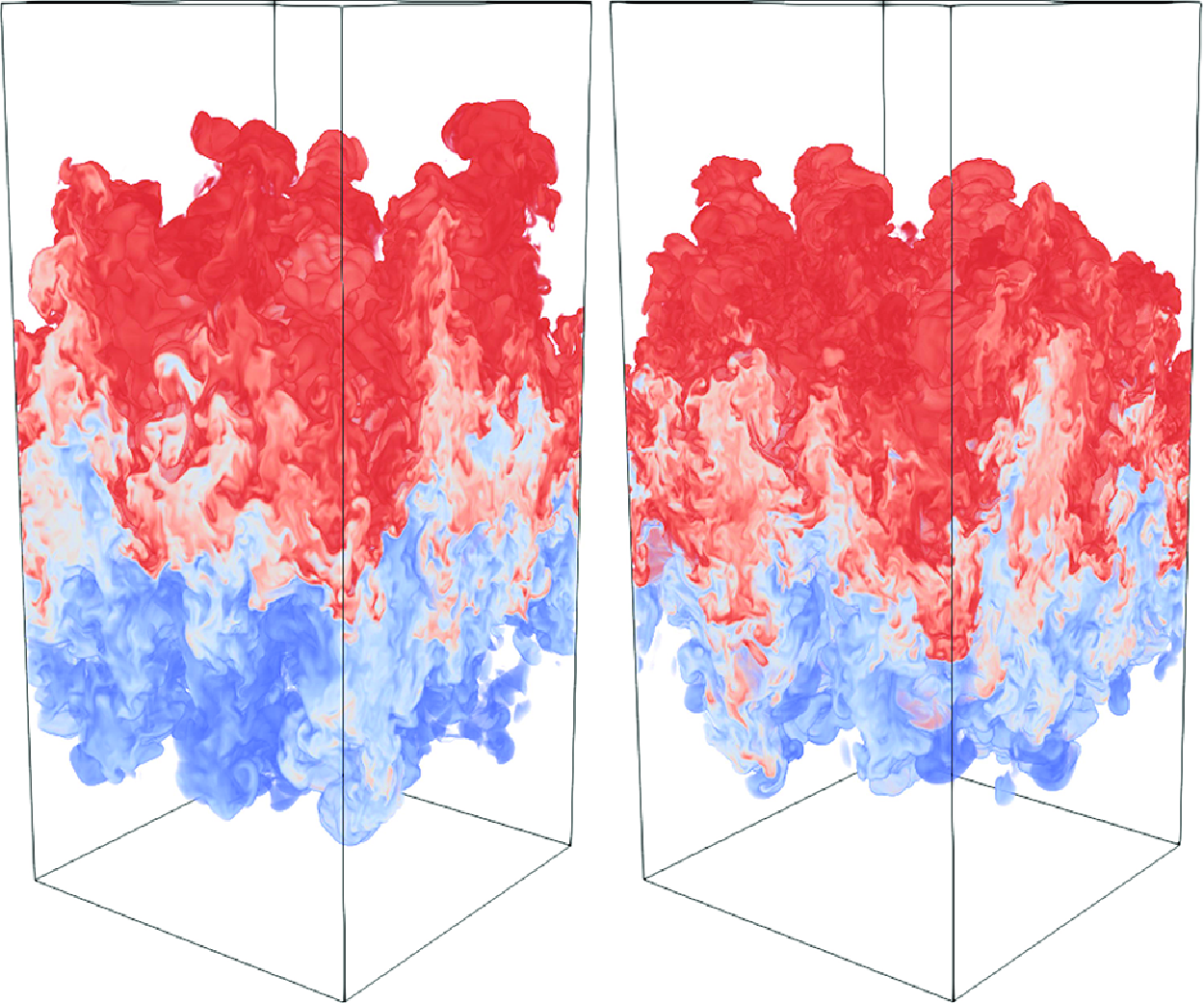
Miscible Rayleigh–Taylor (RT) turbulence exhibits a wide range of length scales in both the velocity and density fields, leading to complex deformations of isoscalar surfaces and enhanced mixing due to nonlinear interactions among different scales. Through high-resolution numerical simulations and a coarse-graining analysis, we demonstrate that the variance of the heavy fluid concentration, initially maximised by the unstable stratification, progressively cascades from larger to smaller scales, eventually dissipates at the smallest scale. The transfer of scalar variance, $\Pi ^Y$, primarily governed by the filtered strain rate tensor, is effectively captured by a nonlinear model that links $\Pi ^Y$ to the isoscalar surface stretching. On the other hand, the backscatter of scalar variance transfer, represented by the negative component of $\Pi ^Y$, is influenced by the filtered vorticity field. Furthermore, we examine the directional anisotropy of scalar transfer in RT turbulence, enhancing the accuracy of the nonlinear model by separating the horizontal mean of the mass fraction from its fluctuating part.


