Refine search
Actions for selected content:
179500 results in Earth and Environmental Sciences

Taylor dispersion for coupled electroosmotic and pressure-driven flows in all time regimes
-
- Journal:
- Journal of Fluid Mechanics / Volume 1011 / 25 May 2025
- Published online by Cambridge University Press:
- 14 May 2025, A36
-
- Article
-
- You have access
- Open access
- HTML
- Export citation

Optimised flow control based on automatic differentiation in compressible turbulent channel flows
-
- Journal:
- Journal of Fluid Mechanics / Volume 1011 / 25 May 2025
- Published online by Cambridge University Press:
- 14 May 2025, A1
-
- Article
-
- You have access
- Open access
- HTML
- Export citation
-
This study presents an automatic differentiation (AD)-based optimisation framework for flow control in compressible turbulent channel flows. Using a differentiable solver, JAX-Fluids, we designed fully differentiable boundary conditions that allow for the precise calculation of gradients with respect to boundary control variables. This facilitates the efficient optimisation of flow control methods. The framework’s adaptability and effectiveness are demonstrated using two boundary conditions: opposition control and tunable permeable walls. Various optimisation targets are evaluated, including wall friction and turbulent kinetic energy (TKE), across different time horizons. In each optimisation, there were around $4\times 10^4$ control variables and $3\times 10^{9}$ state variables in a single episode. Results indicate that TKE targeted opposition control achieves a more stable and significant reduction in drag, with effective suppression of turbulence throughout the channel. In contrast, strategies that focus directly on minimising wall friction were found to be less effective, exhibiting instability and increased turbulence in the outer region. The tunable permeable walls also show potential to achieve stable drag reduction through a ‘flux-inducing’ mechanism. This study demonstrates the advantages of AD-based optimisation in complex flow control scenarios and provides physical insight into the choice of the quantity of interest for improved optimisation performance.


Four species of Mesanthura (Crustacea: Isopoda: Anthuroidea) from Japan, including the description of a new species
-
- Journal:
- Journal of the Marine Biological Association of the United Kingdom / Volume 105 / 2025
- Published online by Cambridge University Press:
- 14 May 2025, e48
-
- Article
- Export citation

Non-modal analysis of Rayleigh–Bénard convection with and without bounded shear flows in viscoelastic fluids
-
- Journal:
- Journal of Fluid Mechanics / Volume 1011 / 25 May 2025
- Published online by Cambridge University Press:
- 14 May 2025, A37
-
- Article
- Export citation
Skeletobiont serpulids on the xanthid crab Lathahypossia aculeata from the middle Eocene of the Chiampo Valley, Vicenza (Northeast Italy)
-
- Journal:
- Journal of Paleontology / Volume 99 / Issue 3 / May 2025
- Published online by Cambridge University Press:
- 14 May 2025, pp. 690-700
-
- Article
- Export citation

Feigenbaum universality in subcritical Taylor–Couette flow
-
- Journal:
- Journal of Fluid Mechanics / Volume 1010 / 10 May 2025
- Published online by Cambridge University Press:
- 14 May 2025, A36
-
- Article
-
- You have access
- Open access
- HTML
- Export citation

Gravitational effects on Faraday instability in a viscoelastic liquid
-
- Journal:
- Journal of Fluid Mechanics / Volume 1011 / 25 May 2025
- Published online by Cambridge University Press:
- 14 May 2025, A28
-
- Article
-
- You have access
- Open access
- HTML
- Export citation

Dynamics of inviscid droplets on fibres: from instability to oscillations
-
- Journal:
- Journal of Fluid Mechanics / Volume 1011 / 25 May 2025
- Published online by Cambridge University Press:
- 14 May 2025, A34
-
- Article
- Export citation

An insulating plate drifting over a thermally convecting fluid: the effect of heating mode on plate motion and coupling mode
-
- Journal:
- Journal of Fluid Mechanics / Volume 1010 / 10 May 2025
- Published online by Cambridge University Press:
- 14 May 2025, A33
-
- Article
- Export citation
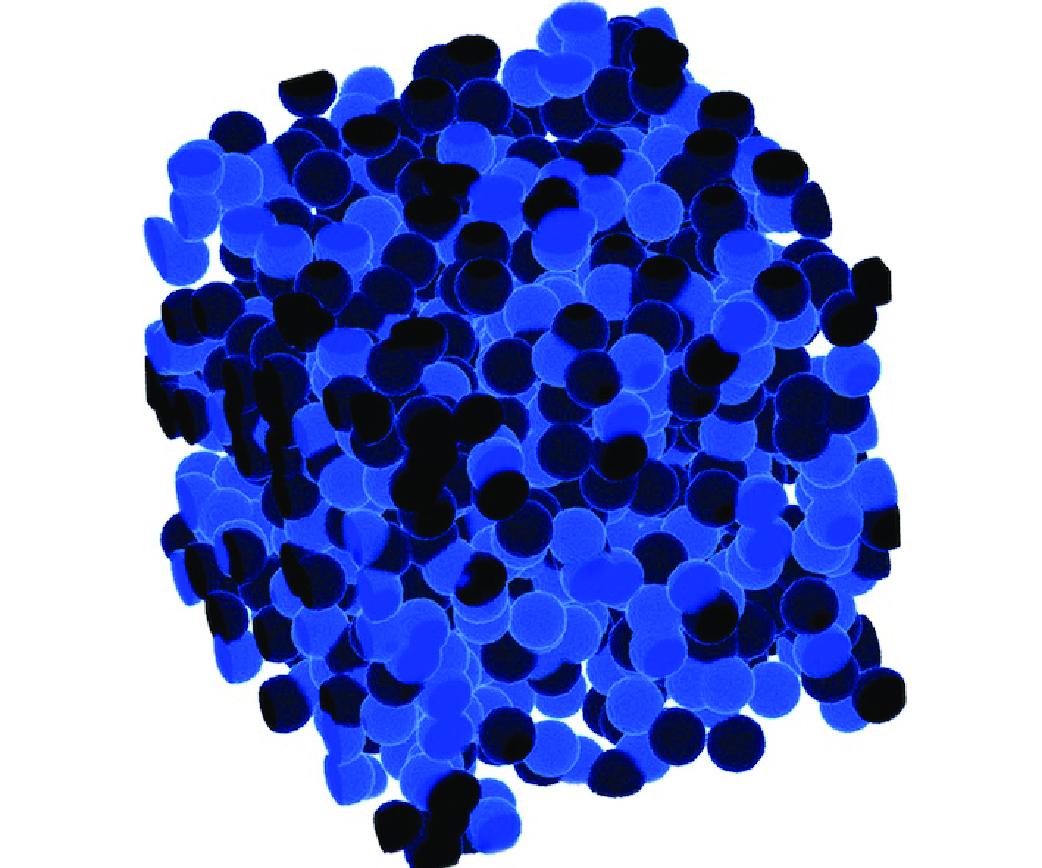
Mean field lattice Boltzmann model for reactive mixtures in porous media
-
- Journal:
- Journal of Fluid Mechanics / Volume 1011 / 25 May 2025
- Published online by Cambridge University Press:
- 14 May 2025, A9
-
- Article
-
- You have access
- Open access
- HTML
- Export citation
Investigating snow sinks on level sea ice: A case study in the western Arctic
-
- Journal:
- Journal of Glaciology / Volume 71 / 2025
- Published online by Cambridge University Press:
- 14 May 2025, e66
-
- Article
-
- You have access
- Open access
- HTML
- Export citation
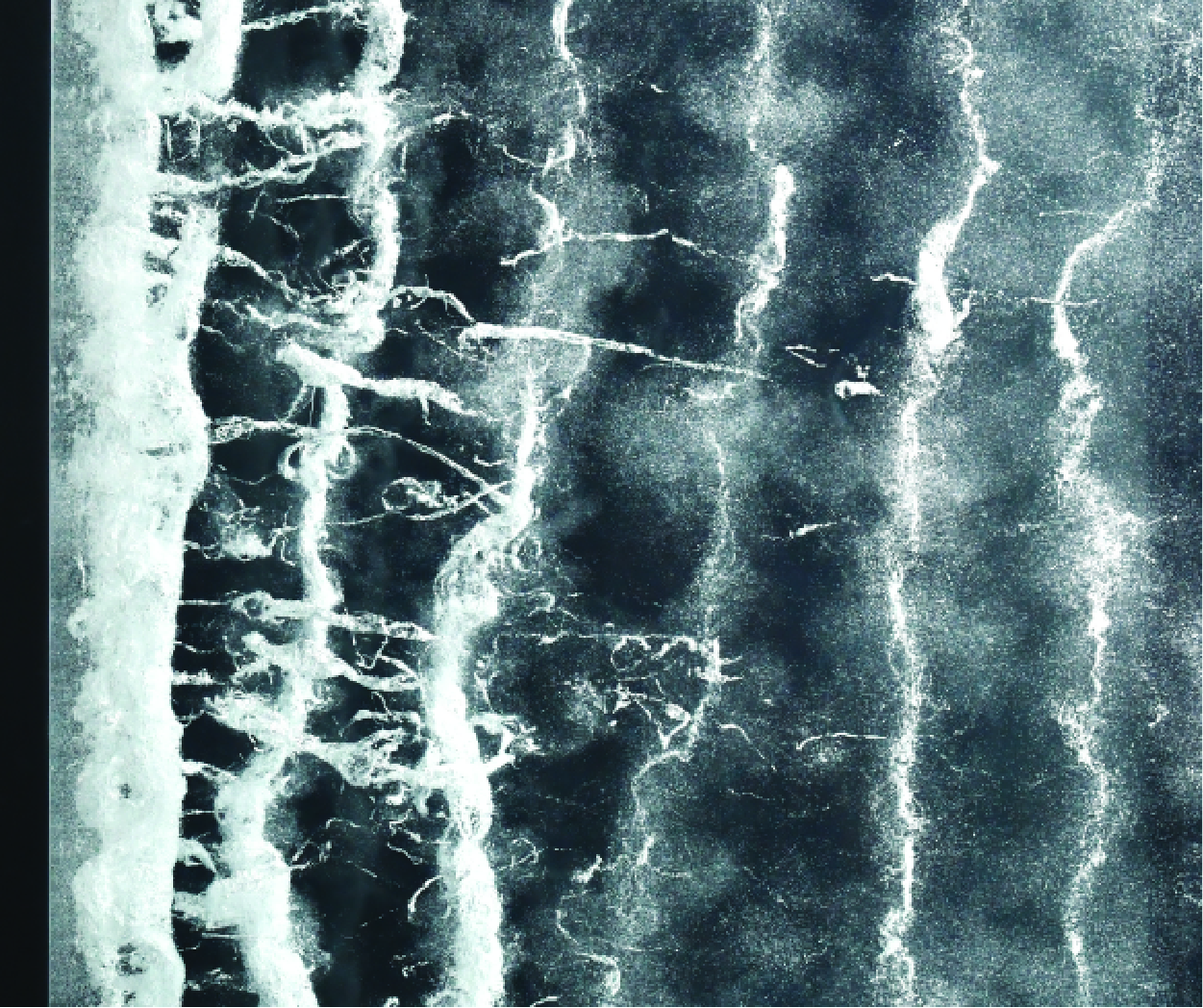
Cavitation nucleation dynamics in structured turbulence
-
- Journal:
- Journal of Fluid Mechanics / Volume 1011 / 25 May 2025
- Published online by Cambridge University Press:
- 14 May 2025, R4
-
- Article
-
- You have access
- Open access
- HTML
- Export citation
-
The effect of nucleation on cavitation inception in a high-Reynolds-number von Kármán wake from a bluff two-dimensional hydrofoil is studied experimentally in a variable pressure water tunnel. Nucleation effects are studied by seeding the flow with sparse monodisperse nuclei populations, with the critical pressure nominally equal to vapour pressure. The injected nuclei population and incipient cavitation events were imaged simultaneously using high-speed cameras to precisely quantify the number of activated nuclei of the total available. Three-dimensional spatial characterisation (orientation and location) of the incipient structures is obtained using two high-speed cameras mounted to the side and below the tunnel test section. Inception was observed predominantly in the stretched cores of secondary structures, with a negligible proportion of events occurring in the primary vortices. A broad peak in the vertical angle distribution is observed about the streamwise axis; however, events at all angles are seen. A symmetric distribution was observed for the horizontal angle, with a dominant orientation $45^{\circ }$ from the free-stream direction. The majority of events occur at approximately one hydrofoil thickness downstream of the hydrofoil trailing edge, with a bimodal symmetric distribution about the hydrofoil vertical centre plane. Nuclei activation rate is determined from the acoustic measurements, and was found to be proportional to the number of the injected nuclei. A power law increase in activation rate was observed following a decrease in cavitation number and an increase in Reynolds number. The nuclei activation rate was of the order of $0.1{-}10 \, \mathrm {s^{-1}}$, which combined with seeding rates of the orderof $100{-}1000 \, \mathrm {s^{-1}}$ reveals inception to be a rare occurrence (0.001 %–10 % of nuclei being activated), requiring the confluence of two unlikely events, the occurrence of a subvapour pressure vortex core with capture of a sufficiently weak nuclei. The presented study provides new insights into the physics of cavitation nucleation and inception and provides a comprehensive dataset for development of computational models.


The evolution of hearing and brain size in Eocene whales
-
- Journal:
- Paleobiology / Volume 51 / Issue 2 / May 2025
- Published online by Cambridge University Press:
- 14 May 2025, pp. 344-355
-
- Article
-
- You have access
- Open access
- HTML
- Export citation
Middle to late Eocene Nummulites from the southern Tethys, Fayum, Egypt: taxonomic, biostratigraphic, and paleobiogeographic context
-
- Journal:
- Journal of Paleontology / Volume 99 / Issue 1 / January 2025
- Published online by Cambridge University Press:
- 14 May 2025, pp. 1-25
-
- Article
- Export citation

Motion of a single microalga with one defective flagellum
-
- Journal:
- Journal of Fluid Mechanics / Volume 1010 / 10 May 2025
- Published online by Cambridge University Press:
- 14 May 2025, A20
-
- Article
- Export citation
-
We experimentally identify a rotational motion of a single microalga (Chlamydomonas reinhardtii) within a microcontainer believed to be induced by one defective flagellum. We numerically adapt the classic two-dimensional squirmer model to replicate this unique motion by partially inhibiting the slip velocity on the boundaries of the squirmer. Subsequently, we employ a lattice Boltzmann method to simulate the motion of the single microalga with one defective flagellum. We examine the influence of swimming Reynolds numbers, self-propelling strength ( $\beta$) and angle ( $\alpha$) on the locomotion of the squirmer with one defective flagellum. The results indicate that a large $\beta$ leads to a large rotational diameter, positively correlating with the speed. Additionally, we observe that a low self-propelling strength ( $\beta =0.5$) yields a monotonically increasing speed for the squirmer with $\alpha$. In general, high $\beta$ values result in fast speeds for the squirmer. This differs from the behaviour observed in a classic squirmer ( $\alpha =360^{\circ }$), where high $\beta$ leads to a slow speed of puller ( $\beta \gt 0$) owing to weak fluid inertia effects. Meanwhile, the energy expenditure increases monotonically with $\alpha$, contrasting with the non-monotonic trends observed for swimming speed and rotational diameter.


Cranial anatomy, intraspecific variation, and positional variation within Calyptosuchus wellesi (Pseudosuchia: Aetosauria) based on new specimens from the Upper Triassic Chinle Formation (Adamanian, early middle Norian) of Petrified Forest National Park, Arizona, USA
-
- Journal:
- Journal of Paleontology / Volume 99 / Issue S97 / August 2025
- Published online by Cambridge University Press:
- 14 May 2025, pp. 1-39
-
- Article
-
- You have access
- Open access
- HTML
- Export citation
Employment in paleontology: status and trends in the United States
-
- Journal:
- Paleobiology / Volume 51 / Issue 2 / May 2025
- Published online by Cambridge University Press:
- 14 May 2025, pp. 250-260
-
- Article
-
- You have access
- Open access
- HTML
- Export citation
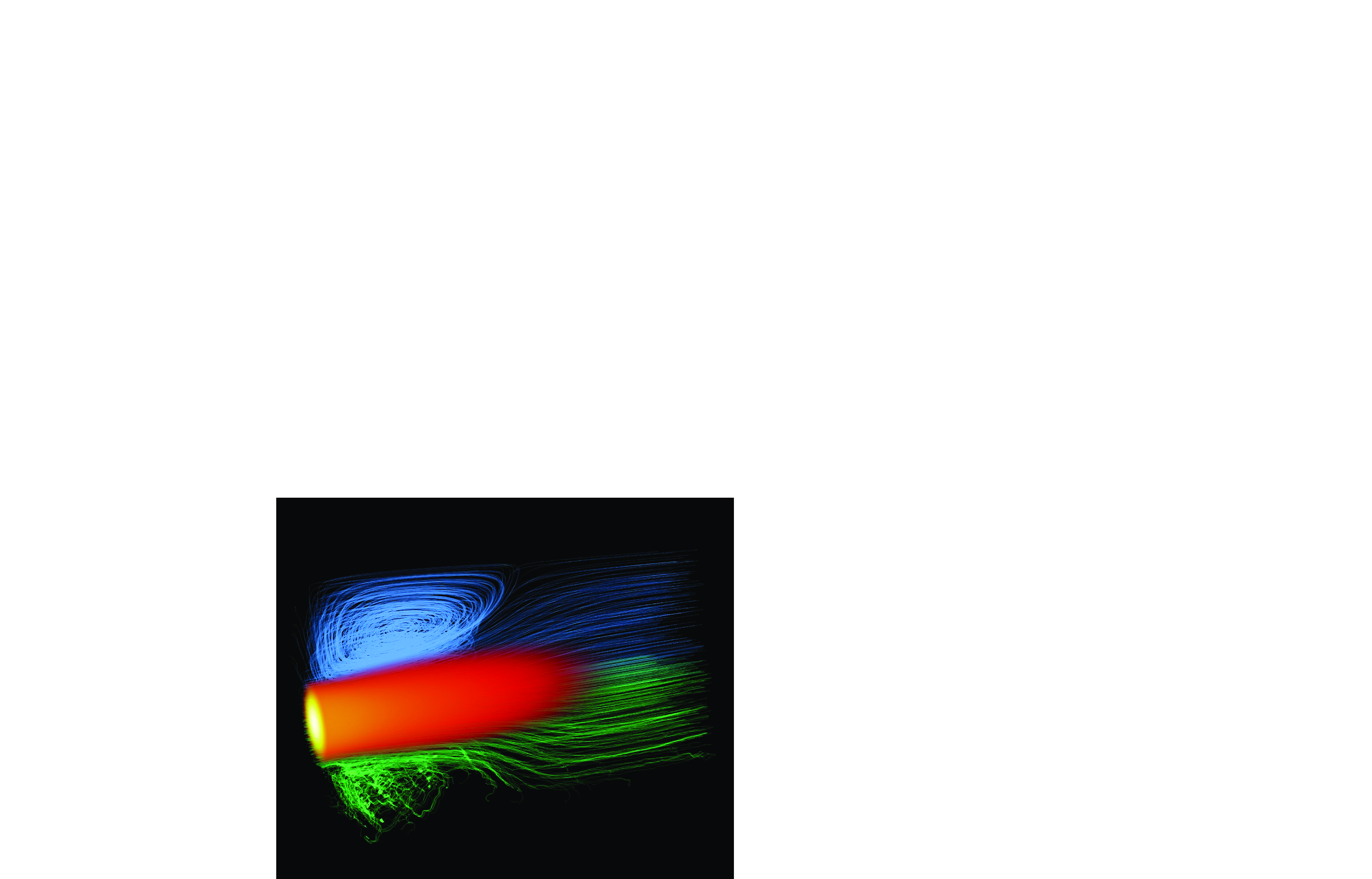
Learning rheological parameters of non-Newtonian fluids from velocimetry data
-
- Journal:
- Journal of Fluid Mechanics / Volume 1011 / 25 May 2025
- Published online by Cambridge University Press:
- 14 May 2025, R3
-
- Article
-
- You have access
- Open access
- HTML
- Export citation

Role of soluble surfactant in linear stability of a liquid film flowing down a compliant substrate
-
- Journal:
- Journal of Fluid Mechanics / Volume 1011 / 25 May 2025
- Published online by Cambridge University Press:
- 13 May 2025, A6
-
- Article
- Export citation

Complex-network modeling of reversal events in two-dimensional turbulent thermal convection
-
- Journal:
- Journal of Fluid Mechanics / Volume 1011 / 25 May 2025
- Published online by Cambridge University Press:
- 13 May 2025, A30
-
- Article
-
- You have access
- Open access
- HTML
- Export citation
