Refine search
Actions for selected content:
211820 results in Engineering
A compact dual-band dual-linearly polarized waveguide slot array antenna with groove at waveguide bottom
-
- Journal:
- International Journal of Microwave and Wireless Technologies / Volume 15 / Issue 7 / September 2023
- Published online by Cambridge University Press:
- 27 February 2023, pp. 1205-1211
-
- Article
-
- You have access
- Open access
- HTML
- Export citation
Obtaining molecular hydrogen from water radiolysis in the nano-SiO2(d = 20 nm)/H2O system under the influence of γ-quanta
-
- Journal:
- Experimental Results / Volume 4 / 2023
- Published online by Cambridge University Press:
- 27 February 2023, e19
-
- Article
-
- You have access
- Open access
- HTML
- Export citation
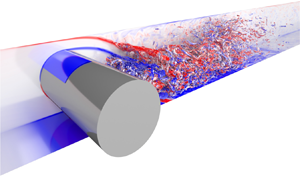
Asymmetric wakes in flows past circular cylinders confined in channels
-
- Journal:
- Journal of Fluid Mechanics / Volume 958 / 10 March 2023
- Published online by Cambridge University Press:
- 27 February 2023, A8
-
- Article
-
- You have access
- Open access
- HTML
- Export citation
-
In this paper, we investigate the flow past a circular cylinder confined in a channel at a blockage ratio of $\beta =0.7$ (the ratio of the cylinder diameter and the channel height) for Reynolds numbers between ${\textit {Re}}=300$ and $3900$ using direct numerical simulation (DNS). We show for varying Reynolds numbers a wide range of wake dynamics occur as the spanwise domain length is changed. At a lower Reynolds number of ${\textit {Re}}=300$, a reverse von Kármán wake alongside either a top- or bottom-biased asymmetry was observed at different spanwise locations. The asymmetry was structurally similar the two-dimensional asymmetry studied by prior investigators, and was found to be a result of the confinement effect. Further, wake-jumping between the two intermittent states was present. For larger Reynolds numbers, ${\textit {Re}}=1000$ and $3900$, these asymmetric structures were found to become dominant. We also examine the dependence of the asymmetries on the spanwise domain. For small spanwise domains the asymmetries were uniformly orientated across the span. In contrast, for sufficiently large spanwise domains, the asymmetry flips its orientation at different spanwise locations. Comparisons of flow statistics demonstrate good agreement between the different spanwise domains, which suggests the same mechanism maintains the asymmetry in both cases. Further analysis at ${\textit {Re}}=1000$ found the number of times the wake flips is dependent on the initial conditions, with a wake that flips zero (purely asymmetric), two and four times being observed. These structures were also determined to remain stable over time scales of $1000D/U$.


Uniform momentum and temperature zones in unstably stratified turbulent flows
-
- Journal:
- Journal of Fluid Mechanics / Volume 958 / 10 March 2023
- Published online by Cambridge University Press:
- 27 February 2023, A7
-
- Article
-
- You have access
- Open access
- HTML
- Export citation
Coffee stain effect on a fibre from axisymmetric droplets
-
- Journal:
- Journal of Fluid Mechanics / Volume 957 / 25 February 2023
- Published online by Cambridge University Press:
- 27 February 2023, A24
-
- Article
- Export citation
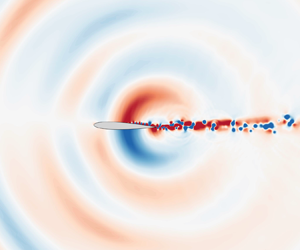
On the origin of quadrupole sound from a two-dimensional aerofoil trailing edge
-
- Journal:
- Journal of Fluid Mechanics / Volume 958 / 10 March 2023
- Published online by Cambridge University Press:
- 27 February 2023, A3
-
- Article
-
- You have access
- Open access
- HTML
- Export citation
-
Tonal noise emitted from the trailing edge of an airfoil is considered using modal analysis techniques to investigate secondary quadrupole tones. We examine the origin of quadrupole sound generated from two-dimensional unsteady laminar flow over a NACA0012 airfoil. In this paper, we consider two flow configurations at Mach numbers of $M_\infty = 0.1$ and 0.05 that lead to different acoustic characteristics: the former has a significant high-frequency quadrupole noise source, whereas the latter does not. We use vortex sound theory, dynamic mode decomposition (DMD), and resolvent analysis to analyze the sound source. First, we employ DMD modes to reveal that the quadrupole sound is only observed in the higher Mach number case. Next, the vortex dynamics in the vicinity of the trailing edge are studied to identify the origin of quadrupole sound. It is found that the quadrupole sound is caused by vortex shedding in the vicinity of the trailing edge. The complex vortex interaction between both sides of the airfoil strengthens the quadrupole source in the higher Mach number case, while it is negligible in the lower one. Furthermore, we perform resolvent analysis to examine the vortex generation over the airfoil. The resolvent mode indicates that the interaction between the vortices on both sides of the airfoil causes a multi-scale vortex structure on the suction-side wall.

BayesTICS: Local temporal image correlation spectroscopy and Bayesian simulation technique for sparse estimation of diffusion in fluorescence imaging
-
- Journal:
- Biological Imaging / Volume 3 / 2023
- Published online by Cambridge University Press:
- 27 February 2023, e5
-
- Article
-
- You have access
- Open access
- HTML
- Export citation

Conical focusing: mechanism for singular jetting from collapsing drop-impact craters
-
- Journal:
- Journal of Fluid Mechanics / Volume 958 / 10 March 2023
- Published online by Cambridge University Press:
- 27 February 2023, R1
-
- Article
-
- You have access
- Open access
- HTML
- Export citation
-
Fast microjets can emerge out of liquid pools from the rebounding of drop-impact craters, or when a bubble bursts at its surface. The fastest jets are the narrowest and are a source of aerosols both from the ocean and from a glass of champagne, of importance to climate and the olfactory senses. The most singular jets, which we observe experimentally at a maximum velocity of $137\pm 4\ {\rm m}\ {\rm s}^{-1}$ and a diameter of $12\ \mathrm {\mu }{\rm m}$, under reduced ambient pressure, are produced when a small dimple forms at the crater bottom and rebounds without pinching off a small bubble. The radial collapse and rebounding of this dimple is purely inertial, but highly sensitive to initial conditions. High-resolution numerical simulations reveal a new focusing mechanism, which drives the fastest jet within a converging conical channel, where an entrained air sheet provides effective slip at the outer boundary of the conically converging flow into the jet. This configuration bypasses any viscous cutoff of the jetting speed and explains the extreme sensitivity to initial conditions observed in detailed experiments of the phenomenon.

Suppressing small-scale self-focusing of high-power femtosecond pulses
-
- Journal:
- High Power Laser Science and Engineering / Volume 11 / 2023
- Published online by Cambridge University Press:
- 27 February 2023, e28
-
- Article
-
- You have access
- Open access
- HTML
- Export citation

Aerodynamic droplet atomization model (ADAM)
-
- Journal:
- Journal of Fluid Mechanics / Volume 958 / 10 March 2023
- Published online by Cambridge University Press:
- 27 February 2023, A2
-
- Article
- Export citation
First checklist triggering the inventory of marine fish ectoparasites in the Syrian coast (Eastern Mediterranean)
-
- Journal:
- Experimental Results / Accepted manuscript
- Published online by Cambridge University Press:
- 27 February 2023, pp. 1-17
-
- Article
-
- You have access
- Open access
- Export citation
Cross-shore wind-induced changes to field-scale overturning wave shape
-
- Journal:
- Journal of Fluid Mechanics / Volume 958 / 10 March 2023
- Published online by Cambridge University Press:
- 27 February 2023, A4
-
- Article
-
- You have access
- Open access
- HTML
- Export citation
-
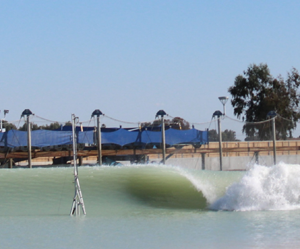
The shape of depth-limited breaking-wave overturns is important for turbulence injection, bubble entrainment and sediment suspension. Overturning wave shape depends on a nonlinearity parameter $H/h$, where $H$ is the wave height, and $h$ is the water depth. Cross-shore wind direction (offshore/onshore) and magnitude affect laboratory shoaling wave shape and breakpoint location $X_{{bp}}$, but wind effects on overturning wave shape are largely unstudied. We perform field-scale experiments at the Surf Ranch wave basin with fixed bathymetry and $\approx 2.25$ m shoaling solitons with small height variations propagating at $C=6.7\ \mathrm {m}\ \mathrm {s}^{-1}$. Observed non-dimensional cross-wave wind $U_w$ was onshore and offshore, varying realistically ( $-1.2 < U_{w}/C < 0.7$). Georectified images, a wave staff, and lidar are used to estimate $X_{{bp}}$, $H/h$, overturn area $A$ and aspect ratio for 22 waves. The non-dimensionalized $X_{{bp}}$ was inversely related to $U_{w}/C$. The non-dimensional overturn area and aspect ratio also were inversely related to $U_{w}/C$, with smaller and narrower overturns for increasing onshore wind. No overturning shape dependence on the weakly varying $H/h$ was seen. The overturning shape variation was as large as prior laboratory experiments with strong $H/h$ variations without wind. An idealized potential air flow simulation on steep shoaling soliton shape has strong surface pressure variations, potentially inducing overturning shape changes. Through wave-overturning impacts on turbulence and sediment suspension, coastal wind variations could be relevant for near-shore morphology.


Compressibility effects on Reynolds stress amplification and shock structure in shock–isotropic turbulence interactions
-
- Journal:
- Journal of Fluid Mechanics / Volume 958 / 10 March 2023
- Published online by Cambridge University Press:
- 27 February 2023, A1
-
- Article
-
- You have access
- Open access
- HTML
- Export citation

Inference and Learning from Data
- Learning
-
- Published online:
- 24 February 2023
- Print publication:
- 22 December 2022
-
- Textbook
- Export citation
Copyright page
-
- Book:
- Structural Dynamics
- Published online:
- 31 March 2023
- Print publication:
- 23 February 2023, pp vi-vi
-
- Chapter
- Export citation
Appendix: - Some Useful Mathematical Concepts
-
- Book:
- Hydrology
- Published online:
- 01 March 2023
- Print publication:
- 23 February 2023, pp 595-603
-
- Chapter
- Export citation
Reviews
-
- Book:
- Structural Dynamics
- Published online:
- 31 March 2023
- Print publication:
- 23 February 2023, pp iv-iv
-
- Chapter
- Export citation
Preface
-
- Book:
- Structural Dynamics
- Published online:
- 31 March 2023
- Print publication:
- 23 February 2023, pp xvii-xx
-
- Chapter
- Export citation
5 - Natural Modes of Vibration: Discrete Systems
-
- Book:
- Structural Dynamics
- Published online:
- 31 March 2023
- Print publication:
- 23 February 2023, pp 245-311
-
- Chapter
- Export citation
2 - The Basic Lidar Models
-
- Book:
- Lidar Engineering
- Published online:
- 16 February 2023
- Print publication:
- 23 February 2023, pp 13-29
-
- Chapter
- Export citation
